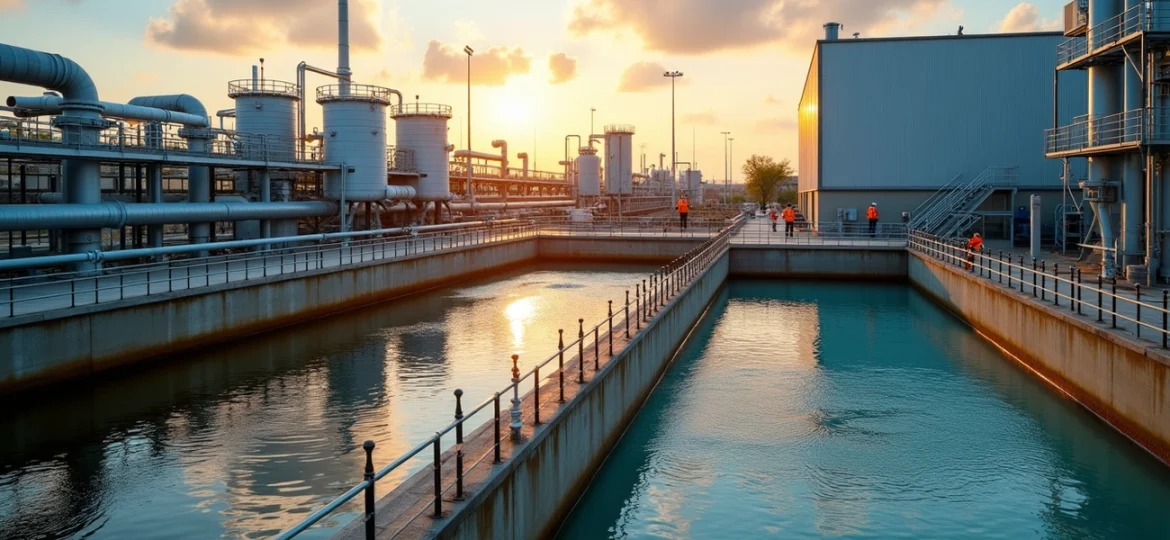


Did you know that decentralized wastewater treatment systems offers a green alternative to conventional large-scale systems? These innovative solutions treat wastewater near its source and work perfectly in settings where centralized infrastructure isn’t practical or budget-friendly.
Decentralized wastewater treatment systems are compact facilities that employ various natural treatment techniques based on specific needs. These systems protect public health and nature by reducing health and environmental risks. The soil’s natural ability removes or changes pollutants as effluent flows through it, which prevents direct discharge into surface waters.
DEWAT solutions stand out because they make economic sense. These systems are budget-friendly since they avoid big capital costs and need less maintenance. Your community can achieve the triple bottom line of sustainability through these systems: helping the environment, economy, and people. The treated water becomes a valuable resource that you can use for irrigation, toilet flushing, or commercial boiler make-up water when proper regulations are in place.
This piece will show you how these systems work, their treatment stages, ground applications, and why they could be the perfect answer to sustainable wastewater management in your community.
How Decentralized Wastewater Treatment Systems Work

Decentralized wastewater treatment systems treat wastewater right where it’s generated instead of sending it to distant facilities. These systems use modular setups that adapt to specific needs, wastewater types, and local conditions.
Onsite vs Cluster-Based DEWATS Configurations
DEWATS come in two main setups. Onsite systems handle wastewater on individual properties and work best for houses spread across large areas. Cluster-based systems serve multiple homes, subdivisions, or small communities through a simple network. While these systems handle multiple sources, they stick to the basic DEWATS principle of local treatment. The systems can handle wastewater flows from 1m³ to 1000m³ per day. This makes them perfect for everything from single homes to small communities.
Flow Separation: Greywater, Blackwater, and Urine Streams
Modern DEWAT solutions split wastewater based on where it comes from. This split needs separate pipeline systems but brings great benefits. Greywater from bathing and washing makes up about 70% of total domestic wastewater but only 40% of the chemical oxygen demand. Blackwater from toilets contains more pollutants that need stronger treatment. Human urine is just 1% of total waste volume but contains 70-80% of total nitrogen and about 50% of phosphorus. This separation lets treatment be more targeted and helps recover more resources.
Anaerobic and Aerobic Modules in DEWATS
DEWATS combine anaerobic and aerobic modules for treatment. Anaerobic modules include settlers for initial treatment, baffled reactors, and filters that work without oxygen. The anaerobic baffled reactor (ABR) stands out as highly effective. It uses upflow processes to break down solids efficiently and handles sudden load changes well. Aerobic modules typically use horizontal flow planted gravel filters. Here, microorganisms and plants team up to clean the water further. This combination works well and keeps maintenance simple since most parts run without power.
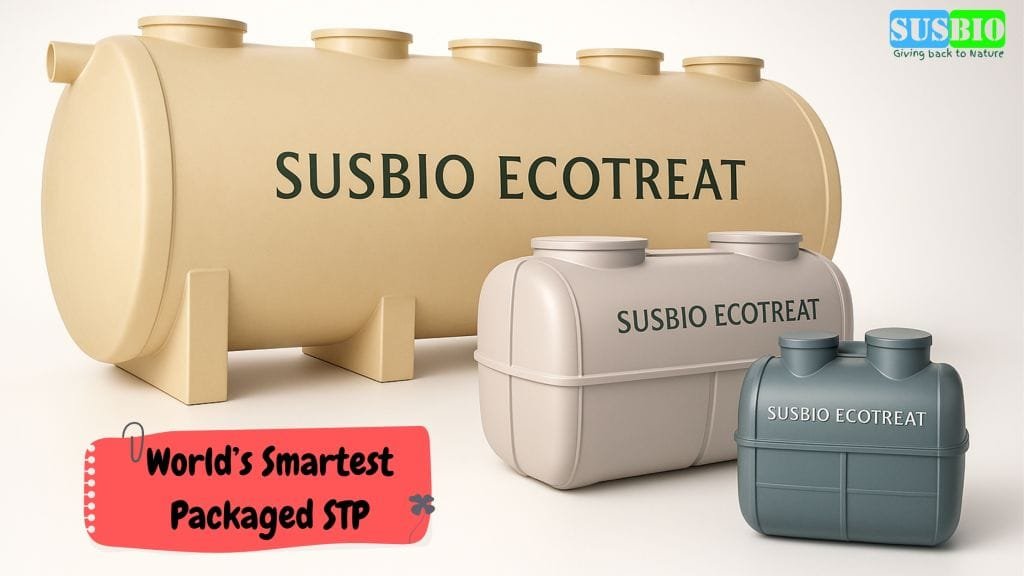
SUSBIO ECOTREAT leads the pack in DEWATS solutions. Its modular design works well in both rural and urban areas. The system runs on minimal energy and needs little maintenance, making it ideal for long-term use.
Treatment Stages in Decentralized Wastewater Systems
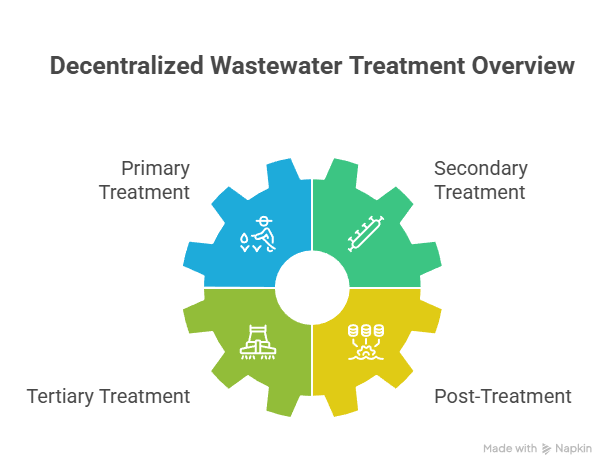
Decentralized wastewater treatment requires several well-designed treatment stages. Each stage plays a vital role to purify wastewater before it becomes safe to discharge or reuse.
Primary Treatment: Settlers and Grease Traps
The process starts with grease traps that capture oil and grease through flotation. These units retain wastewater for 2-4 minutes and allow clearer water to flow underneath into other modules. Settlers work as sedimentation tanks and hold particles that sink during a 1.5-2 hour retention period. Biogas settlers can boost treatment by holding wastewater for 12-24 hours. These settlers produce biogas when anaerobic digestion breaks down settled organic particles. This initial treatment removes 20-25% COD, 15-20% BOD, and 50-55% TSS.
Secondary Treatment: Anaerobic Baffled Reactors
Anaerobic Baffled Reactors (ABRs) mark a substantial improvement in secondary treatment. Wastewater moves through baffles in a zigzag pattern that maximizes contact with bacteria. This smart design helps ABRs remove 60-80% of organic pollutants within 1-2 days. ABRs bounce back quickly from hydraulic and organic shock loads – usually within 9 hours. The compartments separate acidogenic and methanogenic processes, which improves treatment efficiency.
Tertiary Treatment: Planted Gravel Filters and Rootzone Systems
The tertiary stage uses Planted Gravel Filters or Rootzone Treatment Systems (RZTS). It consist of shallow tanks filled with graded gravel or pebbles. These plants channel oxygen through their stems to their roots, which creates ideal conditions for aerobic microorganisms. Deep in the filter bed, anaerobic zones allow various biological processes to occur. Water stays in this stage for 5-10 days and removes 20-25% COD, 15-20% BOD, and 15-20% TSS.
Post-Treatment: Polishing Ponds for Pathogen Removal
Polishing ponds complete the process as shallow basins where sun radiation removes pathogens. These ponds boost water’s hygienic quality by reducing fecal coliform levels. Engineers design these ponds for plug flow conditions, though studies show some mixing still happens with dispersion numbers of 0.14-0.16. Water needs about 10 days in polishing ponds to become suitable for unrestricted irrigation. This is much faster than conventional waste stabilization ponds that need 20-30 days.
Real-World Applications and Case Studies
The ground application of decentralized wastewater treatment systems shows how they serve communities worldwide.
Loudoun County, VA: Cluster System with Developer Ownership Transfer
Loudoun Water in Virginia takes an integrated approach to wastewater management through community cluster systems. This model keeps the county’s rural character intact. Developers design and build cluster wastewater facilities that meet Loudoun Water’s standards before transferring ownership for maintenance. The program sustains itself through rates that cover operating costs.
Rutherford County, TN: STEP System with Drip Dispersal
Tennessee’s Consolidated Utility District manages about 50 subdivision wastewater systems using septic tank effluent pumping (STEP) technology. Each home connects to a 1,500-gallon septic tank that comes with pumps and control panels. These regulate discharge to a centralized collection system. The process uses recirculating sand filters and large effluent drip dispersal systems that enable high-density development where conventional systems don’t work.
Botswana Technology Center: Institutional Onsite DEWATS
The Botswana Technology Center demonstrates a building-level decentralized system that works despite available municipal sewerage. The installation uses a detailed treatment process: septic tank, planted rock filter, bio-filter, and surface flow wetland. The treated effluent waters surrounding green areas with minimal discharge.
EcoSwell, Peru: Community Biodigesters and Greywater Reuse
Peru’s water-stressed Lobitos district benefits from EcoSwell’s community-scale solutions, including biodigesters and greywater reuse projects. Their pilot dry composting toilet has saved over 64,860 liters of water since 2018. The organization’s biodigester at the Lobitos Fishermen’s Guild provides 7,000-liter capacity for blackwater treatment. Their community greening projects have helped reuse 520,000 liters of greywater.
Why SUSBIO ECOTREAT is a Leading DEWATS Solution
SUSBIO ECOTREAT stands out in the decentralized wastewater treatment world with its trailblazing approach that balances speed, eco-friendly practices, and practicality.
Modular Design for Rural and Urban Scalability
SUSBIO ECOTREAT’s design features prefabricated, modular units made from high-quality fiber-reinforced plastic that delivers superior strength and durability. The plug-and-play setup lets users deploy the system quickly in a variety of settings, from small residential complexes to large industrial facilities. The system adapts well to growing communities and changing needs. The modular structure allows customization for projects of any size and delivers optimal performance whatever the location.
Low Energy Consumption and Minimal Maintenance
The system uses 90% less electricity than conventional sewage treatment plants. This dramatic reduction cuts operational costs and environmental impact. The plant runs on autopilot and doesn’t need on-site operators. Yes, it is low maintenance – you only need monthly checks and twice-yearly desludging. The system’s self-sufficiency comes from advanced automation systems that monitor and control treatment processes on their own.
Integrated Reuse for Irrigation and Non-potable Applications
The dual-treatment process blends anaerobic and aerobic methods to produce high-quality effluent that’s perfect for reuse. The treated water works great for landscaping, toilet flushing, and other non-potable uses. This approach reduces freshwater dependency and supports eco-friendly water management practices.
Conclusion
Decentralized wastewater treatment systems represent a major step forward in green water management practices. This piece explores how these innovative solutions treat water near its source and deliver multiple environmental and economic benefits.
The multi-stage treatment process works through several steps. It starts with primary settlement, moves to anaerobic digestion, and finishes with planted filters and polishing ponds. This process will give thorough purification without needing the extensive infrastructure of centralized systems. The system separates greywater, blackwater, and urine streams to enable targeted treatment that maximizes efficiency and resource recovery.
Ground applications in a variety of settings show DEWATS’s versatility and effectiveness. Loudoun County’s developer-transfer model and EcoSwell’s community biodigesters in Peru demonstrate how these systems adapt to different contexts and needs. These examples highlight decentralized solutions that support green development while protecting local environments and water resources.
SUSBIO ECOTREAT leads the pack with its modular design, low energy needs, and water reuse features. The system tackles sustainability from all angles. Communities save money through lower infrastructure costs. Energy savings and pollution prevention protect the environment. Development becomes possible in areas that were previously unsuitable.
Water shortages affect more communities worldwide each year. The need for resilient infrastructure grows stronger. Decentralized wastewater treatment systems provide a practical solution. They revolutionize our view of waste, turning it into a valuable resource. This approach closes the loop in our water cycle and builds a greener future for communities of all sizes.
Key Takeaways
Decentralized wastewater treatment systems offer a sustainable alternative to centralized infrastructure, providing effective treatment close to the source while delivering significant environmental and economic benefits.
• Cost-effective scalability: DEWATS avoid large capital costs while serving 1-1000m³ daily flows, making them ideal for rural areas and small communities where centralized systems aren’t feasible.
• Multi-stage treatment efficiency: The combination of settlers, anaerobic baffled reactors, planted gravel filters, and polishing ponds achieves 60-80% organic pollutant removal with minimal energy input.
• Resource recovery potential: Flow separation enables targeted treatment of greywater (70% of volume) and blackwater, while urine diversion captures 70-80% of nitrogen for potential reuse.
• Proven real-world success: From Virginia’s cluster systems to Peru’s community biodigesters, DEWATS demonstrate adaptability across diverse settings and development contexts.
• Energy-efficient operation: Advanced systems like SUSBIO ECOTREAT consume 90% less electricity than conventional plants while producing high-quality effluent suitable for irrigation and non-potable reuse.
These systems transform wastewater from waste into a valuable resource, supporting the triple bottom line of sustainability by benefiting communities economically, environmentally, and socially while enabling development in previously unsuitable areas.
Frequently Asked Questions
Q1. What are the main advantages of decentralized wastewater treatment systems?
Decentralized wastewater treatment systems offer several benefits, including cost-effectiveness, environmental sustainability, and flexibility. They avoid large capital costs, can be scaled to serve various community sizes, and enable water reuse for irrigation and non-potable applications.
Q2. How do decentralized systems compare to centralized wastewater treatment?
Decentralized systems are designed to serve smaller local communities or facilities, while centralized plants typically handle larger volumes in densely populated areas. Decentralized solutions offer more flexibility, lower infrastructure costs, and can be implemented in areas where centralized systems are not feasible.
Q3. What are the key components of a decentralized wastewater treatment system?
A typical decentralized system includes primary treatment (settlers and grease traps), secondary treatment (anaerobic baffled reactors), tertiary treatment (planted gravel filters or rootzone systems), and post-treatment (polishing ponds). This multi-stage process ensures thorough wastewater purification.
Q4. How efficient are decentralized wastewater treatment systems?
Decentralized systems can achieve 60-80% removal of organic pollutants. Advanced solutions like SUSBIO ECOTREAT consume up to 90% less electricity than conventional plants while producing high-quality effluent suitable for reuse.
Q5. Are there any environmental benefits to using decentralized wastewater treatment?
Yes, decentralized systems contribute to environmental sustainability by reducing greenhouse gas emissions, particularly methane. They also support water conservation through reuse, minimize energy consumption, and help preserve local ecosystems by treating wastewater close to its source.