

Rapid urbanization and growing population pressure have placed India’s cities under immense stress—particularly on water resources and sanitation infrastructure. While metro rail systems are widely recognized as sustainable transport solutions, their operational water footprint often goes unnoticed.
Each metro station generates a continuous stream of wastewater from:
Passenger washrooms
Staff facilities
Daily cleaning and maintenance activities
Utility and service areas
If left unmanaged or sent entirely to municipal sewers, this wastewater adds to the burden on city infrastructure and increases dependence on freshwater supplies.
As part of its commitment to environmentally responsible infrastructure development, Pune Metro adopted a decentralized wastewater treatment strategy. Tata Projects, as a key infrastructure partner, collaborated with SUSBIO to implement a compact, high-performance sewage treatment plant solution that treats, recycles, and reuses wastewater directly at metro stations.
Project Objectives & Sustainability Goals
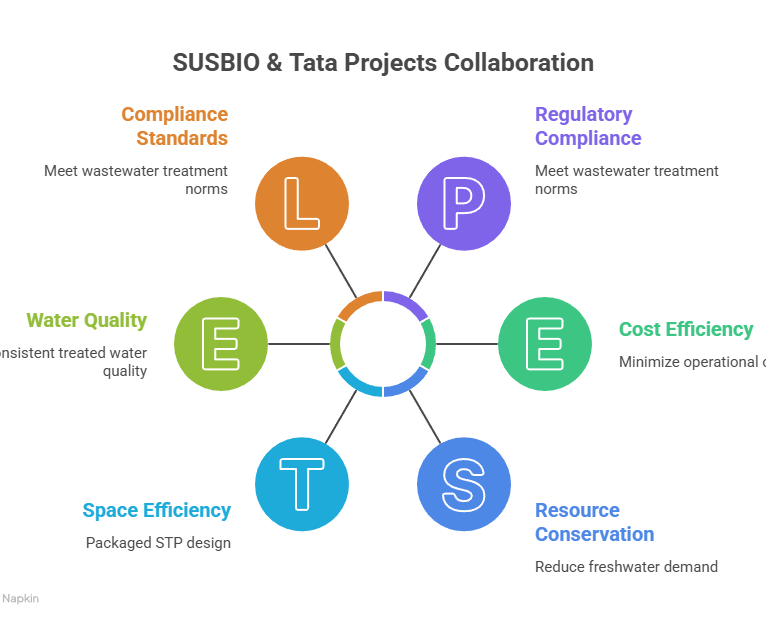
The collaboration between SUSBIO and Tata Projects was driven by clearly defined technical and sustainability objectives:
To deploy an on-site sewage treatment plant (STP) at metro stations
To enable wastewater recycling and reuse, reducing freshwater demand
To ensure consistent treated water quality suitable for non-potable reuse
To design a space-efficient packaged STP suitable for underground stations
To comply with CPCB and SPCB wastewater treatment norms
To minimize operational complexity and lifecycle costs
These objectives aligned strongly with Pune Metro’s broader goals of water conservation, ESG compliance, and long-term operational efficiency.
Challenges of Wastewater Treatment in Metro Stations
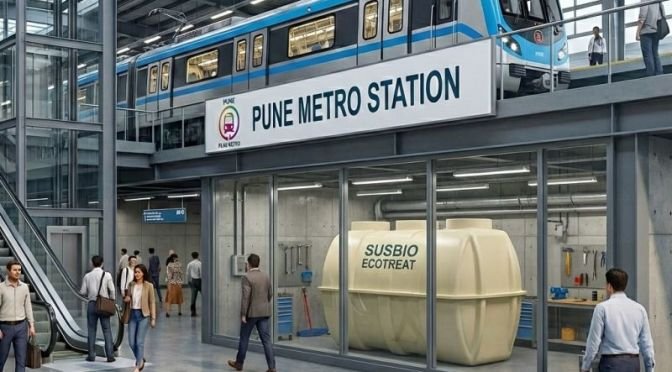
Designing a wastewater treatment plant for metro stations is significantly more complex than for conventional buildings. The key challenges included:
Space Constraints
Metro stations—especially underground ones—have limited utility areas. Traditional sewage treatment plants are bulky and impractical in such environments.
Fluctuating Hydraulic & Organic Loads
Passenger footfall varies throughout the day, resulting in inconsistent inflow patterns and organic loading—demanding a treatment system that can adapt dynamically.
Operational Reliability
Metro stations operate daily with minimal shutdown windows. The STP must deliver uninterrupted performance with minimal manual intervention.
Treated Water Reuse Standards
Water intended for flushing, cleaning, and landscaping must meet stringent quality benchmarks consistently.
Integration with Civil & MEP Design
The system must align seamlessly with station slabs, basements, and service corridors—without impacting passenger movement or station aesthetics.
SUSBIO ECOTREAT: A Packaged STP Designed for Infrastructure Projects
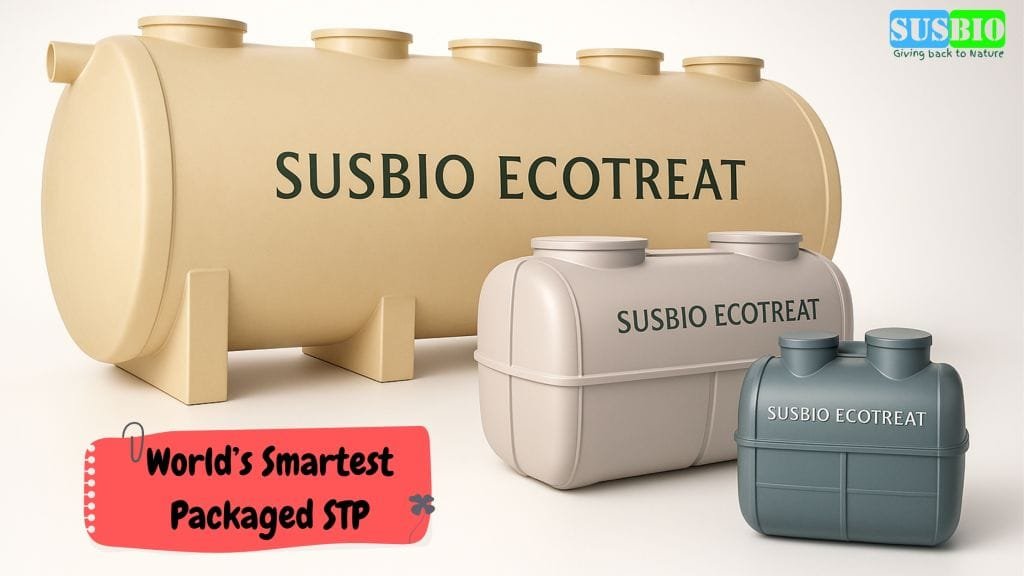
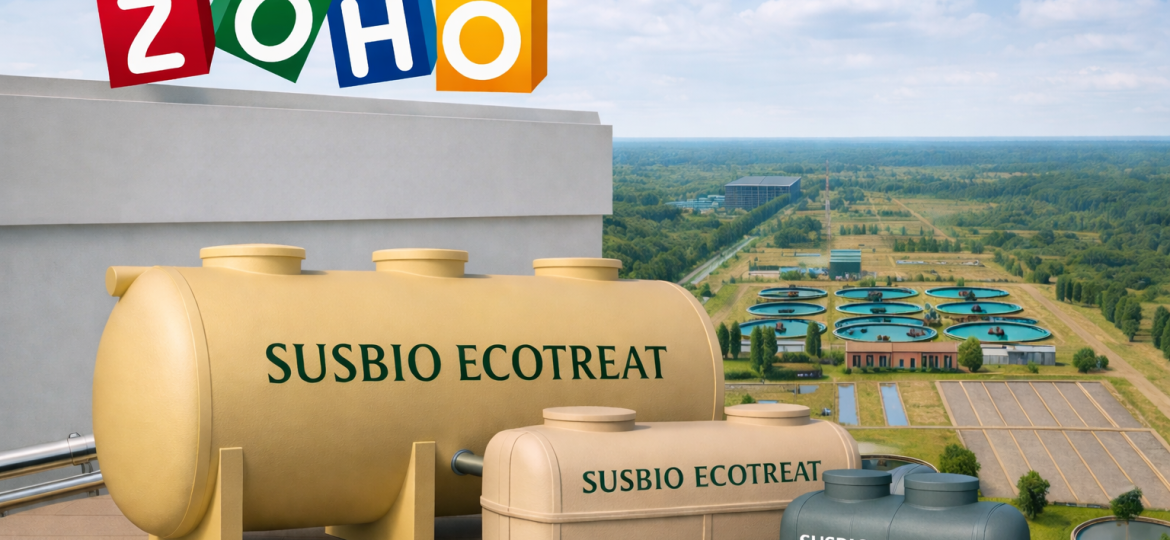
To address the complex wastewater management challenges at Pune Metro stations, SUSBIO ECOTREAT was deployed as the preferred wastewater treatment solution. Unlike conventional sewage treatment plants that require large footprints, extensive civil works, and high operational oversight, SUSBIO ECOTREAT is purpose-built for modern infrastructure environments where space, reliability, and compliance are critical.
SUSBIO ECOTREAT is an advanced packaged sewage treatment plant (STP) engineered for decentralized applications such as metro stations, airports, railways, and other high-footfall public infrastructure. Its design philosophy focuses on delivering consistent treated water quality, operational stability, and long service life, even under fluctuating load conditions.
Compact, Prefabricated Design for Underground Installations
One of the defining strengths of SUSBIO ECOTREAT is its compact and prefabricated construction, which makes it ideal for installation in basements, underground utility zones, and confined service areas. The system is manufactured under controlled factory conditions, ensuring dimensional accuracy, structural integrity, and uniform quality. This approach significantly reduces on-site civil work, accelerates project timelines, and enables seamless integration within metro station layouts without impacting passenger areas or station aesthetics.
Advanced Biological Wastewater Treatment Process
SUSBIO ECOTREAT employs an advanced biological treatment process specifically designed to handle the variable wastewater characteristics typical of metro stations. The system ensures efficient breakdown of organic matter, resulting in stable and consistent effluent quality. Even during peak passenger hours or fluctuating inflow conditions, the treatment process maintains performance, making it highly reliable for continuous public infrastructure operations.
High BOD and COD Removal Efficiency
Metro station wastewater often experiences sharp variations in organic load. SUSBIO ECOTREAT is engineered to deliver high BOD and COD removal efficiencies, ensuring that treated water consistently meets regulatory standards for reuse. This reliability is critical for applications such as toilet flushing, cleaning, and landscaping, where water quality consistency directly affects hygiene and operational safety.
Energy-Efficient Operation for Public Infrastructure
Energy consumption is a key consideration for large public projects with long operating lifecycles. SUSBIO ECOTREAT is designed for low energy consumption, optimising aeration and process efficiency without compromising treatment performance. This results in lower operating costs, reduced carbon footprint, and improved long-term economic viability for metro authorities and infrastructure operators.
Robust Construction for Long Service Life
Built to withstand demanding operating conditions, SUSBIO ECOTREAT features robust construction materials and engineering design that ensure durability and longevity. The system is well-suited for continuous operation in high-usage environments such as metro stations, where reliability and uptime are non-negotiable. This durability translates into reduced maintenance frequency and extended asset life.
Automation-Ready, Low-Maintenance Operation
To minimize dependency on skilled manpower, SUSBIO ECOTREAT is automation-ready, enabling simplified monitoring and control. Automated operations ensure consistent performance, reduce human error, and allow facility teams to manage wastewater treatment efficiently without intensive daily intervention—an essential advantage for metro station operations.
Ideal for Mission-Critical Infrastructure Applications
With its compact footprint, high treatment efficiency, energy-optimized performance, and automation capability, SUSBIO ECOTREAT is particularly suited for mission-critical infrastructure projects, including:
Metro and urban rail stations
Airports and aviation facilities
Railway stations and terminals
Smart city and public infrastructure developments
By combining engineering precision with sustainability-driven design, SUSBIO ECOTREAT enables infrastructure projects like Pune Metro to treat, recycle, and reuse wastewater efficiently—supporting water conservation, regulatory compliance, and long-term operational excellence.

Seamless Installation & Infrastructure Integration
The SUSBIO engineering team worked closely with Tata Projects’ civil and MEP teams to ensure smooth system integration.
Key integration aspects included:
Installation within designated basement and service zones
Alignment with structural slabs and station utility layouts
Safe access pathways for operation and maintenance
No interference with passenger platforms or public areas
Thanks to its factory-fabricated packaged design, SUSBIO ECOTREAT enabled faster installation, reduced on-site construction activities, and ensured consistent quality across stations.
Wastewater Treatment, Recycling & Reuse Model
Wastewater generated at Pune Metro stations is treated through SUSBIO ECOTREAT to produce high-quality treated water suitable for reuse.
The recycled water is used for:
Toilet flushing within station premises
Station and platform cleaning operations
Landscape and green belt irrigation
Other non-potable utility applications
This closed-loop water management system significantly reduces freshwater intake and promotes responsible water reuse within urban transport infrastructure.
Environmental, Operational & Economic Impact
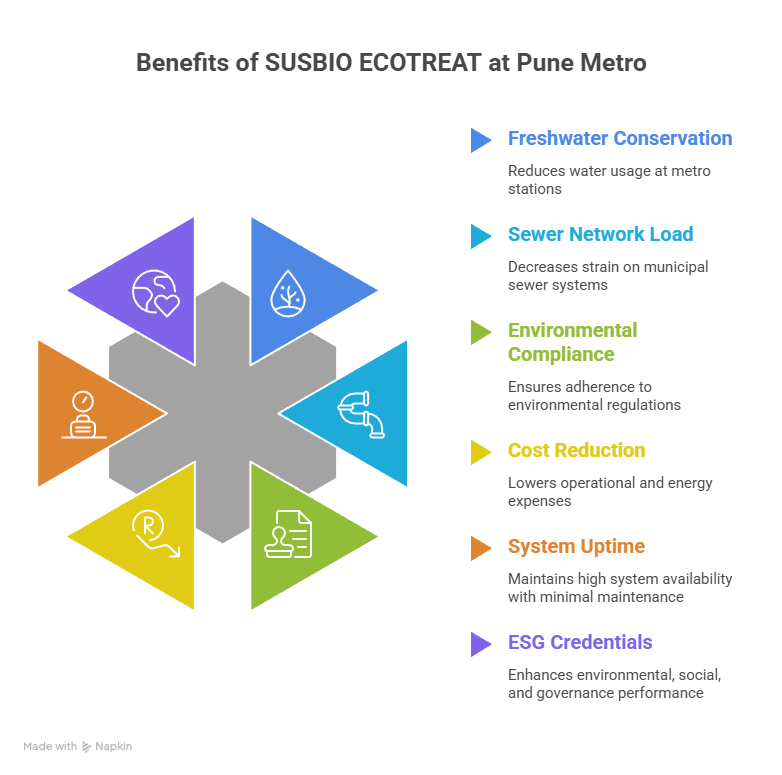
The deployment of SUSBIO ECOTREAT at Pune Metro stations has delivered measurable, long-term benefits:
Major reduction in freshwater consumption, supporting urban water conservation
Lower load on municipal sewer networks
Reliable compliance with environmental regulations
Reduced operational and energy costs
High system uptime with minimal maintenance
Stronger ESG and sustainability credentials for Pune Metro
This approach directly supports India’s vision of sustainable cities and water-secure infrastructure.
Why Tata Projects Chose SUSBIO
SUSBIO was selected as a wastewater treatment partner due to its strong engineering-led execution model:
Specialization in packaged sewage treatment plants and wastewater treatment systems
End-to-end in-house capabilities—from design to commissioning
Proven experience in complex infrastructure environments
Ability to customize solutions for project-specific constraints
Reliable after-sales service and technical support
The partnership ensured technical confidence, execution speed, and long-term performance reliability.
The success of SUSBIO ECOTREAT at Pune Metro establishes a replicable model for:
Future metro corridors and stations
Airports and railway stations
Large commercial and institutional developments
Smart city and public infrastructure projects
The modular design allows easy capacity scaling as operational requirements grow.
Conclusion
The collaboration between SUSBIO and Tata Projects at Pune Metro demonstrates how advanced packaged sewage treatment plants can play a vital role in sustainable urban development. By treating, recycling, and reusing wastewater at the source, SUSBIO ECOTREAT helps reduce freshwater dependency while ensuring regulatory compliance and operational efficiency.
This project reinforces SUSBIO’s position as a trusted wastewater treatment partner for large-scale public infrastructure, delivering future-ready solutions that support India’s journey toward a water-secure and sustainable future—one project at a time.