

Gujarat is one of India’s most industrially active states — and one of its most water-stressed. With over 72,000 MLD of sewage generated daily across India’s cities and Gujarat’s industrial clusters among the most regulated under the Gujarat Pollution Control Board (GPCB), the pressure on developers, industries, institutions, and housing societies to install compliant sewage treatment plants has never been higher.
SUSBIO has been manufacturing and commissioning packaged STPs since 2013. We have 500+ active installations across 24 Indian states, including residential complexes, hotels, hospitals, industrial facilities, and institutional campuses across Gujarat. Our ECOTREAT packaged STP uses Anaerobic + MBBR (Moving Bed Biofilm Reactor) dual-stage technology — the most reliable choice for Gujarat’s varied applications, from Ahmedabad high-rises to remote industrial sites in the Kutch region.
If you need a GPCB-compliant STP that installs in 3–5 days and consistently meets CPCB Class A outlet standards, this page covers what you need to know.
Why Gujarat Has Specific STP Requirements
Gujarat’s compliance environment is more demanding than most Indian states. The GPCB enforces discharge standards that frequently go beyond the national CPCB baseline — particularly for industrial clusters in Ankleshwar, Vapi, Vatva, and Nandesari, where pharmaceutical, chemical, dye, and textile units operate in close proximity.
For residential and commercial projects, GujRERA mandates that all projects above 500 sq.m or 8 units must be registered before marketing or sale. Environmental clearance conditions tied to GujRERA registration increasingly require a functioning STP with documented compliance — making STP installation a critical path item for Occupancy Certificate issuance in Ahmedabad, Surat, Vadodara, and Rajkot.
For bulk users, the CPCB and Liquid Waste Management Rules 2024 require any entity consuming more than 5,000 litres daily to install an STP meeting CPCB outlet quality standards. Plants above 50 KLD must have OCEMS (online continuous monitoring) with data linked to the GPCB server.
GPCB discharge standards for treated sewage (indicative, inland surface water discharge):
| Parameter | GPCB / CPCB Standard | SUSBIO ECOTREAT Output |
|---|---|---|
| pH | 6.5 – 8.5 | 7.0 – 8.0 |
| BOD (5 day, 27°C) | ≤ 10 mg/L | < 10 mg/L |
| COD | ≤ 50 mg/L | < 50 mg/L |
| Total Suspended Solids | ≤ 10 mg/L | < 10 mg/L |
| Fecal Coliform | ≤ 100 MPN/100 mL | ≤ 100 MPN/100 mL |
Source: CPCB discharge norms under NGT Order OA 1069/2018; GPCB enforces equivalent or stricter limits for industrial clusters.
SUSBIO ECOTREAT — Packaged STP for Gujarat
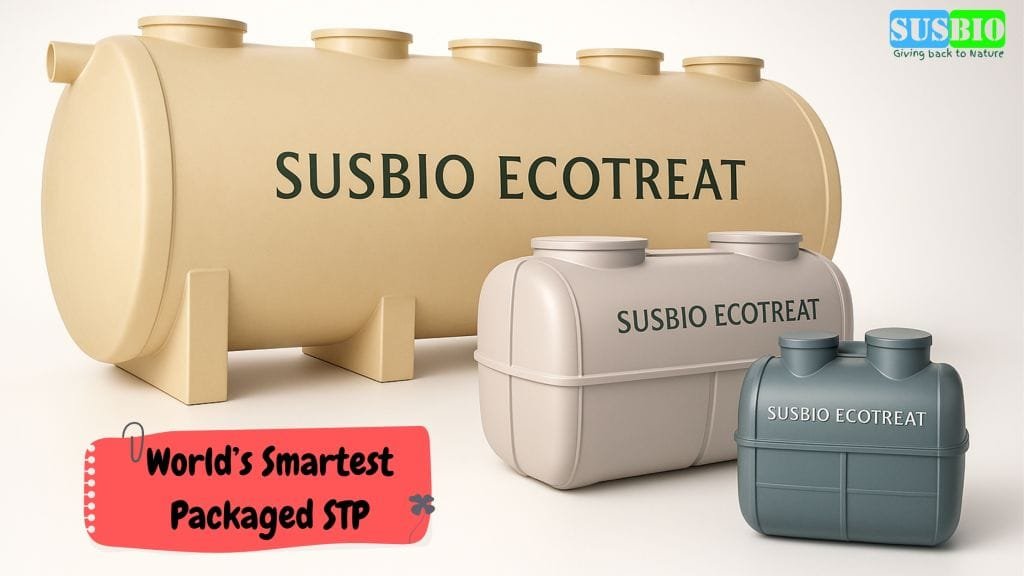
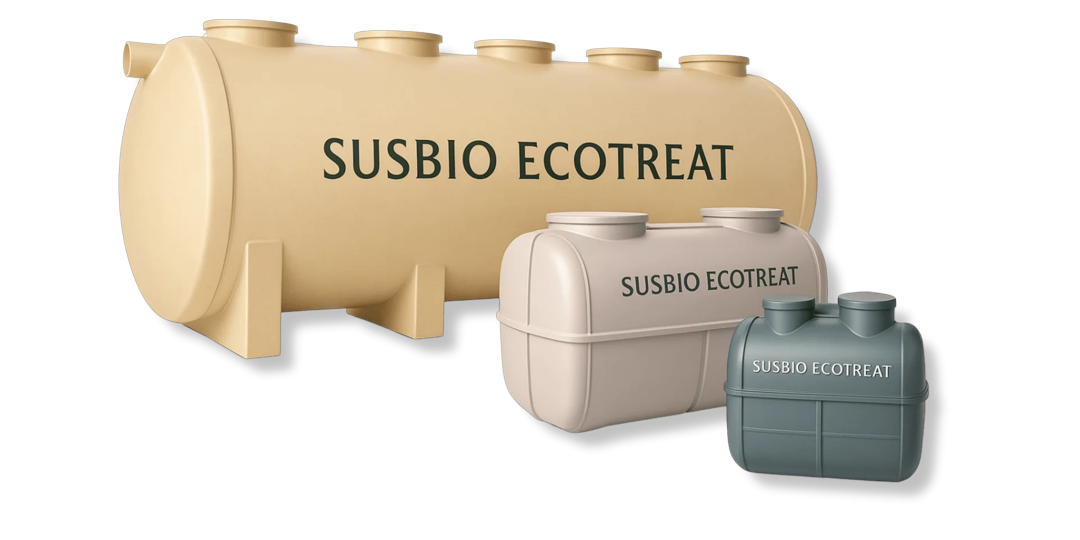
SUSBIO ECOTREAT is a prefabricated FRP packaged STP using Anaerobic + MBBR dual-stage biological treatment. It is manufactured at our Vasuli MIDC, Chakan, Pune facility, fully assembled and tested before despatch, and installs in 3–5 days on a simple RCC base slab.
How ECOTREAT works
Stage 1 — Anaerobic treatment: Raw sewage enters the anaerobic chamber where facultative bacteria break down the bulk of the organic load without any energy input. This pre-treatment step significantly reduces the BOD load entering the MBBR stage, lowering overall energy consumption.
Stage 2 — MBBR treatment: The pre-treated effluent passes through the Moving Bed Biofilm Reactor, where plastic carrier media coated with aerobic biofilm perform the final polishing. Because the biomass is attached to the carriers rather than suspended in liquid, the system handles variable daily flows without performance loss — critical for Gujarat’s apartments and hotels where occupancy fluctuates.
Stage 3 — Clarification and disinfection: Treated water passes through a clarifier for solids separation, followed by chlorination before discharge or reuse.
ECOTREAT technical specifications
| Specification | Details |
|---|---|
| Technology | Anaerobic + MBBR dual-stage |
| Capacity range | 1 KLD to 500 KLD |
| Construction | High-grade FRP (Fibre Reinforced Plastic) |
| Outlet BOD | < 10 mg/L |
| Outlet COD | < 50 mg/L |
| Outlet TSS | < 10 mg/L |
| Energy saving | 70% less electricity vs conventional STPs |
| Installation time | 3–5 days on site |
| Civil work required | Simple RCC base slab only |
| Operation | Fully automatic — no dedicated operator |
| Monitoring | Built-in sensor integration for OCEMS compliance |
| Lifespan | 20+ years with standard maintenance |
Who Needs an STP in Gujarat
Residential developers and housing societies
Any residential project above 50 dwelling units or 2,000 sq.m built-up area requires an STP under CPCB guidelines, with GPCB enforcement applicable in Gujarat. For GujRERA-registered projects in Ahmedabad, Surat, Vadodara, Gandhinagar, and Rajkot, Occupancy Certificate issuance now requires a functioning, compliant STP. The dual plumbing requirement — separating treated water supply for flushing and landscaping from potable supply — is increasingly enforced as a building permit condition.
Hotels, resorts, and hospitality
Gujarat’s hospitality sector — from heritage properties in Ahmedabad’s old city to resort developments along the Rann of Kutch — generates significant sewage loads with highly variable occupancy patterns. MBBR’s biofilm-based treatment handles peak load variation better than SBR or conventional activated sludge. For properties above 10 KLD, an STP is mandatory under GPCB’s hospitality sector guidelines.
Hospitals and healthcare facilities
Healthcare facilities generate sewage with elevated pathogen loads, pharmaceutical residues, and disinfectant chemicals. GPCB’s guidelines for healthcare facilities require STP installation and treated water quality meeting stricter parameters than standard domestic sewage. Our ECOTREAT systems for hospital applications include additional disinfection stages and are designed to handle the chemical load variations common in healthcare settings.
Industrial facilities and SEZs
Gujarat’s industrial clusters — GIFT City in Gandhinagar, GIDC estates across the state, the Dahej SEZ, and Dholera SIR — all have STP requirements embedded in their environmental clearance conditions. For facilities generating domestic sewage alongside industrial effluent, a dedicated packaged STP handles the domestic stream while an ETP (Effluent Treatment Plant) handles the industrial stream. SUSBIO supplies both.
Educational and institutional campuses
Schools, colleges, and institutional campuses above specified thresholds require STPs under CPCB and GPCB guidelines. Gujarat has a large network of residential educational institutions — particularly in Ahmedabad, Anand, and Rajkot — where 24-hour residential populations generate continuous sewage loads that require reliable, low-maintenance treatment systems.
Why Anaerobic + MBBR Is the Right Technology for Gujarat
Gujarat’s diverse geography and industrial mix mean STP applications range from Ahmedabad’s dense urban residential clusters to remote resort developments in Kutch and industrial facilities in Bharuch. Anaerobic + MBBR performs reliably across this range for three reasons.
Energy cost: Gujarat has among the highest industrial electricity tariffs in India. A conventional activated sludge STP running continuous aeration at full capacity imposes a significant recurring cost. ECOTREAT’s anaerobic pre-treatment stage handles the bulk of the organic load without electricity input, reducing the aeration load on the MBBR stage. The result is 70% less electricity consumption versus a conventional STP of equivalent capacity.
Variable load tolerance: Most Gujarat residential complexes, hotels, and institutions do not run at design capacity every day. A Sunday morning in a residential complex might produce 30% of the Monday morning flow. SBR systems depend on precise cycle timing and struggle with significant daily variation. MBBR biofilm carriers simply treat whatever comes through — the biomass does not wash out when the flow drops.
GPCB OCEMS readiness: Plants above 50 KLD in Gujarat must have online continuous monitoring linked to GPCB’s server. SUSBIO ECOTREAT has built-in sensor integration for the parameters GPCB monitors — BOD, COD, TSS, pH, and flow — making compliance documentation straightforward rather than a separate system integration project.
GPCB Consent Process — What Gujarat Buyers Need to Know
Installing an STP in Gujarat requires navigating the GPCB’s consent process. Here is what to expect:
Consent to Establish (CTE): Required before starting construction of any facility with an STP. The application is submitted on the GPCB’s XGN online portal. Documents required include the project layout, proposed STP capacity calculation, technology description, and environmental impact assessment for larger projects. Processing time is typically 30–60 days for standard applications.
Consent to Operate (CTO): Required before commissioning the STP and beginning operations. Requires evidence that the STP is installed, functional, and producing treated water meeting GPCB discharge standards. A site inspection is typically conducted before CTO is granted.
Compliance documentation: Once operational, you must maintain daily operational logs, monthly treated water quality test reports from a NABL-accredited laboratory, and online OCEMS data (for plants above 50 KLD) linked to GPCB’s portal.
SUSBIO provides complete technical documentation packages for the CTE and CTO application process, including capacity calculations, technology specifications, P&ID drawings, and outlet quality test reports from our Pune manufacturing facility.
STP Cost in Gujarat — What Determines It
The cost of a packaged STP in Gujarat depends on four factors: capacity, technology, site conditions, and logistics to site.
As indicative reference points only — actual cost depends on your specific project and site:
A 10 KLD ECOTREAT packaged STP for a small housing society or hotel costs approximately Rs 8–14 lakh delivered and installed in Gujarat’s major cities. A 50 KLD system for a larger residential complex or resort costs approximately Rs 32–50 lakh. Systems above 100 KLD are quoted project-specifically based on site conditions, access logistics, and any local civil work requirements.
These are indicative figures. The delivered cost to remote sites in Kutch, Saurashtra, or tribal areas of south Gujarat will differ from delivery to an Ahmedabad or Surat city site. Contact us at info@susbio.in with your location, capacity requirement, and application type for a specific delivered cost estimate.
Our Process — From Enquiry to Commissioning
Step 1 — Capacity assessment: We calculate the required STP capacity based on your daily water consumption, number of users, and peak flow conditions. The CPCB formula is 80% of daily water consumption for residential applications, with a 1.5–2x peak flow factor applied for sizing.
Step 2 — Technical proposal: We provide a complete technical proposal including system design, P&ID, GPCB CTE documentation package, and delivered cost. Turnaround is typically 48–72 hours for standard applications.
Step 3 — Manufacturing: Your ECOTREAT system is manufactured at Vasuli MIDC, Chakan, Pune. Standard lead time is 3–6 weeks from order to despatch depending on capacity and current production schedule.
Step 4 — Installation: Our installation team commissions the system in 3–5 days. Civil work required from your side is a simple RCC base slab prepared in advance. We handle piping connections, electrical connections, and initial startup testing.
Step 5 — Handover and training: We hand over the completed system with operational manuals, GPCB CTO documentation support, and operator training. Annual maintenance contracts are available.
Conclusion
Gujarat’s STP compliance environment is tightening, not loosening. GPCB enforcement has intensified post the 2026 CPCB discharge norms revision. OCEMS requirements for plants above 50 KLD mean your STP’s outlet data is being transmitted to the GPCB server daily — periodic inspection compliance is no longer the standard, continuous performance is.
The question for any developer, industrial facility, or institution in Gujarat planning an STP is whether the system is designed to continuously deliver BOD ≤ 10 mg/L and COD ≤ 50 mg/L — not just on commissioning day, but every day for 20 years.
We have been engineering that answer since 2013, across 500+ installations in 24 states. If you are planning an STP project in Gujarat — whether a 5 KLD system for a small guesthouse or a 500 KLD system for a large township — the starting point is a conversation with one of our engineers.
Email: info@susbio.in Phone: +91 88889 80197
Frequently Asked Questions
Q1. Is an STP mandatory for apartments in Gujarat? Yes. Any residential complex above 50 dwelling units or 2,000 sq.m built-up area requires an STP under CPCB guidelines enforced by GPCB. For GujRERA-registered projects, a functioning STP is required for Occupancy Certificate issuance. Complexes generating more than 10 KLD of sewage daily must install a compliant STP.
Q2. What are GPCB’s STP discharge standards? GPCB enforces CPCB Class A outlet standards: BOD ≤ 10 mg/L, COD ≤ 50 mg/L, TSS ≤ 10 mg/L, pH 6.5–8.5, and fecal coliform ≤ 100 MPN/100 mL. For plants above 50 KLD, online continuous monitoring (OCEMS) linked to GPCB’s server is mandatory.
Q3. Which STP technology is best for Gujarat? Anaerobic + MBBR dual-stage technology is recommended for most residential, hospitality, and institutional applications in Gujarat. It consistently achieves GPCB/CPCB Class A outlet standards, uses 70% less electricity than conventional STPs, handles variable daily loads better than SBR, and has built-in OCEMS sensor compatibility. SUSBIO ECOTREAT uses Anaerobic + MBBR and has 500+ active installations across India.
Q4. How long does STP installation take in Gujarat? A SUSBIO ECOTREAT packaged STP installs in 3–5 days on site. The unit arrives factory-assembled and tested from our Pune manufacturing facility. Civil work is limited to a simple RCC base slab. This compares to 6–12 weeks for a conventional civil RCC STP, making packaged systems the practical choice for Gujarat project timelines.
Q5. What documents are needed for GPCB STP consent? For Consent to Establish (CTE): project layout, STP capacity calculation, technology description, and environmental documentation. For Consent to Operate (CTO): evidence of installation, initial outlet quality test reports from a NABL-accredited laboratory, and OCEMS installation confirmation for plants above 50 KLD. SUSBIO provides a complete technical documentation package covering all GPCB application requirements.
Q6. What is the cost of an STP in Gujarat? Cost depends on capacity, technology, and site location. Indicative figures: a 10 KLD packaged MBBR STP costs approximately Rs 8–14 lakh delivered and installed in major Gujarat cities. A 50 KLD system costs approximately Rs 32–50 lakh. Remote sites in Kutch, Saurashtra, or south Gujarat will have different logistics costs. Contact info@susbio.in with your capacity and location for a specific delivered cost estimate.
Q7. Does SUSBIO provide after-sales service in Gujarat? Yes. SUSBIO provides annual maintenance contracts, spare parts supply, and service support across Gujarat. Our service network covers Ahmedabad, Surat, Vadodara, Rajkot, Gandhinagar, Bharuch, Anand, Junagadh, and other locations. Service response time for operational issues is 24–48 hours.