

Every large factory in India — whether a textile mill in Surat, a food processing unit in Pune, a pharmaceutical plant in Hyderabad, or an automobile facility in Chennai — generates a significant volume of wastewater daily. Sewage treatment plant design for large factories is one of the most technically demanding and consequential engineering decisions a facility manager or project consultant will make, and getting it wrong is far more expensive than getting it right.
Yet, in practice, STP design is often treated as an afterthought — something to be resolved just before the occupancy certificate is applied for, or after a regulatory notice has already arrived. This reactive approach leads to undersized systems, non-compliant discharge, penalties, and far costlier retrofits.
This guide is written specifically for factory owners, industrial project heads, environmental consultants, EHS managers, and architects across Maharashtra, Gujarat, Tamil Nadu, Uttar Pradesh, Telangana, and other major industrial states who want a clear, step-by-step understanding of how to correctly design a sewage treatment plant for a large factory — one that meets CPCB and SPCB discharge norms, is cost-efficient to operate, and is scalable as the facility grows.
SUSBIO, a leading wastewater treatment company in India, has designed and commissioned packaged STP systems across hundreds of industrial, commercial, and institutional projects. The methodology in this guide reflects real-world engineering practice, not textbook theory alone.
What Is Sewage Treatment Plant Design for a Large Factory?
A sewage treatment plant (STP) for a factory is an on-site wastewater treatment system that processes domestic sewage — from toilets, canteens, and washrooms — and, in some cases, process effluent generated within the facility, removing harmful contaminants before the treated water is safely discharged or reused. Industrial STP design for large factories must account for variability in influent quality, possible presence of industrial pollutants, and stricter outlet norms under the Environment (Protection) Rules, 1986 and subsequent CPCB guidelines.
Unlike municipal STPs, a large factory STP is designed around the specific workforce size, shift patterns, production processes, and regulatory category of the facility — making proper design non-negotiable.
Why Proper STP Design Matters for Large Factories in India
India generates an estimated 72,368 million litres per day (MLD) of sewage, yet treatment capacity covers only a fraction of this. Industrial facilities are a significant contributor to this load, and regulators are increasingly tightening enforcement:
- The Environment (Protection) Act, 1986 mandates adequate wastewater treatment for all industrial units above a threshold.
- CPCB and respective SPCBs issue Consent to Operate (CTO) and Consent to Establish (CTE) based on compliance with effluent discharge standards.
- Industries in red and orange categories are subject to real-time online monitoring (OCEMS) directly linked to CPCB servers.
- Non-compliance can result in shutdown notices, environmental compensation, and reputational damage.
- Many industrial parks and SEZs now mandate zero-liquid discharge (ZLD) or treated water reuse as a condition of plot allotment.
Beyond compliance, a well-designed STP enables water recycling — reducing freshwater procurement costs and contributing to your facility’s ESG and sustainability reporting objectives.
Step-by-Step Guide to Sewage Treatment Plant Design for Large Factories
The design process follows a structured engineering workflow. Skipping or rushing any step increases the risk of failure. Below is the complete methodology used by SUSBIO’s design engineers.
Step 1: Conduct a Detailed Wastewater Survey and Characterisation
Before any design calculations begin, you must understand what you are treating. This involves collecting representative influent samples from all wastewater streams — domestic sewage from toilets, canteens, and bathrooms; washdown water; and any process-related effluent if it will be co-treated.
Test for: BOD (Biochemical Oxygen Demand), COD (Chemical Oxygen Demand), TSS (Total Suspended Solids), TKN (Total Kjeldahl Nitrogen), total phosphorus, pH, oil and grease, heavy metals (if applicable), and fecal coliform count.
For greenfield projects without existing data, use design guidelines from the CPHEEO Manual on Sewage and Sewage Treatment or reference data from similar industrial typologies. A proper characterisation determines every downstream design decision — from reactor volume to sludge handling capacity.
Step 2: Determine Design Flow Rate and Peak Factor
Calculate the average daily flow (Q_avg) from your facility’s population equivalent (PE) for domestic sewage, plus measured or estimated process effluent volumes. For domestic sewage, use 45–90 litres per capita per day (LPCD) for industrial canteen and washroom use depending on meal service and shift patterns.
Apply a Peak Factor of 2.0–3.0 over average flow to size equalization and downstream units. Also account for future expansion — design the STP for a 15–20 year horizon with modular scalability built in.
Example: A factory with 2,000 employees across two shifts, generating 60 LPCD of domestic wastewater, produces approximately 120 KLD average daily flow. The STP should be designed for 120–150 KLD with peak flow capacity of up to 300 KLD.
Step 3: Define Treatment Objectives and Outlet Standards
Determine the applicable discharge standard based on the receiving environment — inland surface water, land for irrigation, or marine outfall — per Schedule VI of the Environment (Protection) Rules.
For Zero Liquid Discharge (ZLD) projects, outlet quality must meet irrigation or cooling tower makeup reuse standards. Document the required outlet concentrations for BOD, COD, TSS, ammoniacal nitrogen, total nitrogen, and fecal coliform.
This defines the treatment efficiency your STP must achieve — typically:
- BOD removal of 90–95%
- COD removal of 80–90%
- TSS removal of 85–95%
- Disinfection to fecal coliform below 1,000 MPN/100 mL for surface water discharge
Step 4: Select the Appropriate Treatment Technology
Match the technology to your influent characteristics, available land area, operational complexity tolerance, and capital budget. The primary biological treatment technologies used in industrial STPs include:
- Sequential Batch Reactor (SBR)
- Moving Bed Biofilm Reactor (MBBR)
- Membrane Bioreactor (MBR)
- Extended Aeration (EA)
- Submerged Aeration Fixed Film (SAFF)
For large factories where footprint is constrained and treated water reuse is a goal, MBR or MBBR-based packaged STP systems are strongly preferred due to their compact footprint, consistent outlet quality, and lower operator dependency. SUSBIO’s ECOTREAT platform is engineered around advanced MBBR and SBR technologies in FRP-housed packaged configurations proven in Indian industrial conditions.
Step 5: Design the Treatment Train — Stage by Stage
A complete industrial STP treatment train for a large factory includes the following stages:
Screening (Coarse and Fine): Removes large solids and debris to protect downstream equipment. Bar screens with 6mm–25mm openings are standard.
Equalization Tank (EQ Tank): Buffers flow and load variations. Sized for 4–8 hours of average daily flow. Equipped with coarse bubble aeration for mixing and odour control.
Primary Treatment (optional): Sedimentation in a primary clarifier to remove 50–65% of TSS and 25–40% of BOD. Often skipped in packaged STPs with high-rate biological systems.
Biological Treatment Reactor: The core of the STP. MBBR reactors use plastic biofilm carriers (typically HDPE) to maintain high biomass concentration (3,000–8,000 mg/L MLSS equivalent). SBR reactors operate in timed cycles — Fill, React, Settle, Decant — in a single tank. Both achieve effluent BOD below 20 mg/L and COD below 100 mg/L under proper loading.
Secondary Clarifier: Separates biological sludge from treated effluent. Return Activated Sludge (RAS) is recycled back to the reactor; Waste Activated Sludge (WAS) is sent to sludge handling.
Tertiary Treatment: Sand filtration, activated carbon filtration, and UV/chlorination for pathogen removal. For reuse-grade water, ultrafiltration (UF) membranes are added.
Sludge Handling: Sludge thickener, sludge holding tank, and mechanical dewatering via filter press or centrifuge. Dewatered sludge (20–25% dry solids) is sent to authorised disposal or composting.
Step 6: Size Each Unit Process Using Engineering Calculations
Each unit must be designed to specific hydraulic and organic loading parameters:
MBBR Reactor: Sized based on surface area loading rate (SALR) typically 3–8 g BOD/m²/day on carrier surface. Carrier fill ratio: 40–67% of reactor volume. Aeration system: fine bubble diffusers maintaining DO of 2.0–3.0 mg/L.
Clarifier: Surface overflow rate (SOR) of 15–25 m³/m²/day for secondary clarifiers. Sludge Volume Index (SVI) used to determine return sludge ratio.
EQ Tank: Volume = Q_avg × retention time (4–8 hrs). Blower sizing: 0.01–0.015 m³/min per m² of tank floor.
Sludge: WAS generation estimated at 0.3–0.6 kg VSS per kg BOD removed. Filter press sized for batch dewatering of daily sludge production.
All calculations should be documented in a Design Basis Report (DBR) submitted to the SPCB along with the CTE/CTO application.
Step 7: Prepare Civil and Structural Drawings
For packaged STPs (prefabricated STP), civil work is minimal — a levelled RCC plinth or pad and piping connections suffice. For civil STPs, full structural drawings of tanks, chambers, and walls are required.
Key documents include: P&ID (Piping and Instrumentation Diagram), general arrangement drawing (GAD), equipment layout plan, and electrical single-line diagram.
For packaged STP installations, SUSBIO provides factory-fabricated FRP (Fibre Reinforced Plastic) vessels that are corrosion-resistant, leak-proof, and certified for below-ground or above-ground installation — eliminating the need for civil tank construction at site.
Step 8: Design the Electrical, Instrumentation, and Automation System
An industrial STP must include:
- MCC panel (Motor Control Centre) with individual DOL/star-delta starters for pumps and blowers
- Level sensors in all tanks for automated pump actuation
- DO sensors in biological reactors for blower modulation
- Flow meters on inlet and outlet lines (mandatory for OCEMS compliance)
- SCADA or PLC-based control system for remote monitoring and alarm management
For facilities covered under CPCB’s online monitoring mandate, a CEMS/OCEMS unit transmitting real-time BOD, COD, TSS, pH, and flow data to the pollution control board server must be integrated.
Step 9: Obtain Environmental Clearances and Consents
Submit the complete STP design documentation to the State Pollution Control Board (SPCB) for Consent to Establish (CTE). Documents required typically include: site plan and location map, design basis report, process flow diagram, equipment list, effluent disposal plan, and environmental impact assessment (if applicable).
After installation and commissioning, apply for Consent to Operate (CTO) with performance test results demonstrating compliance with outlet norms. Renewals are required annually or as per state-specific schedules.
Step 10: Commission, Test, and Validate Performance
Commissioning involves sequential startup: fill the EQ tank, inoculate the biological reactor with seed sludge (or allow natural seeding over 2–4 weeks), gradually increase organic loading, and monitor outlet parameters daily during startup.
Performance validation requires consecutive sampling over 3–7 days meeting outlet standards before final handover. SUSBIO provides full commissioning support, operator training, and a minimum 12-month AMC (Annual Maintenance Contract) for all installed systems, with remote monitoring available through the SUSBIO digital platform.
India-Specific Regulations and Compliance Framework
Industrial STP design in India is governed by a layered regulatory framework. Understanding this is non-negotiable for any factory project:
- Environment (Protection) Act, 1986 and Rules, 1986 — primary legislation; Schedule VI sets effluent discharge standards.
- Water (Prevention and Control of Pollution) Act, 1974 — governs discharge to water bodies; enforced by SPCBs.
- CPCB General Standards for Discharge of Environmental Pollutants — sets minimum national standards.
- National Water Policy 2012 — emphasises treated water reuse in industry.
- CPCB OCEMS Guidelines (2020 onwards) — mandate real-time online monitoring for 17 highly polluting industries (red category).
- NGT Orders — NGT has issued strict directives on industrial wastewater treatment compliance; non-compliance attracts financial penalties under the Polluter Pays Principle.
CPCB Effluent Discharge Standards (Reference Values)
| Parameter | Inland Surface Water | Land Irrigation | Marine Discharge |
|---|---|---|---|
| BOD (mg/L) | ≤ 30 | ≤ 100 | ≤ 100 |
| COD (mg/L) | ≤ 250 | ≤ 250 | ≤ 250 |
| TSS (mg/L) | ≤ 100 | ≤ 200 | ≤ 100 |
| pH | 6.5 – 8.5 | 5.5 – 9.0 | 6.0 – 8.5 |
| Ammoniacal-N (mg/L) | ≤ 50 | — | ≤ 50 |
| Total Nitrogen (mg/L) | ≤ 10 (ZLD) | — | — |
| Fecal Coliform (MPN/100 mL) | ≤ 1000 | ≤ 1000 | — |
Note: Some states including Maharashtra, Gujarat, and Tamil Nadu apply more stringent standards. Always check applicable SPCB norms before finalising design outlet targets.
Packaged STP vs. Conventional Civil STP for Factories: Which Should You Choose?
One of the key decisions in industrial STP design for large factories is whether to use a prefabricated packaged STP or construct a conventional civil STP. The comparison below addresses the most common decision parameters:
| Parameter | Packaged / Prefabricated STP | Conventional Civil STP |
|---|---|---|
| Construction Time | 2–6 weeks | 3–6 months |
| Civil Work Required | Minimal / None | Extensive |
| Footprint | Very compact | Large |
| Scalability | Modular, easy to expand | Difficult and costly |
| Capital Cost | Lower (all-inclusive) | Higher (multi-contractor) |
| Relocation | Possible | Not possible |
| Quality Control | Factory-controlled | Site-dependent |
| O&M Complexity | Low to medium | Medium to high |
| Ideal For | Industries, hotels, apartments | Large municipal projects |
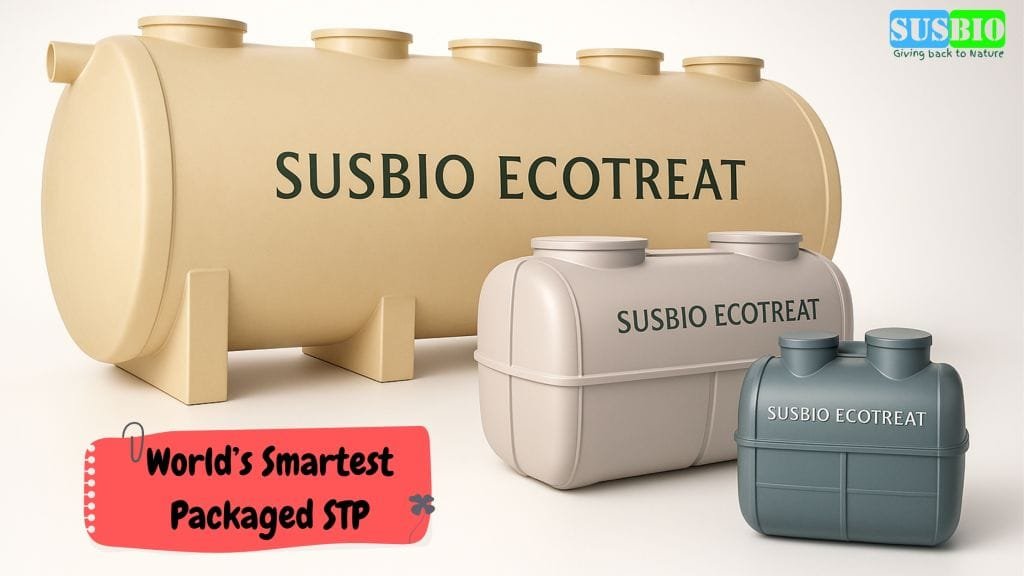
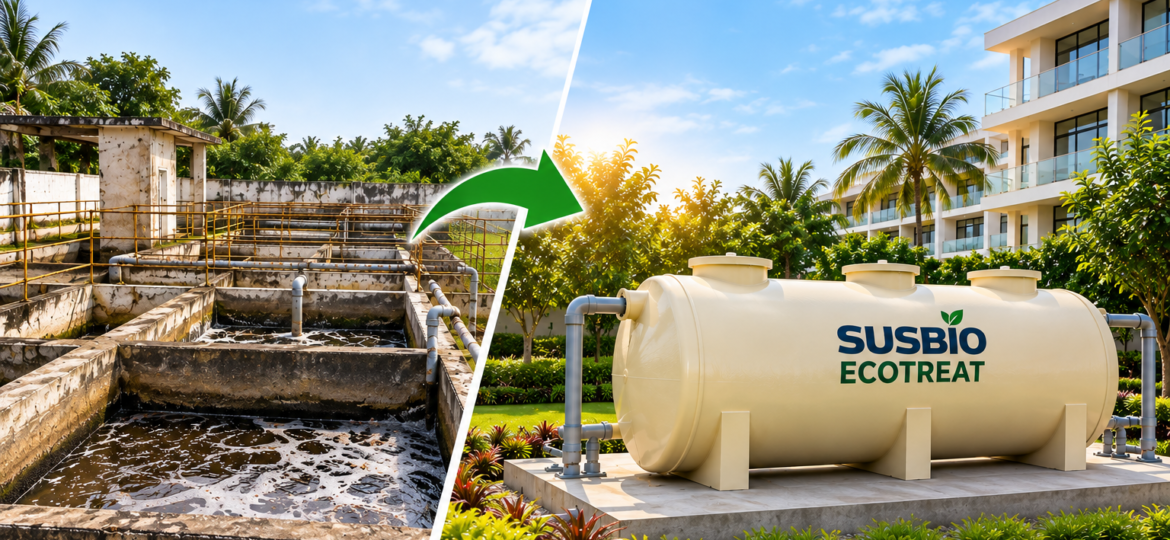
For most large factories with space constraints, timeline pressures, and the need for consistent performance, a packaged STP — particularly SUSBIO ECOTREAT — is the technically and economically superior choice. SUSBIO ECOTREAT units are manufactured in factory-controlled conditions, tested before dispatch, and installed within weeks — dramatically reducing project risk.
Common Design Mistakes That Lead to STP Failure in Factories
- Underestimating influent BOD/COD: Process effluent from canteens or specific production processes often carries very high organic loads. A generic 300 mg/L BOD assumption will result in an undersized reactor.
- Ignoring peak flow: Not providing adequate equalization leads to hydraulic overloading during shift changeovers or production batch discharges.
- No sludge management plan: Many STPs are designed without adequate sludge thickening and dewatering capacity, leading to wet sludge accumulation and operational chaos.
- Selecting technology for low capital cost only: Opting for a simpler system to save money upfront, without considering opex, reliability, and outlet quality, is the most expensive long-term decision.
- Skipping OCEMS integration: Factories in regulated categories that install STPs without online monitoring compliance face retrofit costs later and risk enforcement action.
- No provision for treated water reuse: Designing for discharge-only when reuse was feasible wastes a valuable resource and misses ZLD compliance pathways.
Key Benefits of a Well-Designed Industrial STP
- Regulatory compliance and avoidance of SPCB penalties and shutdown orders.
- Treated water reuse in cooling towers, toilet flushing, landscaping, or process washing — typically replacing 30–60% of freshwater demand.
- Reduced freshwater procurement cost and lower water cess liability under the Water (Prevention and Control of Pollution) Cess Act, 1977.
- ESG and sustainability reporting credentials — industrial clients, investors, and international buyers increasingly require evidence of responsible wastewater management.
- Protection of groundwater and local water bodies from contamination — reducing community and legal risk.
- Improved workplace hygiene and reduced risk of waterborne disease among the workforce.
Why SUSBIO Is India's Preferred Industrial STP Design and Manufacturing Partner
SUSBIO is one of India’s leading sewage treatment plant manufacturers and a trusted wastewater treatment company for industrial, commercial, and institutional projects. With an installed base spanning manufacturing facilities across Maharashtra, Gujarat, Uttar Pradesh, Telangana, Karnataka, and other major industrial states, SUSBIO combines engineering depth with execution reliability.
SUSBIO ECOTREAT — The Industrial-Grade Packaged STP
SUSBIO ECOTREAT is SUSBIO’s flagship prefabricated STP product line, engineered specifically for demanding industrial applications:
- FRP construction: Corrosion-resistant, UV-stable, and rated for a 25+ year service life — significantly outperforming mild steel or conventional RCC tanks in durability and maintenance cost.
- Advanced MBBR and SBR technology: Delivers consistently low outlet BOD (below 10 mg/L achievable), COD (below 50 mg/L), and TSS (below 20 mg/L) — exceeding most SPCB discharge standards.
- Factory pre-tested before dispatch: Every SUSBIO ECOTREAT unit is pressure-tested and functionally verified at the manufacturing facility before it leaves for the project site — eliminating site-stage surprises.
- Compact footprint: Up to 60% smaller than equivalent-capacity civil STPs, making it ideal for factories with constrained utility areas.
- Modular and scalable: SUSBIO ECOTREAT units can be added in parallel as factory capacity expands, without requiring complete system redesign.
- OCEMS-ready: Pre-wired sensor ports and PLC panel provision for seamless integration with real-time online monitoring systems.
- End-to-end support: SUSBIO provides design, supply, installation, commissioning, operator training, and ongoing AMC — a single point of accountability throughout the project lifecycle.

Application Areas: Where SUSBIO Industrial STPs Are Deployed
- Automotive and engineering factories: High volumes of domestic sewage from large workforces; coolant and washdown effluent management.
- Pharmaceutical and chemical plants: Complex effluent composition requiring robust biological treatment and tertiary polishing.
- Food and beverage processing units: High-BOD effluent from production; grease traps and DAF pre-treatment often required upstream of the STP.
- Textile mills and garment factories: High TDS and colour-bearing wastewater from dyeing processes; advanced tertiary treatment for reuse.
- Logistics and warehousing parks: Moderate domestic sewage volumes from large workforce facilities.
- Industrial townships and SEZs: Combined treatment for multiple factories within a managed industrial estate.
- Power plants and refineries: Wastewater from cooling towers, boilers, and domestic amenities requiring integrated treatment.
Conclusion
Sewage treatment plant design for large factories is a multidisciplinary engineering process that demands rigorous wastewater characterisation, careful technology selection, adherence to CPCB and SPCB discharge norms, and disciplined project execution. The ten-step methodology outlined in this guide — from influent survey and flow rate determination, through treatment train design, regulatory documentation, and commissioning validation — provides a proven framework for industrial STP projects of any scale across India.
The choice between a packaged STP and a conventional civil STP increasingly favours the packaged prefabricated route for most industrial applications, given the advantages in speed, quality assurance, footprint efficiency, and operational consistency. SUSBIO ECOTREAT represents the state of the art in packaged industrial STP technology in India — combining advanced MBBR and SBR biological treatment, FRP construction, and factory-tested reliability with SUSBIO’s end-to-end project and service support.
Whether your factory is in Maharashtra, Gujarat, Tamil Nadu, Uttar Pradesh, Telangana, or anywhere across India — in the planning stage needing a design partner for your CTE application, commissioning a new greenfield facility, or upgrading a non-compliant legacy system to meet current SPCB norms — SUSBIO’s engineering team is equipped to deliver a sewage treatment plant that performs, complies, and endures.
Contact SUSBIO today to request a free technical consultation, indicative design, and budgetary proposal for your industrial STP project.
Frequently Asked Questions
What is the typical BOD and COD of sewage from a large factory?
Domestic sewage from factory canteens and washrooms typically has BOD in the range of 150–300 mg/L and COD of 300–600 mg/L. If industrial process effluent is co-treated, these values can be significantly higher — up to 1,500 mg/L BOD and 4,000 mg/L COD in food processing or brewery applications. Proper influent characterisation before design is therefore essential.
What size STP does a factory with 1,500 workers need?
Using a design flow of 60 LPCD for industrial domestic use, a factory with 1,500 workers across two shifts would generate approximately 90 KLD of sewage. The STP should be designed for 90–120 KLD capacity with peak flow handling up to 250 KLD. SUSBIO can supply ECOTREAT packaged STPs in this capacity range as a single or dual-unit configuration.
Is a packaged STP or civil STP better for industrial use?
For most factories, a packaged (prefabricated) STP is the preferred choice. It offers faster installation (weeks vs. months), factory-quality construction, compact footprint, and lower total project risk. Civil STPs are primarily advantageous for very large capacities above 1,000 KLD where the economics of prefabrication become less compelling.
What are the CPCB outlet norms for industrial STP discharge to a river?
For discharge to inland surface water, CPCB norms require: BOD ≤ 30 mg/L, COD ≤ 250 mg/L, TSS ≤ 100 mg/L, pH 6.5–8.5, and fecal coliform ≤ 1,000 MPN/100 mL. Some state boards including MPCB, GPCB, and TNPCB apply more stringent limits. A well-designed STP using MBBR or SBR technology easily meets and typically exceeds these norms.
Does SUSBIO provide OCEMS-integrated STP systems?
Yes. SUSBIO ECOTREAT systems include PLC-based control panels pre-configured for OCEMS integration. SUSBIO’s team handles the full scope of online monitoring — sensor installation, data logger configuration, SPCB server connectivity, and calibration documentation — as part of the installation and commissioning package.
What documents are required to obtain CTE and CTO for a factory STP?
For Consent to Establish (CTE): site plan, process flow diagram, Design Basis Report, equipment list, effluent disposal plan, and source of water details. For Consent to Operate (CTO): installation completion certificate, performance test report showing 3–7 days of compliant outlet samples, and OCEMS integration proof for applicable categories. SUSBIO’s engineering team assists clients with complete documentation preparation.
Can treated STP water be reused within the factory?
Yes, and this is increasingly mandated in water-scarce regions and ZLD-compliant industrial estates. Tertiary-treated effluent meeting defined quality norms can be reused for cooling tower makeup water, toilet flushing, floor and equipment washing, horticulture and green belt irrigation, and boiler feed with additional treatment. SUSBIO designs full water recycling systems integrated with the STP for clients pursuing ZLD compliance or water efficiency goals.
How long does it take to install a packaged STP for a factory?
Typically 2–6 weeks from site readiness for SUSBIO ECOTREAT packaged systems, versus 3–6 months for civil STP construction.
What is the lifespan of an industrial STP?
A well-maintained FRP-housed packaged STP has a design life of 20–25+ years. Civil RCC tanks may require structural repairs after 15–20 years.
What is ZLD and is it mandatory for factories?
Zero Liquid Discharge means no wastewater is discharged outside the factory premises — all water is treated and recycled. It is mandatory for certain industries including textile dyeing, tanneries, sugar mills, and distilleries in specific states by CPCB and NGT orders, and is increasingly being required for new industrial projects.
What is the operating cost of an industrial STP?
Operating costs include power (dominant, approximately 0.2–0.4 kWh per KL treated), chemicals for pH correction, coagulants and disinfectants, consumables, and AMC. Total OPEX for a well-designed system is typically Rs. 8–20 per KL treated depending on capacity and technology.