


A sewage treatment plant (STP) is a system that removes harmful contaminants from domestic wastewater — the water discharged from toilets, bathrooms, kitchens, and washbasins in homes, apartments, hotels, and hospitals. It uses physical, biological, and chemical processes to reduce BOD, COD, TSS, and pathogens to safe levels before the treated water is safely reused for flushing and irrigation or discharged. In India, STPs are mandatory for all residential projects above 50 units or 20,000 sq.m built-up area under CPCB norms.
India generates over 72,000 million litres of sewage every day — yet less than half of that is treated before it reaches rivers, groundwater, or open land. If you are a developer, facility manager, architect, or property owner, understanding how a sewage treatment plant (STP) works is no longer optional. It is a legal requirement, a compliance question, and increasingly, a commercial differentiator.
This guide covers everything you need to know — from how an STP functions at each stage, to choosing the right technology, calculating capacity, understanding CPCB norms, and estimating real costs. Written and reviewed by SUSBIO’s engineering team, based on 13+ years and 500+ installations across India.
What Is a Sewage Treatment Plant — And Why the Definition Matters
A sewage treatment plant is not complicated in principle. It is a system that takes the wastewater generated by people — from toilets, bathrooms, kitchens, washbasins — and removes the contaminants from it before the water is either discharged safely or reused within the building.
The reason the definition matters is that buyers confuse STP, ETP, and WTP constantly — and the confusion leads to wrong purchase decisions.
| Term | Treats | Who Needs It | Common Mistake |
|---|---|---|---|
| STP — Sewage Treatment Plant | Domestic sewage from toilets, bathrooms, kitchens | Apartments, hotels, hospitals, schools, offices | Undersizing for actual population |
| ETP — Effluent Treatment Plant | Industrial process wastewater — chemicals, heavy metals, dyes | Factories, pharma plants, textile mills, food processing | Using an STP where an ETP is needed |
| WTP — Water Treatment Plant | Raw water from river or borewell for drinking | Municipal supply, large campuses with borewell water | Confusing inlet treatment with outlet treatment |
If your project is a residential complex, hotel, hospital, school, or commercial building — you need an STP. If your project is a factory or industrial facility — you need an ETP for process effluent and an STP for your workers domestic sewage. The two are not interchangeable.
Why STPs Are Mandatory in India — And Why Enforcement Is Only Getting Stricter
Let us be direct about something that a lot of STP suppliers gloss over: the STP in your building is not optional. It is not a sustainability initiative. It is a legal requirement — and the consequences of getting it wrong are serious and getting more serious every year.
Here is what the regulatory landscape actually looks like in 2026:
- The Central Pollution Control Board (CPCB) mandates STP installation for all residential projects generating more than a threshold volume of sewage — typically 50 units or 20,000 sq.m built-up area, though many states have lowered this threshold
- State Pollution Control Boards issue Consent to Establish (CTE) before construction and Consent to Operate (CTO) after commissioning — without these, your building cannot legally operate its sewage system
- The National Green Tribunal has issued enforcement orders against thousands of non-compliant buildings across India — the NGT is not a body that issues warnings. It issues financial penalties, closure orders, and in repeat cases, criminal prosecution
- Maharashtra (MPCB), Karnataka (KSPCB), Delhi (DPCC), Tamil Nadu (TNPCB), and Goa (GSPCB) all have specific local requirements that are often stricter than CPCB minimum standards
- As of 2026, many municipal corporations — including PMC in Pune, BBMP in Bengaluru, and MCGM in Mumbai — are actively conducting STP compliance audits in residential complexes during occupancy certificate renewals
From 13 years in the field: The most common scenario we see is a developer who installed an STP just to get the occupancy certificate, with no intention of maintaining it. Two years later, the housing society receives an SPCB notice. By then the developer is gone and the RWA is left dealing with the consequences — and the cost of replacement. A properly designed, properly maintained STP is far cheaper than the alternative.
| Non-compliance consequence | Who It Affects | Typical Timeline |
|---|---|---|
| SPCB Show Cause Notice | Building owner / RWA | Within 30 days of inspection |
| Financial penalty under EP Act | Building owner / RWA | Rs. 10,000 to Rs. 1 lakh per violation |
| Consent to Operate cancellation | Building / facility | Immediate upon order |
| NGT-ordered closure | Entire facility | Can be immediate in serious cases |
| Criminal prosecution | Individual directors / owners | Repeat violations — imprisonment up to 5 years |
How a Sewage Treatment Plant Works — Stage by Stage
A sewage treatment plant treats wastewater in multiple sequential stages. Each stage removes a different category of pollutant. Skipping or undersizing any stage results in non-compliant effluent and regulatory penalties.
Stage 1: Preliminary Treatment
Raw sewage enters the STP and passes through bar screens and grit chambers. Large solids — rags, plastic, sand — are physically removed. This protects downstream equipment from damage.
Stage 2: Primary Treatment (Settling)
In the primary clarifier or settling tank, heavier suspended solids settle to the bottom as primary sludge. Oils and grease float to the top and are skimmed off. This stage typically removes 50–70% of suspended solids and 25–40% of BOD.
Stage 3: Secondary Treatment (Biological)
This is the most critical stage. Microorganisms — bacteria — are used to biologically break down dissolved and colloidal organic matter. This is where the bulk of BOD and COD reduction happens. Different technologies use different biological approaches here (see Section 2).
Stage 4: Secondary Clarification / Settling
After biological treatment, the mixed liquor (water + biomass) enters a secondary clarifier where the biomass settles out. Clear supernatant proceeds to disinfection. Settled sludge is either returned to the biological reactor or processed separately.
Stage 5: Disinfection
Chlorination, UV irradiation, or ozonation is used to kill residual pathogens — bacteria and viruses. CPCB Class A norms require faecal coliform counts below 100 MPN/100 mL. For reuse in toilet flushing or irrigation, UV disinfection is standard.
Stage 6: Sludge Handling
Sludge generated at primary and secondary stages is thickened, digested, and dewatered into a manageable solid (filter cake). This must be disposed of or reused responsibly — as agricultural compost (if certified safe) or through a licensed sludge contractor. Poor sludge management is one of the most common compliance failures at Indian housing societies.
|
What Does ‘Treated Water Reuse’ Require? CPCB mandates that treated water from STPs must be reused for non-potable purposes — toilet flushing, landscape irrigation, cooling towers, or floor washing. This requires a dual plumbing system: one line for freshwater, one for treated water. Buildings that don’t plan this at the OC stage often face costly retrofits. |
Types of STP Technologies in India
India’s sewage treatment market uses several biological treatment technologies. Each has different footprint requirements, capital costs, effluent quality outcomes, and suitability for different project types.
| Technology | Best For | Footprint | Effluent Quality | Energy Use | Install Time |
|---|---|---|---|---|---|
| Anaerobic + MBBR (ECOTREAT) | 1–500 KLD: Residential, Hotels, Hospitals, Industry | Very compact — 40% less than civil | BOD <10 mg/L, exceeds CPCB Class A | 70% less than ASP | 3–5 days |
| SBR (Sequencing Batch Reactor) | 50–500 KLD: Large complexes, institutions | Medium | BOD <10 mg/L | Moderate | 3–6 months (civil) |
| MBR (Membrane Bioreactor) | High reuse quality requirement; space-constrained sites | Very compact | Highest quality; BOD <5 mg/L | High | 2–4 weeks (packaged) |
| ASP (Activated Sludge Process) | Large municipal / 500 KLD+ | Large — civil tanks required | BOD 10–20 mg/L typical | Very high | 6–12 months |
For projects in the 10–500 KLD range — residential complexes, hotels, hospitals, institutions, and industrial campuses — the Anaerobic + MBBR packaged technology delivers the best combination of footprint efficiency, treated water quality, and total cost of ownership.
CPCB Discharge Standards — What Your STP Must Actually Achieve
Every STP in India must meet the effluent quality standards set by CPCB under Schedule VI of the Environment (Protection) Rules, 1986. Your State Pollution Control Board may enforce stricter local standards — and in many states, they do.
The table below shows the standard CPCB norms alongside what SUSBIO ECOTREAT consistently delivers:
| Parameter | CPCB Limit (Surface Water) | CPCB Limit (Irrigation) | SUSBIO ECOTREAT Typical Outlet |
|---|---|---|---|
| BOD (mg/L) | ≤ 30 | ≤ 100 | < 10 |
| COD (mg/L) | ≤ 250 | ≤ 250 | < 50 |
| TSS (mg/L) | ≤ 100 | ≤ 200 | < 10 |
| pH | 6.5 – 8.5 | 5.5 – 9.0 | 7.0 – 8.0 |
| Ammoniacal Nitrogen (mg/L) | ≤ 50 | — | < 5 |
| Fecal Coliform (MPN/100mL) | ≤ 1000 | ≤ 1000 | < 100 |
A word about the numbers: Achieving BOD of 28 mg/L just inside the 30 mg/L limit is not good STP design — it is one bad day away from a compliance failure. SUSBIO ECOTREAT targets BOD below 10 mg/L as a design outcome precisely because real-world STPs encounter loading variations, power fluctuations, and operator inconsistencies. That margin is what keeps you compliant through conditions that are not ideal — which is most of the time in a real building
Who Needs a Sewage Treatment Plant in India?
STP installation is mandatory under the Environment (Protection) Act, 1986 and the Water (Prevention and Control of Pollution) Act, 1974. The following building types are legally required to install and operate an STP:
- Residential complexes — apartments, gated communities, housing societies (generally above 20 units or 5,000 sq ft built-up area depending on state)
- Hotels, resorts, and hospitality properties (mandatory for properties above a certain room count or daily sewage generation)
- Hospitals and healthcare facilities (all sizes — sewage from hospitals may contain pharmaceutical compounds and pathogens)
- Educational institutions — schools, colleges, universities
- Commercial buildings — malls, office complexes, IT parks
- Industrial facilities — factories, manufacturing units with domestic wastewater
- Any property in a CRZ (Coastal Regulation Zone) area — STP mandatory regardless of size
Occupancy Certificate (OC) Requirement Most state building regulations now require a functional STP as a pre-condition for the Occupancy Certificate (OC). Developers who attempt to commission an STP after OC are frequently penalised or required to install a more expensive retrofit system. Plan the STP at the design stage, not after structure completion. |
Packaged STP vs Civil STP — Which Should You Choose?
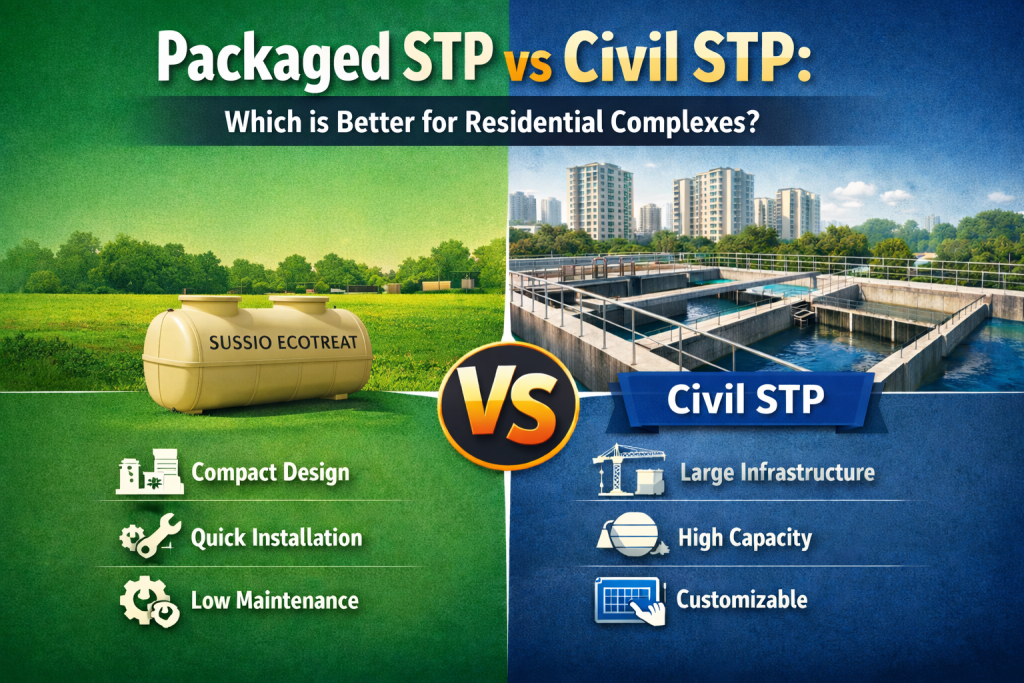
This is the question we get asked more than any other. The honest answer is that for most building-scale applications in India today, a well-engineered packaged STP is the better choice — but not because civil STPs are inherently inferior. It is because of what actually happens when you try to build a civil STP on a real Indian construction site.
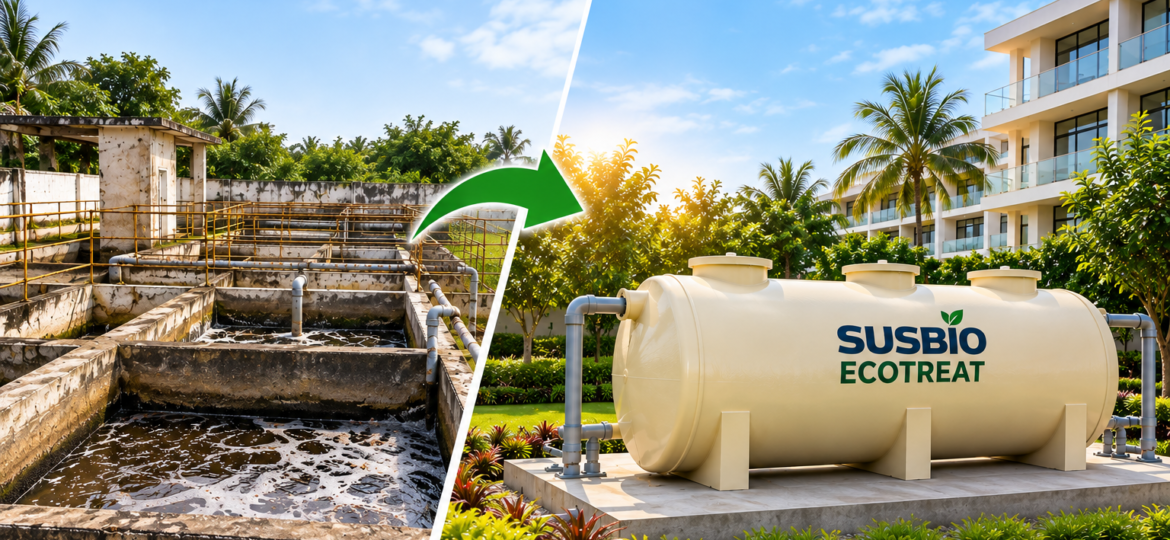
Civil STPs are designed by consultants, built by contractors, and assembled on site using materials of varying quality under conditions that are rarely ideal. In theory, a civil STP built to specification performs well. In practice, we regularly inherit civil STPs from clients where the concrete is already cracking at two years old, the chambers are not the right volume, and the biological system was never properly commissioned because the contractor left before the seed sludge was established.
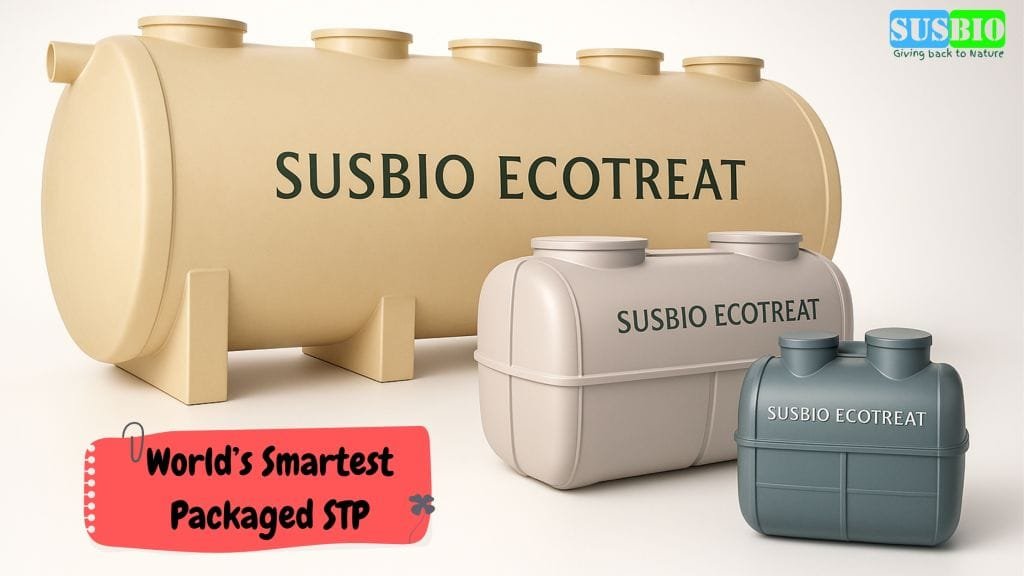
A packaged STP arrives from the factory as a complete, tested, functioning system. The biological chambers are the right volume. The FRP vessel does not crack. The system was tested at the factory before it was dispatched. And it can be installed and commissioned in 3 to 5 days rather than 3 to 6 months.
| Factor | Packaged FRP STP (SUSBIO ECOTREAT) | Civil RCC STP |
|---|---|---|
| Construction time | 3–5 days on site | 3–6 months |
| Civil work required | Minimal — levelled plinth only | Extensive — tanks, chambers, walls |
| Quality control | Factory-fabricated and tested | Site-dependent — varies by contractor |
| Footprint | Up to 60% less than civil equivalent | Large land area required |
| Scalability | Modular — add units in parallel | Difficult and costly to expand |
| Relocation | Possible if project changes | Not possible |
| Service life | 50+ years — FRP does not corrode | 15–20 years before structural repairs needed |
| Warranty | 10-year module warranty (SUSBIO) | No standard warranty |
| Capital cost comparison | Lower all-in (less civil work) | Lower equipment cost, higher civil cost |
The one scenario where a civil STP makes more sense is very large capacity — above 500 KLD to 1 MLD — where the economics of prefabrication become less compelling and civil construction at scale is genuinely cost-efficient. Below that threshold, packaged is almost always the better decision.
STP Cost in India 2026 — Real Numbers, Not Marketing Ranges
We are going to give you honest numbers here. Not the Rs. 1 lakh STP that looks appealing in a brochure and fails in 18 months. Not the Rs. 50 lakh system a consultant specified because they had never actually priced a packaged STP. Real numbers based on what we actually supply and install across India.
| Capacity | Typical Application | Technology | Indicative Cost (Supply + Install) |
|---|---|---|---|
| 5–10 KLD | Villa, small guesthouse, clinic (up to 60 people) | Packaged MBBR + Anaerobic FRP | Rs. 3 – 6 Lakhs |
| 10–25 KLD | Small apartment (50–100 units), boutique hotel | Packaged MBBR + Anaerobic FRP | Rs. 6 – 12 Lakhs |
| 25–50 KLD | Mid-size apartment (100–200 units), hospital | Packaged MBBR + Anaerobic FRP | Rs. 12 – 22 Lakhs |
| 50–100 KLD | Large apartment complex, resort, IT park | Packaged MBBR or SBR | Rs. 20 – 40 Lakhs |
| 100–200 KLD | Large township, hospital complex, factory | Packaged or civil MBBR/SBR | Rs. 35 – 70 Lakhs |
| 200–500 KLD | Large industrial facility, SEZ, township | Civil SBR or MBBR | Rs. 60 Lakhs – 1.5 Crore |
The single most common cause of STP cost problems we see is incorrect capacity sizing. A developer estimates 200 residents and sizes the STP for 20 KLD. The building at full occupancy generates 35 KLD. The STP runs overloaded from day one, produces non-compliant effluent, and needs to be replaced within 3 years at full cost. The right way to size an STP is to calculate your actual peak daily sewage generation first — use our STP capacity calculator at susbio.in/how-to-calculate-sewage-treatment-plant-capacity/ before you do anything else.
Operating Cost — What to Budget Annually
The capital cost of the STP is only part of the picture. Operating costs over the system’s 50-year life are typically 3 to 5 times the capital cost. Here is what to budget:
- Electricity: Rs. 8 to 15 per KL treated — dominant operating cost. A 50 KLD STP running 365 days consumes roughly 18,250 KL annually — electricity cost Rs. 1.5 to 2.7 lakhs per year
- Annual Maintenance Contract (AMC): Rs. 40,000 to Rs. 1.5 lakhs per year depending on capacity — covers scheduled servicing, consumables, and emergency response
- Sludge disposal: Rs. 20,000 to Rs. 60,000 per year for a mid-size system — depends on sludge generation rate and local disposal options
- Chemicals (disinfectants, pH correction): Rs. 10,000 to Rs. 30,000 per year
- Operator cost: If a dedicated operator is required — Rs. 15,000 to Rs. 25,000 per month. SUSBIO ECOTREAT’s automation significantly reduces operator dependency
How to Choose the Right STP for Your Project — 6 Questions to Ask
After 13 years and 500+ installations, we have seen every kind of STP procurement decision — good and bad. The bad ones almost always start with the same mistake: choosing based on price alone without understanding what the price actually buys. Here are the six questions that actually matter:
- What is my actual daily sewage generation at peak occupancy? Not the designed occupancy. The actual occupancy at full building loading, including staff, visitors, and any commercial tenants. Size for this number, not the minimum.
- What outlet quality does my SPCB require? Do not assume CPCB general standards apply in your state. Check with your local SPCB or ask your consultant to confirm the applicable norms for your specific location and project type.
- Is the supplier giving me a system that has been tested, or a system that will be assembled on site? Factory-tested packaged STPs have a fundamentally different risk profile from site-assembled systems. Ask for test certificates.
- What is the post-commissioning support arrangement? An STP is a biological system that needs ongoing attention. Who provides AMC? What is the response time for a breakdown? Does the supplier have engineers in your city?
- What technology is being proposed and why? A supplier who recommends the same technology for every project regardless of application is not engineering a solution — they are selling a product. Ask specifically why this technology is right for your project.
- What documentation support is provided for CTE and CTO? Regulatory approval requires a Design Basis Report, process flow diagram, and performance test documentation. Does the supplier prepare these, or does that fall on you?
Why SUSBIO — What 13 Years and 500+ Installations Actually Means
We started SUSBIO in 2013 during our final year at BITS Pilani with a very specific conviction: that India’s building-scale STP market was dominated by undersized, under-engineered systems that were failing their buildings and failing the environment. Thirteen years later, that conviction has only deepened.
500+ installations is not a marketing number. It means we have commissioned STPs in hill stations in Himachal Pradesh where ambient temperature drops to 4 degrees in January and biological activity slows dramatically. It means we have supplied systems to pharma facilities in Hyderabad where the effluent contains trace APIs that inhibit standard biological treatment. It means we have dealt with MPCB, KSPCB, GSPCB, HPCB, DPCC, and 20 other State Pollution Control Boards — and we know what their inspectors actually look for.
That accumulated experience is in every SUSBIO ECOTREAT system we design. It is in the sizing methodology, the technology selection, the commissioning process, and the AMC structure. It is not something a supplier who has done 30 installations can replicate.
| SUSBIO Capability | Detail |
|---|---|
| Founded | 2013 — 13+ years in wastewater treatment |
| Installations | 500+ across 24 Indian states |
| Manufacturing | Vasuli MIDC, Chakan, Pune — factory-fabricated FRP vessels |
| Headquarters | #5, Umiya Habitat, Zuarinagar, South Goa |
| Technology | Anaerobic + MBBR — SUSBIO ECOTREAT flagship |
| Outlet quality | BOD < 10 mg/L, COD < 50 mg/L, TSS < 10 mg/L — standard |
| Warranty | 10-year module warranty |
| Regulatory support | Complete CTE/CTO documentation for every project |
| OCEMS | Full design, installation, and SPCB server connectivity |
| AMC | Lifetime service commitment — Pune and Goa based engineers |
Which Projects Need What — Application-Specific Guidance
Residential Apartments and Housing Complexes
Residential complexes are the most common STP application in India and also the most commonly under-specified. The critical mistake is sizing for the approved unit count rather than the actual expected occupancy. A 200-unit apartment with an average of 3.5 occupants per unit at 80% occupancy generates roughly 56 KLD of sewage — not the 20 KLD that a consultant might estimate using minimum CPHEEO design flows.
For residential applications, MBBR-based packaged STPs are the clear choice. They handle the morning and evening peak loads that are inherent in residential occupancy patterns, require minimal operator skill, and produce outlet quality that exceeds CPCB norms — which is what your SPCB inspector will check at the annual CTO renewal.
Hotels and Resorts
Hotels have two characteristics that make STP design more complex than residential: high organic load from kitchens and food processing, and highly variable occupancy across the year. A resort in Goa might run at 95% occupancy in November through February and 30% occupancy in June through August.
The kitchen effluent issue is often overlooked. Kitchen wastewater from a hotel’s restaurant carries significantly higher BOD than domestic sewage — fats, oils, and food residue can push BOD above 600 mg/L in the kitchen stream. A grease trap before the STP inlet is not optional for hotel applications — it is essential to prevent the biological treatment stage from being overwhelmed.
For hotels and resorts, we recommend sizing for peak season occupancy with the flexibility to handle 50% of that load efficiently during off-season. MBBR handles this range of loading better than any other technology.
Real-World Example: 50 KLD ECOTREAT for a Hotel Handling 700-Guest Events
Mastiff Grand The Sia Palace in Khopoli needed an STP sized for two very
different loads — steady 88-room occupancy and periodic 700-guest wedding
events. Anaerobic + MBBR technology handled the swing without compromising
CPCB compliance. Treated water is now reused for landscaping and gardening
on-site. Read Full Case Study here-
Hospitals and Healthcare Facilities
Hospital wastewater is the most complex domestic sewage application. In addition to standard BOD and COD, hospital effluent contains pharmaceutical residues, disinfectants (chlorine compounds, quaternary ammonium compounds), and potentially pathogenic microorganisms that are resistant to standard biological treatment.
CPCB has specific norms for hospital wastewater under the Bio-Medical Waste Management Rules. Hospitals need a system specifically designed for the effluent characteristics — not a standard residential STP. The disinfectant concentrations in hospital wastewater can actually inhibit biological treatment if the pre-treatment is not correctly designed.
If you are specifying an STP for a hospital, ensure your supplier has specific hospital project experience and asks for a characterisation of your effluent streams — not just domestic sewage volumes.
Industrial Facilities
Industrial facilities need both an ETP for process effluent and an STP for the domestic sewage from their worker population. These are separate systems with separate regulatory requirements — the ETP goes to the SPCB under the industrial category norms, and the STP for domestic sewage follows standard residential/commercial norms.
The mistake we regularly see is industrial facilities combining their domestic sewage into the ETP and undersizing both. The domestic sewage dilutes the process effluent going into the ETP and reduces its treatment efficiency. Keep the streams separate where possible.
Frequently Asked Questions
Q1. How do I calculate the STP capacity I need for my project?
Start with your actual peak occupancy — not the approved unit count. For residential projects, use 135 litres per capita per day (LPCD) as your design flow for domestic sewage. Multiply peak occupancy by 135 LPCD to get your average daily flow. Then add a 20 to 25% safety margin for future growth and peak-hour surges. For a 200-unit apartment at 3.5 occupants per unit and 80% occupancy: 200 x 3.5 x 0.8 x 135 = 75,600 litres per day = 75 KLD. Add 20% safety margin — size for 90 KLD. Use our STP capacity calculator at susbio.in/how-to-calculate-sewage-treatment-plant-capacity/ for an accurate estimate.
Q2. What documents do I need for SPCB Consent to Establish (CTE)?
CTE documentation typically requires: site plan and location map showing STP placement, Design Basis Report with capacity calculations and technology justification, process flow diagram, equipment list with specifications, effluent disposal plan showing where treated water will be discharged or reused, and source of water details. SUSBIO prepares complete CTE documentation for every project as part of the supply scope — this is not an additional service. The documentation we prepare is based on 13 years of CTE approvals across 24 states and is formatted to meet the specific requirements of each state’s SPCB.
Q3. Can the treated water from an STP be reused in the building?
Yes — and in many states it is now mandatory, not optional. CPCB guidelines and NGT orders require treated water reuse wherever feasible. Tertiary-treated water meeting CPCB Class A norms (BOD < 10 mg/L, TSS < 10 mg/L, fecal coliform < 100 MPN/100 mL) can be reused for toilet flushing, landscape irrigation, vehicle washing, and cooling tower makeup. A typical 50 KLD STP producing 45 KLD of reuse-quality water saves the building approximately 1.35 crore litres of freshwater per year — at current Mumbai water tariffs, that is a saving of Rs. 8 to 12 lakhs annually.
Q4. What is the difference between a packaged STP and a civil STP?
A packaged STP arrives from the factory as a complete, pre-fabricated, tested system — typically in an FRP (Fibre Reinforced Plastic) vessel. It requires minimal civil work on site, can be installed in 3 to 5 days, and comes with a manufacturer warranty. A civil STP is constructed on site using RCC (Reinforced Cement Concrete) tanks built by local contractors. Civil STPs have higher civil construction costs, longer construction timelines (3 to 6 months), and quality outcomes that depend entirely on the contractor’s workmanship. For most building-scale applications below 500 KLD, a properly engineered packaged STP delivers better outcomes at lower total project cost.
Q5. How often does an STP need to be serviced?
A well-designed packaged STP requires weekly screen cleaning (10 minutes), monthly equipment checks on blowers and pumps, quarterly water quality testing to verify CPCB compliance, bi-annual or annual sludge removal depending on loading, and annual inspection of electrical systems and sensors. Total maintenance time for a well-designed packaged STP is approximately 4 to 6 hours per month for a trained operator. SUSBIO provides AMC that covers all scheduled maintenance and emergency response — we recommend all projects have an active AMC to protect the warranty and ensure SPCB compliance.
Q6. What happens if my STP fails SPCB inspection?
An SPCB inspection finding of non-compliance triggers a Show Cause Notice requiring you to demonstrate corrective action within typically 30 days. Failure to remedy results in a direction order with financial penalties under the EP Act — up to Rs. 1 lakh per violation. Continued non-compliance can lead to Consent to Operate cancellation, which means the building cannot legally operate. NGT cases from non-compliance have resulted in financial penalties of Rs. 5 to 50 lakhs for housing societies in several documented cases. The most common cause of SPCB non-compliance is not equipment failure — it is neglected maintenance. An active AMC with a reputable supplier is your best protection.
Q7. What is the lifespan of a SUSBIO ECOTREAT packaged STP?
SUSBIO ECOTREAT FRP vessels are rated for 50+ year service life. FRP does not corrode, does not crack under ground pressure the way RCC does, and does not require the structural repairs that civil tanks need after 15 to 20 years. We back this with a 10-year module warranty — the longest offered by any packaged STP manufacturer in India. Major mechanical components — blowers, pumps — have a typical service life of 7 to 10 years with proper maintenance and will need refurbishment or replacement in that window. This is factored into the AMC structure we provide.
Q8. Does SUSBIO provide service support after installation?
Yes — SUSBIO provides a lifetime service commitment on every installation. We have service engineers based in Pune and Goa, with network coverage across major cities. For Pune and PMC/PCMC area projects, same-day response is standard. For other locations, we provide next-day support as a minimum under AMC. All SUSBIO ECOTREAT systems include a minimum 10-year module warranty from commissioning date, and we recommend transitioning to an annual AMC after the warranty period to maintain compliance and protect the investment.
Conclusion — The Right STP Decision Is Not About the Lowest Price
If there is one thing 13 years of STP projects has taught us, it is this: the Rs. 2 lakh saving on a cheaper STP system will cost Rs. 15 lakhs in replacements, SPCB penalties, and emergency call-outs within 5 years. Every time.
A sewage treatment plant is infrastructure. It runs every day for 50 years. The quality of the engineering that goes into it, the quality of the manufacturing, and the quality of the ongoing service support determine whether those 50 years are unremarkable or whether they are a recurring source of problems and expense for your building, your residents, and your relationship with the regulatory authorities.
SUSBIO ECOTREAT exists because we believe Indian buildings deserve STP systems that actually work — consistently, reliably, and in compliance with CPCB norms — without requiring a full-time engineer on site to keep them running. That is what 13 years of continuous product development, 500+ real-world installations, and a manufacturing facility in Pune has produced.
If you are making an STP decision for a project in India — whether it is a 10 KLD villa system or a 300 KLD township — we would like to be part of that conversation. Not to sell you something. To help you make the right decision for your specific project, your specific budget, and your specific regulatory situation.
Contact SUSBIO for a free technical consultation: susbio.in/contact-us/ | +91 88889 80197 | info@susbio.in
Read More — Related Resources


35 Comments
[…] 0 By Akshat Tyagi Latest Blogs July 9, […]
[…] while meeting stringent environmental regulations. This blog delves into why hotels need sewage treatment plants (STPs), the challenges they address, and how SUSBIO ECOTREAT offers a state-of-the-art solution for […]
[…] Sewage treatment plants play a crucial role in safeguarding the environment and conserving water resources. By effectively treating wastewater, these plants remove harmful pollutants and pathogens, ensuring that the water released back into the environment is clean and safe. This not only protects aquatic ecosystems but also prevents waterborne diseases and safeguards public health. Moreover, sewage treatment plants help in the sustainable management of water resources by recycling treated wastewater for various purposes such as irrigation, industrial processes, and even potable water in some cases. Overall, these plants contribute significantly to mitigating water pollution, conserving water, and promoting environmental sustainability. […]
[…] Untreated sewage leads to environmental pollution and poses a significant health risk. Sewage Treatment Plants (STPs) play a vital role […]
[…] increase comes the need for efficient and sustainable solutions for wastewater management. Sewage Treatment Plants (STPs) are crucial in ensuring that wastewater generated by apartment complexes is […]
[…] Sewage Wastewater Treatment, its types, reasons for sewage generation, the role of Sewage Treatment Plants (STPs), and innovative solutions like packaged STPs that are transforming wastewater […]
[…] industrial areas, or large-scale commercial properties, managing sewage effectively is essential. Sewage Treatment Plants (STPs) are at the heart of this transformation, ensuring that wastewater is treated and can be […]
[…] daily, including organic waste, chemicals, and other pollutants. Without a well-designed sewage treatment plants (STPs), untreated sewage can lead to environmental hazards, health issues, and even financial penalties […]
[…] offers a range of sewage treatment plants designed for domestic use. These systems primarily rely on traditional treatment technologies like […]
[…] Sewage treatment plants often face issues related to outdated or insufficient infrastructure. Many plants operate with older equipment that struggles to meet the demands of modern wastewater volumes and regulatory standards. […]
[…] 2025, the demand for efficient, eco-friendly, and innovative sewage treatment plants (STPs) has reached an all-time high. With growing awareness about environmental sustainability, […]
[…] the demand for sustainable and efficient wastewater management grows, sewage treatment plants (STPs) have become essential for residential, commercial, and industrial properties. They ensure […]
[…] Two essential technologies for treating wastewater are Effluent Treatment Plants (ETPs) and Sewage Treatment Plants (STPs). While both systems aim to treat wastewater before its discharge or reuse, their processes, […]
[…] waste management in healthcare facilities. In this blog, we will explore why hospitals need sewage treatment plants, the ideal features of an STP for hospitals, and why SUSBIO ECOTREAT stands out as the best […]
[…] witnessing rapid urbanization and industrial growth, leading to an increased demand for efficient sewage treatment plants (STPs). While STPs play a crucial role in wastewater management, their operation comes with […]
[…] treatment is essential for maintaining environmental sustainability and public health. Modern sewage treatment plants (STPs) are designed with advanced technologies to efficiently purify water before it is discharged […]
[…] sustainability and public health. Two common treatment systems used for wastewater management are Sewage Treatment Plants (STP) and Effluent Treatment Plants (ETP). While both serve the purpose of treating wastewater, […]
[…] of Proper Sewage Treatment: Many urban and rural areas lack adequate sewage treatment plants (STPs), leading to direct discharge into water […]
[…] is a multi-step process that transforms wastewater into environmentally safe water. The primary sewage treatment plant process steps […]
[…] urbanization accelerates and environmental concerns grow, the need for efficient sewage treatment plants (STPs) has never been more pressing. Traditional wastewater treatment systems often struggle […]
[…] struggles to keep up, leading to environmental concerns and water pollution. This is why efficient sewage treatment plants (STPs) are essential for Hyderabad’s sustainable […]
[…] sewage treatment company specializing in the design, manufacturing, and installation of advanced sewage treatment plants (STPs). Over the years, SUSBIO has established itself as one of the top wastewater treatment plant […]
[…] Sewage treatment plants (STPs) are crucial for managing wastewater efficiently, ensuring that sewage is treated before discharge or reuse. With growing concerns over environmental pollution and water scarcity, industries, municipalities, and commercial establishments must adopt cost-effective sewage treatment solutions. Investing in packaged sewage treatment plants and advanced wastewater treatment technologies not only promotes sustainability but also yields significant economic benefits. […]
[…] solutions, SUSBIO provides top-tier sewage and wastewater treatment solutions through the sewage treatment plant process for residential, commercial, and industrial […]
[…] discharge into the environment. These plants use advanced technologies and processes similar to the sewage treatment plant process to treat raw water, which could be sourced from rivers, lakes, groundwater, or even […]
[…] this blog, we will delve into how sewage treatment plant process function, why they are essential, and the detailed steps involved in the wastewater treatment […]
[…] undergoing the wastewater treatment plant process, the treated water meets environmental standards and can be used for irrigation, flushing, or […]
[…] PSTPs are like small factories that clean up dirty water. They use special tiny creatures called microorganisms to break down the bad stuff in the water. These microorganisms are like nature’s cleaners, turning dirty water into cleaner water. These microorganisms are like nature’s cleaners, turning dirty water into cleaner water through the wastewater treatment plant process. […]
[…] types of packaged sewage treatment plants available in the market and how they work through the wastewater treatment plant process. We will also discuss the factors to consider when choosing the right system for your needs, such […]
[…] Sewage Treatment Plants (STPs) are at the core of sustainable wastewater management, offering vital solutions for protecting the environment, conserving water resources, and ensuring public health. With rapid urbanization and increasingly stringent environmental regulations, the demand for efficient, eco-friendly, and technologically advanced sewage treatment solutions is at an all-time high. […]
[…] accelerates, residential developers face increasing challenges in managing wastewater efficiently. Sewage treatment plants (STPs) have become essential for residential projects, ensuring compliance with environmental […]
[…] and population growth. To address these, the government has implemented stringent regulations for sewage treatment plants (STPs) to ensure environmental protection, public health, and sustainable water management. This […]
[…] odors are the most common complaint about sewage treatment plants (STPs). But what if you could eliminate odor, maximize efficiency, and monitor every critical parameter in […]
[…] A sewage treatment plant (STP) is a facility designed to treat and purify wastewater generated from homes, businesses, and industries. Through a series of physical, biological, and sometimes chemical processes, STPs remove contaminants, solids, and pathogens, producing water that is safe to discharge into the environment or reuse for non-potable purposes. These plants play a crucial role in maintaining public health and protecting our natural water bodies. […]
[…] Sewage Treatment Plants (STPs) are critical for maintaining public health, environmental safety, and regulatory compliance. However, like any complex system, STPs can fail due to design flaws, operational errors, or external factors. Recognizing the signs of a malfunctioning STP early can prevent environmental hazards, costly repairs, and non-compliance penalties. In this blog, we’ll explore the most common signs of STP failure, their causes, and how SUSBIO ECOTREAT—a next-generation prefabricated STP—addresses these challenges with unmatched efficiency, reliability, and ease. […]