

An Effluent Treatment Plant (ETP) for hospitals is a specialized facility designed to treat and manage wastewater generated from various hospital activities before discharge into the environment or municipal sewage systems. ETP stands for Effluent Treatment Plant — a system designed to treat chemical, pharmaceutical, and biomedical wastewater, distinct from a Sewage Treatment Plant (STP), which handles domestic and biological sewage from wards, toilets, and patient areas.
The main goal of an ETP is to remove suspended solids, organic matter, contaminants, pathogens, and harmful chemicals from hospital effluent. This ensures safe wastewater release or potential reuse within the facility, with the multi-stage process removing the large majority of organic load before discharge.
Hospital effluent consists of a complex mixture of contaminants arising from diverse sources within healthcare facilities. Patient wards, surgery units, clinical wards, intensive care units, kitchens, and laundries each contribute distinct waste streams with varying compositions. The wastewater contains pharmaceuticals, radionuclides, detergents, antibiotics, antiseptics, surfactants, solvents, medicinal residues, heavy metals, radioactive substances, and drug-resistant microbes. Blood, body fluids, disinfectants, chemical and biological waste from diagnostic tests, organic waste, and food residues are also present.
Hospital wastewater is characterized by high biochemical oxygen demand (BOD), chemical oxygen demand (COD), ammonia nitrogen content, total suspended solids, Kjeldahl nitrogen, and coliforms — concentrations that run significantly higher than domestic wastewater. The effluent contains biodegradable, toxic, and infectious pollutants along with excreta from patients and medical staff. Hospitals produce large volumes of wastewater daily that can contaminate natural water sources and pose serious public health risks if left untreated.
An ETP for hospitals uses sophisticated technologies and processes to treat this highly contaminated wastewater and meet stringent regulatory standards and environmental guidelines. The treatment process includes preliminary, primary, secondary, and tertiary stages, with each stage designed to remove specific types of contaminants. Conventional hospital ETPs typically use the activated sludge process during secondary treatment, where wastewater mixes with air in aeration tanks to encourage microbial growth and breakdown of organic matter — SUSBIO IONTREAT takes a different, electrochemical approach, covered below. The system also categorizes effluent into blackwater, greywater, and stormwater for targeted treatment approaches.
What is IONTREAT? Electrochemical ETP for Hospitals
SUSBIO IONTREAT is an electrochemical effluent treatment system built specifically for the kind of mixed chemical, pharmaceutical, and biomedical wastewater hospitals generate. Rather than relying on biological digestion in an aeration tank, IONTREAT uses an electrochemical process to break down contaminants — a meaningful difference for hospital effluent, where pharmaceutical residues, antiseptics, and disinfectant chemicals can suppress or kill the biological cultures that conventional activated sludge systems depend on.
How IONTREAT differs from conventional ETPs
- Electrochemical treatment, not biological: Since the process doesn’t rely on live microbial cultures, it isn’t disrupted by the antiseptics, antibiotics, and disinfectants that are unavoidable in hospital effluent.
- Zero Liquid Discharge (ZLD) capable: IONTREAT can be configured for ZLD, recovering water for reuse and minimizing liquid waste sent for disposal — useful for hospitals working toward stricter SPCB norms or sustainability targets.
- Reduced chemical consumption: IONTREAT uses fewer chemical inputs than conventional ETPs for equivalent treatment performance.
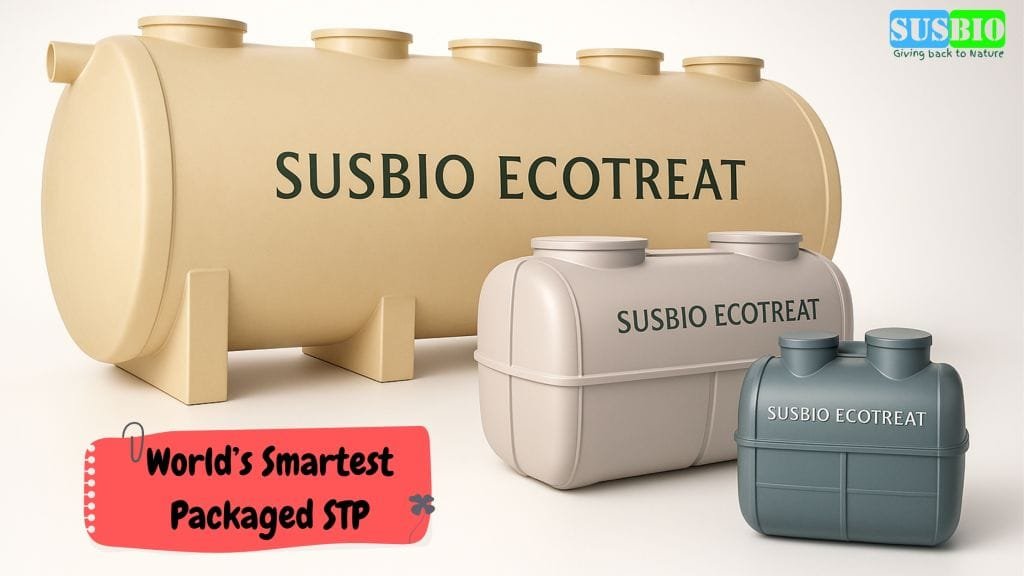
- Compact, modular, prefabricated: Like SUSBIO ECOTREAT, IONTREAT is factory-built and installed quickly, with a smaller operational footprint than a custom-built ETP.
- CPCB and SPCB compliant: Designed to meet hospital effluent discharge norms set by the Central Pollution Control Board and respective State Pollution Control Boards.
When a hospital needs an ETP rather than an STP
Not all hospital wastewater should go through the same treatment path. Domestic sewage from wards, toilets, and patient areas is handled by a Sewage Treatment Plant (STP) using SUSBIO ECOTREAT. Streams with concentrated chemical, pharmaceutical, or laboratory contamination — pathology labs, pharmacy effluent, and certain diagnostic department discharges — require ETP-grade treatment instead, since biological STP systems aren’t designed to handle that level of chemical load.
Many hospitals run both systems in parallel: an STP for domestic wastewater and an ETP for higher-contamination streams, with each routed and treated according to its actual composition.
What does hospital wastewater contain?
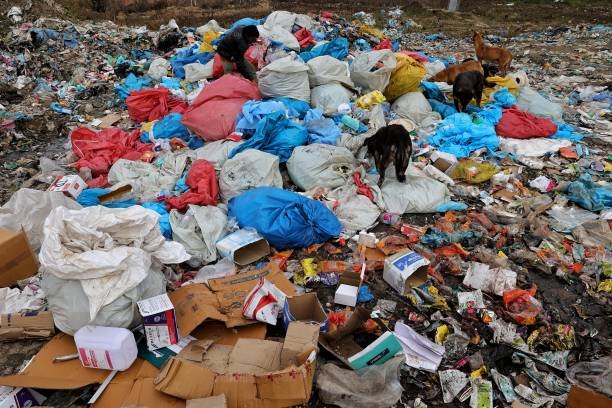
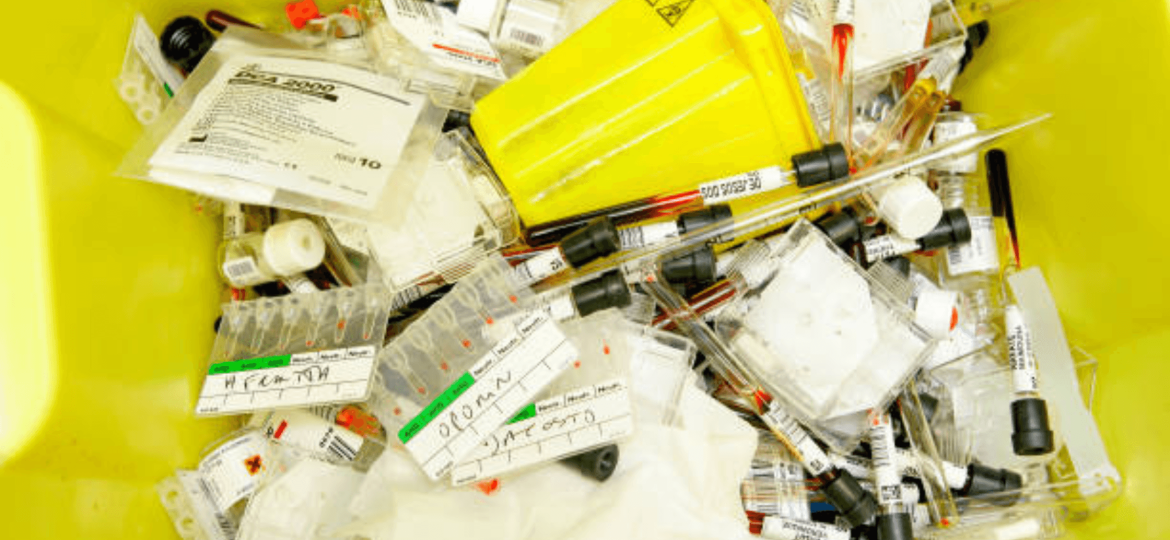
Hospital wastewater has distinct categories of effluent, each with unique composition and contamination profiles that require specialized treatment approaches.
Blackwater
Blackwater consists of fecal matter and urine discharged from toilets in hospital wards. It accounts for much of the biochemical oxygen demand in wastewater. This category contains high concentrations of organic matter and represents approximately 51% of COD, 91% of nitrogen, and 78% of phosphorus in hospital wastewater. Blackwater serves as the main source of microorganisms in wastewater. These organisms include pathogenic species and multi-drug resistant bacteria that have developed antimicrobial resistance. The fecal content harbors various pathogens such as E. coli, Salmonella, Shigella, enterovirus, and hepatitis A virus. Blackwater also contains unmetabolized pharmaceutical compounds administered to patients during treatment.
Greywater
Greywater originates from washing, bathing, laundry, and hospital processes that include disinfection, sterilization, and rinsing of X-ray films. This effluent stream contains recalcitrant substances such as surfactants, detergents, cytotoxic agents, genotoxic agents, and radioactive elements. The composition has materials from kitchens, bathrooms, and laundry facilities, with substances such as soap, toothpaste, food residues, and cleaning agents. High concentrations of anionic surfactants, aluminum, sodium, and silica characterize greywater and result from detergent usage.
Pharmaceutical residues
Patients excrete between 30% to 90% of orally administered pharmaceuticals into wastewater as active substances through feces and urine. Hospital effluent contains specialized pharmaceutical products that include cytostatic drugs, antibiotics, and X-ray contrast agents. Healthcare facilities administer these products. Europe sees 20% to 30% of inpatients receive antibiotic treatment during hospitalization. Hospital wastewater shows specific pharmaceutical concentrations that include atenolol at 919 ng/L and carbamazepine at 7008 ng/L. Iodinated contrast media used for medical imaging are excreted unmetabolized within 24 hours after consumption. Standard wastewater treatment struggles to remove them.
Pathological waste
Pathological waste covers recognizable human-derived tissues, organs, body parts, and body fluids generated during medical procedures. This category has surgical specimens, blood specimens, and materials contaminated by body fluids. Pathological materials often contain infectious agents and require incineration for proper disposal. The waste poses significant risks due to potential pathogen transmission. Strict containment protocols must handle it.
Chemical compounds
Hospital wastewater contains chemical waste that has solvents, reagents for laboratory preparations, disinfectants, sterilants, and heavy metals from medical devices. The effluent has toxic substances such as acids, alkalis, pharmaceutical residues, and X-ray contrast media. Heavy metals present in hospital discharge include cadmium, copper, nickel, mercury, and tin. Radioactive substances from diagnostic materials and radiotherapeutic procedures contribute to the chemical load.
Why do hospitals need an ETP?
Untreated hospital effluent poses serious threats to public health, environmental integrity, and regulatory compliance, which makes effluent treatment plants vital infrastructure for healthcare facilities. Hospital effluent carries intrinsic toxicity well beyond that of urban wastewater, creating substantial risk when discharged without proper treatment. Many hospitals in developing countries discharge effluent into drainage systems, rivers, and lakes without any pre-treatment, exacerbating public health and environmental hazards.
Untreated wastewater from hospitals is a major driver of antimicrobial resistance development among microbial communities. Hospital drains and septic tanks provide conditions for antimicrobial resistance to flourish, especially in low-income countries. Bacteria exposed to sub-lethal doses of antimicrobials and chemical substances can mutate, giving rise to new resistant strains. These strains distribute resistance genes to other bacteria through horizontal gene transfer, and untreated wastewater used to irrigate crops can transfer resistant bacteria to fresh produce and then to community members.
Regulatory authorities impose strict standards on hospital wastewater discharge to safeguard public health and the environment. An effluent treatment plant ensures compliance with these regulations and helps hospitals avoid potential fines and legal repercussions, since regulatory bodies require hospitals to meet stringent discharge parameters before releasing wastewater into municipal systems or natural water bodies.
Contamination of freshwater sources is another driving reason for hospital ETPs. Hospital effluent contains chemicals and pollutants that compromise the availability and quality of water for drinking and agriculture. Contaminants can mobilize and return to the food chain or drinking water, increasing exposure of organisms to hazardous substances and imparting greater environmental risk. If not handled well, these wastes can disrupt ecological balance and lead to outbreaks of communicable disease, water contamination, and radioactive pollution.
Treating hospital wastewater eliminates the spread of harmful bacteria and viruses that can affect hospital staff, patients, and surrounding communities. Proper treatment is significant for minimizing long-term effects on human health and aquatic ecosystems — particularly important given how much hospital wastewater in low- and middle-income countries is still discharged without adequate treatment.
How does a Hospital ETP work?
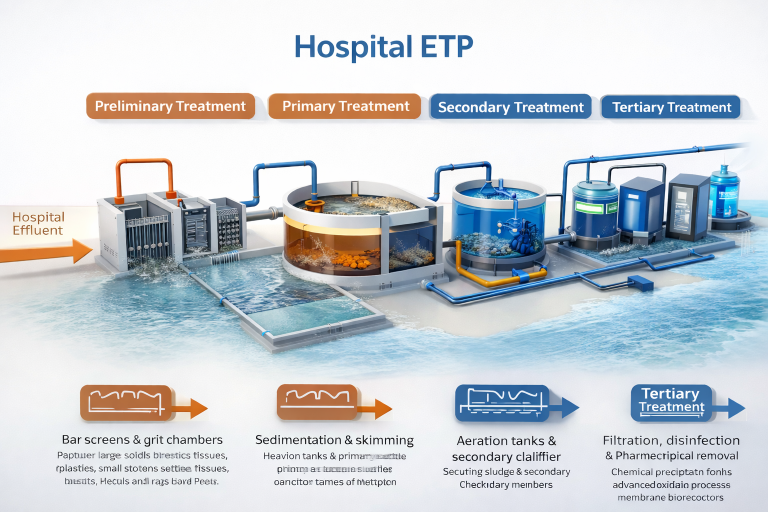
Hospital effluent treatment follows a systematic multi-stage approach that removes contaminants through physical, chemical, and biological processes, addressing the unique challenges posed by healthcare facility wastewater.
Preliminary treatment
Preliminary treatment removes large solids and debris to protect downstream equipment from damage and clogging. Bar screens filter out suspended materials such as tissues, plastics, metals, and rags from incoming wastewater. The effluent then flows into grit chambers where water velocity decreases, allowing heavier particles like sand, gravel, and small stones to settle. This stage prevents abrasion and mechanical damage to pumps, valves, pipes, and clarifiers, and flow equalization may occur here to dampen the effects of peak hydraulic or organic loading.
Primary treatment
Primary treatment uses physical separation to remove suspended solids and floating materials. Wastewater enters sedimentation tanks or primary clarifiers where flow slows; heavier solids settle as primary sludge while oils and grease float to the surface for skimming. The settled primary sludge is sent to sludge digesters for further processing. Coagulation-flocculation processes using aluminum sulfate or ferric chloride may improve particle aggregation for better removal efficiency.
Secondary treatment
Secondary treatment addresses dissolved and colloidal organic matter. Conventional systems use the activated sludge method, where wastewater enters aeration tanks and aerobic bacteria consume organic pollutants, converting them into carbon dioxide and water. The aerated mixture moves to secondary clarifiers where biological solids settle as secondary sludge, with a portion recycled back to maintain microbial populations. SUSBIO IONTREAT takes a different, electrochemical route at this stage — covered in detail above — which avoids dependency on biological cultures that hospital disinfectants and antiseptics can suppress.
Tertiary treatment
Tertiary treatment provides advanced purification to remove residual contaminants, nutrients, and pathogens. Filtration through sand filters, activated carbon, or membrane processes removes fine particles and colloidal matter. Disinfection eliminates pathogenic microorganisms through chlorination, ultraviolet radiation, or ozone treatment, while advanced oxidation processes degrade persistent organic pollutants and pharmaceutical residues. Nutrient removal targets nitrogen and phosphorus through chemical precipitation or biological methods.
Benefits of installing an ETP in hospitals
An effluent treatment plant in hospital facilities delivers advantages spanning environmental protection, public health safety, and operational efficiency. ETPs substantially reduce the environmental footprint of healthcare facilities and prevent contamination of natural water bodies and soil. The treatment process removes harmful pathogens effectively and minimizes the risk of infectious outbreaks in nearby communities, while protecting aquatic ecosystems from hazardous contaminants.
Regulatory compliance represents a critical benefit. ETPs help hospitals adhere to strict regulations imposed by pollution control boards, preventing penalties, legal action, and reputational damage that result from non-compliance. Advanced treatment processes can also enable resource recovery, including clean water for reuse.
Water recycling capabilities bring cost efficiency. Systems like SUSBIO IONTREAT, with ZLD configurations, treat wastewater to quality levels suitable for non-potable purposes such as toilet flushing and gardening — reducing freshwater dependency, promoting water conservation, and lowering reliance on external water supplies.
Hospital ETP systems demonstrate social responsibility and a commitment to eco-friendly healthcare practices, enhancing the institution’s reputation within communities. Pharmaceutical residue removal helps prevent antibiotic resistance development, addressing a serious public health threat, while groundwater protection ensures community access to safe water resources — particularly important for populations dependent on borewells and natural springs.
Key Takeaways
Hospital effluent treatment plants are critical infrastructure that protect public health and the environment while ensuring regulatory compliance for healthcare facilities.
- Hospital wastewater contains dangerous contaminants including pharmaceutical residues, pathogens, and antimicrobial-resistant bacteria that pose serious environmental and health risks.
- Untreated hospital effluent can be significantly more toxic than urban wastewater and contributes to antimicrobial resistance development in microbial communities.
- Multi-stage ETP systems remove the large majority of organic matter through preliminary, primary, secondary, and tertiary treatment processes targeting specific contaminants.
- Installing a hospital ETP ensures regulatory compliance, reduces chemical and operational overhead, and — with IONTREAT’s ZLD capability — enables water recycling that cuts freshwater dependency.
- Proper effluent treatment prevents contamination of natural water sources, protects aquatic ecosystems, and demonstrates social responsibility in healthcare operations.
The investment in hospital ETP technology represents a crucial step toward sustainable healthcare practices that safeguard both community health and environmental integrity while delivering measurable operational benefits.
Frequently Asked Questions
Q1. What makes hospital wastewater different from regular domestic wastewater?
Hospital wastewater contains a complex mixture of contaminants including pharmaceutical residues, antibiotics, disinfectants, heavy metals, radioactive substances, and drug-resistant microbes. It has significantly higher concentrations of biochemical oxygen demand (BOD), chemical oxygen demand (COD), and pathogenic organisms compared to domestic wastewater. It also includes blood, body fluids, chemical and biological waste from diagnostic tests, and specialized pharmaceutical products like cytostatic drugs and X-ray contrast agents.
Q2. How much organic matter can a hospital ETP remove from wastewater?
Hospital effluent treatment plants remove the large majority of organic matter from wastewater through multi-stage treatment processes — preliminary screening, primary sedimentation, secondary treatment, and tertiary polishing each targeting specific contaminants before discharge.
Q3. Can treated hospital wastewater be reused within the facility?
Yes, modern hospital ETPs can treat wastewater to quality levels suitable for non-potable purposes such as toilet flushing, gardening, and other facility maintenance activities. Systems like SUSBIO IONTREAT, which support Zero Liquid Discharge (ZLD) configurations, can recover and recycle water on-site, reducing a hospital’s dependency on freshwater supply.
Q4. Why is untreated hospital wastewater particularly dangerous for public health?
Untreated hospital effluent is significantly more toxic than urban wastewater and is a major driver of antimicrobial resistance development. It contains pathogenic bacteria and viruses that can spread infectious disease, and when bacteria are exposed to sub-lethal doses of antimicrobials in untreated wastewater, they can develop resistance. These resistant strains can spread to communities through contaminated water sources or crops irrigated with untreated wastewater.
Q5. What are the main stages of treatment in a hospital ETP?
A hospital ETP typically operates through four main stages: preliminary treatment removes large debris and solids using bar screens and grit chambers; primary treatment uses sedimentation tanks to separate suspended solids and floating materials; secondary treatment breaks down organic matter — conventionally through biological processes like activated sludge, or electrochemically with systems like SUSBIO IONTREAT; and tertiary treatment provides advanced purification through filtration, disinfection, and oxidation processes to remove residual contaminants, nutrients, and pathogens.