

In 2026, Sewage Treatment Plants (STPs) are no longer optional infrastructure components in India—they are mandatory compliance systems governed by strict environmental, judicial, and municipal regulations. Across residential, commercial, hospitality, industrial, and institutional sectors, the focus has shifted from installation to consistent performance, monitoring, and reuse.
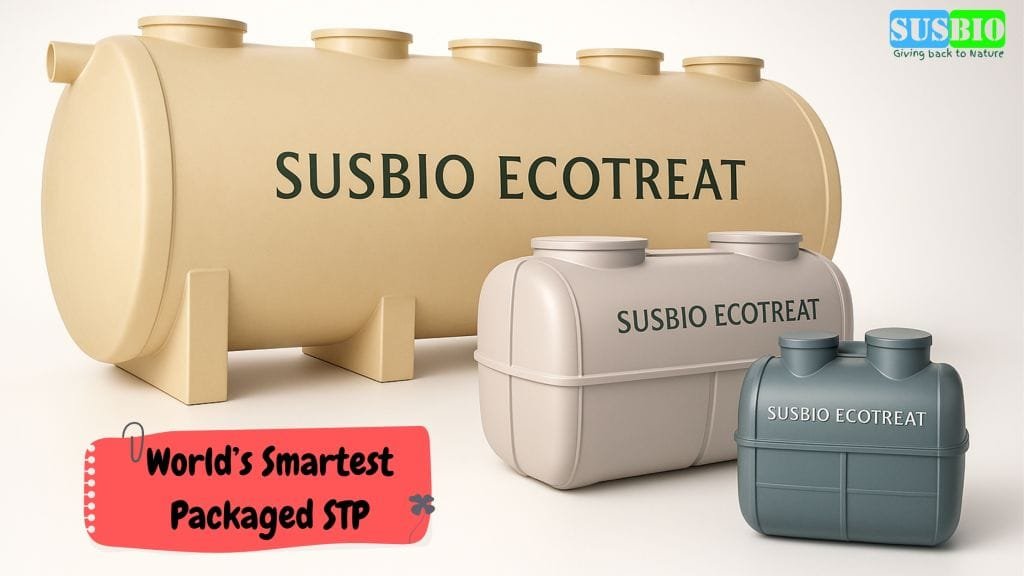
This regulatory shift has significantly increased the demand for advanced packaged sewage treatment plants, especially solutions that are CPCB-compliant, performance-guaranteed, and monitoring-ready. In this evolving regulatory landscape, SUSBIO ECOTREAT stands out as a future-ready packaged STP designed specifically to meet India’s 2026 compliance requirements.
Why 2026 Is a Defining Year for STP Compliance in India
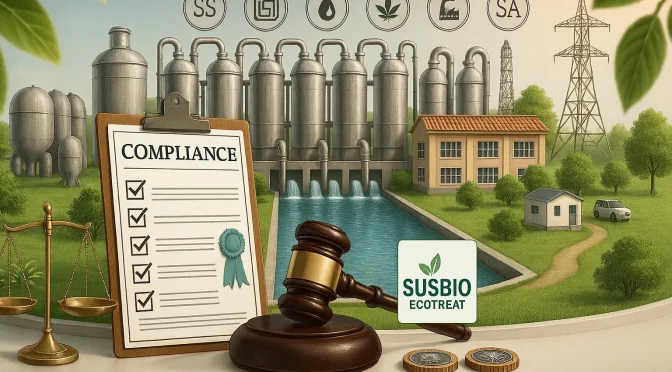
The year 2026 marks a decisive regulatory transition due to:
Increased intervention by pollution control authorities and courts
Mandatory reuse of treated wastewater
Real-time monitoring requirements
Penalties for non-performing STPs
Pressure on groundwater resources
Authorities now evaluate how efficiently an STP operates over time, not merely whether it exists on paper.
Key Regulatory Authorities Driving STP Adoption
CENTRAL POLLUTION CONTROL BOARD (CPCB)
CPCB defines national effluent discharge standards and operational guidelines for STPs. These standards form the basis for approvals, audits, and enforcement actions.
State Pollution Control Boards (SPCBs)
SPCBs enforce CPCB norms by issuing Consent to Establish (CTE) and Consent to Operate (CTO). In 2026, SPCBs are increasingly:
Rejecting poorly performing STPs
Conducting surprise inspections
Demanding operational logs and water quality data
National Green Tribunal (NGT)
NGT has emerged as the strongest enforcement authority, imposing fines, deadlines, and environmental compensation for untreated or poorly treated sewage discharge.
Ministry of Jal Shakti
The Ministry promotes wastewater reuse, groundwater conservation, and decentralised treatment through national missions and funding programs.
Key Regulatory Trends Impacting STP Selection in 2026
1. Performance-Based Compliance
Authorities now prioritise:
Consistent BOD, COD, and TSS reduction
Odour-free operation
Sludge management efficiency
Long-term operational stability
A poorly maintained STP is treated as non-compliant, even if installed.
2. Mandatory Treated Water Reuse
Most cities now require treated sewage to be reused for:
Landscaping
Toilet flushing
Cooling towers
Gardening and utility use
Discharge without reuse is discouraged and, in some cases, penalised.
3. Digital Monitoring & Data Transparency
Large and mid-sized projects are increasingly required to implement:
Flow meters
Online effluent quality monitoring
Automated reporting
Manual logs are no longer considered reliable.
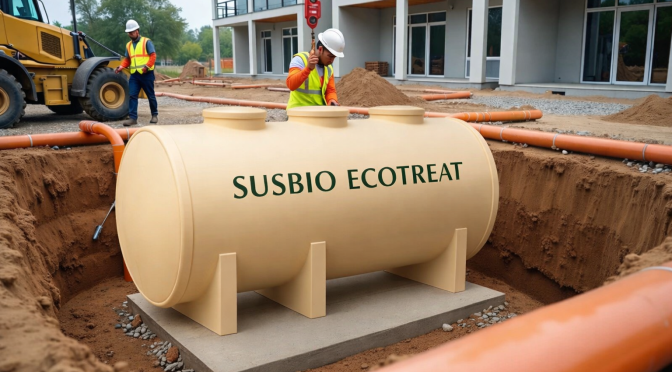
Why Packaged STPs Are Preferred by Regulators
From a regulatory standpoint, packaged STPs offer:
Factory-controlled quality
Faster approvals and installation
Compact footprint
Lower operational variability
This is precisely where SUSBIO ECOTREAT aligns with regulatory expectations.
How SUSBIO ECOTREAT Meets 2026 Regulatory Requirements
Regulatory Requirements vs SUSBIO ECOTREAT Capabilities
| Regulatory Requirement (2026) | How SUSBIO ECOTREAT Complies |
|---|---|
| CPCB discharge norms | Designed to meet and exceed CPCB standards |
| Consistent effluent quality | Dual biological treatment ensures stable performance |
| Treated water reuse | Output suitable for flushing, landscaping & utilities |
| Compact installation | Prefabricated modular design saves space |
| Fast deployment | Quick installation compared to civil STPs |
| O&M accountability | Supported by in-house service and maintenance teams |
| Monitoring readiness | Easily integrates with flow meters & sensors |
Why Regulators and Consultants Prefer SUSBIO ECOTREAT

Unlike conventional STPs that depend heavily on site execution quality, SUSBIO ECOTREAT is:
Prefabricated and quality-controlled
Designed for Indian sewage load variations
Structurally robust with long service life
Low in operational complexity
Proven across residential, commercial, and hospitality projects
This reduces enforcement risks for regulators and compliance risks for project owners.
Regulatory Risk Comparison: Traditional STP vs SUSBIO ECOTREAT
Compliance Risk Analysis
| Parameter | Traditional Civil STP | SUSBIO ECOTREAT |
|---|---|---|
| Installation time | Long & site-dependent | Fast & standardised |
| Performance stability | Highly operator-dependent | Consistent & predictable |
| Space requirement | High | Compact |
| Odour issues | Common | Minimal |
| Monitoring integration | Difficult | Easy |
| Regulatory risk | High | Low |
What Developers & Industries Gain with SUSBIO ECOTREAT
By choosing SUSBIO ECOTREAT, project owners benefit from:
Faster approvals and smoother SPCB compliance
Reduced risk of NGT notices and penalties
Lower long-term O&M costs
Assured treated water reuse
Future-ready monitoring compatibility
In a regulatory environment where non-compliance is expensive, SUSBIO ECOTREAT offers peace of mind.
Detailed Conclusion: Why SUSBIO ECOTREAT Is the Right Choice for 2026 and Beyond
India’s sewage treatment regulations in 2026 demand accountability, consistency, and performance. Authorities are no longer tolerant of non-functional or poorly operated STPs. With real-time monitoring, stricter discharge norms, and judicial oversight, compliance has become a continuous obligation.
SUSBIO ECOTREAT is not just a packaged sewage treatment plant—it is a regulation-ready wastewater treatment solution built for India’s present and future regulatory realities.
For developers, industries, hotels, and institutions, investing in SUSBIO ECOTREAT means:
Staying ahead of regulatory changes
Reducing environmental and legal risks
Ensuring long-term compliance
Contributing to sustainable water management
In 2026, the smartest compliance strategy is choosing a system that regulators trust, consultants recommend, and operators can reliably manage—SUSBIO ECOTREAT.
Frequently Asked Questions
1. Is SUSBIO ECOTREAT compliant with CPCB and SPCB norms?
Yes. SUSBIO ECOTREAT is designed to meet CPCB discharge standards and is widely accepted by State Pollution Control Boards across India.
2. Can treated water from SUSBIO ECOTREAT be reused?
Absolutely. The treated output is suitable for landscaping, flushing, and other non-potable reuse applications as mandated by regulations.
3. Is SUSBIO ECOTREAT suitable for residential and commercial projects?
Yes. It is ideal for apartments, villas, hotels, resorts, IT parks, hospitals, and industrial facilities.
4. Does SUSBIO ECOTREAT support online monitoring?
Yes. The system can be easily integrated with flow meters, sensors, and monitoring systems required by pollution control authorities.
5. Why is a packaged STP like SUSBIO ECOTREAT safer than traditional STPs?
Because packaged STPs offer predictable performance, faster installation, lower operational risk, and easier regulatory compliance.