

Even a 20% improvement in efficiency can translate into millions of dollars in annual savings for your industrial wastewater treatment operations. Energy usage emerges as the main operating expense for these plants, second only to manpower costs.
Here’s what makes this especially compelling: aeration systems alone can account for up to 60% of an ETP’s total power consumption. Switching to Variable Frequency Drives combined with live monitoring can cut aeration energy costs by 20-40%.
The chance is clear. Optimizing your industrial wastewater treatment plants delivers immediate financial returns and reduces environmental effect.
In this piece, we’ll walk you through proven strategies that assess your ETP performance, slash energy costs, optimize chemical usage and implement advanced industrial wastewater treatment systems that deliver measurable results.
Assess Your Industrial Wastewater Treatment Plant Performance
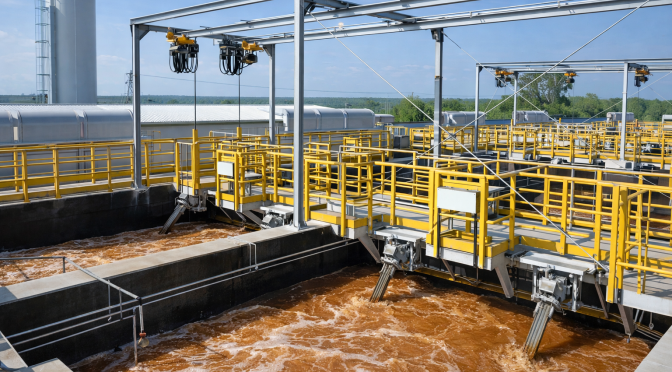
You need to understand what’s happening inside your effluent treatment plant before implementing any optimization strategy. Assessment provides the baseline data that makes targeted improvements possible.
Characterize Influent Quality and Flow Patterns
Properties of influent wastewater must be analyzed to determine your industrial wastewater treatment plant specifications. Different industries generate wastewaters containing varied pollutants including organic compounds, inorganic compounds, phosphorus, nitrogen and heavy metals.
Standard parameters like pH and conductivity only scratch the surface. Chemical Oxygen Demand (COD) fractionation gives you a full picture of organic matter degradability. This technique identifies four distinct fractions:
- Readily biodegradable COD (rbCOD): Biomass consumes this within minutes, creating rapid oxygen demand
- Slowly biodegradable COD (sbCOD): Related to particulate matter and requires extended contact time as the largest biodegradable fraction
- Soluble non-biodegradable COD (snbCOD): Passes through treatment unchanged and discharges with effluent
- Particulate non-biodegradable COD (pnbCOD): Settles with sludge, reducing outflow concentration
Respirometry measures oxygen consumption rates over time and provides precise information about microorganism activity and substrate consumption rates. To name just one example, biological systems with short retention times won’t work if slowly biodegradable fraction dominates your wastewater.
Measure Key Performance Indicators
Track removal efficiency for Biochemical Oxygen Demand (BOD), COD, Total Suspended Solids (TSS), Total Nitrogen (TN) and Total Phosphorus (TP). Plants that run well reduce BOD by 90% or more. COD reductions should hit 85% or higher. TSS in effluent should reach as low as 10 mg/L. Target total nitrogen below 10 mg/L and total phosphorus under 1 mg/L.
Conduct Energy Audits to Identify Waste
Specific Energy Consumption (SEC) measures kWh consumed per m³ of treated effluent. Conventional ETPs without RO operate at 0.4 to 0.8 kWh/m³ when running at peak performance, while average plants consume 0.8 to 1.2 kWh/m³. Plants with RO require 1 to 2.5 kWh/m³, and ZLD systems demand 5 to 10+ kWh/m³.
Aeration consumes 50 to 70% of total electricity, pumping takes 15 to 30%, and sludge handling uses 5 to 10%. Small plants demonstrate low energy efficiency in recirculation of settled sludge and aerobic stabilization, especially when you have equipment oversizing that leads to energy waste without controls and inverters.
Map Your Treatment Process Bottlenecks
Storage capability and sludge handling capacity are two common areas where industrial wastewater treatment systems experience bottlenecks. Mixing index analysis can reveal zones that underperform and confirm that geometric dead zones persist despite operational adjustments.
Cut Energy Costs in ETP Operations
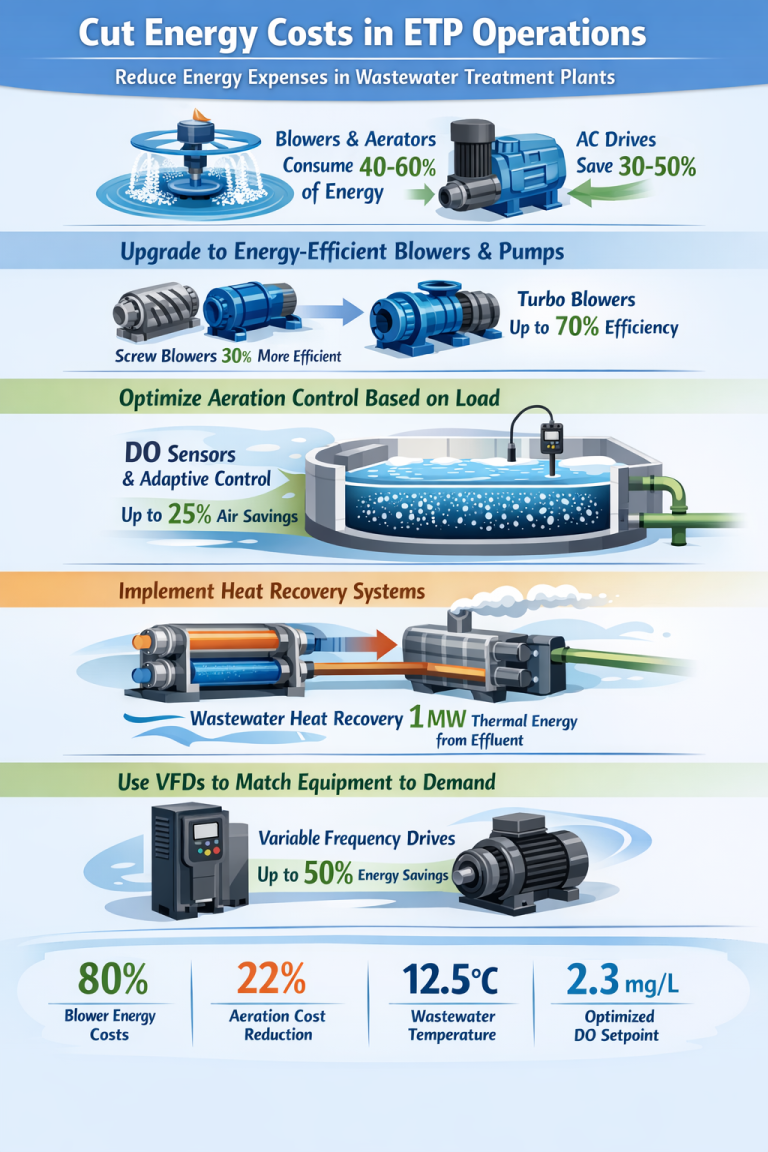
Energy represents the largest controllable expense in industrial wastewater treatment operations. Blowers and surface aerators consume 40 to 60% of total power in effluent treatment plants. AC drives that control aeration equipment deliver energy savings of 30 to 50%.
Upgrade to Energy-Efficient Blowers and Pumps
Operational costs of aeration blowers account for roughly 80% of an industrial wastewater treatment plant’s energy expenses. Screw blowers demonstrate 30% greater energy efficiency than tri-lobe blowers at pressures above 0.5 bar. Turbo blowers push efficiency levels up to 70% and surpass traditional blower technologies by a wide margin. These advanced machines incorporate variable frequency drives, magnetic bearings, optimized impeller designs and high-efficiency motors that work together to minimize energy waste.
Optimize Aeration Control Based on Load
Dissolved oxygen control systems that respond to immediate demand reduce air requirements by 24 to 25% compared to fixed airflow systems. DO setpoints decreased from 2.5 mg/L to 2.3 mg/L result in average aeration cost savings of 4%. Lower setpoints at 1.5 mg/L maximize savings up to 22% while maintaining effluent quality. DO sensor-based aeration control in aerobic tanks arranges air supply to match biological demand precisely.
Implement Heat Recovery Systems
Municipal wastewater maintains temperatures of 10 to 25°C, which supports ideal operation of wastewater heat exchangers. Heat recovery systems extract about 1 MW of thermal energy at a wastewater temperature of 12.5°C. Heat exchangers installed in treatment plant outlets use gravity flow and eliminate additional pumping energy requirements.
Use VFDs to Match Equipment to Demand
Variable frequency drives adjust motor speed based on actual process requirements rather than running at full capacity. VFDs in industrial wastewater treatment systems lead to energy savings up to 50% when compared to fixed-speed systems. AC-drive control cuts energy consumption by 20 to 40% in biological processes.
Optimize Chemical Usage and Biological Processes
Biological process stability depends on precise control of chemical inputs and maintaining healthy microbial populations in your effluent treatment plant.
Fine-Tune Chemical Dosing with Automated Controls
Automated chemical dosing systems adjust reagent delivery every minute based on immediate water quality data analysis. This precision narrows effluent phosphate fluctuation ranges and delivers stability improvements of 67% compared to semi-manual dosing. Feed forward control systems monitor phosphate levels at the inlet and calculate optimal dose rates using combined flow and concentration data. This results in chemical savings between 10 to 40% depending on the plant’s current optimization status. Automated systems eliminate the risks of overdosing that increase sludge production and corrosion potential. They also prevent underdosing that causes permit violations.
Maintain Optimal Sludge Age and MLSS Levels
Mixed Liquor Suspended Solids concentrations in activated sludge processes range from 2,000 to 5,000 mg/L. Membrane Bioreactors operate at 10,000 to 12,000 mg/L. Optimizing MLSS levels can improve effluent quality by 25% and reduce overall operational costs. Monitoring MLSS and MLVSS allows operators to adjust aeration rates and sludge wasting to maintain desired microbial populations. Sludge age, or solids retention time, serves as the steering wheel of activated sludge processes. Plants targeting BOD removal and nitrification should maintain sludge age between 8 to 15 days at moderate temperatures.
Prevent Shock Loads with Equalization Tanks
Equalization tanks protect biological treatment units from sudden flow surges and pollutant concentration spikes that can kill microorganisms. These tanks are sized between 20 to 40% of average daily flow. Equalization systems stabilize hydraulic and organic loads. This reduces chemical usage through steady pH conditions and improves sludge quality.
Implement Advanced Technologies and Management Practices
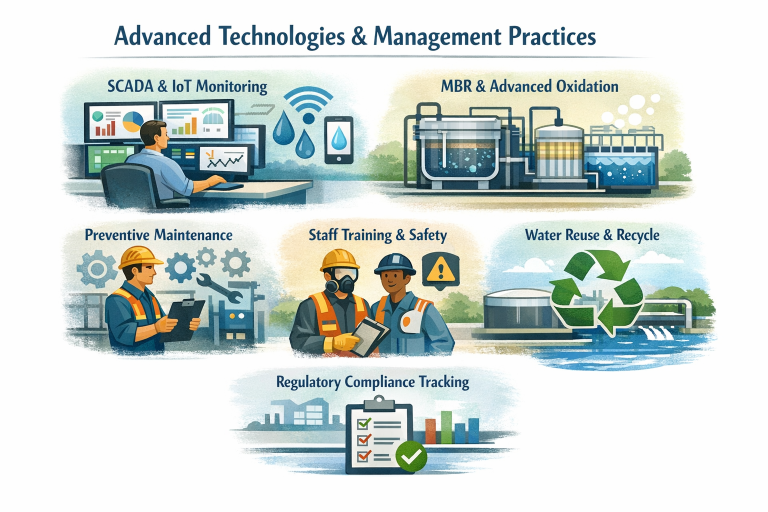
Advanced technologies transform reactive operations into predictive, analytical systems that deliver consistent compliance and cost control.
Deploy Automated Monitoring and Control Systems
SCADA systems provide centralized, live visibility of all treatment operations. Operators monitor pH, BOD, COD, turbidity and equipment status from a single dashboard and receive automated alerts for parameter deviations. IoT sensors track flow rate, turbidity and temperature, which allows remote monitoring of plants across different facilities. Machine learning algorithms analyze sensor data to adjust aeration timing, sludge recirculation rates and chemical dosing. This minimizes human error and maintains consistent treatment quality.
Think Over MBR or Advanced Oxidation Processes
Membrane bioreactors combine biological treatment with microfiltration. The effluent becomes suitable for reuse. Advanced oxidation processes using hydrogen peroxide reduce BOD by 96 to 100% within 60 minutes and cut detention time from 3.5 hours to 2 hours.
Establish Preventive Maintenance Programs
Preventive maintenance reduces emergency repairs by 40 to 60%. Equipment life extends by 25 to 40%.
Develop Staff Training and Safety Protocols
OSHA standards require training on hazards, PPE usage and confined space entry.
Implement Water Reuse Programs
Selective contaminant removal uses less energy than full treatment. It targets specific compounds for affordable reuse.
Track Compliance and Performance Metrics
Automated monitoring tracks parameters with tamper-proof data logging for regulatory audits.
Conclusion
You now have everything you need to revolutionize your industrial wastewater treatment plant from a cost center into an efficiency powerhouse. The strategies we’ve covered deliver measurable results: energy savings up to 50% and reduced chemical costs while improving compliance.
Begin with an energy audit to identify your biggest opportunities. Implement automated controls to eliminate waste. Monitor your performance metrics, and your ETP will operate leaner while meeting discharge standards with ease.
Key Takeaways
Optimizing industrial wastewater treatment plants can deliver immediate financial returns while reducing environmental impact. Here are the essential strategies to cut costs and boost ETP efficiency:
- Conduct comprehensive energy audits – Aeration systems consume 50-70% of total electricity; efficient plants operate at 0.4-0.8 kWh/m³ compared to 0.8-1.2 kWh/m³ for average facilities
- Upgrade to energy-efficient equipment – Turbo blowers achieve 70% efficiency and VFDs can reduce energy consumption by 20-50% compared to fixed-speed systems
- Implement automated chemical dosing – Real-time monitoring systems deliver 10-40% chemical savings and 67% stability improvements over manual dosing methods
- Deploy advanced monitoring technologies – SCADA systems and IoT sensors enable predictive maintenance, reducing emergency repairs by 40-60% while extending equipment life
- Optimize biological processes – Maintain MLSS levels between 2,000-5,000 mg/L and sludge age of 8-15 days to improve effluent quality by 25%
Even a 20% efficiency improvement can translate into millions in annual savings. The key is starting with baseline assessments, then systematically implementing these proven optimization strategies to transform your ETP from a cost center into an efficiency powerhouse.
Frequently Asked Questions
Q1. What are the most effective ways to reduce wastewater in industrial facilities?
Industrial facilities can significantly reduce wastewater by identifying and fixing problematic runoff issues, installing water-saving devices like meters and high-efficiency equipment, implementing water reuse and recycling programs throughout operations, and transitioning to waterless processes wherever feasible. These combined approaches can substantially decrease discharge volumes while lowering operational costs.
Q2. How can I improve the efficiency of my wastewater treatment plant?
Improving wastewater treatment efficiency involves assessing current performance metrics, inspecting and optimizing flow rates, evaluating existing infrastructure and technology, upgrading to energy-efficient equipment like turbo blowers and VFDs, implementing automated monitoring and control systems, and regularly reviewing operational data to identify improvement opportunities. These steps can reduce energy consumption by 20-50% while maintaining compliance.
Q3. What removal efficiency can I expect from different ETP treatment stages?
Primary treatment typically achieves removal efficiencies between 88% to 98% for suspended solids and settleable materials. Secondary biological treatment adds an additional 9% to 20% removal of dissolved organic matter. Well-optimized plants can achieve overall BOD reductions of 90% or more and COD reductions of 85% or higher across all treatment stages.
Q4. What equipment changes deliver the best water savings in industrial operations?
High-efficiency plumbing fixtures and equipment provide substantial water, sewer, and energy savings. Installing high-efficiency toilets or retrofitting existing ones with water-saving devices, adding faucet aerators and low-flow showerheads, and upgrading to water-efficient industrial equipment can reduce consumption significantly while maintaining operational effectiveness.
Q5. How much energy do aeration systems consume in wastewater treatment plants?
Aeration systems account for 50-70% of total electricity consumption in effluent treatment plants, with some facilities seeing aeration alone consume up to 60% of total power. Implementing dissolved oxygen control systems and variable frequency drives can reduce aeration energy costs by 20-40%, making aeration optimization one of the highest-impact efficiency improvements available.