

Industrial wastewater treatment can achieve remarkable results. Proper methods remove up to 98.4% COD and 90% TDS. Many facilities struggle to meet these standards due to strict pollution norms and complex effluent characteristics.
High COD often comes from dyes, solvents, or food waste. Elevated TDS results from bleaching agents and neutralization chemicals. Conventional biological treatment fails at extreme TDS levels, especially above 160,000 ppm.
This piece walks you through proven industrial wastewater treatment methods and advanced technologies to help your industrial wastewater treatment plant meet discharge standards and enable water reuse.
Understanding COD and TDS in Industrial Wastewater
What is Chemical Oxygen Demand (COD)
Chemical Oxygen Demand measures the amount of oxygen that reactions consume in a measured solution. This parameter quantifies both biodegradable and non-biodegradable organic matter present in wastewater. We express it in milligrams per liter (mg/L). The measurement relies on strong oxidizing agents like potassium dichromate under acidic conditions to break down organic compounds through chemical means.
COD is different from Biochemical Oxygen Demand (BOD) in a fundamental way. BOD measures only oxygen that microbial oxidation consumes, while COD captures the total oxidizable content through chemical reactions. The COD/BOD5 ratio for domestic wastewater falls between 1.5 and 2, suggesting good biodegradability. A ratio greater than 2.5 or 3 suggests the presence of complex substances that are difficult to eliminate. Raw sewage becomes susceptible to biodegradation only when the COD/BOD5 relationship stays lower than 2.2 or 2.0. Industrial facilities must think this over.
What is Total Dissolved Solids (TDS)
Total Dissolved Solids represent the combined content of all inorganic and organic substances dissolved in water. These appear in molecular, ionized, or colloidal form. The substances include inorganic salts such as calcium, magnesium, potassium, sodium, bicarbonates, chlorides and sulfates, along with trace amounts of organic matter. We measure them in parts per million (ppm) or milligrams per liter (mg/L).
The EPA recommends a maximum TDS level of 500 mg/L in drinking water as part of Secondary Maximum Contaminant Levels. Water below this threshold remains safe to drink. Groundwater may contain TDS below this permissible limit, but certain locations and industrial sources can reach concentrations of 8500 mg/L.
TDS measurement uses electrical conductivity meters because dissolved ions carry electric current. A conversion factor between 0.5 and 0.7 translates conductivity readings into TDS estimates.
Why High COD and TDS Are Problematic
High COD depletes dissolved oxygen in receiving water bodies. This harms aquatic life and destabilizes ecosystems. COD values exceeding 400 mg/L cause nitrification inhibition above 50%. Values below 200 mg/L only reduce process efficiency a bit. Wastewater from acrylonitrile production inhibits nitrification by about 51%, and styrene-butadiene rubber production causes roughly 60% inhibition.
Elevated TDS creates multiple operational challenges. High TDS increases water conductivity and accelerates corrosion on industrial appliances like boilers and cooling towers. It causes incrustation on pipe walls and process equipment. Conventional biological treatment removes organic pollutants but fails to eliminate dissolved salts. Treatment becomes more difficult and expensive as TDS increases. Facilities face this additional burden.
Excess TDS proves toxic to fish, amphibians and macro-invertebrates in aquatic environments. Salmonid embryo turgidity reduces under high TDS conditions, threatening fertilization.
Common Industrial Sources of COD and TDS
Several industries generate wastewater with high COD levels. Food processing facilities discharge effluent containing 80,000 to 100,000 mg/L COD, along with high nitrogen and phosphorus concentrations. Chemical manufacturing, pharmaceutical production and certain textile and pulp/paper mills using non-biodegradable dyes produce refractory organic compounds with very high COD/BOD ratios.
Major TDS contributors include coke oven plants, solar photovoltaic cell facilities, semiconductor manufacturers, iron and steel operations, oil and gas extraction, petroleum refining and pharmaceutical industries. These sectors discharge both fluoride and TDS at concentrations that exceed permissible limits.
Core Industrial Wastewater Treatment Process
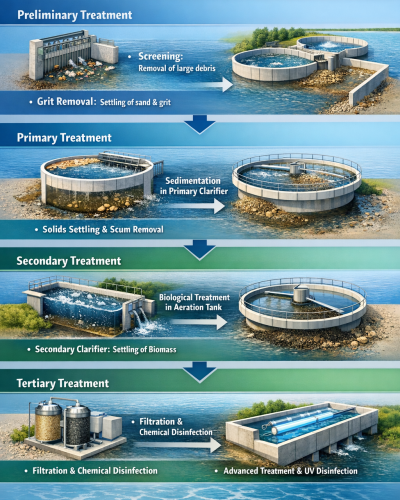
Most industrial wastewater treatment plants operate through four distinct stages. Each targets specific contaminants before water reaches safe discharge or reuse standards.
Preliminary Treatment Stage
Wastewater first passes through screens that capture large debris such as plastic, paper and food scraps. These materials could clog pipes or damage downstream equipment without this step. Bar screens use long metal bars spaced close together to block bulky objects, with spacing that ranges from 15 to 40mm.
The flow moves next to grit chambers where heavier particles like sand and gravel settle at the bottom. The chambers reduce water velocity and allow inorganic solids measuring 200-300 μm or larger to settle through gravity. This protects moving mechanical equipment from abrasion and reduces formation of heavy deposits in pipelines.
Primary Treatment Stage
Gravity separates suspended solids from the water stream at this stage. Large settling tanks, called primary clarifiers, provide detention time of one to two hours. Heavier solids sink and form primary sludge while oils and grease float to the surface to be skimmed.
Primary treatment removes about 50-60% of suspended solids. Some facilities achieve 60-65% removal at peak efficiency. The process also reduces biological oxygen demand by 25-40%. Mechanical scrapers move settled solids along the tank bottom toward collection hoppers.
Secondary Treatment Stage
Biological processes break down organic waste and nutrients once large solids are removed. Bacteria living in aeration tanks feed on organic matter under varying oxygen conditions depending on removal requirements. Aerobic systems introduce oxygen and support bacterial growth that consumes organic pollutants and forms biological flocs.
The activated sludge process represents the most common secondary treatment method. Water remains in tanks for several days under aerobic, anoxic and anaerobic conditions as bacteria remove organic matter and nutrients. Water enters secondary clarifiers after biological treatment where biological flocs settle as secondary sludge.
Food industry facilities, breweries and pulp mills use anaerobic digestion sometimes earlier in the treatment sequence to handle high-strength organic waste. Treatment often ends at this point when effluent meets defined discharge requirements without additional reuse specifications.
Tertiary Treatment Stage
Tertiary treatment provides final polishing by removing remaining bacteria and nutrients. Common methods include carbon or sand filtration to remove fine particles, chemical treatment with chlorine or other disinfectants to kill bacteria, and advanced disinfection using UV light or ozone gas to neutralize microorganisms without adding chemicals. This stage proves necessary when facilities discharge to sensitive ecosystems or plan water reuse applications.
Advanced Industrial Wastewater Treatment Technologies
Advanced industrial wastewater treatment technologies become necessary when conventional methods fail to meet discharge standards or specific pollutants resist biological degradation. These systems target complex organic compounds, dissolved salts, and recalcitrant substances that standard processes cannot eliminate.
Moving Bed Biofilm Reactor (MBBR)
MBBR systems use plastic carriers covered with biofilm that move within the reactor. This allows microorganisms to degrade organic matter without requiring sludge recirculation. The technology achieved removal efficiencies of 95-98% for BOD5 and 89-94% for COD when treating commercial laundry wastewater. A combined MBBR-MBR system treating textile wastewater reached 92% COD removal, 95% BOD removal, and 87% color removal with just 1-day hydraulic retention time. Hospital wastewater treatment using MBBR showed 97.8% BOD removal and 95.6% COD removal under optimal conditions with 70% packing rate and 24-hour HRT. The carriers provide protected surfaces for biofilm growth and reduce reactor volume requirements compared to activated sludge systems. Most carriers are made from high-density polyethylene with surface areas around 800 m²/m³.
Membrane Bioreactor (MBR)
MBR technology combines biological treatment with microfiltration or ultrafiltration membranes and eliminates the need for secondary clarifiers. The membrane’s small pore size below 0.5 µm produces high-quality effluent suitable for direct discharge to sensitive water bodies or feeding to reverse osmosis systems. MBR systems operate at higher mixed liquor suspended solids concentrations. This reduces footprint requirements while achieving superior pollutant removal. The technology allows independent control of solids retention time and hydraulic retention time. This encourages development of slower-growing nitrifying microorganisms. Membrane fouling remains the biggest operational problem and requires strategies like air scouring, backwashing, and chemical cleaning to maintain performance.
Reverse Osmosis (RO) Systems
RO membranes remove dissolved salts and ionic contaminants by forcing water through semipermeable barriers with very fine pores. The technology reduces TDS concentrations, with some applications achieving 96% TDS removal from industrial wastewater. Pretreatment protects membranes from fouling and scaling and allows higher recovery rates. The concentrated reject stream requires proper management through disposal, further treatment, or integration into zero liquid discharge systems.
Advanced Oxidation Processes
AOPs generate reactive hydroxyl radicals that break down non-biodegradable pollutants at the molecular level. The Fenton process combines hydrogen peroxide and ferrous ions. This process reduced COD by 86% in oil recovery wastewater, from 21,000 mg/L to 2,980 mg/L. Photo-Fenton processes achieved 81% COD removal efficiency. These processes eliminate pharmaceutical residues, pesticides, synthetic dyes, and volatile organic compounds that resist conventional biological treatment. Hydroxyl radicals oxidize harmful compounds into non-toxic byproducts like water and carbon dioxide without generating sludge.
Evaporation and Crystallization
Thermal evaporation and crystallization enable zero liquid discharge by recovering water and producing dry solid waste. Falling film evaporators achieve water recovery greater than 90% and produce high-purity distillate suitable for process reuse. Mechanical vapor recompression systems can save up to 80% energy compared to other evaporation methods. Crystallizers handle continuous crystallization of dissolved salts, which sometimes become valuable recoverable by-products. A pilot study showed 95% water recovery from RO reject using mechanical vapor compression evaporation, with the remaining 5% crystallized into about 85% dry solids.
Optimizing Your Industrial Wastewater Treatment Plant
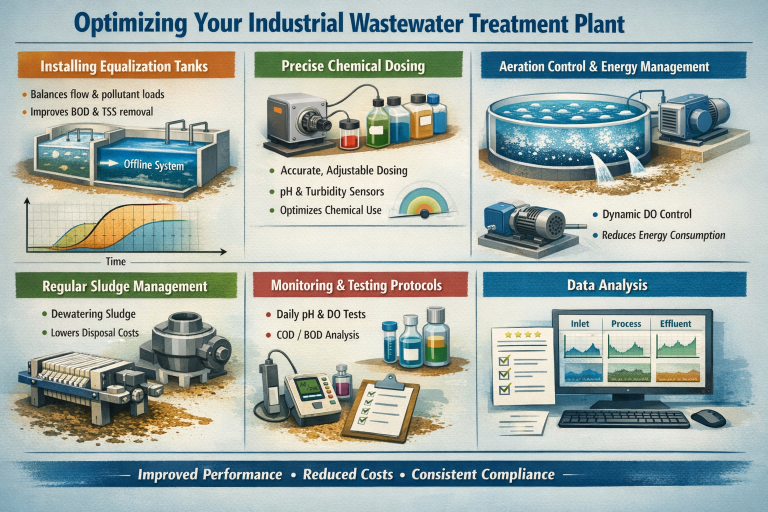
Operational efficiency separates treatment plants that consistently meet discharge limits from those facing compliance issues and excessive costs. Small adjustments to existing infrastructure often deliver substantial performance gains.
Installing Equalization Tanks
Flow and pollutant concentration variations disrupt downstream biological processes. Equalization tanks store wastewater during high-flow periods and release it at controlled rates. This prevents shock loads that kill beneficial bacteria. All influent passes through the basin in in-line configurations and provides maximum stabilization. Off-line systems divert only excess flow above predetermined thresholds and reduce pumping requirements.
Volume calculation uses mass-curve analysis. The method plots cumulative influent against time to determine storage needs. Studies show BOD removal improvements up to 30% and TSS removal gains of 10-30% when influent variability decreases. Proper mixing prevents settling and odor formation while treatment readiness is maintained.
Precise Chemical Dosing Methods
Peristaltic pumps enable incremental adjustments from 0.1ml to 2,000ml per minute and reduce chemical waste. A German treatment plant achieved 97.5% phosphorus load reduction over one year using accurate ferric chloride dosing. Jar testing determines optimal coagulant dosages by observing floc formation at different chemical concentrations. Automation through pH sensors and turbidity monitors adjusts dosing live and minimizes human error and operational costs.
Aeration Control and Energy Management
Aeration consumes approximately 60% of a plant’s total energy. Most facilities operate at fixed dissolved oxygen concentrations of 2.0 mg/L whatever the influent loading and waste substantial energy. Dynamic DO control based on live biochemical oxygen demand predictions reduces energy consumption by 23%. Variable frequency drives on blowers adjust motor speed according to oxygen demand rather than running at full capacity. DO between 1.0-3.0 mg/L supports microbial activity without excess aeration.
Regular Sludge Management
Sludge dewatering reduces volume and lowers disposal and transportation costs. The process decreases moisture content below 60% for landfill or composting applications. Filter presses and centrifuges extract water and produce concentrated solids easier to handle. Accumulated sludge reduces tank capacity and can carry over into treated effluent when removal schedules lag.
Monitoring and Testing Protocols
Daily testing should cover pH, dissolved oxygen, and temperature in aeration tanks. COD and BOD require weekly or monthly analysis depending on regulatory requirements. Instruments need regular calibration to ensure accuracy. This prevents false readings that lead to treatment adjustments based on incorrect data. Testing at inlet, during treatment, and at outlet points confirms each stage performs as designed.
Choosing the Right Industrial Wastewater Treatment Systems
Assessing Your Wastewater Characteristics
Determine your facility’s specific effluent profile before you select industrial wastewater treatment systems. Water quality is different across industries and requires tailored solutions. Test samples to identify flow volumes, pollutant types and concentration ranges. Manufacturing, food processing and pharmaceutical sectors generate highly specific wastewater that just needs customized approaches. Your technology selection should be guided by COD levels, TDS concentrations, heavy metal content and organic compound complexity.
Evaluating Treatment Technology Options
Match treatment methods to your actual contaminant load. Vendors with strong process knowledge study water characteristics before they propose solutions and reduce implementation risk. Biological processes handle organic waste well, while chemical precipitation removes metals. System longevity depends on material quality since wastewater equipment operates without interruption. Vendors should test pumps, blowers and panels under load conditions before delivery to prevent commissioning failures.
Space and Budget Considerations
Modular decentralized facilities need two acres, including equipment placement, access roads and expansion capacity. Plan for 150-foot buffer zones between treatment plants and residences. Installation costs range between 15-40% of project cost and depend on prepackaging and site civil work. Freight adds 5-10% to equipment expenses. Prepackaged systems save about three months in construction time at comparable or lower cost.
Selecting Reliable Equipment Suppliers
Experienced suppliers understand unique industrial wastewater challenges and deliver proven solutions. Review completed project portfolios and focus on facilities like yours. Verify ISO certifications and compliance with local and international discharge standards. Suppliers should provide end-to-end services that include site analysis, design, installation, commissioning, staff training and maintenance contracts. Responsive after-sales support reduces downtime and operational disruptions.
Planning for Future Compliance Requirements
Regulations tighten without pause and demand stricter discharge limits. Select suppliers that offer modular systems to accommodate capacity changes and evolving standards. Systems should integrate renewable energy options, AI-based monitoring and provisions for emerging contaminant removal. Confirm vendors prepare documentation that matches regulatory formats required during inspections and audits.
Key Takeaways
Master these essential strategies to achieve up to 98.4% COD and 90% TDS removal in your industrial wastewater treatment facility.
• Assess wastewater characteristics first – Test COD, TDS, and pollutant types before selecting treatment technologies to ensure proper system design and avoid costly mistakes.
• Optimize existing operations before upgrading – Install equalization tanks, control aeration systems, and implement precise chemical dosing to improve performance by 10-30% with minimal investment.
• Match advanced technologies to specific contaminants – Use MBBR for organic waste (95-98% BOD removal), RO systems for dissolved salts (96% TDS reduction), and AOPs for non-biodegradable compounds.
• Plan for future compliance requirements – Select modular systems that accommodate stricter discharge limits and emerging contaminant removal to avoid costly retrofits.
• Choose experienced suppliers with proven track records – Verify ISO certifications, review similar project portfolios, and ensure comprehensive support from design through maintenance.
Proper industrial wastewater treatment requires systematic implementation of proven methods. Start with operational optimization, then add advanced technologies as needed. With the right approach, your facility will consistently meet discharge standards while reducing operational costs and preparing for future regulatory changes.
Conclusion
You now have everything you need to reduce COD and TDS levels in your industrial wastewater treatment plant. We’ve covered proven treatment processes, advanced technologies and practical optimization strategies that deliver consistent results.
Start by assessing your wastewater characteristics and current system performance. Fix any operational inefficiencies like aeration control or chemical dosing before investing in new equipment. Simple adjustments deliver major improvements most of the time.
Choose equipment suppliers with expertise in your industry that they have showed through past work. Verify they provide complete support through installation and beyond.
Meeting discharge standards takes effort, but these methods work. Implement them systematically and your facility will achieve compliance while reducing operational costs.
Frequently Asked Questions
Q1. What are the most effective methods to reduce COD levels in industrial wastewater?
Controlled microbial action is one of the most effective approaches for reducing COD in wastewater. This natural method involves introducing specific bacteria or microorganisms that break down soluble organic matter and decompose organic compounds. Advanced oxidation processes can also achieve significant COD reduction, with some methods removing up to 86% of COD from high-strength industrial effluent.
Q2. How can facilities lower TDS concentrations in their wastewater?
Reverse osmosis is the most common and effective method for reducing TDS in wastewater. This process uses multiple filtration stages to remove dissolved salts and ionic contaminants, achieving up to 96% TDS removal in some applications. For complete TDS elimination, facilities can implement evaporation and crystallization systems that enable zero liquid discharge while recovering over 90% of water.
Q3. What COD levels are considered acceptable for treated wastewater discharge?
Acceptable COD levels vary by region and application. For domestic sewage influent, COD typically ranges from 600-900 mg/L. After treatment, European standards require reduction to 75-100 mg/L for discharge. Some advanced treatment systems can achieve COD levels as low as 10-15 mg/L when stringent standards apply or water reuse is planned.
Q4. How does TDS concentration affect COD removal efficiency in treatment systems?
TDS levels significantly impact biological treatment performance. Research shows that COD removal efficiency remains high (94.8% and 92.2%) at TDS concentrations of 750 and 1500 mg/L respectively. However, when TDS levels reach 3000 mg/L or higher, COD removal efficiency drops by approximately 20%, making conventional biological treatment less effective.
Q5. What industries typically generate the highest COD and TDS levels in their wastewater?
Food processing facilities produce some of the highest COD levels, ranging from 80,000 to 100,000 mg/L. Chemical manufacturing, pharmaceutical production, and textile mills using non-biodegradable dyes also generate very high COD concentrations. For TDS, major contributors include semiconductor manufacturers, petroleum refining, pharmaceutical industries, iron and steel operations, and oil and gas extraction facilities.