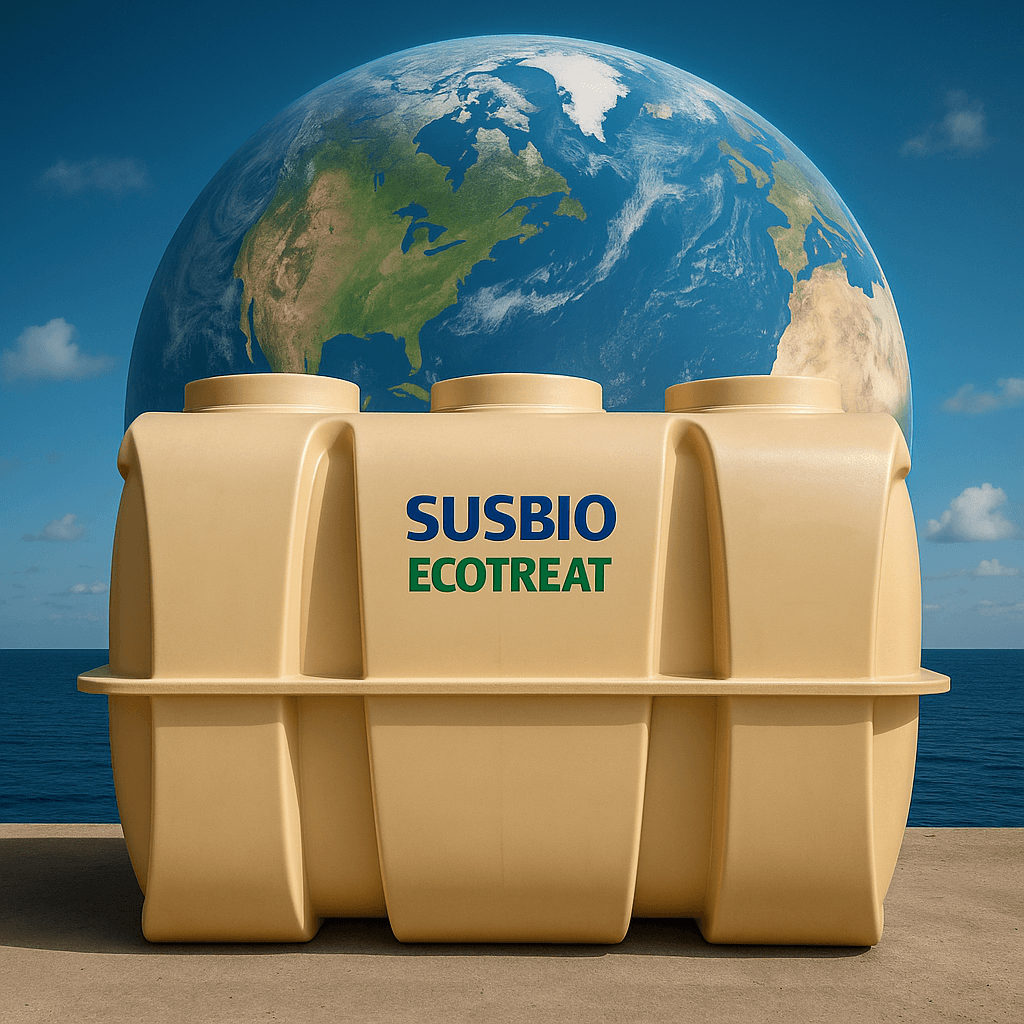


You’ve been told your project needs an STP. You’ve gotten a few quotes. One contractor is proposing a conventional civil STP — RCC tanks, brick chambers, a pump room, and a 4-month construction timeline. Another is quoting a packaged FRP system that arrives on a truck and can be running in three weeks.
The civil option looks cheaper on paper. The packaged option looks faster. Neither vendor is explaining what matters more for your specific situation — a residential complex.
This guide does that job honestly. Civil STPs are not bad technology. Packaged STPs are not always superior. The right answer depends on five things: your project’s footprint, timeline, long-term budget, operator skill availability, and treated water reuse plan. We’ll walk you through each.
What Are We Actually Comparing?

What Is a Packaged (Prefabricated) STP?
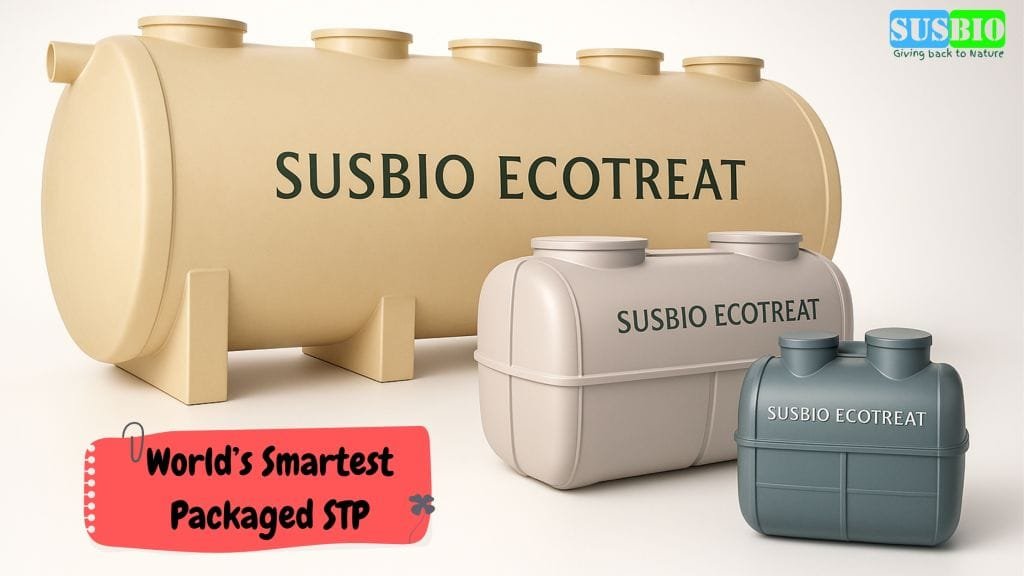
A packaged STP is a factory-built, pre-engineered sewage treatment system assembled off-site — typically in fibre-reinforced plastic (FRP), mild steel (MS), or high-density polyethylene (HDPE) — and delivered to site as a complete module or set of modules. All components (biological reactor, aeration system, clarifier, control panel) are integrated and pre-tested. On-site, it only needs to be placed, connected to inlet/outlet pipes and power, and commissioned.
- Technologies typically used: MBBR, MBR, SBR, or hybrid combinations
- Construction material: FRP (most common), MS, HDPE
- Capacity range: 1 KLD to 500 KLD (modular expansion possible)
- Installation time: 2–6 weeks from delivery to commissioning
What Is a Civil (Conventional/RCC) STP?
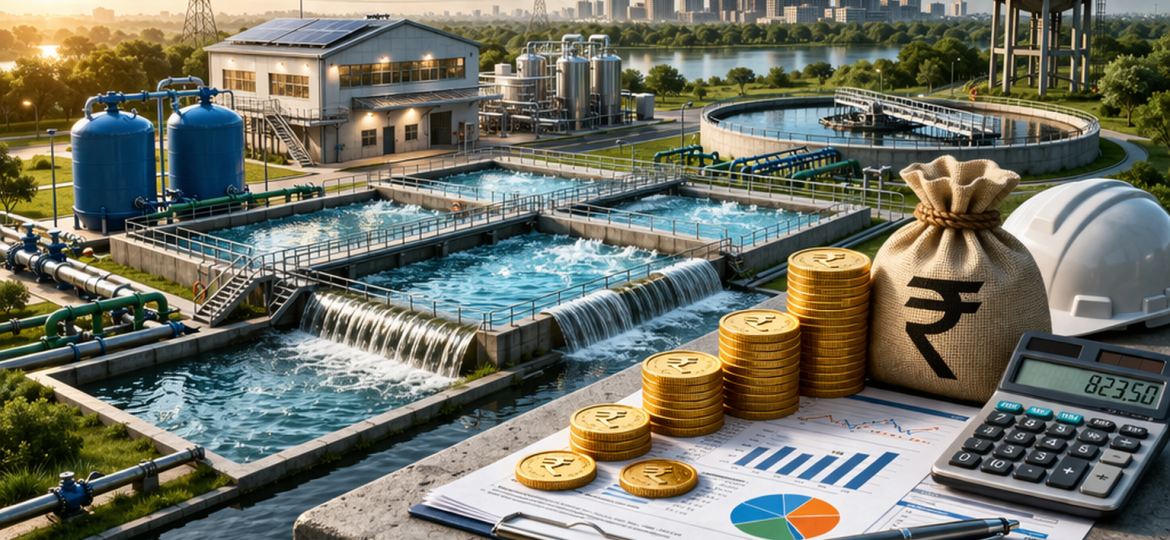
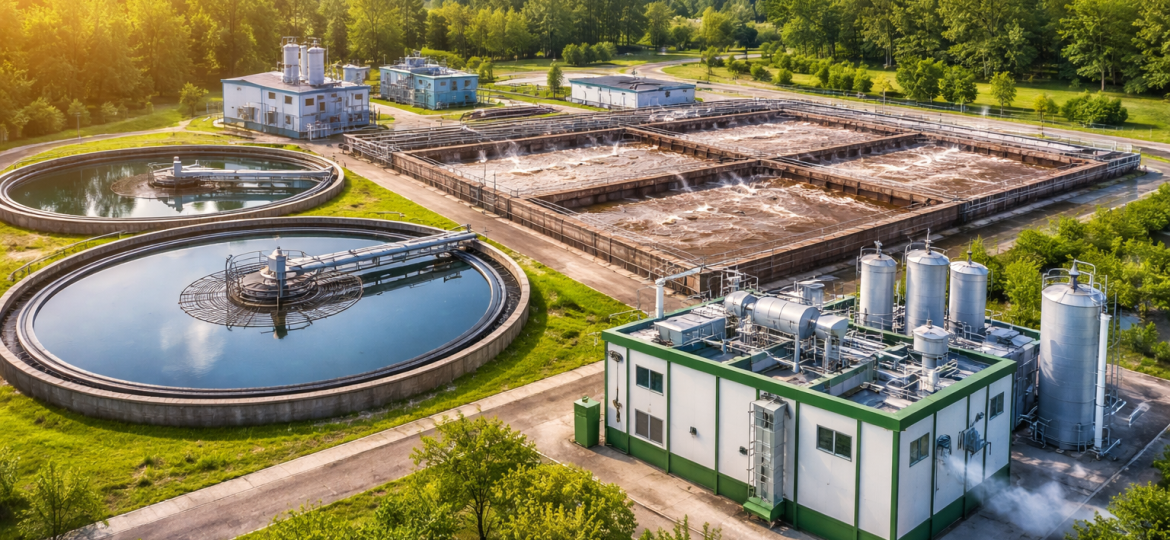
A civil STP is constructed on-site using reinforced concrete cement (RCC) tanks and brick or concrete chambers, customised to the site’s shape and requirements. Each component is built individually — equalization tank, aeration tank, secondary clarifier, sludge holding tank — and then connected with pipework and electromechanical equipment. The biological process can use ASP (activated sludge), MBBR media in RCC tanks, SBR mode, or other technologies.
- Technologies typically used: ASP, MBBR in RCC tanks, SBR in RCC tanks
- Construction material: RCC (reinforced cement concrete)
- Capacity range: Any — most cost-effective above 500 KLD
- Installation time: 3–8 months including civil construction
Head-to-Head Comparison — 10 Decision Factors
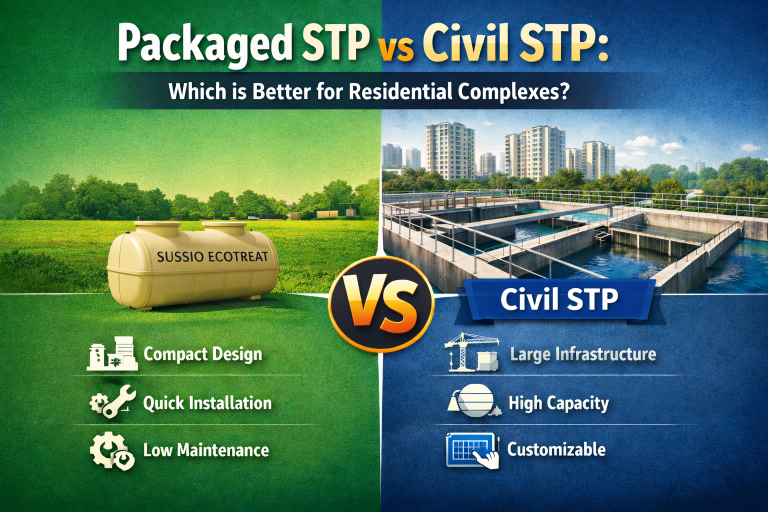
Here is a structured comparison across the factors that matter most for a residential complex buyer:
| Decision Factor | ✅ Packaged STP | ⚙️ Civil STP |
|---|---|---|
| Footprint / Space | 40–60% less space than civil STP for same capacity. Can be installed in basements, utility areas, rooftops. | Requires 450+ sq. m. per MLD. Needs dedicated open area. Impractical in urban high-rises. |
| Installation Time | 2–6 weeks from delivery to commissioning. Ideal for projects with tight Occupancy Certificate deadlines. | 3–8 months including civil construction, curing time, and testing. Causes project delays. |
| Capital Cost (Equipment) | Higher per KLD: ₹45,000–1,10,000/KLD. Includes all components pre-integrated. | Lower per KLD for large capacities: ₹15,000–40,000/KLD for equipment. But civil adds significantly. |
| Civil Cost | Minimal — only small civil plinth/base slab needed. Saves ₹5,000–15,000/KLD vs conventional civil. | High — full RCC construction. Excavation, shuttering, curing. Adds ₹8,000–20,000/KLD to total cost. |
| Total Installed Cost | Competitive at small-medium scale (<500 KLD). Higher up-front but lower TCO over 10+ years. | More economical at very large scale (>500 KLD) where civil economies of scale kick in. |
| Effluent Quality | Excellent — factory-tested and calibrated. Modern MBBR/MBR packages achieve BOD <5–10 mg/L consistently. | Good — but highly dependent on quality of civil construction and operational skill. More variable. |
| O&M Complexity | Lower. Fewer moving parts, factory-set process, automated controls. Suitable for non-specialist operators. | Higher. More components, more maintenance points, requires experienced STP operator. |
| Energy Consumption | 0.1–0.5 kWh/KL for advanced packaged systems. IoT controls optimize aeration cycles automatically. | 0.5–2 kWh/KL. Higher aeration requirements in large open tanks. Less precise control. |
| Scalability | Easy — add modules as society population grows. No demolition needed. | Difficult — expanding an RCC civil STP requires breaking concrete and fresh civil work. |
| Lifespan | 15–25 years for quality FRP-based systems. Corrosion-resistant by construction material. | 40–50 years for the civil structure. But internal equipment (pumps, blowers) still needs replacement every 10–15 years. |
| Odour & Aesthetics . | Fully enclosed system. Minimal odour if maintained. Suitable for residential settings close to occupied areas. | Open tanks or semi-open structures. More prone to odor issues in built-up areas. |
The Four Factors That Matter Most for Residential Projects
Of the 10 factors above, four are especially decisive for housing societies, gated communities, and apartment complexes. Let’s go deeper on each:
Factor 1: Space — The Urban Reality
Urban residential land in India is expensive. Very few housing projects in Tier 1 or Tier 2 cities have the luxury of dedicating 500+ sq. ft. of open ground-level space purely to an STP. High-rise apartments are even more constrained — the STP often needs to fit in a basement corner, a utility room, or on a service terrace.
A conventional civil STP for a 100 KLD capacity needs approximately 350–500 sq. m. of footprint. A packaged STP for the same capacity needs 80–150 sq. m.
That difference — 200–400 sq. m. — in a prime residential location is often worth more than the cost of the STP itself. Developers who choose packaged STPs for space reasons typically recoup the cost premium immediately in usable space.
Factor 2: Installation Timeline — The OC Problem
Here’s the situation most developers face: the project is near completion, the buyers are ready to move in, but the Occupancy Certificate is being held up because the STP isn’t functional. A civil STP started late (which happens on almost every large project) takes 3–6 months to complete.
Packaged STPs change this entirely. The unit is manufactured off-site while the building is being constructed, delivered to site, placed, and commissioned in 2–4 weeks. Developers who choose packaged STPs as a deliberate strategy to hit OC deadlines avoid months of delay, penalty clauses, and buyer dissatisfaction.
Timeline Example A 200-flat residential complex in Pune needed an 80 KLD STP. The builder chose a civil STP in Year 1. Civil construction ran 5 months late, delaying OC by 4 months. Carrying costs on delayed possession: approximately ₹15–20 lakhs in interest and compensation. A packaged STP of the same capacity could have been commissioned in 3 weeks after delivery. |
Factor 3: Operator Skill — The Maintenance Reality
Civil STPs — particularly ASP-based systems — require trained, experienced operators who understand aeration control, sludge recirculation ratios, mixed liquor suspended solids (MLSS) management, and process troubleshooting. Finding and retaining such staff for a residential society in India is genuinely difficult.
The practical reality in most housing societies is that the STP is operated by a security guard or building maintenance staff who has received a 30-minute briefing from the commissioning engineer. This works adequately for a well-automated packaged STP with clear SOPs. It works poorly for a complex civil ASP system with multiple manual adjustment points.
Packaged STPs with PLC/SCADA control and automated aeration cycling are far more tolerant of operator gaps. The system runs its own process cycles, alerts operators when parameters deviate, and logs data for AMC review. Civil ASP-based systems have more failure modes that require human intervention.
Factor 4: Total Cost of Ownership (TCO) — The 10-Year View
The civil STP’s lower equipment cost looks attractive on a purchase order. But evaluating cost over a 10-year period tells a different story for residential-scale projects:
| Cost Category (50 KLD, 10-year view) | Packaged STP | Civil ASP STP |
|---|---|---|
| Equipment CAPEX | ₹20–30 L | ₹12–18 L |
| Civil construction | ₹2–4 L (plinth only) | ₹8–14 L |
| Total installation | ₹22–34 L | ₹20–32 L |
| Energy cost (10 years) | ₹8–14 L | ₹18–30 L |
| O&M / AMC (10 years) | ₹6–10 L | ₹12–20 L |
| Operator salary (10 years) | ₹0–4 L (semi-automated) | ₹15–25 L (skilled operator needed) |
| Major component replacement | ₹3–6 L | ₹4–8 L |
| Total 10-year TCO | ₹39–68 L | ₹69–1.15 Cr |
The picture that emerges: packaged STPs cost 20–30% more upfront on equipment, but over 10 years their lower energy consumption, lower staffing requirement, and reduced maintenance complexity typically result in 30–50% lower total cost of ownership for residential-scale applications.
When a Civil STP Is the Right Choice
This guide would be dishonest if it didn’t acknowledge where conventional civil STPs genuinely win. There are real scenarios where they are the better option:
Large Municipal or Township Scale (>500 KLD)
At very large capacities — municipal-scale STPs, large township projects, industrial estates — the economy of scale in RCC civil construction becomes very significant. A 2 MLD civil STP may cost ₹25–35 lakh per MLD in civil construction, but the volume processed makes the per-KLD cost very competitive. Packaged systems at this scale become expensive and logistically complex to deploy.
When Land Is Not a Constraint
If a housing project has a large dedicated plot for utilities — typical in township developments or large SEZs — the civil STP’s space requirements become irrelevant. In such cases, the lower equipment cost of civil systems can be a genuine advantage.
When Extreme Custom Inlet Conditions Exist
Civil STPs can be designed and built to handle unusual inlet conditions — very high BOD loads, mixed industrial-residential sewage streams, or specific nutrient removal requirements. Packaged systems, while available in many configurations, are pre-engineered and less adaptable to highly unusual wastewater characteristics.
Retrofit or Expansion of Existing Civil Infrastructure
If an existing civil STP is already in place and needs capacity expansion, adding to the civil structure is often more practical and cost-effective than installing a new packaged system alongside it.
Important Note Choosing a civil STP to save money on a residential project under 200 KLD almost always backfires. The civil cost savings are small. The hidden costs — delayed OC, operator dependency, higher energy, poorer compliance reliability — are large. We see this regularly when societies come to us to replace non-performing civil STPs. |
The Decision Matrix — Which Is Right for Your Project?
Use this matrix to quickly identify the right choice for your specific situation:
| Your Situation | Packaged STP | Civil STP | Recommendation |
|---|---|---|---|
| Residential apartments / housing society, 5–500 KLD | ✅ Ideal | ⚠️ Possible | Packaged STP |
| Tight urban plot, limited space | ✅ Ideal | ❌ Not suitable | Packaged STP only |
| OC deadline pressure — need STP fast | ✅ 2–6 weeks | ❌ 3–8 months | Packaged STP only |
| Basement / rooftop installation | ✅ Possible | ❌ Not possible | Packaged STP only |
| No skilled STP operator available | ✅ Automated | ⚠️ Risky | Packaged STP |
| Large township / SEZ, 500 KLD+ | ⚠️ Possible | ✅ Better value | Civil STP or hybrid |
| Municipal project, 1 MLD+ | ❌ Not ideal | ✅ Ideal | Civil STP |
| Retrofit — existing civil STP to upgrade | ✅ Add packaged module | ✅ Expand civil | Case by case |
| Premium project — high effluent quality needed | ✅ MBBR+MBR packaged | ⚠️ MBR possible | Packaged MBR system |
What Makes SUSBIO ECOTREAT Different from Other Packaged STPs
Not all packaged STPs are equal. The Indian market has a wide range of packaged STP suppliers — from imported systems to locally fabricated units with inconsistent quality. Here’s what to look for, and how SUSBIO ECOTREAT addresses each criteria:
| Quality Criteria | What to Look For | SUSBIO ECOTREAT |
|---|---|---|
| Construction Material | High-grade FRP with anti-corrosion layers; no mild steel (rusts) | Food-grade FRP with UV-stabilized outer layer; designed for 20+ year lifespan |
| Biological Process | Proven technology — MBBR, MBR, or hybrid; not outdated FAB | Patented dual-stage MBBR+MBR hybrid; consistently achieves BOD <10 mg/L |
| Factory Testing | Pre-tested with water before dispatch; test certificate provided | Every unit tested with water at the Pune factory before dispatch |
| Automation | PLC/SCADA controls; auto-alarm on parameter deviation | IoT-enabled; real-time remote monitoring dashboard for operator and owner |
| Energy Use | Below 0.5 kWh/KL at rated capacity | 0.1–0.2 kWh/KL — up to 90% less than conventional systems |
| After-Sales | Local service team; spare parts within 48 hours; AMC availability | Pan-India service network; AMC programs; 24/7 helpline |
| CPCB Compliance | Effluent quality documentation and SPCB application support | Full documentation support for CTO applications across all states |
SUSBIO ECOTREAT is available from 2 KLD to 500 KLD, making it suitable for everything from a luxury villa to a large gated community or hotel complex. Each unit is customised to the project’s specific KLD requirement, available footprint, and effluent reuse objectives.
Frequently Asked Questions
Q1. Is a packaged STP as durable as a civil STP?
Yes — for the structural components. High-quality FRP packaged STPs are rated for 20–25 years of service life. FRP is inherently corrosion-resistant, which is a significant advantage over RCC civil tanks that develop cracks, seepage, and rebar corrosion over time in aggressive sewage environments. The electromechanical components (pumps, blowers) in both systems have similar replacement cycles of 8–12 years.
Q2. Can a packaged STP be installed underground?
Yes. Most FRP-based packaged STPs can be partially or fully buried, depending on structural specifications. Underground installation is popular in premium residential projects where the STP needs to be completely out of sight. The vendor should confirm the tank’s burial rating (typically 1–2 metres of cover is standard) and provide appropriate structural support details.
Q3. What if our packaged STP needs to be expanded as more residents move in?
Packaged STPs are inherently modular. Capacity expansion is done by adding a parallel module or a supplementary unit — no demolition of the existing system required. This is one of the biggest practical advantages over civil STPs, where capacity expansion requires breaking concrete, extending tanks, and additional civil construction.
Q4. We already have a civil STP that’s not performing well. Can we upgrade to a packaged system?
In most cases, yes. A common approach is to install a packaged MBBR or MBR system alongside the existing civil infrastructure — using the existing equalization tank and primary clarifier as pre-treatment, and routing flow through the new packaged biological stage and tertiary treatment. This hybrid upgrade approach is often faster and cheaper than building a completely new civil system. SUSBIO has done several such retrofits across India.
Q5. Does a packaged STP produce less sludge than a civil STP?
This depends more on the biological technology than the package vs civil distinction. MBR-based systems generally produce less excess sludge than ASP-based systems, regardless of construction type. MBBR-based systems are in the middle. If sludge minimisation is important for your project, discuss technology options with your STP vendor — it’s a separate decision from packaged vs civil.
Q6. What is the odour situation with a packaged STP near residential buildings?
A properly designed, well-maintained packaged STP produces negligible odour because all biological processes happen inside enclosed FRP vessels with controlled ventilation. Civil ASP-based STPs with open aeration tanks are more prone to odour — particularly when organic loading is high or the system is under-performing. For installations close to residential buildings (within 30–50 metres), packaged enclosed systems are strongly preferred.
Q7. Our society has a budget constraint. The civil STP quote is 20% lower. Should we still go packaged?
The 20% lower equipment quote needs to be evaluated against: (a) civil construction cost, which will be higher for the civil system; (b) energy savings over 5–10 years; (c) reduced operator costs; and (d) compliance reliability. When you run the numbers over a 5-year horizon, the packaged system is typically comparable or cheaper in total cost. Additionally, the OC timeline risk from a civil STP delay can cost more than the equipment cost saving. We recommend asking for a total cost of ownership comparison, not just an equipment price comparison.
Conclusion
For residential complexes in India in the 5 KLD to 500 KLD range — which covers the vast majority of housing societies, gated communities, apartment blocks, and smaller township projects — packaged STPs are the better choice in 2026. Not because civil STPs are bad engineering. But because they are optimised for a different scale and context.
The residential buyer’s reality is: limited space, tight OC timelines, unavailability of skilled STP operators, and growing regulatory scrutiny. Packaged STPs address all four of these challenges directly. They cost more per KLD on equipment — but they save money, time, and compliance risk everywhere else.
Civil STPs remain the right choice for projects above 500 KLD, townships with ample land, and municipal-scale applications where construction economics work in their favour. For everything below that threshold, a quality packaged STP from a reputable manufacturer is the smarter investment.
Need help choosing the right STP for your project?
SUSBIO offers free site consultations and project-specific recommendations. ECOTREAT packaged STPs are available from 2 KLD to 500 KLD with full design, installation, and AMC support. Visit susbio.in or call us.