

Bhutan treats wastewater differently from most of its neighbours — and for good reason. The country’s Gross National Happiness philosophy places environmental conservation at the centre of national policy. The National Environment Commission (NEC) enforces discharge standards under the Water Act of Bhutan and the NEC Act, and the Wang Chuu River that flows through Thimphu is closely monitored for pollution. Getting an STP wrong in Bhutan is not just a compliance problem. It is a reputational one.
Only 20% of Bhutan’s urban population currently has access to sewage treatment facilities. The rest rely on septic tanks that discharge into the environment with minimal treatment. Thimphu’s Babesa treatment plant is being expanded from 1.75 MLD to 14 MLD — but that centralized capacity will not cover the hotels in Paro valley, the resorts in Punakha, the institutional campuses in Trongsa, or the new commercial developments across Bhutan’s growing towns.
This is where decentralized packaged STPs become the practical answer. A prefabricated system can be installed and operational in 3–5 days, without connecting to a centralized sewer network, in locations where civil construction is constrained by terrain, by permit timelines, or by the cost of bringing RCC construction teams to remote sites.
SUSBIO has been manufacturing and commissioning packaged sewage treatment plants since 2013 with 500+ active installations across 24 Indian states. We supply to Bhutan through our manufacturing facility at Vasuli MIDC, Chakan, Pune.
Why Bhutan's STP Requirements Are Different
Bhutan’s environmental standards are driven by a combination of factors that most generic STP vendors don’t design for:
Wang Chuu River Protection
The Wang Chuu (Wangchu) river system is Bhutan’s primary water resource and is protected under national environmental law. Discharge into or near this system requires treated effluent meeting strict BOD, COD, TSS, and coliform standards. An STP that achieves compliance in India’s industrial zones needs to be verified against Bhutan’s specific discharge norms before specification.
Terrain and Logistics
Bhutan’s topography makes conventional civil construction expensive and slow. A packaged prefabricated FRP system that arrives factory-tested and installs in under a week is not a convenience — it is often the only practical option for hillside hotels, remote resorts, and off-grid institutional campuses.
Cold Climate Performance
At higher elevations, temperatures drop significantly in winter. Biological treatment systems that rely on suspended biomass — like conventional activated sludge — are sensitive to temperature drops that slow microbial activity. MBBR biofilm carriers maintain biological activity at lower temperatures better than suspended biomass systems, making Anaerobic + MBBR technology better suited to Bhutan’s climate range than conventional alternatives.
Tourism-Driven Load Variation
Bhutan controls tourist arrivals through its Sustainable Development Fee. This means hotel and resort STPs experience highly variable loading — high season occupancy versus low season. An STP sized for peak load and running at 30% load in the off-season needs to handle that variation without treatment quality deteriorating. MBBR handles variable loads better than SBR or conventional activated sludge because the biofilm is attached to media rather than suspended — it doesn’t wash out during low-load periods.
SUSBIO ECOTREAT — What It Is and Why It Works in Bhutan
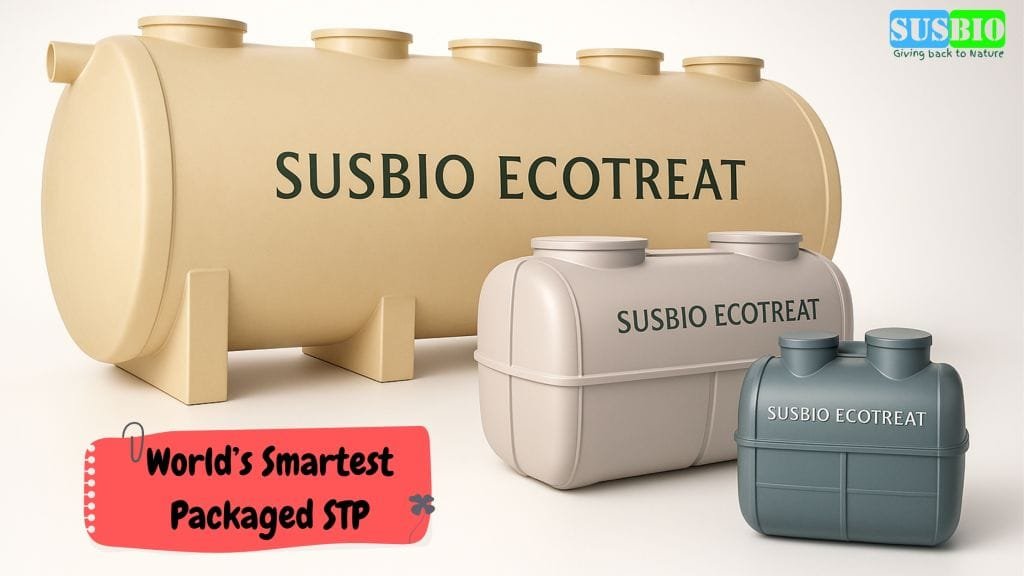
SUSBIO ECOTREAT is a prefabricated FRP (Fibre Reinforced Plastic) sewage treatment plant using Anaerobic + MBBR dual-stage biological treatment. It is manufactured at our Pune facility, tested before despatch, and shipped as a complete unit ready for installation.
How It Works
Sewage enters an anaerobic chamber where the bulk organic load (BOD/COD) is broken down by anaerobic bacteria without oxygen input. The effluent then passes into the MBBR aerobic chamber where biofilm growing on plastic carrier media removes residual BOD, COD, and suspended solids. The treated effluent passes through a clarifier and UV disinfection before discharge or reuse.
What This Achieves
Outlet BOD < 10 mg/L, COD < 50 mg/L, TSS < 10 mg/L — meeting both Indian CPCB Class A standards and Bhutan’s NEC discharge requirements for surface water.
Key Specifications
| Parameter | SUSBIO ECOTREAT |
|---|---|
| Capacity range | 1 KLD – 500 KLD |
| Construction material | Food-grade FRP |
| Installation time | 3–5 days |
| Energy consumption | 70% less than conventional STPs |
| Operator requirement | Fully automatic — no dedicated operator |
| Design life | 25+ years |
| Outlet BOD | < 10 mg/L |
| Outlet COD | < 50 mg/L |
| Outlet TSS | < 10 mg/L |
| Odour | Zero odour — fully enclosed |
How SUSBIO Compares to Other STP Suppliers in Bhutan
Several Indian manufacturers supply STPs into the Bhutan market. Here is an honest comparison of what differentiates SUSBIO from the most commonly encountered alternatives:
| SUSBIO ECOTREAT | Generic Suppliers | Conventional RCC STP | SBR Technology | |
|---|---|---|---|---|
| Technology | Anaerobic + MBBR | Varies | Activated sludge | SBR batch cycles |
| Installation time | 3–5 days | 2–4 weeks | 6–12 weeks | 3–6 weeks |
| Cold climate suitability | ✓ Excellent | Unknown | Poor | Moderate |
| Variable load handling | ✓ Excellent | Unknown | Poor | Poor |
| Own manufacturing | ✓ Yes — Pune | No | Civil contractors | Varies |
| Operator required | None — automatic | Operator Needed | Full-time operator | Part-time operator |
| Energy consumption | 70% less than conventional | Standard | High | Moderate |
| Remote site suitability | ✓ Excellent | Unknown | Poor | Poor |
SUSBIO ECOTREAT vs Generic Indian Packaged STP Suppliers
A significant number of suppliers listing themselves as ‘STP manufacturers in Bhutan’ are trading companies assembling STPs from bought-in components. They do not manufacture the vessel, do not control the biological media specification, and do not have in-house process engineers. SUSBIO has co-founders with engineering backgrounds — Akshat Tyagi (technical and business direction) and Raghavendra Suryavanshi (process engineering and manufacturing, BITS Pilani) — and a manufacturing facility that produces the FRP vessel, installs the media, assembles the mechanical package, and tests the complete unit before despatch.
SUSBIO ECOTREAT vs Conventional RCC STPs
A civil RCC STP for a 50-person hotel in Bhutan requires 6–12 weeks of construction, local civil contractors familiar with STP design, and ongoing operator attention. A SUSBIO ECOTREAT 10 KLD unit ships from Pune, arrives in Thimphu, installs in 3–5 days, and runs automatically. For a Bhutan project where construction windows are limited by monsoon season, terrain, or permit timelines, this difference is often decisive.
SUSBIO ECOTREAT vs SBR Technology
SBR (Sequencing Batch Reactor) operates in timed batch cycles — fill, aerate, settle, decant. It works well for consistent daily flow patterns. Bhutan’s hotels and resorts generate highly variable daily loads. An SBR sized for 100 guests running at 30 guests in the off-season will have cycle timing mismatches that reduce treatment efficiency. MBBR’s biofilm is load-tolerant — it does not need recalibration when occupancy changes.
Who Needs an STP in Bhutan
Hotels and Resorts
All hotels and resorts in Bhutan generating more than 10 KLD of sewage require STP installation as a condition of operating license. Peak season loading can be 3–4x off-season loading — MBBR handles this variation without performance deterioration.
Institutional Campuses
Schools, colleges, hospitals, and government facilities with 50+ occupants generating more than 5 KLD. Packaged STPs are the fastest path to compliance without major civil works.
Commercial Developments
Thimphu’s commercial growth is generating new office complexes, shopping areas, and mixed-use developments. Buildings above a certain built-up area require STP under Thimphu Thromde regulations.
Remote Tourism Infrastructure
Guesthouses and eco-lodges in Paro, Punakha, Gangtey, and Bumthang that cannot connect to centralized sewerage. Compact 1–5 KLD packaged units are the only viable solution.
What the Installation Process Looks Like
- Step 1 — Site assessment and sizing: SUSBIO’s engineers calculate the required STP capacity based on occupancy, water consumption data, and peak flow factors. We specify the correct KLD capacity and technology for your site conditions.
- Step 2 — Design and manufacturing: The FRP vessel is manufactured at our Pune facility. MBBR media, aeration equipment, pumps, blowers, UV system, and control panel are installed and tested in factory conditions before despatch.
- Step 3 — Logistics to Bhutan: The complete packaged unit is shipped from Pune to Phuentsholing and transported to site. Our team coordinates with local logistics partners for last-mile delivery including to remote or elevated sites.
- Step 4 — Installation and commissioning: On-site installation takes 3–5 days. Civil work is limited to a simple RCC base slab. Electrical connection, inlet and outlet piping, and commissioning are completed by SUSBIO’s team.
- Step 5 — Operator training and handover: The plant is handed over with complete documentation, operation manual, and trained site staff. The system runs automatically — no dedicated STP operator is required.
- Step 6 — Ongoing service support: Annual maintenance contracts available. Remote monitoring via IoT sensors optional. SUSBIO service team accessible from our India offices.
SUSBIO ECOTREAT, Built for Bhutan's Terrain and Standards
The SUSBIO ECOTREAT uses Anaerobic + MBBR (Moving Bed Biofilm Reactor) technology, consuming 70% less electricity than conventional sewage treatment plants — a meaningful saving in a country where many installations sit far from Thimphu’s most stable power supply. The plant is prefabricated from corrosion-resistant FRP, arrives in modular sections, and is fully installed in 3–5 days — a real advantage when Bhutan’s mountain roads and limited heavy-machinery access make long on-site construction projects expensive and slow.
ECOTREAT covers 1–500 KLD, sized for everything from a boutique hotel in Paro to a hospital or residential development in Thimphu. The same Anaerobic + MBBR engineering and Class A-grade effluent design standards SUSBIO builds to under India’s CPCB framework translate directly to the discharge parameters set by Bhutan’s own national effluent standards, with the plant configurable to whichever BOD, COD, TSS and pathogen limits the specific site falls under. Across 500+ installations in 24 Indian states and exports to 8 countries, the underlying engineering doesn’t change with geography — only the compliance paperwork does.
SUSBIO vs. the Other Options Available in Bhutan
| Option | What It Actually Offers | The Catch |
|---|---|---|
| Centralized municipal sewer | Functioning treatment where it exists, no capital cost to the property owner | Available in only 8 of 35 classified towns nationally; even Thimphu’s Babesa plant covers a fraction of the city |
| Septic tank + soak pit (status quo) | Low upfront cost, no electricity required | No real treatment to NEC discharge standards; many of these systems in Bhutan lack a functioning soak pit at all, polluting groundwater directly |
| Imported modular WWTP systems | Already proven and adopted in roughly six Bhutanese towns | Long supply chains from overseas manufacturers mean slower spares, slower service callouts, and higher landed cost |
| SUSBIO ECOTREAT | Anaerobic + MBBR packaged plant, 3–5 day install, 70% less electricity, 500+ installation track record | Requires periodic monitoring like any packaged STP — minimal compared to running a centralized system |
Frequently Asked Questions
Does Bhutan legally require treated sewage discharge before release into rivers?
Yes. The Water Act of 2011 prohibits discharging untreated wastewater into water bodies, and the National Environment Commission (NEC) monitors compliance — this applies to property owners directly, not just municipalities.
What percentage of Bhutan’s population has access to sewerage treatment?
Only around 20% of Bhutan’s urban population has access to any sewerage system; the rest rely on individual septic tanks, many without a functioning soak pit.
Can a packaged STP be installed in Bhutan’s remote or mountainous locations?
Yes. SUSBIO ECOTREAT is fully prefabricated and modular, designed specifically for sites where heavy on-site construction is difficult — installation takes 3–5 days regardless of terrain.
How long does it take to install an STP in Bhutan?
Most ECOTREAT installations are completed in 3–5 days once the unit arrives on site, since the plant is prefabricated and requires minimal civil work.
What size range does SUSBIO ECOTREAT cover?
ECOTREAT is available from 1 KLD to 500 KLD, suitable for everything from a small guesthouse to a hospital or large residential complex.
How much electricity does ECOTREAT save compared to conventional systems?
ECOTREAT uses 70% less electricity than conventional sewage treatment plants, a significant saving given Bhutan’s variable power access outside Thimphu.
Is SUSBIO ECOTREAT suitable for hotels and resorts in Bhutan?
Yes. It’s specifically sized and engineered for hospitality properties, where consistent effluent quality protects both regulatory standing and the surrounding tourism environment.
Conclusion
Bhutan’s environmental standards are among the strictest in South Asia — and that is a feature, not a problem. The NEC’s enforcement of discharge limits, the protection of the Wang Chuu river system, and the GNH-driven commitment to environmental preservation create a market where the right STP matters more than the cheapest one.
We have been building packaged STPs since 2013. The plants that create compliance problems are almost never the wrong technology — they are plants that were undersized for peak loads, installed without proper commissioning, or handed over to facility teams with no training and no service support.
For Bhutan’s hotels, resorts, institutions, and commercial developments, SUSBIO ECOTREAT offers factory-manufactured quality, NECS-compatible outlet standards, 3–5 day installation, fully automatic operation, and service support from a manufacturer that has 500+ active installations in operation.
Reach us at info@susbio.in or +91 88889 80197 for a site-specific capacity calculation and delivered cost estimate for your Bhutan project.
Contact SUSBIO
Email: info@susbio.in
Phone: +91 88889 80197
Website: susbio.in/sewage-treatment-plant-manufacturer-in-bhutan/
Manufacturing: Vasuli MIDC, Chakan, Pune | HQ: Zuarinagar, Goa