


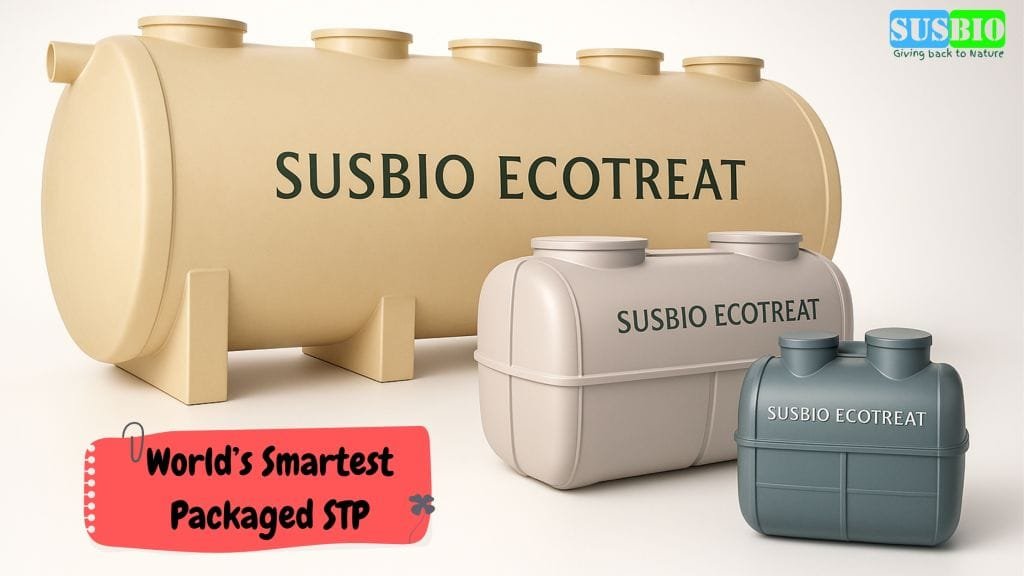
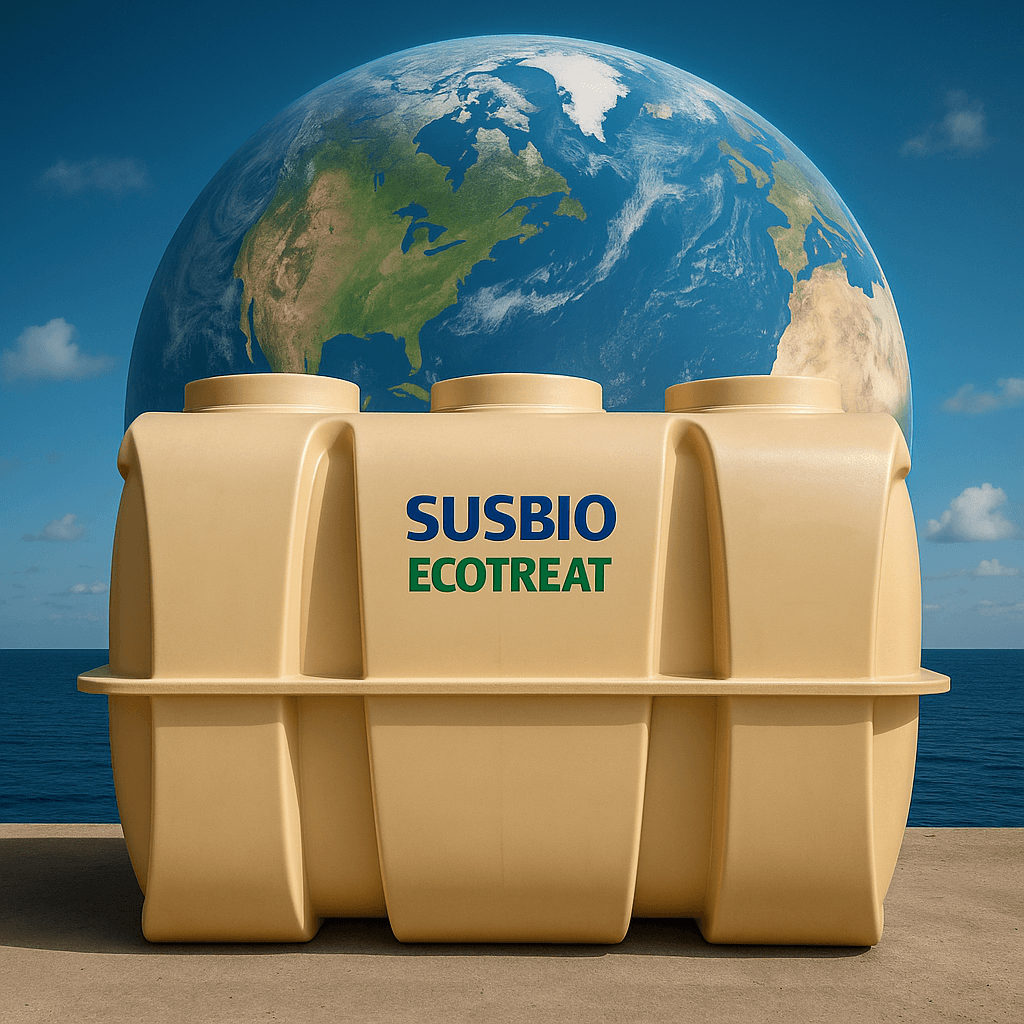
MBBR Full Form: MBBR stands for Moving Bed Biofilm Reactor — a biological wastewater treatment process that uses free-floating plastic carriers (media) to grow biofilm colonies that break down organic matter in sewage. MBBR is the core technology in SUSBIO’s ECOTREAT packaged STP, delivering BOD below 10 mg/L with 70% less electricity than conventional STPs.
As urbanization accelerates and environmental regulations tighten, efficient sewage treatment is more critical than ever. Among the most advanced and widely adopted solutions is the Moving Bed Biofilm Reactor (MBBR) process. This innovative technology has revolutionized how municipal and industrial sewage treatment plants (STPs) manage and treat wastewater, offering high efficiency, scalability, and cost-effectiveness.
If you’re searching for the best solution for wastewater treatment, want to upgrade your existing STP, or simply wish to understand the latest in sewage treatment plant technology, this comprehensive guide on the MBBR process covers everything you need to know.
What is MBBR Technology?
MBBR stands for Moving Bed Biofilm Reactor. It is a state-of-the-art biological wastewater treatment process that utilizes free-floating plastic carriers (also known as bio-media) to support the growth of biofilm. These carriers move freely in the reactor, providing a large surface area for microorganisms to attach and thrive.
Key features of MBBR technology:
- Hybrid of activated sludge and fixed-film processes
- High treatment efficiency for BOD, COD, nitrogen, and phosphorus removal
- Compact footprint, ideal for urban and space-constrained sites
- Low maintenance and operational simplicity
How Does the MBBR Process Work?
1. Biofilm Carrier Media Thousands of free-floating polyethylene plastic carriers are placed inside the aeration tank. Each carrier has a protected inner surface where bacteria grow as a biofilm. The carriers move continuously through the tank, ensuring constant contact between the biofilm and the sewage.
2. Biological Treatment The biofilm bacteria break down organic pollutants (BOD, COD, nitrogen) through aerobic degradation. Because the bacteria are attached to the carriers — not suspended in the liquid — they are not washed out during high flow conditions, making MBBR far more stable than conventional activated sludge systems.
3. Aeration System Silent diaphragm air pumps provide continuous aeration to maintain oxygen levels for microbial activity and keep the carriers in motion throughout the tank.
Key Process Steps:
- Inlet: Raw sewage enters the anaerobic pre-treatment stage for bulk organic load reduction
- MBBR Stage: Aerated tank with floating carriers handles residual BOD and COD polishing
- Clarification: Settled treated water is separated from sludge
- Outlet: Treated water exits at BOD below 10 mg/L, meeting CPCB Class A norms
How MBBR Works: A Deep Dive
| Parameter | MBBR | ASP | SBR |
|---|---|---|---|
| Footprint | Compact | Large | Medium |
| Energy use | 70% less than conventional | High | Medium |
| BOD output | Below 10 mg/L | 20–30 mg/L | 10–20 mg/L |
| Operator needed | Zero permanent | Daily | Daily |
| Installation time | 3–5 days | Weeks | Weeks |
| Best for | Packaged STPs, buildings | Large municipal | Batch systems |
1. Biofilm Carriers and Reactor Design
At the heart of every MBBR system are thousands of specially engineered plastic carriers, often made from high-density polyethylene. These carriers are designed to maximize surface area, allowing a dense population of beneficial microorganisms to attach and thrive as biofilm. The carriers typically fill 50–70% of the reactor’s volume, ensuring an active and robust microbial community.
2. Aeration and Mixing
An aeration system, usually installed at the bottom of the reactor tank, supplies a continuous flow of air. This aeration serves two main purposes:
It keeps the carriers in constant, random motion, ensuring even contact between the biofilm and the wastewater.
It provides oxygen, which is vital for aerobic microbial processes that break down organic pollutants.
3. Biological Degradation
As wastewater passes through the reactor, organic matter and nutrients are metabolized by the microorganisms on the carriers. This process significantly reduces BOD (Biochemical Oxygen Demand) and COD (Chemical Oxygen Demand). In advanced systems, MBBR can also achieve nitrification and denitrification, removing nitrogen compounds for even cleaner effluent.
4. No Sludge Recycling
Unlike conventional activated sludge systems, MBBR does not require the recycling of sludge. Excess biomass naturally detaches from the carriers and is carried out with the treated water to a clarifier. This greatly simplifies operation and maintenance.
5. Retention and Separation
A fine sieve or mesh at the reactor’s outlet ensures that only treated water and excess biomass exit the system, while the carriers remain inside the reactor.
Key Components of an MBBR System
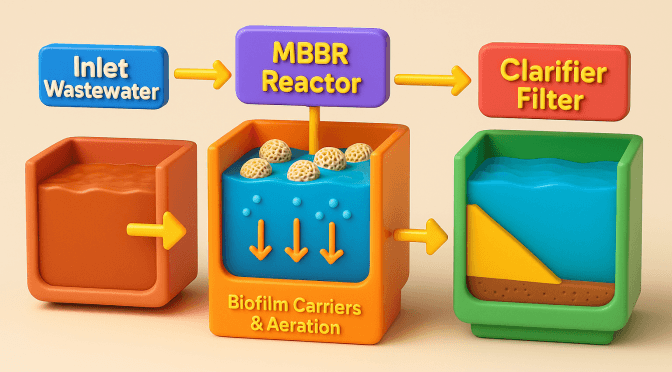
A typical MBBR sewage treatment plant consists of the following components:
- MBBR Media/Carriers: High-density polyethylene (HDPE) or polypropylene carriers with a large protected surface area for biofilm growth. Examples include Kaldnes K1, K3, and other proprietary media.
- Reactor/Aeration Tank: The main treatment basin where the carriers are suspended.
- Aeration System: Fine bubble diffusers or coarse bubble aerators provide oxygen and keep the carriers moving.
- Retention Screens: Mesh screens or sieves at the tank outlet retain the carriers while allowing treated water to exit.
- Settling/Clarification Stage: Optional, for further removal of suspended solids and polishing of effluent.
- Control and Monitoring System: For optimizing aeration, monitoring dissolved oxygen (DO), and ensuring process stability.
Step-by-Step MBBR Process in STP
- Pre-Treatment
- Screening, grit removal, and equalization to protect downstream equipment and stabilize flow.
- MBBR Biological Treatment
- Wastewater enters the MBBR tank.
- Carriers provide a habitat for bacteria and other microorganisms.
- Aeration ensures mixing and supplies oxygen for aerobic processes.
- Biofilm Activity
- Biofilm on carriers consumes organic matter (BOD, COD) and nutrients (ammonia, nitrogen, phosphorus).
- As the biofilm matures, excess biomass sloughs off and is carried out with the effluent.
- Separation and Clarification
- Effluent passes through a screen to retain carriers.
- Settling tanks or clarifiers remove suspended solids and sloughed biofilm.
- Tertiary Treatment (Optional)
- Filtration, disinfection, or advanced nutrient removal for high-quality effluent.
- Sludge Handling
- Minimal excess sludge is produced, reducing disposal costs.
Advantages of MBBR in Sewage Treatment
- High Treatment Efficiency
- Superior removal of BOD, COD, ammonia, and nitrogen.
- Effective for both municipal and industrial wastewater.
- Compact and Modular Design
- Smaller footprint than conventional activated sludge systems.
- Easily scalable by adding more carriers or tanks.
- Low Sludge Production
- Less excess sludge compared to traditional processes, lowering handling and disposal costs.
- Operational Simplicity
- No need for sludge recycling or complex process control.
- Resilient to load fluctuations and toxic shocks.
- Energy Efficiency
- Optimized aeration reduces energy consumption.
- Easy Retrofitting
- Can be integrated into existing STPs to enhance capacity and performance.
- Stable and Robust Performance
- Handles variable loads and influent quality without process upsets.
MBBR vs. Other Wastewater Treatment Technologies
| Feature | MBBR | MBR (Membrane Bioreactor) | SBR (Sequencing Batch Reactor) | Conventional Activated Sludge |
|---|---|---|---|---|
| Treatment Efficiency | High | Very High | High | Moderate |
| Footprint | Compact | Compact | Moderate | Large |
| Sludge Production | Low | Low | Moderate | High |
| Maintenance | Low | High (membrane fouling) | Moderate | Moderate |
| Energy Consumption | Moderate | High | Moderate | Moderate |
| Capital Cost | Moderate | High | Moderate | Moderate |
| Scalability | Excellent | Good | Good | Limited |
| Shock Load Resistance | High | Moderate | Moderate | Low |
Applications of MBBR Systems
- Municipal Sewage Treatment Plants: For cities, towns, and urban areas with space constraints.
- Industrial Wastewater Treatment: Food and beverage, pharmaceuticals, textiles, pulp and paper, petrochemicals, and more.
- Decentralized & Containerized STPs: Residential complexes, hotels, hospitals, resorts, and remote sites.
- Upgrading Existing STPs: Retrofit old plants to increase capacity and meet stricter discharge norms.
- Tertiary Treatment & Polishing: For advanced nutrient removal and water reuse applications.
Design Considerations and Optimization
- Carrier Fill Ratio: Typically 50–70% of tank volume for optimal biofilm growth.
- Surface Area: Higher surface area carriers support more biomass and higher treatment rates.
- Aeration Rate: Must provide adequate oxygen for microbial activity and carrier movement.
- Hydraulic Retention Time (HRT): Designed based on influent load and desired effluent quality.
- Temperature Control: MBBR is robust but extreme temperatures may affect microbial activity.
- Effluent Quality Monitoring: Regular testing for BOD, COD, TSS, ammonia, and other parameters.
Maintenance and Troubleshooting
- Routine Checks: Monitor dissolved oxygen, carrier movement, and effluent quality.
- Screen/Sieve Cleaning: Prevent clogging to avoid carrier loss.
- Aeration System Maintenance: Ensure diffusers are clean for uniform aeration.
- Sludge Removal: Periodic removal from clarifiers.
- Biofilm Monitoring: Healthy biofilm is essential; sudden loss may indicate toxicity or shock loads.
Frequently Asked Questions (FAQs)
Q1: What does MBBR stand for?
MBBR stands for Moving Bed Biofilm Reactor — a biological wastewater treatment technology that uses free-floating plastic carriers to grow bacteria that break down sewage.
Q2: How much space does an MBBR STP need compared to a conventional STP?
MBBR systems are 30–40% more compact than conventional activated sludge plants because biofilm carriers fill 50–70% of the tank volume, eliminating the need for large secondary clarifiers.
Q3: Is MBBR better than SBR for residential sewage treatment?
MBBR generally requires less operator involvement and handles fluctuating loads more reliably than SBR, though SBR offers more flexible batch control. SUSBIO ECOTREAT’s Anaerobic + MBBR process achieves BOD below 10 mg/L consistently — meeting CPCB Class A standards — making it ideal for residential complexes and commercial projects requiring compliant effluent for reuse.
Q4: What are the operational costs of MBBR compared to other systems?
MBBR systems typically have lower operational costs than conventional or SBR systems due to reduced sludge disposal, lower energy consumption from optimized aeration, and minimal manual intervention. SUSBIO ECOTREAT’s Anaerobic + MBBR process uses 70% less electricity than conventional STPs — the largest single operational cost saving available in any packaged STP design.
Q5: Can MBBR handle industrial wastewater?
Yes. MBBR is widely used for industrial effluents including food and beverage, pharmaceutical, and textile wastewater, because the attached biofilm resists shock loads and toxic compounds better than suspended-growth systems.
Q6: What is the typical lifespan of MBBR carrier media?
High-quality HDPE MBBR carriers last 15–20 years or more with proper maintenance, making the media one of the lowest lifecycle-cost components of the system.
Q7: Does MBBR require a full-time skilled operator?
No. MBBR systems are largely self-regulating once commissioned, requiring only periodic monitoring rather than continuous skilled supervision — unlike conventional activated sludge plants that need daily operator attention. SUSBIO ECOTREAT’s Anaerobic + MBBR packaged STP is fully automated with zero permanent operator requirement.
Conclusion
The MBBR process is a proven, robust, and highly efficient solution for modern sewage treatment plants. Its unique combination of biofilm technology, modular design, and operational simplicity makes it the preferred choice for municipalities, industries, and developers worldwide. Whether you are planning a new STP, upgrading an existing plant, or seeking a cost-effective and sustainable wastewater treatment solution, MBBR technology — and specifically SUSBIO ECOTREAT’s Anaerobic + MBBR packaged STP — delivers unmatched performance and reliability backed by 13+ years of real-world installations.
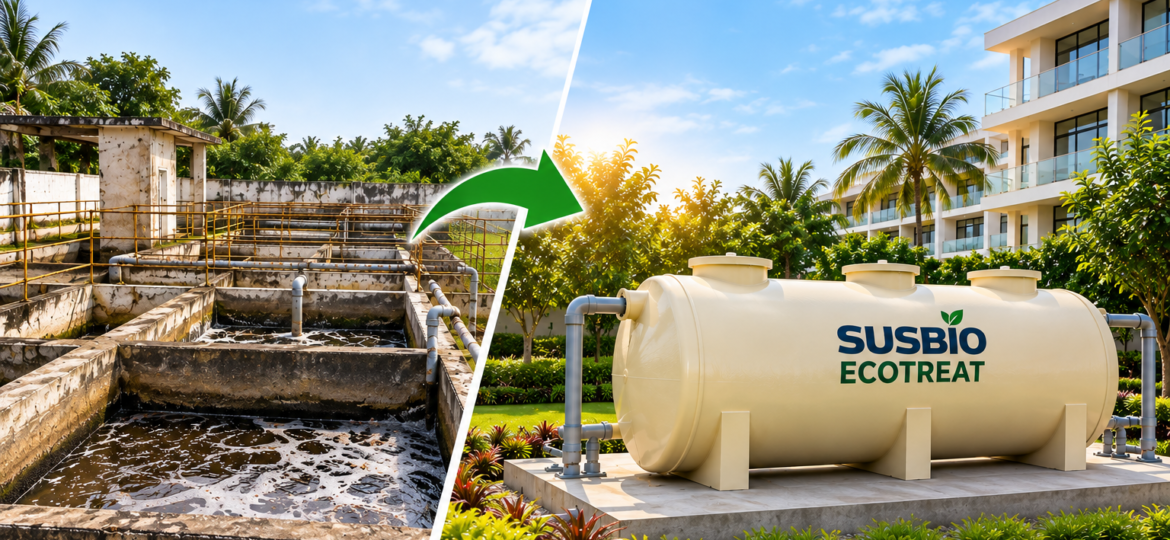
Ready to implement MBBR in your STP? SUSBIO ECOTREAT is India’s most proven Anaerobic + MBBR packaged sewage treatment plant — 500+ installations across 24 Indian states, exports to 8 countries, CPCB Class A compliant, 70% less electricity than conventional STPs, and fully operational in 3–5 days. Get a free consultation from SUSBIO’s technical team and take the next step towards sustainable, compliant, and future-ready wastewater management.


1 Comments
[…] Moving Bed Biofilm Reactor (MBBR) technology is a highly efficient biological process used to treat both municipal and industrial wastewater. Developed in the 1980s, MBBR utilizes thousands of specially designed plastic carriers, known as biofilm media, which float freely within an aeration tank. These carriers provide a large surface area for beneficial bacteria to grow and form biofilms. As wastewater flows through the tank, these microorganisms break down organic pollutants, nitrogen, and phosphorus. The constant movement of the carriers, maintained by aeration, ensures optimal contact between the biofilm, wastewater, and oxygen—resulting in effective, reliable treatment. […]