


Climate change continues to overwhelm our wastewater treatment systems. Heavy rainfall events force treatment facilities to discharge untreated sewage directly into rivers, lakes, and oceans because they cannot handle the excess water volume. Most existing facilities lack the capacity to withstand the intensity of atmospheric rivers or superstorms that we experience more frequently.
System failures create problems way beyond the reach and influence of infrastructure damage. Treatment efficiency decreases as temperatures rise, which creates odor problems. Coastal facilities face destructive flooding and storm surges. Climate change’s effects on water resources trigger cascading disruptions in environmental, social, economic, and cultural domains. These disruptions pose the most important risks to human health because wastewater overflow damages local ecosystems.
The challenges will intensify as we approach 2025, with implications felt both immediately and long-term. This piece gets into the hidden threats climate change poses to our wastewater systems. The focus remains on storm-related risks, temperature disruptions, infrastructure strain, and adaptive strategies for drought conditions.
Rising Storm Events and Overflow Risks in 2025
Climate change makes storms more intense and frequent in major urban centers. Weather patterns are changing faster than ever, and experts project extreme rainfall will increase 10-70% by mid-century. Our aging wastewater systems were never built to handle these conditions.
Increased Overflow Events in Urban Drainage Systems
Climate models show the most important changes in peak flow rates. The projections reveal 1-hour peak inflows will rise by 74.3% in the 2050s and reach a massive 170.7% by the 2080s. The problem gets worse as cities grow and paved surfaces replace natural drainage areas. Research in industrial zones shows climate change could increase rainwater flow to retention reservoirs by up to 53.1%. Combined sewer systems, common in Europe and parts of North America, cannot handle intense rainfall.
Untreated Sewage Discharge into Natural Water Bodies
Treatment facilities must release untreated wastewater into the environment when heavy rain threatens to overwhelm the system. Superstorm Sandy in 2012 caused about 776 million gallons of wastewater spills in the U.S. Mid-Atlantic region alone. Washington saw a sewage overflow of 475 million gallons after more than five inches of rain fell in 24 hours. The storm’s total impact led to 11 billion gallons of untreated or partially treated wastewater flowing into waterways across eight states. Yes, it is becoming more common – in 2024, England and Wales reported over 450,000 raw sewage discharges lasting 3.6 million hours.
Stormwater Pollution and Public Health Hazards
Stormwater runoff contains a dangerous mix of pollutants, including:
- Toxic elements and heavy metals from vehicular emissions
- Pharmaceutical compounds and personal care products
- Emerging contaminants like PFAS and microplastics
On top of that, these flows have high levels of fecal bacteria that create major health risks. Rain-driven discharges lead to harmful algal blooms from excess nutrients. They deplete oxygen in water bodies and destroy coastal marshlands, which ironically removes natural flood protection. These pollutants can contaminate drinking water sources, especially where sandy soils and shallow water tables exist. Regulators in many countries now admit current overflow levels are “unacceptable” and need urgent action.
Temperature-Driven Treatment Inefficiencies
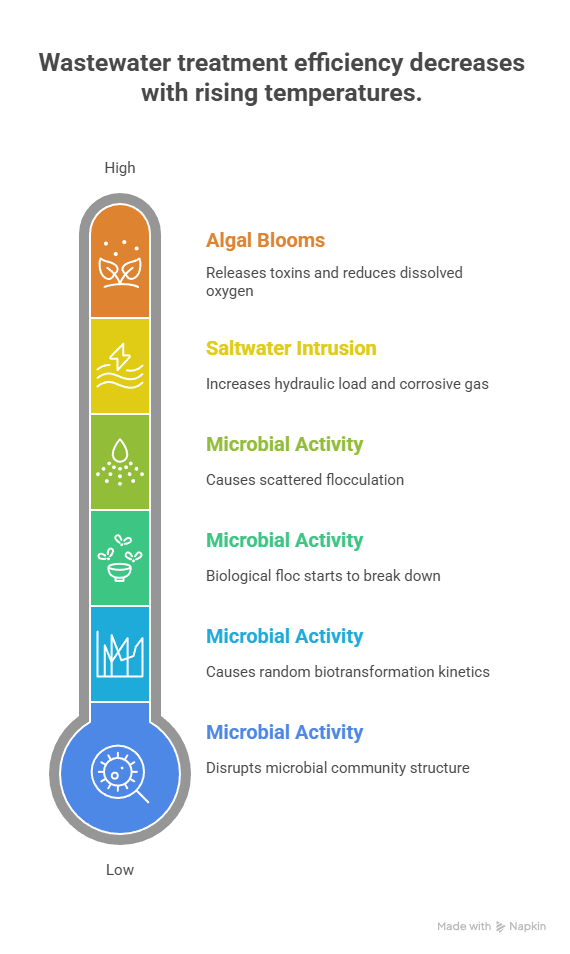
Rising temperatures change the biological and chemical processes that make wastewater treatment work by a lot. These temperature-driven problems become worse for treatment facilities worldwide as climate change intensifies.
Microbial Activity Disruption in Activated Sludge Systems
Microorganisms in activated sludge systems work best within the mesophilic temperature range of 20-40°C. Temperature changes beyond this range disrupt the microbial community structure that powers wastewater treatment. Studies show that long exposure to temperatures below 15°C or above 25°C causes random biotransformation kinetics and moves away from the classic Arrhenius model. Biological floc starts to break down at temperatures above 35.5°C, and temperatures above 43°C cause scattered flocculation. This breakdown results in higher effluent total suspended solids and poorly treated wastewater.
Odor and Algal Bloom Risks in Treated Effluent
Warm water temperatures create perfect conditions for harmful algal blooms that happen more often in summer and fall. These blooms release toxins like microcystins that pollute water supplies and put public health at risk. Higher temperatures also reduce oxygen’s ability to dissolve in water. This creates low dissolved oxygen conditions that lead to bad odors. Algal blooms add to high effluent total suspended solids, biological oxygen demand, and pH compliance issues. Dead blooms form large sludge blocks that make treatment even harder.
Saltwater Intrusion in Coastal Treatment Plants
Sea level rise lets saltwater seep into coastal wastewater systems through structural defects. A coastal treatment plant’s conductivity levels went above 5,000 μS/cm during high tide events in 2017—more than triple the normal levels. Saltwater intrusion increases hydraulic load, creates corrosive hydrogen sulfide gas, and limits water reuse options. High salt levels interfere with chemical reactions like coagulation-flocculation and stress the activated sludge microbiome by increasing osmotic pressure. Keep in mind that this reduces treatment efficiency and requires expensive additional treatment methods like reverse osmosis.
Energy and Infrastructure Strain from Climate Adaptation
Climate adaptation measures put enormous strain on wastewater infrastructure. These challenges show up through higher energy use, structural damage, and financial pressure on coastal communities.
Increased Power Demand for Cooling and Filtration
Research shows a direct link between rainfall intensity and energy usage at wastewater treatment plants. The electrical consumption jumps from 0.36 kWh/m³ to 0.51 kWh/m³ when rainfall intensity rises from 0.8 mm/min to 2.9 mm/min. Heat waves create extra cooling needs and change wastewater flows and treatment processes. The facilities use large amounts of energy for:
- Pumping operations
- Aeration systems
- Advanced filtration technologies that need high-pressure pumping
Corrosion of Metal Components from Sea-Level Rise
Rising sea levels create two major problems through saltwater intrusion. The saltwater promotes ionic interactions with subsurface soils that affect pipe stability. The flood water’s salinity speeds up corrosion of vital plant components. Protective structures might block direct marine flooding, but rising groundwater could still flood infrastructure. This flooding requires non-stop pumping operations.
Cost Implications of Relocating Coastal Facilities
Many coastal communities now look at facility relocation as their best option. Fort Pierce, Florida’s estimate to move a beachfront treatment plant eight miles inland reached INR 9113.09 million. These expenses often grow unexpectedly – Vero Beach watched projected costs climb from INR 10210.03 million to about INR 15019.72 million in just months. The relocations need massive capital investment, yet officials see them as essential long-term solutions for protecting the environment and economic growth.
Of course, these infrastructure changes represent one of climate change’s most important economic effects on water resources management systems.
Drought Conditions and Water Reuse Strategies

Drought brings unique challenges to wastewater systems as climate change effects grow stronger. Water shortages create more complex problems than floods, and these issues need innovative solutions.
Reduced Flow Volumes and Pollutant Concentration
Drought conditions lead to a sharp drop in wastewater volumes while pollutant levels rise. Studies from California show that water conservation during the 2014-2016 drought cut effluent flows by 6-10% and raised total dissolved solids by 5-12%. Treatment plants struggle with these concentrated pollutants, especially in nutrient removal and meeting discharge permits. Long dry spells make contaminants much more complex than before.
Treated Wastewater Reuse in Agriculture and Industry
Reusing wastewater helps adapt to drought conditions. Farmers get several benefits:
- Nutrient-rich water boosts crop productivity
- Less reliance on freshwater resources
- Lower costs compared to other sources
California and Florida now use 587.76 million gallons of recycled water daily for agricultural irrigation. Treated wastewater costs only AED 1.2–1.8 per cubic meter to recharge aquifers, compared to AED 6–8 for desalinated water.
Water-Efficient Technologies for Low-Flow Scenarios
Treatment facilities now use monitoring systems that spot drops in wastewater quality as they happen. Advanced micro-irrigation and greywater recycling systems help stretch water supplies during shortages. A strange problem emerges – successful conservation leads to higher recycled water demand right when wastewater supplies drop.
Conclusion
Climate change creates unprecedented challenges to wastewater treatment systems as we near 2025. This piece explores how these vital infrastructures face growing threats from multiple directions all at once.
Stronger and more frequent storms overwhelm aging systems. This leads to billions of gallons of untreated sewage flowing into waterways. The contamination carries toxic elements, pharmaceuticals, and emerging pollutants that put public health and ecological balance at risk. On top of that, it becomes harder to manage microbes, algal blooms, and odors as rising temperatures disrupt the biological processes needed to work.
Coastal facilities face the toughest challenges. The infrastructure’s critical components suffer damage from saltwater intrusion while treatment costs rise. Many communities must think about moving their whole facilities—a financially difficult but essential adaptation measure. The drought conditions create a paradox where reduced wastewater flows concentrate pollutants. This makes treatment harder right when water reuse becomes most valuable.
The solution requires multiple approaches. Water reuse strategies, energy-efficient technologies, and immediate monitoring systems show promise. These adaptations just need proper investment and planning. Communities worldwide should prioritize climate-resilient wastewater infrastructure.
Without doubt, our wastewater systems face a critical moment. The hidden threats we got into will show up clearly in coming years unless we take decisive action. Communities that invest in strong systems now will definitely handle intensifying climate effects better than those caught off guard. Our water resources’ protection depends only when we are willing to face these challenges and implement complete adaptation strategies before system problems become systemic.
Key Takeaways
Climate change is creating unprecedented challenges for wastewater treatment systems that demand immediate attention and strategic adaptation to prevent widespread environmental and public health crises.
• Storm intensity increases of up to 170% by 2080 will overwhelm aging infrastructure, causing billions of gallons of untreated sewage to discharge into waterways annually.
• Rising temperatures above 35°C disrupt biological treatment processes, reducing efficiency and creating harmful algal blooms that contaminate water supplies with dangerous toxins.
• Coastal facilities face relocation costs exceeding $150 million per plant due to saltwater intrusion and sea-level rise accelerating infrastructure corrosion.
• Drought conditions concentrate pollutants while reducing wastewater volumes, making treatment more difficult precisely when water reuse becomes most critical for communities.
• Investment in climate-resilient infrastructure, real-time monitoring systems, and water reuse technologies is essential now to prevent catastrophic system failures in 2025 and beyond.
The convergence of these threats creates a perfect storm for wastewater systems worldwide. Communities that act decisively to upgrade infrastructure and implement adaptive strategies will protect both public health and water resources, while those that delay face exponentially higher costs and environmental damage.
Frequently Asked Questions
Q1. How does climate change affect wastewater treatment systems?
Climate change impacts wastewater treatment systems through increased storm intensity, rising temperatures, and sea-level rise. These factors lead to system overflows, reduced treatment efficiency, and infrastructure damage, particularly in coastal areas.
Q2. What are the consequences of wastewater system failures due to climate change?
Wastewater system failures can result in the discharge of untreated sewage into natural water bodies, leading to pollution, public health hazards, and ecological damage. This can contaminate drinking water sources and contribute to harmful algal blooms.
Q3. How do rising temperatures impact wastewater treatment processes?
Rising temperatures disrupt microbial activity in activated sludge systems, reduce oxygen solubility in water, and promote algal blooms. These effects can lead to treatment inefficiencies, odor problems, and challenges in meeting effluent quality standards.
Q4. What strategies are being implemented to address drought conditions in wastewater management?
To address drought conditions, wastewater treatment facilities are implementing water reuse strategies for agriculture and industry, adopting water-efficient technologies, and using real-time monitoring systems to detect changes in wastewater quality.
Q5. What are the financial implications of adapting wastewater infrastructure to climate change?
Adapting wastewater infrastructure to climate change can be costly, particularly for coastal facilities. Relocation of treatment plants can cost over $150 million per facility. Additionally, there are increased energy costs for cooling and filtration, and expenses for implementing new technologies and monitoring systems.