

The quote looks attractive. A sewage treatment plant at a price that fits your project budget, delivered on time, and installed before handover. The builder signs off. The occupancy certificate arrives. And then — a few months into operations — the real bills start coming in.
Across India, a pattern repeats itself in residential complexes, hotels, and institutional buildings: an STP chosen primarily on lowest CAPEX becomes one of the highest-OPEX assets on the property. What looked like a saving of ₹5–10 lakhs at purchase ends up costing multiples of that figure over 3–5 years.
This article breaks down the seven hidden costs builders and developers commonly discover after commissioning a cheap STP — and what to evaluate before you commit.
Why Builders Choose on Price — and Why That Logic Breaks Down
The decision to buy an STP is rarely driven by enthusiasm. It is a compliance requirement — mandated by CPCB, State PCBs, and increasingly by RERA and local development authorities for projects above a certain floor area or unit count. Buyers compare quotes, pick the most competitive, and move on.
What this misses is the fundamental structure of STP economics: the purchase price is a one-time event, but the operational cost is perpetual. A plant that runs for 15–20 years will accumulate OPEX that dwarfs its original sticker price many times over. The cheap quote today can be the expensive plant tomorrow.
The 7 Hidden Costs Builders Discover After Commissioning
1. High Electricity Consumption
Power is the largest ongoing cost of operating an STP, and it varies significantly by technology. Older aeration-heavy systems — particularly extended aeration and conventional activated sludge plants — run blowers, aerators, and pumps continuously. For a 100 KLD plant, this can translate to power consumption of 15–25 units per day, or roughly ₹1.5–2.5 lakh per year at standard tariffs.
A mid-sized 200 KLD plant with energy-inefficient equipment can cost upwards of ₹20 lakh annually in electricity and labour alone. This figure is often invisible at the time of purchase because electricity costs are borne by the housing society or facility manager — not the builder.
2. Skilled Operator Dependency
Many low-cost STPs are mechanically intensive and require a trained operator to manage aeration cycles, chemical dosing, sludge withdrawal, and equipment checks on a daily basis. Operator salaries in Indian cities typically range from ₹15,000 to ₹30,000 per month, and finding and retaining qualified operators for a mid-rise housing society is a persistent challenge.
Plants that rely heavily on manual operation are also vulnerable to errors during shift changes, festivals, or high-turnover periods — creating windows where the plant runs sub-optimally and effluent quality suffers.
3. Frequent Breakdowns and Spare Parts Costs
Budget STPs often use generic blowers, pumps, and diffusers sourced from low-cost suppliers. These components have shorter service lives and are prone to wear under continuous operation. When they fail — and they will — two problems emerge:
- Replacement parts may not be readily available, causing downtime.
- The original vendor may no longer support the product, leaving the RWA or facility to source parts from third parties at premium prices.
A single blower replacement can cost ₹40,000–₹1.5 lakh depending on plant size. Membrane replacements in poorly maintained MBR systems can run into several lakhs. Over a 10-year lifespan, cumulative maintenance and repair costs on a cheap plant routinely exceed its original purchase price.
4. Non-Compliance Penalties from PCBs and NGT
This is the cost that surprises builders most — and it is no longer a remote risk. Enforcement action against non-functional or underperforming STPs has intensified significantly across India.
In December 2024, the Greater Noida Industrial Development Authority (GNIDA) issued notices to 202 housing societies for STP violations. Within weeks, six societies were collectively fined ₹27 lakh for non-compliance. In a separate case, a Gurugram housing society was initially handed a penalty of ₹1.55 crore by the Haryana State Pollution Control Board for STP failure — later revised by the NGT after the society demonstrated it had repaired the plant. The original penalty figure, however, illustrates the financial exposure that non-compliance carries.
State PCBs and the NGT now treat non-functional or underperforming STPs in residential complexes as serious violations. Fines, shutdown orders, and legal notices are the standard toolkit. A cheap plant that fails to consistently meet CPCB effluent standards for BOD, COD, and TSS is not just a maintenance problem — it is a legal liability.
5. Retrofitting and Technology Upgrade Costs
Effluent standards in India have been tightening. CPCB has progressively reduced permissible discharge limits, and the push for treated water reuse — particularly under programmes like AMRUT 2.0 and state-level safe reuse policies — means that the bar for treated water quality is rising, not holding steady.
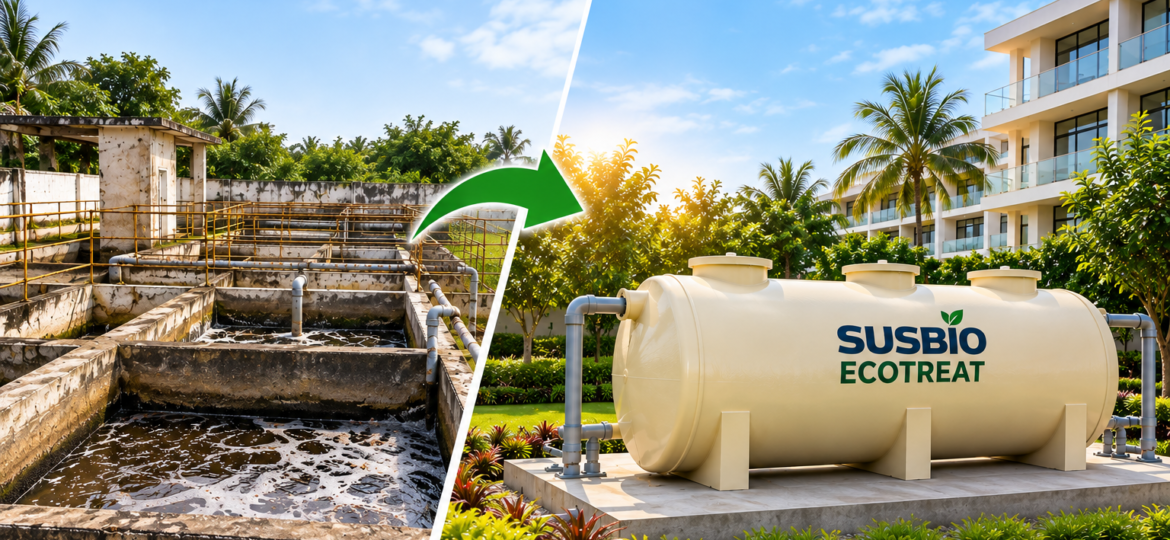
A plant commissioned today on a cheap conventional technology may not meet the discharge or reuse standards being enforced five years from now. Retrofitting an existing plant — adding membrane filtration, upgrading aeration, or installing SCADA-based monitoring — is disproportionately expensive when done on a legacy system. It is nearly always cheaper to buy the right technology at the start.
6. Odour Complaints and Resident Grievances
A poorly designed or inadequately maintained STP generates hydrogen sulphide and other malodorous compounds. In residential complexes, this leads to persistent complaints from residents, especially those in lower floors or units near the STP room.
Odour complaints have a direct cost: they consume RWA committee time, generate correspondence, sometimes escalate to local authority complaints, and in at least a few documented NGT cases, have triggered regulatory inspection. The reputational cost for a developer — particularly in a branded or premium project — is harder to quantify but real.
7. Sludge Disposal Costs
Sludge management is the hidden tail of every STP. All biological treatment processes generate excess sludge that must be periodically removed, dewatered, and disposed of. Poorly designed plants produce larger volumes of sludge relative to throughput. Plants without sludge drying beds or dewatering equipment require wet sludge to be carted away by third-party vendors — at ₹2,000–₹5,000 per trip, several times a month.
Improper sludge disposal is also increasingly a basis for regulatory action. The NGT and state PCBs treat unauthorized sludge dumping as an independent violation, separate from effluent discharge non-compliance.
The CAPEX vs OPEX Calculation Builders Should Run
Before signing any STP purchase order, a realistic 10-year total cost of ownership analysis should be run. The table below illustrates a simplified comparison between a typical low-CAPEX conventional system and a quality packaged MBBR/MBR system for a 100 KLD installation:
| Cost Component | Low-Cost Conventional STP | Quality Packaged MBBR/MBR STP |
|---|---|---|
| Initial Purchase (CAPEX) | ₹8–12 lakhs | ₹15–25 lakhs |
| Annual Electricity | ₹1.8–2.5 lakhs/yr | ₹0.5–1.0 lakh/yr |
| Annual Operator Cost | ₹2.4–3.6 lakhs/yr | ₹0 – ₹1.2 lakhs/yr |
| Annual Maintenance/AMC | ₹1.0–2.0 lakhs/yr | ₹0.6–1.2 lakhs/yr |
| Estimated Repair/Replacement (10 yr) | ₹8–15 lakhs | ₹3–6 lakhs |
| Compliance Risk Exposure | Moderate to High | Low |
| 10-Year Total Cost (approx.) | ₹65–95 lakhs | ₹30–50 lakhs |
Note: Figures are indicative estimates based on industry data and are plant-size and location dependent. The gap widens significantly for larger capacity plants.
What to Look for When Evaluating an STP Quote
A lower quoted price should prompt more questions, not less. Ask any vendor the following before committing:
- What is the estimated daily power consumption at design load?
- Does the plant require a dedicated full-time operator, or is it designed for automatic operation?
- What is the expected membrane or media replacement cycle, and what does it cost?
- What are the guaranteed effluent quality parameters — specifically BOD, COD, TSS, and total coliform?
- What AMC coverage is offered after the warranty period?
- What is the expected sludge generation rate, and what sludge handling is included?
- Has the technology been tested and certified against CPCB discharge norms?
A vendor who cannot answer these questions in writing is a vendor whose true costs will emerge only after commissioning.
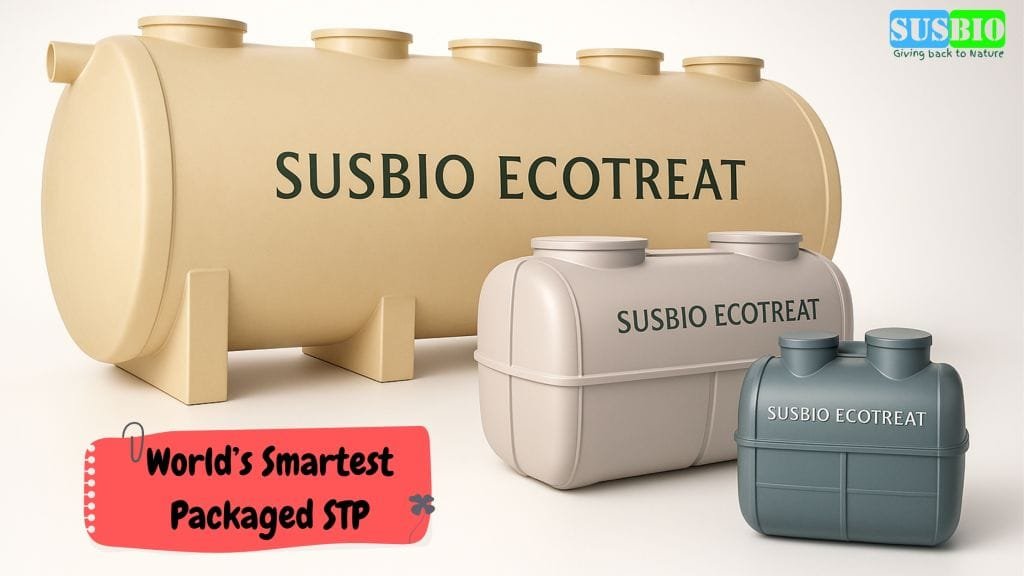
SUSBIO’s approach: ECOTREAT packaged STPs are designed with total cost of ownership in mind — MBBR+MBR hybrid technology, automated operation requiring no dedicated on-site operator, and low energy consumption. All plants are supplied with a formal AMC structure and are backed by SUSBIO’s in-house service team. For a site-specific CAPEX + OPEX estimate, contact our engineering team.
Conclusion
The decision to install an STP is not optional — but the decision of which STP to install is entirely within a developer’s control. The seven hidden costs described above are not theoretical. They are being borne today by housing societies, facility managers, and RWAs across India who inherited cheap systems from developers looking to trim project costs.
The right question to ask is not ‘What is the lowest price STP I can buy?’ — it is ‘What is the lowest total cost STP I can operate for the next 15 years?’ The answer to those two questions is almost never the same plant.
Frequently Asked Questions
Is it really mandatory for my residential project to have an STP?
Yes. CPCB norms require STPs for residential buildings generating more than 10 KLD of sewage. Most state PCBs have adopted similar thresholds, and several states have strengthened enforcement significantly over 2024–2026.
Can I face personal legal liability as a builder if the STP fails after handover?
While the immediate penalty typically falls on the RWA or facility operator after possession, builders face reputational risk, potential RERA-related complaints, and in some states, regulatory conditions that require commissioning a functional STP before occupancy certificates are issued.
What is a reasonable AMC cost for a 100 KLD STP?
A well-structured Annual Maintenance Contract for a 100 KLD packaged STP typically ranges from ₹60,000 to ₹1.5 lakh per year depending on technology, scope of coverage, and whether consumables are included. This is significantly lower than the cost of ad-hoc reactive repairs on a poorly maintained plant.
What effluent quality standards does my STP need to meet?
For discharge into surface water or municipal drains, CPCB norms specify BOD ≤10 mg/L, COD ≤50 mg/L, TSS ≤10 mg/L, and total coliform ≤100 MPN/100 mL for treated water reuse. The exact standard applicable to your project depends on your state PCB’s consent conditions.