

Most countries that need packaged sewage treatment need it because sewer infrastructure hasn’t caught up with growth. South Africa’s case is different, and more urgent, because two separate crises are compounding at once: water and power.
On the water side, the country is one of the more water-stressed in the world, a fact that became globally visible in 2018 when Cape Town came within months of “Day Zero” — the point at which municipal taps would have been switched off entirely. On the power side, Eskom’s electricity tariffs have risen by more than 900% since the 2008 crisis, with South Africa ranked among the top 50 most expensive countries for electricity in a 2024 global comparison at roughly R3.29 per kWh average, and further increases of 8.76% and 8.83% have already been approved for the 2026/27 and 2027/28 financial years on top of that. For commercial and industrial users, per-kWh costs typically fall in the R1.85–R3.12 range — still a significant, rising operating cost for any facility running pumps, blowers, and aeration equipment around the clock.
For a game lodge, mining camp, housing estate, or institution without municipal sewer access, this means the choice of treatment technology isn’t just an environmental or compliance decision — it’s directly tied to the electricity bill and the water bill, in a country where both are becoming structurally more expensive every year. This is the specific gap SUSBIO ECOTREAT is built for.
How SUSBIO ECOTREAT Works
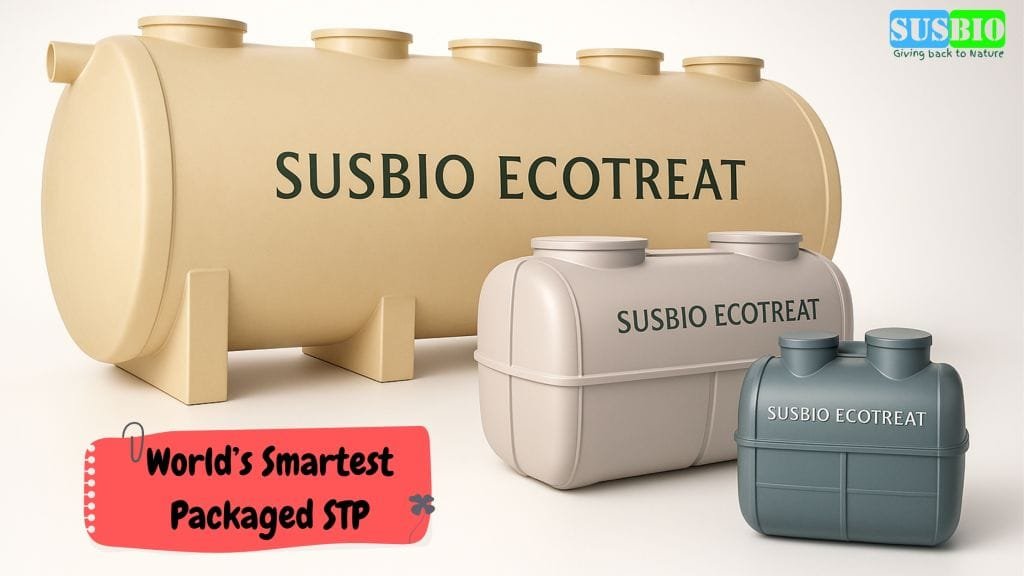
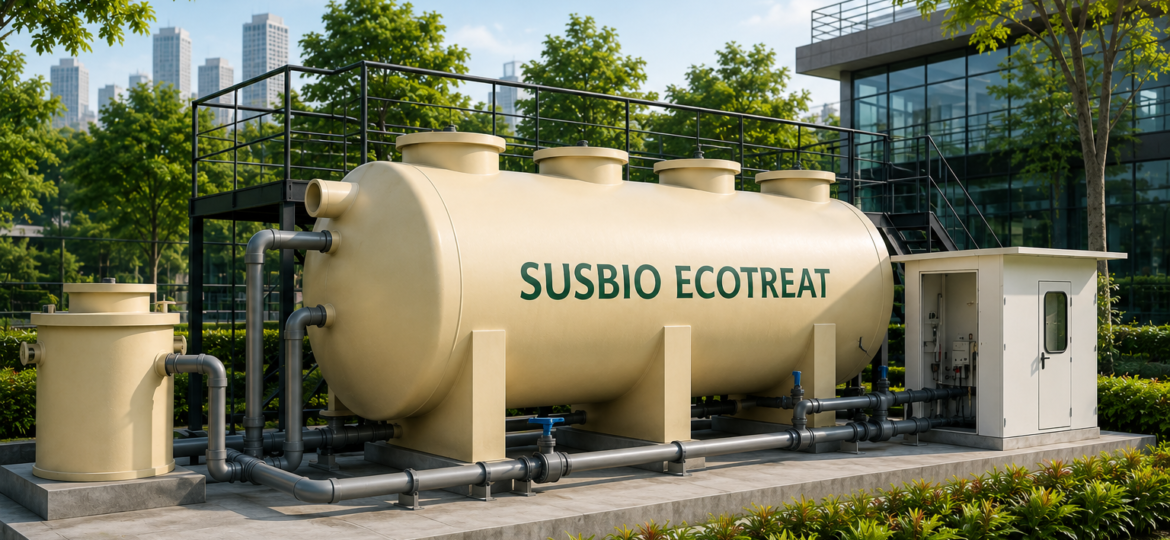
SUSBIO ECOTREAT is a packaged, prefabricated sewage treatment plant built on Anaerobic + MBBR (Moving Bed Biofilm Reactor) technology — never a single-stage, SBR-only, or MBBR+MBR design.
- Equalisation & anaerobic stage — incoming sewage is buffered and organic load is broken down without the constant, power-hungry aeration that conventional activated-sludge systems require
- MBBR stage — bacteria colonize floating plastic media carriers suspended in the reactor, giving dramatically more biological surface area per cubic metre of tank than a plain activated-sludge basin — smaller footprint, same treatment capacity
- Clarification — treated water settles, separating clear effluent from residual solids
- Disinfection — before discharge or reuse, treated water is disinfected to reduce pathogen load
Because the anaerobic stage handles the bulk of the organic load before the aerobic stage takes over, the blowers and aerators run far less than in a conventional plant — which is where the roughly 70% electricity saving comes from, not from a marketing claim but from the physics of a two-stage process doing less continuous aeration work.
The Economics, Worked Through
It’s worth being explicit about why this matters more in South Africa than in most markets SUSBIO serves elsewhere:
| Factor | Conventional STP | SUSBIO ECOTREAT (Anaerobic + MBBR) |
|---|---|---|
| Continuous aeration load | High — full biological load aerated throughout | Reduced — anaerobic stage pre-treats before aeration |
| Approx. electricity draw | Baseline | ~70% lower than baseline |
| Generator/inverter backup sizing (relevant given load-shedding) | Larger, costlier backup needed | Smaller backup load, more realistic to run off batteries/generator during outages |
| Footprint | Larger tankage for equivalent biological surface area | Compact — MBBR media increases surface area per m³ |
| Typical install timeline | Weeks of civil work | 3–5 days once the FRP unit is on site |
With commercial tariffs in the R1.85–R3.12/kWh range and rising at a compounding 8–9%+ a year, a lower-power treatment process compounds in savings every year the plant operates — the opposite of a one-time efficiency gain.
Why SUSBIO ECOTREAT Is the Best Choice for South Africa
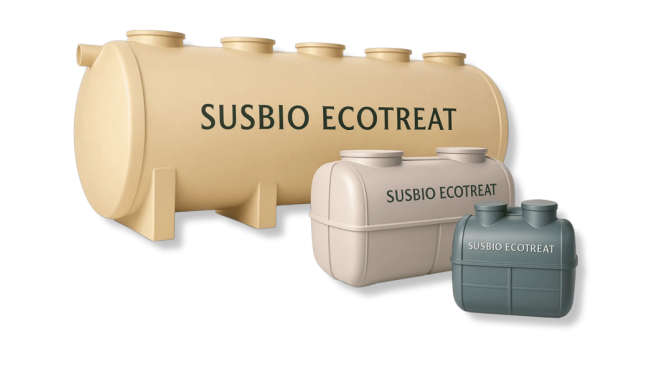
This isn’t a generic “why choose us” section — each point maps to something specific about South African conditions, not a claim that would apply equally anywhere:
1. It’s the only major differentiator that directly targets Eskom’s tariff trajectory.
Local competitors compete on tenure, certification, and reference sites — legitimate factors, but none of them address the compounding cost of electricity itself. SUSBIO ECOTREAT’s ~70% lower power draw is the one specification that gets more valuable every year tariffs rise, and tariffs are approved to keep rising through at least 2027/28.
2. Lower power draw makes off-grid and load-shedding resilience actually affordable.
A conventional STP’s aeration load requires proportionally larger battery banks, solar arrays, or generator capacity to keep running through an outage. A plant that draws 70% less power needs a fraction of that backup capacity — which matters directly in a country running structural load-shedding, not as a hypothetical.
3. FRP construction suits South Africa’s geography, not just its climate.
Many of the highest-value use cases — game lodges, mining camps, remote estates — are hours from the nearest service depot. FRP won’t corrode in transit or in humid coastal/lowveld conditions, and it’s light enough to move to sites where heavy concrete civil work isn’t practical or affordable.
4. Modular 1–500 KLD sizing matches South Africa’s actual project mix.
The market here isn’t dominated by single large municipal-scale plants — it’s fragmented across lodges, estates, and camps of very different sizes. A manufacturer with a genuinely modular range (rather than one or two fixed sizes) fits that fragmentation better than a one-size product line.
5. Treated water directly addresses South Africa’s water-scarcity reality, not just compliance.
In a country where Cape Town nearly ran out of municipal water in 2018 and water restrictions remain a recurring feature across provinces, treated effluent available for irrigation and non-potable reuse isn’t a nice-to-have add-on — it’s a genuine hedge against future restrictions for any water-intensive site like a lodge, estate, or agricultural operation.
6. A 10-year material warranty backed by 500+ installations gives buyers a track record to check.
This is a claim buyers can verify — ask for reference installations, not just a warranty document — and it’s presented that way rather than as an unfalsifiable promise.
Where SUSBIO ECOTREAT does not yet have an edge: established South African suppliers like Scarab Water have direct local reference sites, local spares stocking, and years of in-market support history that an importing manufacturer has to earn over time. That’s a fair gap to be upfront about rather than paper over.
Where This Fits in South Africa
Game lodges & eco-tourism properties — Off-grid by design, often already running on generators or solar/battery hybrids. Lower treatment plant power draw means backup power sizing (and cost) stays manageable, and treated water can go straight into landscaping/irrigation, matching the sustainability positioning most lodges already market on.
Mining camps & remote industrial sites — No municipal infrastructure to rely on. FRP construction handles transport to remote sites without corrosion risk, and the compact footprint suits temporary or semi-permanent camp layouts.
Gated communities & housing estates — Capacity scales modularly from 1 KLD up to 500 KLD, so a single estate can size a plant to actual occupancy rather than over-building for worst-case municipal failure.
Schools, clinics & institutional sites — Particularly relevant in areas with documented backlogs in municipal wastewater infrastructure capacity, where new institutional buildings can’t always get a sewer connection approved in a reasonable timeframe.
Commercial & hospitality developments — Reducing both electricity and water costs simultaneously is a rare combination in facilities management, and one that’s disproportionately valuable given where both cost curves are headed in South Africa.
Regulatory Context
Wastewater discharge and reuse in South Africa are governed by the National Water Act (Act 36 of 1998), administered by the Department of Water and Sanitation (DWS). Two paths typically apply to a site:
- General Authorisation (Government Notice 665, Government Gazette 36820, 6 September 2013) — covers biodegradable industrial/domestic wastewater disposal (soakaways, French drains, septic/conservancy systems, irrigation reuse) up to specified volume and quality thresholds, without requiring an individual licence
- Individual water use licence — required where volumes or site conditions fall outside the General Authorisation’s thresholds, assessed against DWS General or Special Standard effluent limits for parameters like pH, BOD, COD, and nutrients
SUSBIO ECOTREAT’s two-stage biological process is designed to meet these limits, but — and this matters for an honest page — final compliance sign-off always depends on site-specific effluent testing and confirming which authorisation category the property falls under. SUSBIO’s recommendation to every South African buyer is to confirm this with the DWS or a local environmental consultant before finalising a system, not after.
SUSBIO ECOTREAT vs. Local Suppliers
| Factor | Scarab Water | Calcamite | Big Red / Eco Tanks | SUSBIO ECOTREAT |
|---|---|---|---|---|
| Local presence | Established since 2000/2001, strong footprint | SABS-certified septic products, South Africa-based | Modular plug-and-play, South Africa-based | International manufacturer, 500+ installs across 24 Indian states, 8 countries |
| Treatment technology | Proprietary aeration/bioreactor design | Fixed-film activated sludge | Modular packaged system | Anaerobic + MBBR (two-stage) |
| Stated energy focus | Not primary marketed differentiator | Not primary marketed differentiator | Not primary marketed differentiator | ~70% less electricity vs. conventional STP |
| Construction material | Proprietary tank design | Roto-moulded tanks | Modular units | FRP (fibre-reinforced plastic) |
| Typical use cases marketed | Mines, schools, clinics, eco-estates, game lodges, camping sites | Septic/on-site sanitation | Off-the-shelf modular installs | Game lodges, estates, institutions, mining, industrial |
| Warranty | Not independently confirmed | Not independently confirmed | Not independently confirmed | 10-year material warranty, 15–25 year lifespan |
Buyers should weigh actual measured electricity draw, real warranty terms, spares/local support lead times, and reference sites — not just years in-market — when comparing these options.
Frequently Asked Questions
Q1. Does SUSBIO have installations already operating in South Africa?
Yes. SUSBIO has installations operating in South Africa as part of its footprint along with 8 other countries internationally, alongside 500+ installations across 24 Indian states.
Q2. What technology does SUSBIO ECOTREAT use?
A two-stage Anaerobic + MBBR (Moving Bed Biofilm Reactor) process — never a single-stage, SBR-only, or MBBR+MBR design.
Q3. How much electricity does SUSBIO ECOTREAT save, and why does that matter more in South Africa?
Approximately 70% less electricity than a conventional sewage treatment plant, because the anaerobic pre-treatment stage reduces the continuous aeration load. Given commercial tariffs in the R1.85–R3.12/kWh range and annual increases running at 8–9%+, that saving compounds every year the plant runs.
Q4. Will SUSBIO ECOTREAT meet South Africa’s DWS discharge standards?
The treatment process is designed to meet DWS General and Special Standard limits for parameters like BOD and COD. Actual compliance depends on the water use authorisation (General Authorisation or individual licence) applicable to the specific site, which should be confirmed with the DWS before installation.
Q5. How does SUSBIO ECOTREAT compare to Scarab Water or other local suppliers?
Scarab Water has an established South African track record since 2000/2001 in similar use cases (mines, lodges, estates, schools). SUSBIO ECOTREAT’s differentiation is its Anaerobic + MBBR process, stated ~70% electricity saving, FRP construction, and 10-year material warranty — buyers should compare these directly against any local supplier’s actual specifications rather than tenure alone.
Q6. How long does installation take?
3–5 days on site once the prefabricated FRP unit arrives; minimal civil work required.
Q7. What size plants does SUSBIO manufacture?
From 1 KLD up to 500 KLD in modular capacity steps.
Q8. What is the warranty and expected lifespan of SUSBIO ECOTREAT?
A 10-year material warranty on the FRP construction, with a 15–25 year operational lifespan under normal use.
Q9. Can treated water from SUSBIO ECOTREAT be reused for irrigation, given South Africa’s water scarcity?
Yes — treated effluent is suitable for irrigation, toilet flushing, and dust suppression, subject to the reuse conditions in the applicable DWS authorisation.
Q10. Does SUSBIO ECOTREAT work well with generator or battery backup during load-shedding?
Its lower continuous power draw makes backup sizing (generator or battery) more realistic and less costly than backing up a conventional STP’s higher aeration load — though exact backup sizing should be calculated against the specific plant capacity and site’s power profile.
Conclusion
South Africa doesn’t need convincing that decentralized wastewater treatment matters — Scarab Water and other local suppliers have proven that demand for over two decades. What’s changed is the cost structure around it: electricity tariffs that have risen over 900% since 2008 and are still climbing, water scarcity that pushed Cape Town to the edge of Day Zero, and a growing footprint of off-grid lodges, mining camps, and estates that can’t wait on municipal infrastructure that isn’t coming.
SUSBIO ECOTREAT’s case for South Africa comes down to one thing local competitors don’t lead with: a treatment process engineered to use roughly 70% less electricity, in a market where every percentage point of power saved compounds year over year. Combined with FRP construction built for remote transport and harsh conditions, 3–5 day installation, modular sizing from 1–500 KLD, and a 10-year material warranty, it’s a system built for the specific pressures South African buyers are actually facing — not a generic import repackaged for a new market.
If you’re evaluating a packaged sewage treatment plant for a lodge, estate, mining site, or institution in South Africa, get in touch with SUSBIO for a site-specific assessment and quote.