

Australia presents some of the world’s most demanding conditions for sewage treatment infrastructure — extreme heat, vast distances, high energy costs, and project sites ranging from remote mining camps in the Pilbara and eco-resorts on the Queensland coast to residential developments in fast-growing urban corridors. For all of these, reliable, compliant, low-maintenance on-site sewage treatment is not optional — it is the only practical path where municipal sewerage networks don’t exist or don’t reach.
SUSBIO ECOTREAT is an Anaerobic + MBBR packaged sewage treatment plant manufactured in India and exported to project sites across 8 countries, including Australia. Since 2013, SUSBIO has delivered 500+ installations across 24 Indian states — developing a product built for the conditions Australian projects actually face: high energy costs, harsh climates, constrained staffing, and the need for installation speed that conventional civil construction cannot match.
This page covers what Australian projects need from a packaged STP, how SUSBIO ECOTREAT is engineered to meet those requirements, and what to verify before specifying an imported system.
Australia's Sewage Treatment Challenge — Why Standard Approaches Fall Short
Australia’s wastewater treatment market is shaped by three realities that distinguish it from most other markets:
Vast geography with limited sewerage coverage. Mining camps in the Pilbara, eco-resorts on the Kimberley coast, pastoral stations in outback Queensland, residential developments in peri-urban corridors, and island facilities off the Queensland coast all share one common challenge — no connection to municipal sewerage infrastructure is available, practical, or forthcoming. On-site packaged treatment is the only viable solution.
Among the world’s highest energy costs. Whether running on diesel generation at a remote mine site or paying commercial electricity rates in an urban development, energy efficiency is a material financial consideration for any STP operating in Australia over a 15–25 year lifecycle. The difference between a conventional activated sludge STP and an Anaerobic + MBBR system compounds into real money over that timeframe — particularly at remote sites where diesel generation costs frequently exceed AUD $0.40–$0.60/kWh.
Staffing constraints across all project types. Mining camps, eco-resorts, rural stations, and urban residential societies alike face the same practical problem — dedicated specialist wastewater operators are expensive, hard to source, and impractical for most project scales. A packaged STP must run reliably with minimal human intervention: automated monitoring, low-frequency maintenance, and no requirement for on-site technical expertise.
Australian Regulatory Context — What Projects Need to Meet
Sewage treatment in Australia is regulated at the state level, with each state EPA setting discharge standards and approval requirements for on-site wastewater treatment systems. While specific approval pathways vary by state and project type, effluent quality requirements are broadly consistent across Australia’s major regulatory frameworks:
| Parameter | Australian Class C (General Reuse) | Australian Class A (Unrestricted Reuse) |
|---|---|---|
| BOD | ≤ 20 mg/L | ≤ 10 mg/L |
| TSS | ≤ 30 mg/L | ≤ 10 mg/L |
| E. coli | ≤ 100 CFU/100 mL | < 1 CFU/100 mL |
| Turbidity | — | ≤ 2 NTU |
Projects intending to reuse treated water — for landscaping, dust suppression, toilet flushing, or cooling — or discharging near sensitive ecosystems are typically required to meet the stricter Class A standard. Projects in Western Australia must additionally comply with the WA Department of Health’s guidance on non-potable recycled water use.
Important note: SUSBIO ECOTREAT is CPCB (India’s Central Pollution Control Board) Class A compliant, achieving BOD ≤10 mg/L, COD ≤50 mg/L, TSS ≤10 mg/L, and Fecal Coliforms ≤230 MPN/100 mL. Buyers specifying SUSBIO ECOTREAT for Australian projects should verify compliance with their specific state EPA requirements and engage a local hydraulic engineer or environmental consultant to confirm suitability for their site’s discharge licence conditions.
SUSBIO ECOTREAT — Engineered for Australian Conditions
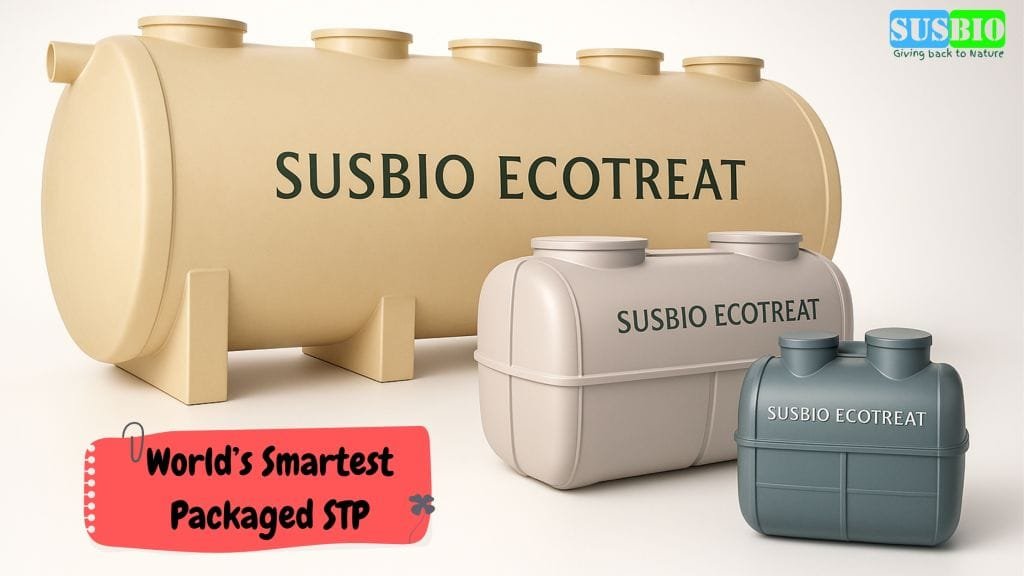
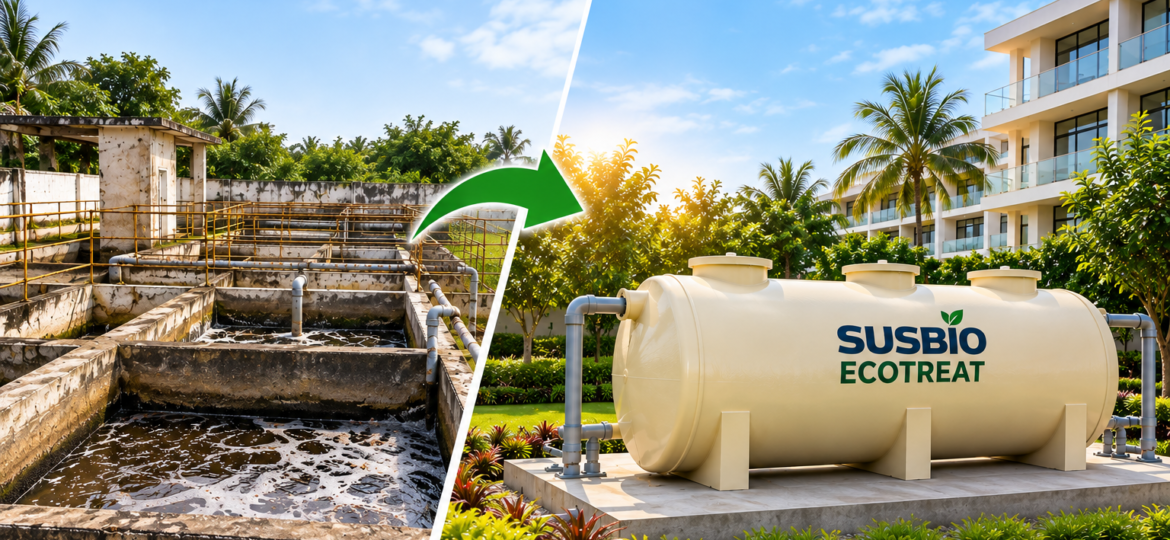
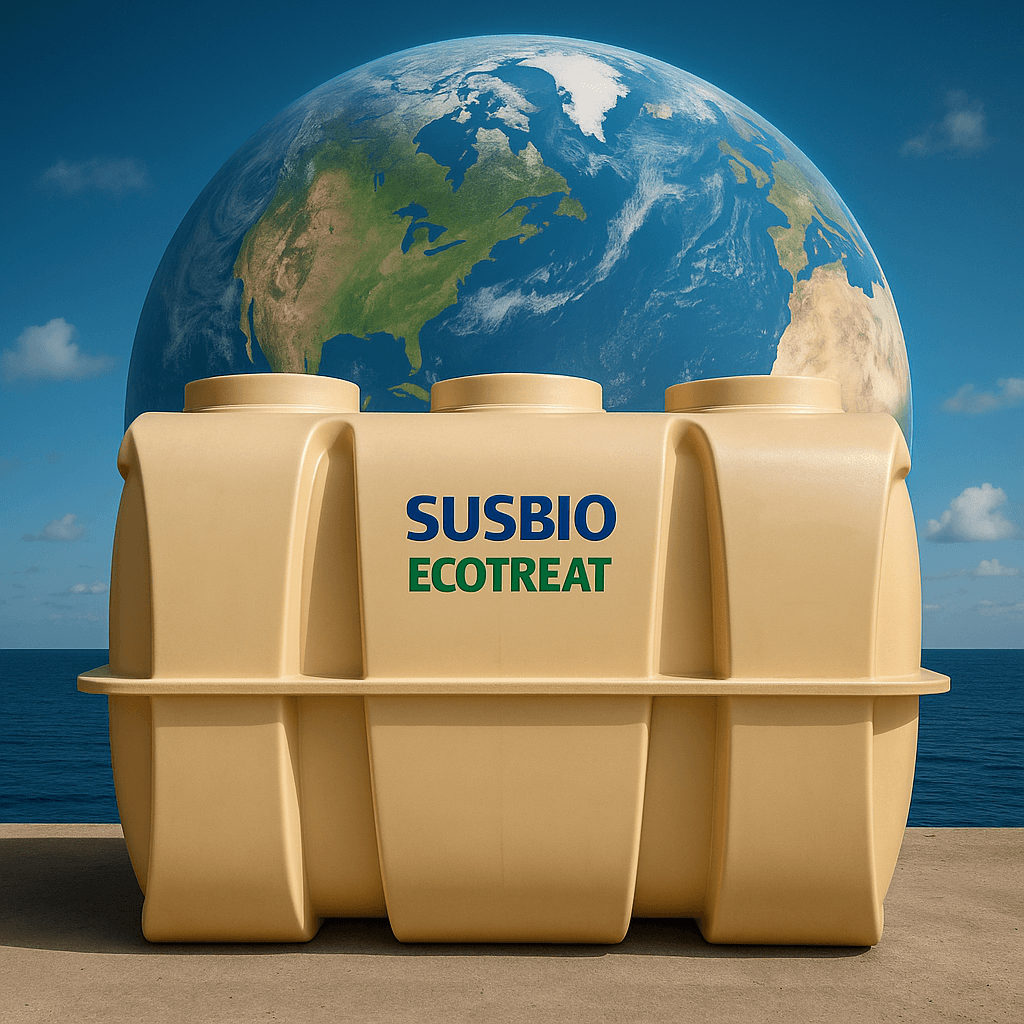
SUSBIO ECOTREAT moves wastewater through oil and grease separation, sedimentation, anaerobic contact media, MBBR biofilm treatment, secondary sedimentation, and disinfection — delivering dual-stage biological treatment through a single prefabricated FRP vessel with no civil construction required beyond a level base.
Technical specifications
| Spec | Detail |
|---|---|
| Capacity range | 1–500 KLD |
| Construction | Fiber-reinforced plastic (FRP), corrosion-resistant |
| Treatment technology | Anaerobic + MBBR (dual-stage biological) |
| Installation time | 3–5 days on a prepared level base |
| Energy consumption | 70% less electricity than conventional STPs |
| Effluent standard | CPCB Class A (BOD ≤10 mg/L, COD ≤50 mg/L, TSS ≤10 mg/L) |
| Operational lifespan | 15–25 years with minimal maintenance |
| Operation | Fully automated — no specialist operator required |
| Footprint | Compact, no civil tanks, no extended site works |
SUSBIO ECOTREAT vs. Conventional STPs
| Factor | SUSBIO ECOTREAT | Conventional STP |
|---|---|---|
| Installation time | 3–5 days | 3–6 months civil construction |
| Energy consumption | 70% less electricity | High operational power draw |
| Operator requirement | Fully automated | Specialist operator required |
| Construction material | FRP — corrosion and heat resistant | Steel (corrodes) or concrete (cracks) |
| Footprint | Compact single vessel | Extensive civil footprint |
| Water reuse suitability | CPCB Class A — suitable for reuse | Often requires additional tertiary treatment |
| Freight to remote sites | Single vessel, one delivery | Multiple mobilizations required |
Where SUSBIO ECOTREAT Is Used in Australia
Mining and resources accommodation camps
Fly-in-fly-out mining accommodation in Western Australia and Queensland — particularly across the Pilbara, Goldfields, and Bowen Basin — requires reliable, automated sewage treatment with minimal maintenance overhead. SUSBIO ECOTREAT’s 70% electricity saving is directly relevant at sites running on diesel generation, where operational cost compounds significantly over a 15–25 year mine life. FRP construction handles the Pilbara’s extreme temperatures without the corrosion and thermal stress issues that affect steel-fabricated systems.
Eco-resorts and remote tourism facilities
Australia’s eco-tourism sector — from Cape York peninsula lodges to Kimberley wilderness camps and Great Barrier Reef island resorts — operates in locations where environmental compliance is both regulatory and reputational. SUSBIO ECOTREAT’s CPCB Class A effluent quality supports treated water reuse for landscaping and irrigation, while its enclosed, odour-free operation maintains the guest experience that premium eco-tourism depends on.
Residential developments outside sewerage networks
Fast-growing peri-urban developments across Queensland, NSW, and WA frequently sit beyond the reach of reticulated sewerage networks. SUSBIO ECOTREAT’s automated, low-maintenance operation suits residential societies and developers where dedicated wastewater management staff is impractical, and its compact design fits constrained suburban and semi-rural plot sizes.
Commercial and hospitality projects
Hotels, resorts, aged care facilities, and commercial campuses across Australia require consistent effluent quality regardless of occupancy variation. SUSBIO ECOTREAT’s automated operation and Class A-capable treatment suit facilities where regulatory compliance must be maintained reliably without specialist technical staff.
Infrastructure and construction camps
Major infrastructure projects — rail corridors, highway construction, pipeline projects — establish temporary or semi-permanent accommodation camps requiring on-site sewage treatment for the construction duration. SUSBIO ECOTREAT’s fast installation and relocatable design suits the project lifecycle of construction camp applications.
Remote agricultural and pastoral stations
Large pastoral stations across outback Queensland, NT, and WA house permanent workforces requiring compliant on-site sewage treatment for decades. Low energy consumption, minimal maintenance, and long operational lifespan make SUSBIO ECOTREAT a practical fit for station infrastructure that must run reliably without major intervention.
What to Verify Before Specifying an Imported Packaged STP for Australia
Imported STPs can offer genuine cost advantages over locally manufactured equivalents. Before specification, Australian project managers and procurement teams should verify:
1. State EPA and local authority compliance. Confirm the system’s effluent quality meets your state’s specific discharge licence conditions. Engage a local hydraulic engineer or environmental consultant to review the technical specification against your site’s requirements — CPCB Class A is a robust benchmark, but each state’s approval pathway has specific documentation requirements.
2. Total landed cost. Calculate ocean freight, port charges, import duty (if applicable), and inland freight to site. For remote Australian locations, inland freight from port to site is often a significant cost component. SUSBIO ECOTREAT’s compact single-vessel design simplifies logistics — one unit, one delivery, one crane lift onto a prepared base.
3. Commissioning and after-installation support. Confirm what commissioning support is included in the supply scope. SUSBIO provides commissioning support and technical documentation for Australian projects — confirm specific arrangements at the time of order.
4. Long-term spare parts availability. A 15–25 year operational lifespan requires a reliable spare parts supply chain. Verify that critical consumable components are available through Australian supply channels or can be reliably sourced internationally within acceptable lead times.
5. FRP specification for Australian conditions. Confirm the FRP laminate specification — wall thickness, resin type, UV resistance rating — against your site’s specific conditions (UV exposure, temperature range, salt air proximity, chemical exposure).
SUSBIO's Track Record in Australia and the Asia-Pacific
SUSBIO has been exporting ECOTREAT packaged STPs to international markets since 2013, with installations across 8 countries including Australia, Sri Lanka, Bangladesh, Nepal, Saudi Arabia, UAE, Oman, and Mauritius. The export programme has validated SUSBIO ECOTREAT’s performance in climatic and operational conditions comparable to Australia’s most demanding project environments — high-heat Gulf installations, remote island facilities in the Indian Ocean, and off-grid resort applications across South Asia.
For project-specific references, technical documentation, and compliance specifications relevant to your Australian state and project type, contact SUSBIO’s technical team directly.
Why Australian Projects Choose SUSBIO ECOTREAT
Australia’s wastewater treatment market demands systems that work reliably in conditions that would challenge most equipment — extreme heat, salt air, diesel-dependent energy, vast distances from service support, and project timelines that conventional civil construction cannot meet. SUSBIO ECOTREAT was built for exactly these constraints.
Since 2013, SUSBIO has delivered 500+ installations across 24 Indian states and exports to 8 countries — including Australia. Every ECOTREAT unit leaves our Pune manufacturing facility factory-tested, FRP-fabricated for long-term durability, and configured for automated operation without specialist on-site staff. The same product that handles a remote eco-resort in the Maldives or a mining accommodation facility in the Gulf handles the Pilbara, the Kimberley, and the Queensland outback.
70% less electricity. 3–5 day installation. 15–25 year operational lifespan. No specialist operator required. CPCB Class A effluent — suitable for reuse.
For Australian project enquiries, technical documentation, state EPA compliance specifications, and FOB pricing, contact SUSBIO’s technical team directly.
Frequently Asked Questions
Q1: Is SUSBIO ECOTREAT approved for use in Australia?
SUSBIO ECOTREAT is CPCB (India) Class A compliant, achieving BOD ≤10 mg/L, COD ≤50 mg/L, and TSS ≤10 mg/L — broadly comparable to Australia’s Class A recycled water quality requirements. On-site wastewater treatment approval in Australia is managed at the state level through each state’s EPA and relevant local authority. Buyers should engage a local hydraulic engineer or environmental consultant to confirm suitability for their specific site, licence conditions, and state approval pathway.
Q2: How much can SUSBIO ECOTREAT save on electricity costs at an Australian project site?
SUSBIO ECOTREAT consumes 70% less electricity than conventional activated sludge STPs. At remote Australian diesel generation costs — often exceeding AUD $0.40–$0.60/kWh — this translates into substantial annual savings compounding over a 15–25 year lifespan. At grid-connected urban sites, the saving is proportionally smaller but still significant over the system’s operational life. SUSBIO’s technical team can provide a site-specific energy comparison on request.
Q3: How quickly can SUSBIO ECOTREAT be installed at an Australian site?
SUSBIO ECOTREAT installs in 3–5 days on a prepared level base, with minimal civil work required. The single-vessel prefabricated design means one delivery, one crane lift, and straightforward connection to site services — significantly faster than conventional civil STP construction timelines of 3–6 months.
Q4: Does SUSBIO ECOTREAT require a specialist operator?
No. The system is fully automated, requiring no specialist wastewater operator on site. Routine maintenance checks can be performed by general site maintenance staff. Remote monitoring capability is available for sites with data connectivity — relevant for mining camps, eco-resorts, and rural stations.
Q5: How does FRP construction perform in Australian conditions?
FRP is inherently corrosion-resistant, performs reliably across extreme temperature ranges, and is unaffected by salt air — addressing the two most common failure modes for STPs in Australian conditions (corrosion and thermal stress). SUSBIO ECOTREAT’s FRP vessel is designed for a 15–25 year operational lifespan across Australia’s most demanding environments including the Pilbara, coastal Queensland, and the NT.
Q6: What capacity range does SUSBIO ECOTREAT cover for Australian projects?
SUSBIO ECOTREAT spans 1–500 KLD — covering small remote station workforces, mid-sized eco-resorts and mining accommodation camps, and larger construction camps, residential developments, and commercial facilities within a single product family.
Q7: Can treated effluent from SUSBIO ECOTREAT be reused?
Yes. SUSBIO ECOTREAT produces effluent meeting CPCB Class A standards — BOD ≤10 mg/L, COD ≤50 mg/L, TSS ≤10 mg/L — suitable for non-potable reuse including landscaping irrigation, dust suppression, toilet flushing, and cooling tower makeup, subject to confirmation against your state EPA’s specific recycled water quality requirements.
Q8: What are the freight and logistics considerations for importing SUSBIO ECOTREAT to Australia?
SUSBIO ECOTREAT ships as a single compact FRP vessel, simplifying container freight from India to Australian ports. Total landed cost — including ocean freight, import duty, port charges, and inland freight — should be calculated as part of the project cost. SUSBIO’s team provides FOB pricing and can advise on freight logistics for Australian destinations including remote inland sites.
Q9: Does SUSBIO provide after-sales support for Australian installations?
SUSBIO provides technical documentation, commissioning support, and spare parts supply for Australian installations. Buyers should confirm specific arrangements — including commissioning attendance, warranty terms, and spare parts lead times — at the time of order to ensure alignment with project requirements.