

It happens more often than you might think. A developer planning a residential complex or hotel hears about biogas plants — green, energy-generating, eco-friendly — and assumes it ticks the box for wastewater management. A contractor quotes a biogas digester as a cheaper alternative to a sewage treatment plant. The project goes ahead, the occupancy certificate is applied for, and then the pollution control board inspection arrives.
The result? Non-compliance. Penalties. Delays. And a costly retrofit.
The root of this problem is a genuine misunderstanding about what a biogas plant does versus what a packaged sewage treatment plant (STP) does. They are not substitutes. They serve fundamentally different purposes. And in 2026, with India’s environmental enforcement tighter than ever, getting this wrong is an expensive mistake.
This blog sets the record straight — with facts, data, and a clear comparison — so you can make the right infrastructure decision for your project.
What Is a Biogas Plant? (And What It Is NOT)
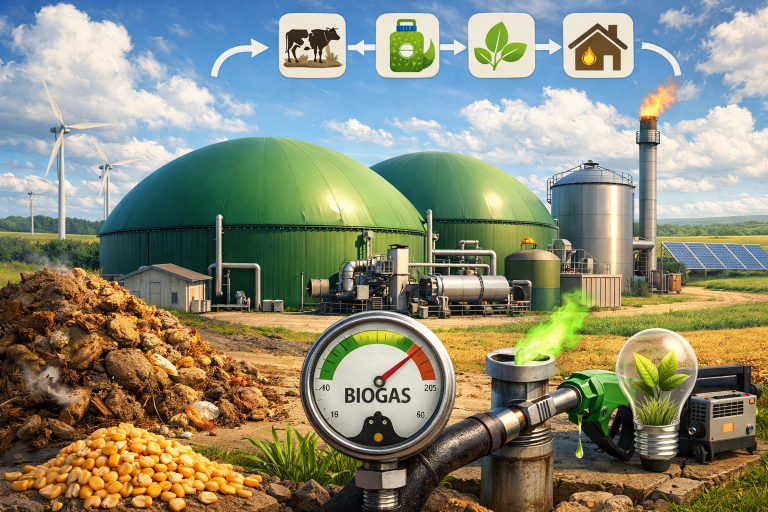
A biogas plant uses a process called anaerobic digestion — the breakdown of organic matter by microorganisms in the absence of oxygen — to produce biogas, a mixture of methane and carbon dioxide that can be used as fuel.
Common feedstocks for a biogas plant include:
- Cattle dung and animal waste
- Agricultural residue (rice straw, crop stubble)
- Food waste and kitchen waste
- Municipal solid waste (organic fraction)
- Sewage sludge — a by-product of wastewater treatment
Notice the last item: sewage sludge. This is the key distinction. A biogas plant may consume sludge produced by an STP — but it cannot replace the STP itself. Raw sewage from your toilets, kitchens, and washrooms cannot simply be fed into a biogas digester and come out as clean, compliant effluent.
A biogas plant is an energy recovery system. It recovers fuel from organic waste. It is NOT a wastewater treatment system. It does not produce clean, safe, reusable water. |
Biogas technology at large scale — for instance, municipal sewage-to-Bio-CNG projects of 10 MLD and above — is genuinely promising. It transforms an STP from a cost centre into a revenue-generating asset. But that is a supplementary function layered on top of a fully functioning treatment plant, not a replacement for one.
What Is a Packaged STP? (The Complete Wastewater Solution)
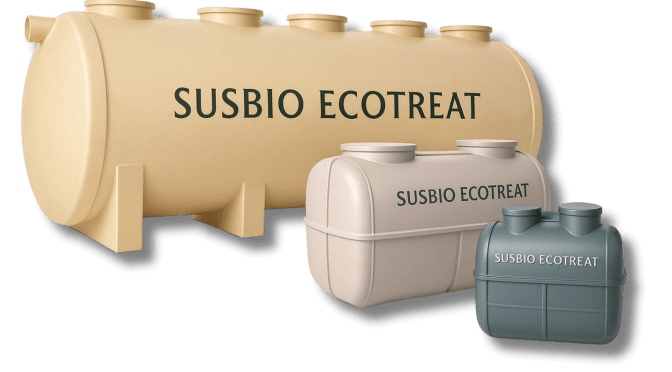
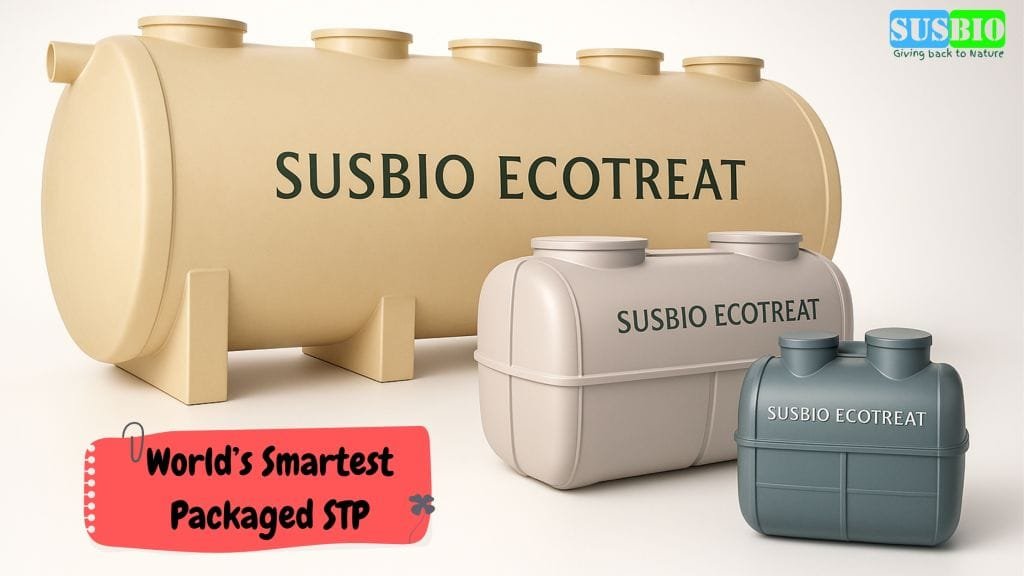
A packaged sewage treatment plant is a factory-built, pre-engineered, modular system that takes raw sewage and treats it through multiple biological and physical stages to produce clean, reusable effluent that meets regulatory standards.
A packaged STP treats wastewater through:
- Screening and grit removal — removing large solids and particles
- Equalization — stabilising flow variations
- Biological treatment — breaking down organic matter using microorganisms (MBBR, MBR, or hybrid processes)
- Membrane filtration — separating treated water from biomass
- Tertiary treatment — disinfection using UV or chlorination
The end product is treated water with BOD, COD, TSS, and coliform levels within CPCB-mandated discharge norms — water clean enough for toilet flushing, landscape irrigation, cooling towers, and groundwater recharge.
SUSBIO ECOTREAT, for instance, uses a proprietary MBBR+MBR hybrid process that achieves BOD below 10 mg/L and COD below 50 mg/L — consistently exceeding 2026 CPCB standards — while cutting sludge production by up to 78% and consuming 90% less energy than a conventional civil STP.
Why the Confusion Happens — And Why It Is Dangerous
The confusion between biogas plants and STPs arises from several overlapping factors:
Reason 1: Both deal with organic waste
Since sewage contains organic matter, and biogas plants process organic matter, it seems logical that a biogas plant could handle sewage. It cannot handle it completely — anaerobic digestion alone does not remove pathogens, nutrients, suspended solids, or residual organics to the levels required by law.
Reason 2: Low-cost vendors misrepresent biogas systems
Some contractors quote biogas digesters as ‘eco-friendly wastewater solutions’ to win bids on price. The client installs it, believes the problem is solved, and only discovers the gap during a compliance inspection.
Reason 3: The ‘green’ narrative
Biogas plants generate renewable energy, which sounds appealing. But environmental sustainability is not the same as regulatory compliance. You need both clean energy AND clean water — not one instead of the other.
The Compliance Reality in 2026
India’s regulatory environment for wastewater has undergone a decisive shift in 2026. Here is what facility managers, builders, and RWAs need to understand:
- CPCB 2026 norms mandate: BOD < 10 mg/L, COD < 50 mg/L, TSS < 10 mg/L, and coliform removal for any treated effluent discharged or reused.
- NGT enforcement: The National Green Tribunal has emerged as the strongest enforcement authority, with documented fines and shutdown orders for non-compliant facilities.
- AMRUT 2.0 mandate: Cities above 1 lakh population must recycle a minimum of 20% of their wastewater — requiring proper treatment infrastructure, not biogas digesters.
- State PCB inspections: State Pollution Control Boards are increasingly conducting effluent quality tests. A poorly performing or incomplete system is treated as non-compliant even if something has been installed.
- Wastewater reuse mandates: Many cities now require treated water to be reused for flushing, landscaping, or construction. A biogas system produces no reusable water.
A standalone biogas plant fails all of the above tests. A properly installed and maintained packaged STP like SUSBIO ECOTREAT meets all of them.
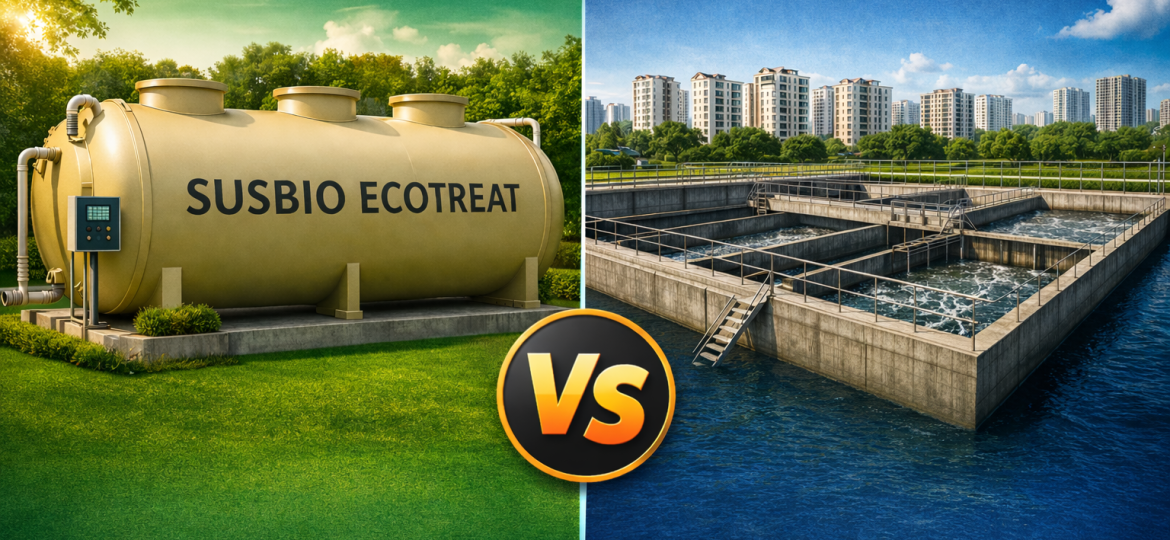
Side-by-Side Comparison: Biogas Plant vs Packaged STP
| Parameter | Standalone Biogas Plant | Packaged STP (SUSBIO ECOTREAT) |
|---|---|---|
| Primary purpose | Energy recovery from organic waste | Wastewater treatment + safe reuse |
| Clean water output | No — produces digestate slurry | Yes — reusable quality effluent |
| CPCB / SPCB compliance | Not achieved as standalone | Fully compliant, 2026 norms |
| BOD in treated water | High — not treated to standard | Below 10 mg/L (exceeds norms) |
| COD in treated water | High — not treated to standard | Below 50 mg/L (exceeds norms) |
| Odour management | Poor — H2S gas emissions | Enclosed, odour-controlled |
| Installation time | Weeks to months (civil work) | Days — plug & play modular |
| Land / space needed | Large footprint required | 40–60% less space than civil STP |
| Energy consumption | Produces gas but needs infra | 90% less than conventional STP |
| Sludge produced | High digestate volume | Up to 78% less sludge (MBR-OSA) |
| NGT penalty risk | High — effluent not compliant | Low — built for compliance |
| Water reuse potential | None | Flushing, gardening, cooling towers |
| Ideal scale | 10 MLD+ municipal plants | 50 KLD to 500+ KLD |
| Best suited for | Rural / agricultural / large cities | Residential, hotels, hospitals, industries |
When Does Biogas Actually Make Sense?
To be clear: biogas technology is not bad. It is simply misapplied when used as a substitute for wastewater treatment. Here is when biogas is genuinely valuable:
- Large municipal STPs (10 MLD and above): At this scale, sludge volumes are large enough to justify anaerobic digesters and Bio-CNG upgrading systems — turning the STP into a revenue-generating facility.
- Agricultural and rural settings: Cattle dung-based gobar gas plants are proven and cost-effective for rural households and farms.
- Food processing industries: High-organic-load industrial effluent can benefit from biogas recovery as part of a larger ETP system.
- As a supplementary layer on an STP: For a large residential township or hotel complex, sludge from the STP can feed a small biogas unit — offsetting electricity or cooking gas costs.
None of the above cases involve replacing an STP. They all add biogas recovery on top of proper treatment infrastructure.
The SUSBIO ECOTREAT Advantage
SUSBIO ECOTREAT is India’s most advanced packaged sewage treatment plant — designed specifically for the regulatory, spatial, and operational realities of residential complexes, hotels, hospitals, and industrial facilities in 2026.
Why SUSBIO ECOTREAT is the right choice:
- CPCB 2026 compliant by design: BOD < 10 mg/L and COD < 50 mg/L — consistently surpassing regulatory requirements.
- MBBR + MBR hybrid technology: The best of biological treatment and membrane filtration in a single, compact system.
- 90% less energy: Dramatically lower operating costs compared to conventional civil STPs.
- 78% less sludge: MBR-OSA technology minimises sludge production — reducing disposal headaches and costs.
- Plug-and-play installation: Ready to operate in days, not months. Minimal civil work. No excavation surprises.
- 40–60% smaller footprint: Ideal for urban sites, basement installations, and space-constrained projects.
- Treated water for reuse: Output quality suitable for flushing, gardening, cooling towers, and construction — cutting your freshwater bill.
- In-house technical support: Dedicated AMC teams ensure consistent performance and regulatory compliance throughout the system’s life.
The Bottom Line
If your project generates sewage — from residents, guests, patients, or workers — you need a sewage treatment plant. That is not a choice; it is a legal requirement under CPCB norms, enforced by the NGT, your State Pollution Control Board, and increasingly, your local municipal authority.
A biogas plant, however green its credentials, does not treat your sewage to the standard the law requires. It does not produce clean, reusable water. It does not protect you from penalties. And it will not get you your occupancy certificate.
A packaged STP like SUSBIO ECOTREAT does all of this — compactly, efficiently, affordably, and with in-house technical support from day one to year twenty.
Frequently Asked Questions
1. What is the main difference between a biogas plant and a packaged STP?
A biogas plant converts organic waste into biogas (energy), while a packaged STP treats sewage water to make it safe for discharge or reuse.
2. Which system is suitable for residential or commercial projects?
A packaged STP is mandatory for treating wastewater in most projects, whereas a biogas plant is optional and depends on the availability of organic waste.
3. Can a biogas plant replace a sewage treatment plant?
No, a biogas plant cannot replace an STP, as it does not fully treat wastewater to meet environmental discharge standards.
4. Which option offers better long-term benefits?
Packaged STPs provide consistent compliance and water reuse benefits, while biogas plants offer additional energy savings when sufficient organic waste is available.
5. Can biogas plants and packaged STPs be used together?
Yes, both systems can be integrated—STP treats wastewater, and the biogas plant processes sludge or organic waste for energy, creating a sustainable solution.