

More than one in five American households – over 60 million people – don’t send their wastewater to a centralized municipal treatment plant at all. They rely on individual or small community onsite systems: septic tanks, package plants, and decentralized treatment units doing, quietly and locally, the job a city sewer line does everywhere else. That number isn’t shrinking. If anything, it’s the fastest-growing part of the US wastewater picture, because it’s simply cheaper and faster to treat wastewater close to where it’s generated than to dig miles of new sewer main to reach it. This piece is about that shift, what to actually look for in a decentralized treatment system, and why we built SUSBIO ECOTREAT around exactly this kind of need.
What is decentralized wastewater treatment, and why is it growing in the US
Decentralized (or onsite) wastewater treatment means treating sewage at or near the property where it’s generated, instead of piping it to a centralized municipal plant. It ranges from simple soil-based septic systems to fully mechanized package treatment plants that produce high-quality, dischargeable or reusable water on-site.
- More than a third of all new development in the US is served by septic or other decentralized systems rather than municipal sewer, according to EPA data – a reflection of how expensive and slow it’s become to extend centralized infrastructure to new or rural sites.
- Septic and decentralized system density already varies from around 10% of homes in dense states like California to more than half of homes in states like Vermont – and growth in exurban and rural development keeps pushing more properties toward onsite treatment, not away from it.
- Water scarcity in the West and Southwest is pushing developers and municipalities toward onsite treatment paired with reuse – treated water for irrigation, cooling towers, and flushing – rather than one-way water use.
- States with sensitive coastal and lake ecosystems are tightening nitrogen and phosphorus discharge limits, raising the bar for what an onsite system needs to deliver, not just whether one is installed.
- Seasonal and remote-occupancy properties – RV resorts, campgrounds, vacation communities, hospitality developments – often can’t economically justify a sewer connection at all, no matter how large they get.
What to actually look for in a packaged sewage treatment plant
If you’re evaluating an onsite or package wastewater treatment system for a property in the US, the technology on the spec sheet matters less than a handful of practical questions. Here’s what we tell every prospective client to check, regardless of who they end up buying from:
- Biological process resilience: does the system handle load spikes and intermittent occupancy gracefully, or does performance collapse the first weekend the property is at full capacity? This matters enormously for hospitality, RV parks, and seasonal residential sites, and far less for a steady daily-load office building.
- Installation speed and site disruption: a prefabricated, factory-tested plant installs in days; a site-built concrete plant can take months of civil work, which matters on active hospitality or residential construction sites where downtime is expensive.
- Energy consumption: aeration and blower power draw is usually the single largest ongoing operating cost of a package plant. The difference between an efficient and inefficient design compounds every month for the life of the plant.
- Footprint and corrosion resistance: fiber-reinforced plastic (FRP) construction resists corrosion far better than mild steel in wastewater service, and a compact footprint matters on tight urban or coastal lots.
- Documented track record: how many units are actually operating today, for how many years, across how many climates and load profiles – not just a lab test result.
- Certification and regulatory pathway: in the US, this means NSF/ANSI 40 (organic and solids reduction) and, where nutrient-sensitive local rules apply, NSF/ANSI 245 (nitrogen reduction) – the standards referenced inside most state and county onsite wastewater codes.
How SUSBIO ECOTREAT's Anaerobic + MBBR technology works
ECOTREAT runs a two-stage biological process that was built specifically to be resilient against the kind of unpredictable, spiking loads that break simpler package plants.
- Stage one – Anaerobic pre-treatment: incoming sewage passes through a sealed anaerobic chamber first. Anaerobic bacteria break down complex organic compounds without oxygen, cutting incoming BOD by 40-60% before the water ever reaches the biological treatment stage. This is the step many cheaper packaged plants skip entirely – and it’s exactly why those plants struggle when load spikes on a busy weekend.
- Stage two – Moving Bed Biofilm Reactor (MBBR): free-floating plastic carriers inside the aeration chamber provide a large surface area for aerobic bacteria to colonize. These organisms consume the remaining organic load and carry out nitrification. Because the biomass lives on the carriers rather than in suspension, MBBR handles flow and load fluctuations far better than conventional activated sludge, with no sludge recirculation required.
- Clarification and disinfection: treated water passes through a settling zone where remaining biomass separates out, and clarified water is disinfected before discharge or reuse.
The result is a plant that treats variable, real-world loading – not just steady, textbook loading – reliably. That’s the exact profile of most decentralized US properties: hotels with weekend peaks, RV resorts with seasonal swings, residential communities with morning-and-evening surges.
Why SUSBIO ECOTREAT is a strong fit for US properties

- Prefabricated FRP construction, installed in 3-5 days once the unit reaches site – a meaningful advantage anywhere skilled trade labor is expensive or backlogged, which describes most of the US onsite construction market today.
- 70% less electricity consumption than conventional sewage treatment systems, which matters directly to the bottom line on any property carrying an onsite plant as a permanent operating cost, and makes ECOTREAT a strong match for off-grid or solar-hybrid sites.
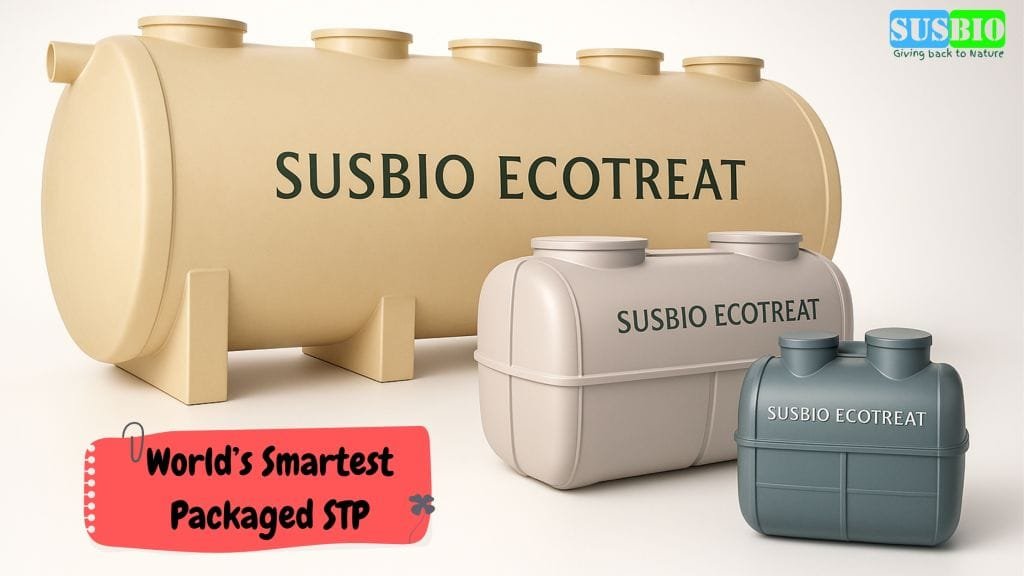
- Scalable from 1 KLD to 500 KLD (roughly 264 to 132,000 gallons per day), covering everything from a single hospitality property to a large residential or institutional development on one platform.
- A 10-year material warranty on the FRP vessel, reflecting a construction standard built for decades of continuous wastewater exposure, not a short product lifecycle.
- A genuinely field-proven track record: 500+ installations across 24 Indian states and export markets in 8 countries, covering hospitality, healthcare, residential, industrial, and institutional sites – not a lab prototype, but a design that has been running in the field for 13+ years since SUSBIO’s founding in 2013.
- A design built around a country with far less centralized sewer infrastructure than the US on a per-capita basis – meaning ECOTREAT was engineered from day one for exactly the decentralized, self-sufficient operating model that unsewered US properties need, rather than adapted after the fact from a municipal-scale design.
Where ECOTREAT fits best in the US market
- Hospitality and resort properties – hotels, RV parks, campgrounds, and vacation communities with seasonal or weekend-peaked occupancy, where the anaerobic buffering stage genuinely matters.
- Residential developments and gated communities outside municipal sewer service areas, where a compact, fast-install plant avoids months of civil construction delay.
- Institutional and commercial sites – schools, small hospitals, industrial parks – needing dependable, low-maintenance treatment without a large operations team on-site.
- Off-grid, rural, and remote sites where every kilowatt-hour matters and centralized sewer access simply isn’t coming.
What's next for ECOTREAT in the US
SUSBIO ECOTREAT is currently manufactured in Goa and Pune, India, and exported to 8 countries across South Asia and the Gulf. As we bring ECOTREAT to the US market, our approach is straightforward: pursue NSF/ANSI 40 and 245 certification, the standards referenced across US state and county onsite wastewater codes, and build a proper US-based distribution and service partnership so every installation has fast, local support – the same standard of accountability our 500+ installations in India and existing export markets already run on.
If you’re a developer, hotelier, or institution planning a property in an unsewered or under-served US location, we’d genuinely like to talk with you early – decentralized treatment decisions are easiest to get right at the design stage, not after ground has broken.
Frequently Asked Questions
What is a decentralized or onsite sewage treatment plant?It’s a wastewater treatment system that operates at or near the property generating the sewage, rather than piping it to a centralized municipal plant. It ranges from simple septic systems to fully mechanized package plants like SUSBIO ECOTREAT.
What technology does SUSBIO ECOTREAT use?A two-stage Anaerobic + Moving Bed Biofilm Reactor (MBBR) process: anaerobic pre-treatment reduces incoming BOD by 40-60%, followed by MBBR biological treatment and nitrification, then clarification and disinfection.
How much electricity does SUSBIO ECOTREAT use compared to conventional systems?ECOTREAT uses 70% less electricity than conventional sewage treatment systems, thanks to its optimized aeration and biofilm-based design.
How long does installation take?Most ECOTREAT installations are completed in 3-5 days once the prefabricated FRP unit arrives on-site, since it requires minimal civil work compared to a site-built plant.
What size properties can ECOTREAT serve?ECOTREAT scales from 1 KLD to 500 KLD (roughly 264 to 132,000 gallons per day), covering single hospitality properties up to large residential and institutional developments.
Is SUSBIO ECOTREAT currently available in the US?SUSBIO ECOTREAT is manufactured in India and currently exported to 8 countries across South Asia and the Gulf. SUSBIO is pursuing NSF/ANSI 40 and 245 certification and a US distribution partnership to bring ECOTREAT to the US market – reach out to discuss early-stage projects.