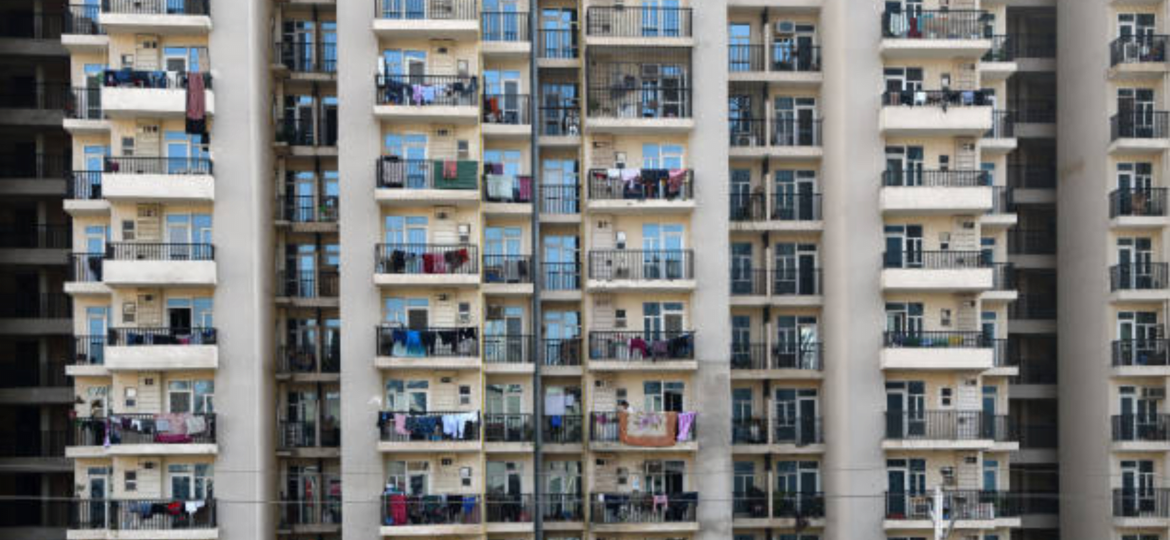


Across India’s rapidly urbanising landscape, a growing category of mid-sized buildings is emerging as a major contributor to untreated sewage: small apartment complexes with 20-40 units, boutique hotels with 20-30 rooms, community hospitals with 30-50 beds, and mid-sized institutional buildings generating 8,000-12,000 litres of domestic sewage per day. These buildings are too large to be served by a single household STP, yet too small to justify the cost and complexity of a large civil sewage treatment plant. They sit in a gap that, until recently, was poorly served by the Indian wastewater equipment market.
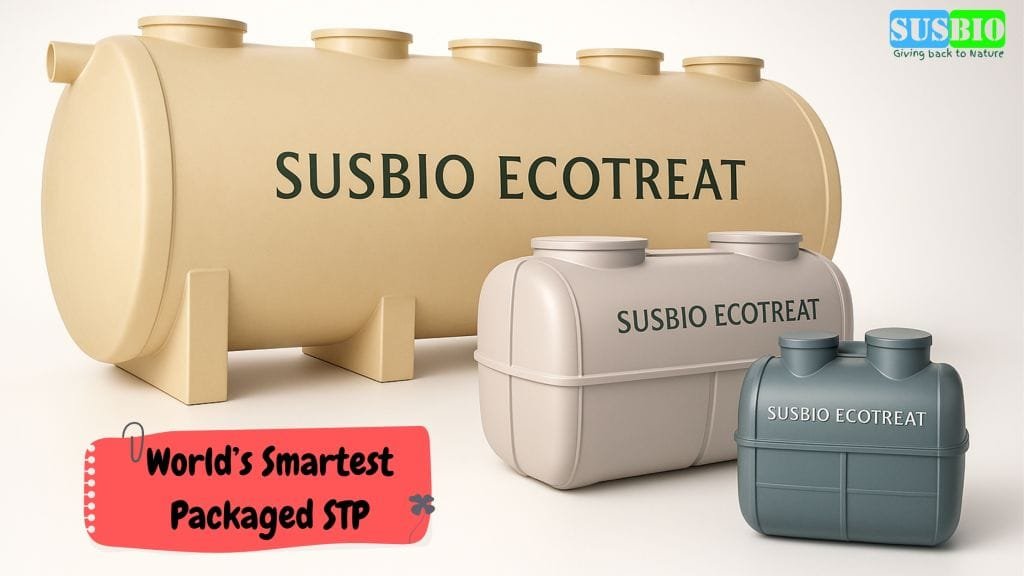
The SUSBIO ECOTREAT 10 KLD is designed specifically to fill this gap — a CPCB-approved, single-vessel packaged sewage treatment plant that treats 10,000 litres of domestic sewage per day, serves 40-50 persons, and delivers reuse-grade outlet water quality in a compact, factory-manufactured FRP unit at Rs. 8.5 lakhs.
This blog is the complete technical and commercial guide to the SUSBIO ECOTREAT 10 KLD — covering how it works, who needs it, what regulations apply, how it compares to civil STP alternatives, and why it is the most technically advanced and commercially sensible 10 KLD packaged STP available in India today.
What Is a 10 KLD Sewage Treatment Plant?
A 10 KLD sewage treatment plant processes ten thousand litres of raw domestic sewage every day. Based on the CPHEEO design norm of 135-200 litres per capita per day (LPCD) for residential and institutional use, a 10 KLD STP is designed to serve approximately 40-50 persons on a sustained daily basis.
In practical building terms, this translates to:
- A small apartment complex of 15-25 units with an average occupancy of 2-3 persons per flat.
- A boutique hotel or resort with 20-30 rooms at typical occupancy rates.
- A community hospital or nursing home with 30-50 beds plus medical staff.
- A mid-sized school, college hostel, or institutional building with 40-60 resident occupants.
- A large guesthouse, service apartment, or corporate residential facility.
Raw sewage from these buildings contains a mix of blackwater (from toilets) and greywater (from bathrooms, kitchens, and laundry), carrying BOD levels of 150-350 mg/L, COD of 300-700 mg/L, TSS of 150-400 mg/L, and fecal coliform counts in the millions per 100 mL. Without proper treatment, this load represents a serious public health and environmental liability for building owners, facility managers, and surrounding communities.
The SUSBIO ECOTREAT 10 KLD addresses this comprehensively — reducing BOD to below 10 mg/L, COD to below 50 mg/L, and TSS to below 20 mg/L through its dual-stage Anaerobic + MBBR biological treatment process, producing a treated effluent that is safe for reuse and fully compliant with CPCB discharge standards.
Why Apartments, Hotels, and Hospitals in India Need a 10 KLD STP
The Apartment Complex Challenge
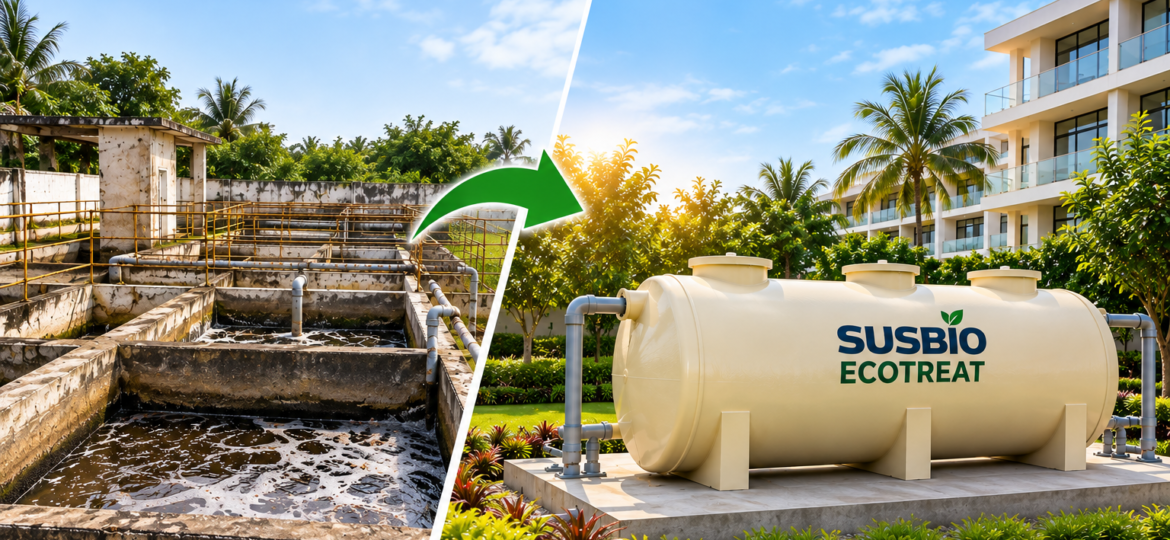
Small and mid-sized apartment complexes represent one of the fastest-growing segments of India’s residential real estate market and one of the most underserved in terms of on-site wastewater infrastructure. Many complexes with 20-40 units were built without an on-site STP, relying instead on municipal sewer connections that are often non-functional, under-capacity, or simply absent in newer layouts and peripheral urban areas.
Resident welfare associations (RWAs) in such complexes increasingly face SPCB notices, court orders, and NGT penalties for untreated sewage discharge. The SUSBIO ECOTREAT 10 KLD provides the right-sized, cost-effective solution: a single factory-manufactured unit that can be installed within weeks with minimal civil disruption to the existing complex.
The Hotel and Resort Challenge
Hospitality properties — boutique hotels, resorts, and heritage guesthouses — face some of the strictest environmental scrutiny of any building category in India. Many operate in ecologically sensitive locations: coastal zones, riverbanks, hill stations, forest areas, and wildlife buffer zones — all of which are subject to CRZ regulations, NGT directives, and state-specific environmental conditions. A non-compliant STP — or worse, no STP at all — is one of the most common grounds for closure notices and licence cancellations for hospitality properties.
Beyond compliance, hotels that install the SUSBIO ECOTREAT 10 KLD gain a tangible operational advantage: treated water available for toilet flushing and garden irrigation, reducing freshwater procurement costs — a significant saving for properties in water-scarce tourist destinations.
The Hospital and Healthcare Facility Challenge
Hospital and healthcare facility wastewater is among the most complex and regulated categories of domestic sewage. In addition to the standard domestic pollutants (BOD, COD, TSS), hospital effluent may contain pharmaceutical residues, disinfectant chemicals, and elevated pathogen loads from patient care areas. The SUSBIO ECOTREAT 10 KLD’s dual biological treatment stages, combined with UV disinfection, provide the comprehensive treatment needed to bring hospital effluent within CPCB discharge norms — protecting the surrounding environment and the facility’s regulatory standing with the SPCB and local health authorities.
Regulatory Framework: What Building Owners and Facility Managers Must Know
The regulatory obligation to install a functional, CPCB-compliant STP applies to all buildings of the types served by the SUSBIO ECOTREAT 10 KLD. Key regulatory instruments include:
- Environment (Protection) Act, 1986: The foundational legislation mandating that all establishments treat wastewater to CPCB standards before discharge. Applies to apartment complexes, hotels, and hospitals without exception.
- Water (Prevention and Control of Pollution) Act, 1974: Prohibits discharge of untreated or inadequately treated sewage into any water body, drain, or land. Enforced by State Pollution Control Boards through Consent to Establish (CTE) and Consent to Operate (CTO) mechanisms.
- CPCB Discharge Standards (Schedule VI, EP Rules 1986): Sets minimum outlet quality: BOD < 30 mg/L, TSS < 100 mg/L for inland surface water discharge. The SUSBIO ECOTREAT 10 KLD exceeds these by 3-5x.
- NGT Orders on Apartment Complexes: The National Green Tribunal has specifically directed that all apartment complexes above a defined threshold must install functional STPs and submit compliance reports. Non-compliance attracts penalties of Rs. 50,000 to several lakhs per violation.
- State-Specific Hotel and Tourism Regulations: States including Goa, Kerala, Himachal Pradesh, and Uttarakhand mandate on-site STPs for all hospitality establishments as a condition of trade licence and tourism department registration renewal.
- NABH / Healthcare Regulations: National Accreditation Board for Hospitals and Healthcare Providers (NABH) accreditation standards include requirements for proper effluent management as part of the hospital’s environmental safety protocols.
| Parameter | CPCB Norm (Inland Surface Water | SUSBIO ECOTREAT 10 KLD Output | Compliance Margin |
|---|---|---|---|
| BOD (mg/L) | < 30 | < 10 | 3x better than norm |
| COD (mg/L) | < 250 | < 50 | 5x better than norm |
| TSS (mg/L) | < 100 | < 20 | 5x better than norm |
| pH | 6.5 – 8.5 | 6.8 – 7.5 | Within range |
| Fecal Coliform (MPN/100 mL) | < 1,000 | < 100 | 10x better than norm |
How the SUSBIO ECOTREAT 10 KLD Works: Dual-Stage Anaerobic + MBBR Technology
The SUSBIO ECOTREAT 10 KLD uses the same proven dual-treatment technology platform that underpins SUSBIO’s entire ECOTREAT range — scaled and optimised for 10,000 litres per day of domestic sewage from multi-occupancy buildings. The entire treatment process is housed within a single compact FRP vessel, eliminating the need for multiple tanks, civil construction, or complex site assembly.
Stage 1: Inlet Screening and Flow Equalisation
All domestic sewage from the building — collected from toilets, bathrooms, kitchens, and floor drains — enters the ECOTREAT unit through the main inlet connection. A fine inlet screen removes coarse solids and debris that could damage downstream components. The screened sewage enters a primary equalisation zone that buffers peak flow variations — particularly important for buildings with concentrated usage patterns such as morning peak hours in apartments or meal service times in hotels.
Stage 2: Anaerobic Pre-Treatment
In the anaerobic chamber, sewage undergoes biological treatment in the complete absence of oxygen. Anaerobic bacteria break down the complex organic compounds present in domestic sewage — fats, proteins, carbohydrates, and detergent residues — into simpler molecules, achieving a BOD reduction of 50-60% in this stage alone. No electricity is consumed in the anaerobic stage. The biological sludge produced accumulates slowly in the chamber and is stabilised, requiring desludging only once every 12-18 months.
Stage 3: MBBR Aerobic Polishing
Partially treated effluent from the anaerobic zone flows into the MBBR (Moving Bed Biofilm Reactor) polishing chamber — the technological core of the ECOTREAT system. Thousands of HDPE plastic biofilm carriers are kept in suspension throughout the reactor by the aeration system. Each carrier provides a specific surface area of 500-900 m2/m3 for aerobic biofilm growth.
The aerobic biofilm community processes the remaining BOD and COD, nitrifies ammonia compounds, and reduces suspended solids to reuse-grade levels. Aeration is supplied by the ECOTREAT’s built-in silent diaphragm air pumps, maintaining dissolved oxygen (DO) at 2.0-3.0 mg/L throughout the MBBR zone. The MBBR stage operates continuously without the need for sludge recycle pumps or complex sequencing controls — a significant advantage for buildings where reliable low-maintenance operation is essential.
Stage 4: Secondary Clarification and Disinfection
Biologically treated effluent passes through the secondary clarification zone where residual fine solids settle out. The clarified effluent is then disinfected using UV treatment or chlorination, reducing fecal coliform to below 100 MPN/100 mL and producing a final treated water that is safe for toilet flushing and garden irrigation reuse within the building premises.
SUSBIO ECOTREAT 10 KLD: Complete Technical Specifications
| Parameter | Specification |
|---|---|
| Capacity | 10 KLD (10,000 litres per day) |
| Population Equivalent | 40-50 persons |
| Treatment Technology | Dual-stage: Anaerobic + MBBR |
| Configuration | Single FRP vessel |
| Aeration System | Silent diaphragm air pumps (built-in) |
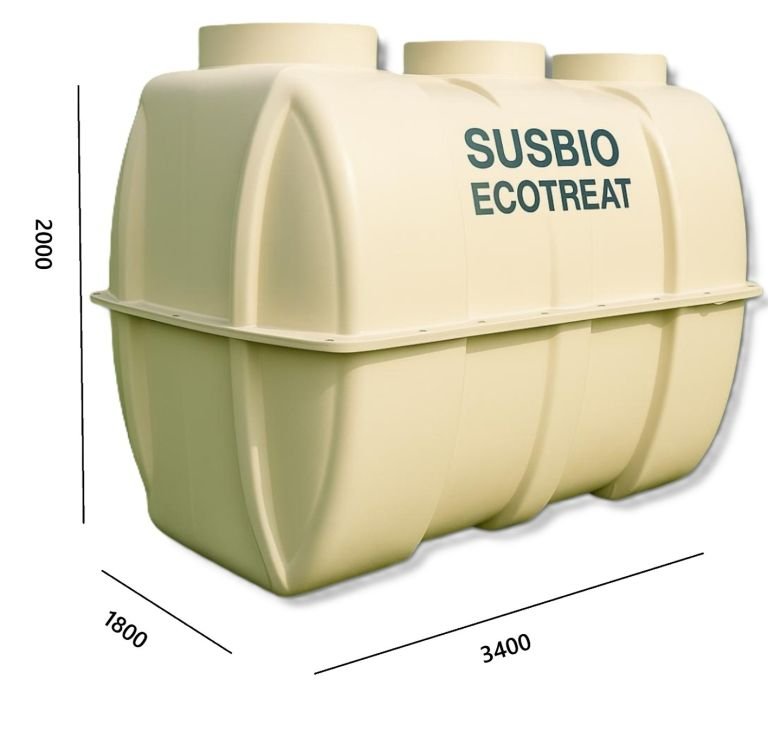
| Dimensions (L x W x H) | 3.4 m x 1.8 m x 2.0 m |
| Power Consumption | 3-4 kWh per day |
| Construction Material | FRP (Fibre Reinforced Plastic) |
| Outlet BOD | < 10 mg/L |
| Outlet COD | < 50 mg/L |
| Outlet TSS | < 20 mg/L |
| Fecal Coliform (Outlet) | < 100 MPN/100 mL |
| Treated Water Reuse | Toilet flushing and garden irrigation |
| Installation Options | Above-ground or below-ground |
| Regulatory Approval | CPCB Approved |
| Module Warranty | 10 Years |
| Service Commitment | Lifetime Service by SUSBIO |
| Price | Rs. 8.5 Lakhs (supply + standard installation) |
Packaged STP vs. Conventional Civil STP: The Case for SUSBIO ECOTREAT 10 KLD
For a 10 KLD application, the decision between a packaged prefabricated STP and a conventional civil-constructed STP involves weighing capital cost, construction time, outlet quality, and long-term operational reliability. The comparison below makes the choice clear:
| Parameter | SUSBIO ECOTREAT 10 KLD | Conventional Civil STP |
|---|---|---|
| Construction Time | 2-3 weeks from site readiness | 3-5 months of civil construction |
| Civil Work Required | Level RCC pad only | Extensive multi-tank RCC construction |
| Footprint | 3.4 m x 1.8 m — compact single vessel | 3-4x larger multi-tank layout |
| Outlet BOD | < 10 mg/L (reuse grade) | Variable, often 20-50 mg/L |
| Power Consumption | 3-4 kWh/day | 6-10 kWh/day typical |
| Quality Assurance | Factory-manufactured and pre-tested | Site-dependent, variable quality |
| Odour | Fully enclosed FRP — odour-free | Open tanks — potential odour issues |
| Scalability | Add ECOTREAT units in parallel | Costly and disruptive to expand |
| Operator Dependency | Low — automated operation | Medium to high |
| Warranty | 10-year module + lifetime service | No structured warranty |
| CPCB Approval | Yes | Not applicable |
| Price | Rs. 8.5 Lakhs all-inclusive | Typically higher with hidden costs |
Who Needs the SUSBIO ECOTREAT 10 KLD: Detailed Application Areas
| Building / Facility Type | Typical Sewage Load | Why SUSBIO ECOTREAT 10 KLD Is the Right Fit |
|---|---|---|
| Small Apartment Complex (15-25 units) | 8,000-12,000 L/day | No sewer connectivity; RWA compliance obligation; treated water reduces common area water costs |
| Boutique Hotel / Resort (20-30 rooms) | 8,000-12,000 L/day | CRZ/ESZ compliance; SPCB trade licence requirement; reuse for landscaping reduces water procurement |
| Community Hospital / Nursing Home (30-50 beds) | 8,000-10,000 L/day | Healthcare effluent with elevated pathogen load; NABH compliance; SPCB CTO requirement |
| School / College Hostel (40-60 residents) | 8,000-10,000 L/day | Institutional sewage from dormitories and dining; SPCB compliance for educational institutions |
| Corporate Guesthouse / Service Apartment | 8,000-12,000 L/day | Managed accommodation with consistent occupancy; low-maintenance packaged STP preferred |
| Banquet Hall / Marriage Hall | Variable — up to 10,000 L/day | High-BOD kitchen and washroom effluent; peak flow management critical; equalization built into ECOTREAT |
| Religious Institution / Ashram | 8,000-12,000 L/day | Residential community with variable occupancy; compact footprint; minimal operator dependency |
Treated Water Reuse: Turning 10,000 Litres of Sewage Into a Daily Building Resource
One of the most operationally and economically significant features of the SUSBIO ECOTREAT 10 KLD is the quality of its treated water output. With BOD below 10 mg/L and TSS below 20 mg/L, the treated effluent is a genuine building resource — not merely a discharge product.
Toilet Flushing in Common Areas and Units
In an apartment complex of 20-25 units or a hotel with 20-30 rooms, toilet flushing accounts for 25-35% of total water consumption — approximately 2,500-3,500 litres per day. Redirecting ECOTREAT treated water to toilet cisterns eliminates this demand on municipal supply or borewell water entirely, with no compromise on hygiene given the treated water’s fecal coliform levels far below CPCB norms.
Garden, Landscape, and Common Area Irrigation
Hotels and apartment complexes typically maintain gardens, lawns, and landscape areas that require regular irrigation. Treated effluent from the SUSBIO ECOTREAT 10 KLD meets CPCB reuse standards for unrestricted garden irrigation — and its residual nutrients (nitrogen, phosphorus) actually support plant growth, reducing the need for chemical fertilisers.
Water Savings at 10 KLD Scale
| Reuse Application | Daily Volume Recovered | Annual Volume Saved | Estimated Annual Saving |
|---|---|---|---|
| Toilet flushing (apartments/hotel) | 2,500-3,500 L/day | 9-12.75 lakh litres/year | Rs. 25,000-55,000 |
| Garden and landscape irrigation | 1,500-3,000 L/day | 5.5-11 lakh litres/year | Rs. 18,000-40,000 |
| Combined total | 4,000-6,500 L/day | 14.5-23.75 lakh litres/year | Rs. 43,000-95,000/year |
Note: Savings estimated based on prevailing municipal water tariffs and tanker water rates in Indian urban areas. Actual savings vary by location, occupancy, and water source. At Rs. 43,000-95,000 of annual water cost savings, the SUSBIO ECOTREAT 10 KLD begins recovering its investment through operational savings within a few years of installation.
Key Design and Site Considerations for a 10 KLD STP Installation
A successful 10 KLD STP installation requires attention to several site-specific factors before procurement and installation:
- Accurate flow estimation: Verify that actual daily sewage generation is within the 8,000-12,000 L/day range appropriate for the 10 KLD unit. Under-estimating peak flows or future occupancy growth leads to hydraulic overloading. SUSBIO’s engineers conduct a detailed site assessment before confirming the appropriate capacity.
- Inlet drainage consolidation: All sewage streams from the building — toilet blackwater, bathroom greywater, kitchen wastewater — must be consolidated into a single inlet line to the STP. Stormwater, roof drainage, and HVAC condensate must be kept separate.
- Treated water reuse infrastructure: Define the reuse application (toilet flushing, garden irrigation, or both) before installation. SUSBIO can design and install a treated water holding tank, transfer pump, and distribution piping as part of the overall ECOTREAT installation package.
- Location and access: The STP unit requires periodic access for routine checks and annual desludging. Ensure the installation location — whether above or below ground — is accessible to a small service vehicle and SUSBIO’s maintenance team.
- SPCB documentation: In most states, a 10 KLD STP installation requires CTE (Consent to Establish) before installation and CTO (Consent to Operate) after commissioning. SUSBIO prepares and assists with all regulatory documentation.
Future expansion provision: If the building’s population or occupancy is expected to grow beyond 50 persons, plan for a parallel ECOTREAT unit installation in the future. SUSBIO’s modular approach means a second unit can be added alongside the first without system redesign.
Common Mistakes Building Owners Make When Procuring a 10 KLD STP
- Selecting technology based on lowest tender price: A non-CPCB-approved STP with poor outlet quality (BOD 40-80 mg/L) saves money upfront but creates ongoing compliance liability, SPCB enforcement risk, and the need for costly upgrades. The SUSBIO ECOTREAT 10 KLD is priced at Rs. 8.5 lakhs — a competitive, all-inclusive price for a system that genuinely performs.
- Underestimating peak flow: Hotel kitchens, hospital laundries, and apartment buildings have significant peak flow periods. Without adequate flow equalisation, the biological treatment stage is hydraulically overloaded. The ECOTREAT 10 KLD’s built-in equalisation zone handles peak flows up to 2-3x average flow.
- No treated water reuse plan: Installing a 10 KLD STP for discharge only — without any reuse infrastructure — misses Rs. 43,000-95,000 of annual water savings. SUSBIO strongly recommends integrating a reuse system at the time of installation.
- Neglecting sludge management: Even a well-designed packaged STP produces sludge that requires periodic removal. Without a clear desludging schedule, sludge accumulates and degrades treatment performance. SUSBIO’s lifetime service commitment includes scheduled desludging visits.
- Ignoring OCEMS requirements for certain categories: Hospitals and hotels in some states are required to install online effluent monitoring (OCEMS) linked to SPCB servers. SUSBIO’s team advises on applicable OCEMS obligations and integrates monitoring provisions into the ECOTREAT installation where required.
Benefits of Installing the SUSBIO ECOTREAT 10 KLD
For Apartment Complexes
- Full CPCB and SPCB compliance — eliminates NGT penalty risk and SPCB enforcement action for the RWA.
- Treated water reuse reduces monthly common area water bills by Rs. 3,500-8,000 per month.
- Single-vendor accountability — SUSBIO manages design, supply, installation, commissioning, and lifetime service.
- Compact footprint — the 3.4 m x 1.8 m unit fits in a utility corner without consuming valuable parking or garden space.
For Hotels and Resorts
- Meets CRZ, NGT, and state tourism department STP requirements — secures trade licence and environmental clearance renewals.
- Treated water for garden and landscape irrigation reduces freshwater procurement costs at tourist destinations where water is scarce and expensive.
- Odour-free, fully enclosed FRP unit — no aesthetic or guest experience impact.
- CPCB approval demonstrates environmental responsibility — increasingly important for eco-certification and international booking platform ratings.
For Hospitals and Healthcare Facilities
- Dual biological treatment plus UV disinfection reduces fecal coliform to below 100 MPN/100 mL — meeting healthcare effluent discharge norms.
- Supports NABH accreditation requirements for environmental safety and effluent management.
- Protects the facility’s reputation and licence to operate from SPCB enforcement action.
- SUSBIO’s lifetime service commitment ensures the treatment system is always operational — critical for healthcare settings where regulatory compliance is non-negotiable.
Why SUSBIO Is India's Preferred 10 KLD STP Manufacturer
SUSBIO is one of India’s leading wastewater treatment companies and sewage treatment plant manufacturers, with a proven installed base spanning apartment complexes, hotels, hospitals, industrial facilities, and institutional buildings across the country. The SUSBIO ECOTREAT 10 KLD brings the engineering rigour and execution reliability of SUSBIO’s large-project experience to the mid-sized building segment.
What Makes SUSBIO ECOTREAT 10 KLD the Best 10 KLD STP in India
|
Installing the SUSBIO ECOTREAT 10 KLD: Process and Timeline
SUSBIO manages the complete installation process for the ECOTREAT 10 KLD, from initial site assessment through commissioning and operator training. Here is what the process involves:
- Site Assessment and Design Confirmation: SUSBIO’s engineer visits the building, verifies sewage generation volumes, confirms the optimal STP location, and finalises the inlet/outlet drainage configuration and treated water reuse routing.
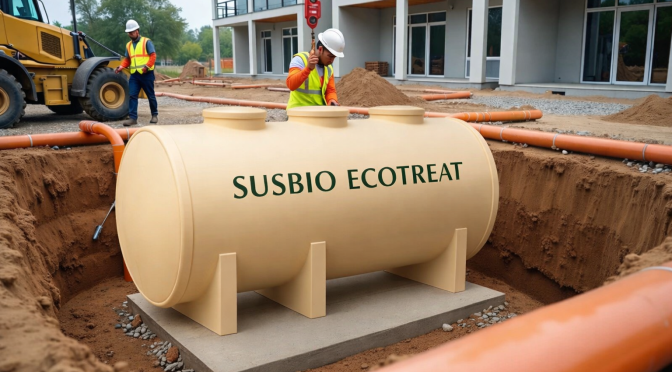
- Civil Preparation: For above-ground installation, a level RCC pad (approximately 4 m x 2.5 m) is prepared. For underground installation, an excavated pit of appropriate dimensions is dug. This is the only civil work required — no multi-tank construction, no waterproofing works.
- Unit Delivery and Placement: The factory-manufactured, pre-tested single FRP vessel is delivered and positioned. Inlet and outlet piping connections are made. The treated water outlet is connected to the building’s reuse distribution system.
- Electrical and Control Connection: The built-in diaphragm air pumps and any automated level sensors are connected to the building’s electrical supply. A standard 15-amp industrial power connection is typically sufficient.
- Biological Commissioning: The MBBR chamber is seeded with starter biological culture. Sewage flow is established and gradually increased over 2-3 weeks as the biofilm establishes and treatment efficiency builds to full capacity.
- Performance Verification and Handover: SUSBIO’s engineer collects and tests outlet samples to confirm BOD, TSS, and fecal coliform compliance before formal handover. CTO application documentation is prepared based on the performance test results.
Total installation timeline: 2-3 weeks from site readiness to commissioning completion. Full biological treatment efficiency is achieved within 3-4 weeks of commissioning.
Conclusion: The SUSBIO ECOTREAT 10 KLD Is the Definitive Solution for Mid-Sized Buildings
For apartment complexes with 15-25 units, boutique hotels with 20-30 rooms, community hospitals with 30-50 beds, and comparable mid-sized buildings generating 10,000 litres of domestic sewage per day, the SUSBIO ECOTREAT 10 KLD represents the most complete, most technically capable, and most commercially sensible packaged sewage treatment plant available in India today.
Its dual-stage Anaerobic + MBBR treatment technology delivers outlet water quality of BOD below 10 mg/L and TSS below 20 mg/L — three to five times better than CPCB discharge norms and fully qualified for toilet flushing and garden irrigation reuse. The single FRP vessel configuration eliminates multi-tank civil construction. The built-in silent diaphragm air pumps consume just 3-4 kWh per day — a fraction of the power required by conventional aeration systems. And CPCB approval means building owners have genuine regulatory protection when SPCB inspectors arrive or NGT notices are issued.
At Rs. 8.5 lakhs — fully inclusive of the packaged unit, supply, and standard installation — the SUSBIO ECOTREAT 10 KLD is priced competitively against both inferior packaged alternatives and the significantly more expensive civil STP option. The 10-year module warranty and SUSBIO’s lifetime service commitment make the total cost of ownership case even stronger: this is a system built to perform for 25+ years with the full support of India’s leading wastewater treatment company behind it.
Whether you are a developer completing a new apartment project, an RWA addressing an existing SPCB compliance gap, a hotel operator protecting your trade licence, or a hospital administrator meeting NABH and pollution board obligations — SUSBIO’s engineering team is ready to assess your site, design the optimal installation, and deliver the SUSBIO ECOTREAT 10 KLD with the technical excellence and execution reliability that have made SUSBIO India’s most trusted STP plant manufacturer.
Contact SUSBIO for a Free 10 KLD STP Consultation
Frequently Asked Questions
Q1. What capacity is the SUSBIO ECOTREAT 10 KLD and how many people does it serve?
It treats 10,000 litres/day and serves approximately 40–50 people. Suitable for small apartments, hotels, hospitals, and hostels.
Q2. What treatment technology is used?
It uses a dual-stage process: Anaerobic Digestion + MBBR for high efficiency and reuse-quality output.
Q3. What are the dimensions and footprint?
Size: 3.4 m × 1.8 m × 2.0 m (6.12 sq. m footprint). Compact single FRP unit with no civil tanks required.
Q4. What is the power consumption?
Consumes 3–4 kWh/day, costing approx. ₹700–₹1,000/month.
Q5. Is it CPCB approved?
Yes, it is fully CPCB approved and compliant with Indian environmental regulations.
Q6. Can treated water be reused?
Yes, treated water (BOD < 10 mg/L) is suitable for flushing and irrigation.
Q7. What warranty is offered?
10-year warranty on the module with lifetime service support.
Q8. What is the price?
Approx. ₹8.5 lakhs, including unit and standard installation.
Q9. Is a 10 KLD STP mandatory for small apartments?
Yes, if not connected to a sewer, STP installation is mandatory under environmental laws.
Q10. How long does installation take?
2–3 weeks after site readiness.
Q11. Can capacity be increased later?
Yes, modular expansion by adding another unit.
Q12. What maintenance is required?
Minimal—monthly checks and desludging every 12–18 months.