

An ETP plant is no longer optional for industries that generate wastewater. Industrial operations produce large volumes of effluent that pose a most important threat to the environment if not managed properly. Strict environmental regulations now mandate the installation and operation of effluent treatment plants in sectors of all types. Industries such as textiles, pharmaceuticals, chemicals, food processing, and leather manufacturing require these systems to curb the direct release of untreated wastewater into water bodies. Understanding what is etp plant, how the etp plant process works, and the factors affecting etp plant cost can help you make informed decisions. This piece will walk you through everything you need to know before installing an industrial effluent treatment plant for your facility.
What is an Effluent Treatment Plant (ETP) and Why Your Industry Needs It
Understanding ETP Full Form and Simple Concept
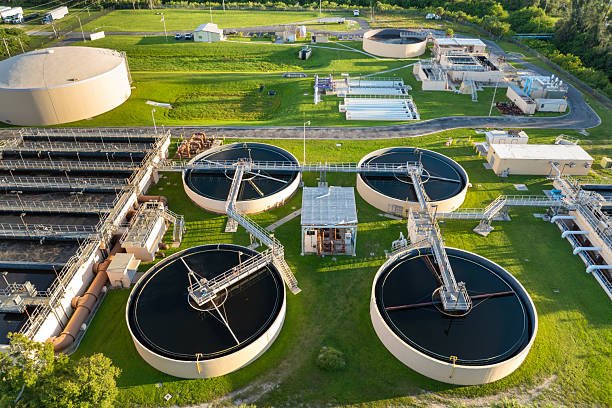
ETP stands for Effluent Treatment Plant. An effluent treatment plant is a specialized system designed to purify industrial wastewater through physical, chemical and biological processes before discharge into the environment or reuse within facilities. Effluent refers to the liquid waste that flows out from industrial processes and contains various contaminants such as oils, grease, toxic chemicals like cyanide, heavy metals, organic compounds and suspended solids.
The treatment methodology is different based on effluent characteristics. Food and beverage factories produce wastewater with high levels of degradable organic pollutants. Pharmaceutical and textile industries release more complex chemical compounds that need advanced treatment approaches. These plants address growing water lack concerns and make water recycling possible within industrial facilities.
Environmental Effect of Untreated Industrial Effluent
Over 70% of industrial wastewater in India remains untreated before being released into the environment. Indian industries discharge approximately 13,468 million liters of wastewater daily. Only 60% receives adequate treatment. Untreated industrial effluent degrades surface water and soil. This creates negative effects on crops, insect populations, animal life and human health.
Water bodies receiving industrial effluents become heavily contaminated with excessive levels of Electrical Conductivity, Total Dissolved Solids, Biological Oxygen Demand, Chemical Oxygen Demand, Total Suspended Solids, Total Nitrogen and Total Phosphorus. This contamination threatens aquatic ecosystems and disrupts the natural food chain. Fish populations suffer harm through toxic discharges and oxygen depletion. Communities relying on these water bodies face increased risks of waterborne diseases including cholera, dysentery and other infections.
Legal Requirements and Compliance Standards
The Water (Prevention and Control of Pollution) Act, 1974 governs industrial wastewater discharge in India. The Central Pollution Control Board and State Pollution Control Boards enforce stringent discharge standards. The National Green Tribunal now possesses authority to impose penalties reaching up to Rs. 25 crore for severe violations. Industries in polluted areas face zero liquid discharge mandates. They must recycle water with no external discharge.
Non-compliance results in consent withdrawal, production shutdowns, heavy fines and potential criminal proceedings. State Pollution Control Boards conduct surprise inspections and mandate live effluent monitoring systems. The change from periodic testing to continuous online monitoring represents a fundamental alteration in regulatory enforcement.
Industries That Require ETP Installation
Textile industries need ETPs to remove dyes, detergents and suspended solids from wastewater. Pharmaceutical manufacturing facilities use these systems to eliminate complex organic compounds and pharmaceutical residues. Food processing industries rely on ETPs to treat wastewater rich in organic material and nutrients. Chemical industries handle hazardous by-products. Leather tanneries treat wastewater containing chromium and sulfides. Hospitals need specialized treatment for wastewater containing pharmaceuticals and pathogens. Pulp and paper industries treat effluents with lignin and chlorinated compounds.
How ETP Plant Process Works: Treatment Stages Explained
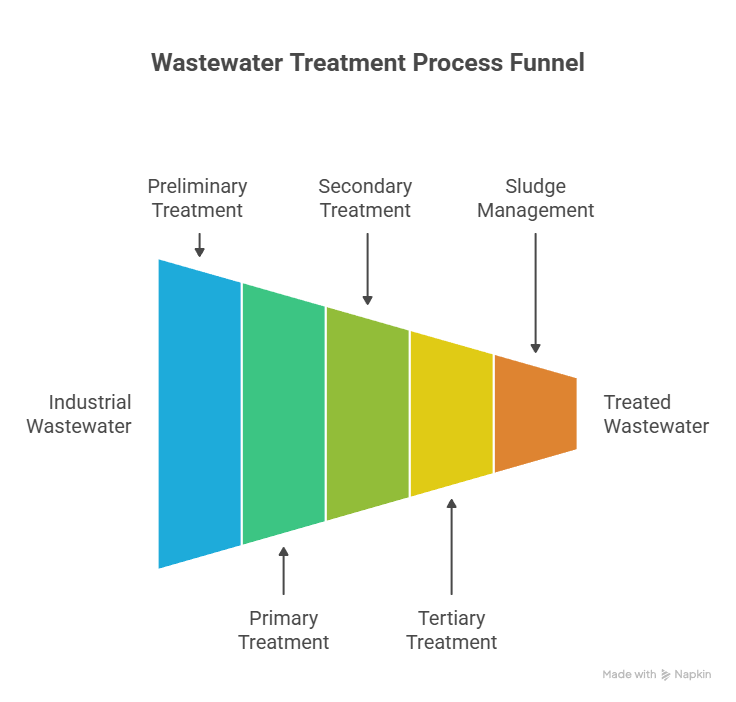
Industrial wastewater treatment follows a systematic multi-stage approach where each phase targets specific contaminants through specialized mechanisms.
Preliminary Treatment: Screening and Removal of Large Solids
Preliminary treatment serves as the first line of defense and protects downstream equipment from damage. Screens with openings ranging from 25mm for trash racks to 6mm for coarse screens filter out large debris including plastic, leaves, wood and rags. Grit chambers remove sand, gravel and heavy particles by controlling flow velocity after screening. The quantity of grit removed varies widely, from 4 to 37 mL/m³ in separate sewer systems to 4 to 180 mL/m³ for combined systems.
Primary Treatment: Sedimentation and Physical Separation
Chemical processes remove suspended solids and organic matter during primary treatment. Coagulants like aluminum sulfate or ferric chloride neutralize negative charges on particles and help them bind together. Flocculation then creates larger, settleable particles through gentle mixing. These combined steps reduce TSS by 80-95% and BOD by 58-68%. Sedimentation tanks provide approximately two hours of detention time. Heavier particles settle as primary sludge while lighter materials like oils float to the surface.
Secondary Treatment: Biological Processing Methods
Biological processes break down organic pollutants using microorganisms in aeration tanks. The activated sludge process mixes wastewater with bacteria that consume organic materials and convert them into carbon dioxide and water. This method reduces BOD and suspended solids by more than 90%. The process produces about 70-100 grams of waste activated sludge per cubic meter of wastewater treated.
Tertiary Treatment: Advanced Purification Techniques
Tertiary treatment removes remaining contaminants through advanced technologies. Reverse osmosis uses selective membranes to filter dissolved solids and works especially well for textile, pharmaceutical and metals manufacturing wastewater. UV disinfection or chlorination eliminates pathogens. Carbon adsorption removes trace organic compounds.
Sludge Management and Disposal
Sludge management represents 20-60% of operational costs at conventional wastewater treatment plants. Cement manufacturers now use ETP sludge as alternative fuel in kilns operating above 1,400°C, with sludge requiring minimum 1,500 kcal/kg calorific value. Non-hazardous sludge finds application in brick manufacturing and construction materials after proper stabilization.
Key Factors to Consider Before Installing an ETP Plant
Selecting the right effluent treatment plant requires you to assess multiple interconnected factors that directly affect both short-term implementation and long-term operational success.
Determining the Right ETP Plant Capacity for Your Industry
You need to understand your industry’s wastewater generation patterns to plan capacity. Textile operations typically need 50-500 KLD. Pharmaceuticals require 10-250 KLD, and chemical plants demand 100-1000 KLD. Dairy and meat processing facilities range from 20-300 KLD. Add a 20-30% buffer to current requirements. This accommodates future production increases.
Understanding ETP Plant Cost and Budget Planning
Your budget planning must account for capital expenditure and operational expenses. Small-scale ETPs up to 50 KLD cost between ₹1.5-5 lakh. Medium plants handling 50-100 KLD range from ₹6-30 lakh, and systems exceeding 500 KLD start at ₹50 lakh. Membrane Bioreactor technology costs approximately 300 lacs per MLD but delivers superior water quality.
Choosing Between ETP Plant Manufacturers in India
You must scrutinize industry experience, customization capabilities and technological innovation when selecting a manufacturer. Check their project portfolio for effluent streams like yours and verify client references. Confirm that after-sales support is available, including annual maintenance contracts.
Site Selection and Space Requirements
Space allocation varies with capacity. Small-scale ETPs up to 50 KLD need 500-1000 square feet. Medium-scale plants handling 50-200 KLD require 2000-5000 square feet, and large systems exceeding 200 KLD demand 10,000 square feet or more.
Technology Selection Based on Effluent Characteristics
Your technology choices hinge on effluent composition analysis. High BOD and COD levels indicate that biological treatment is suitable, while toxic compounds necessitate chemical-physical processes. Regulatory discharge standards and water reuse goals further influence your technology selection.
Installation Process and Post-Installation Considerations
Step-By-Step ETP Plant Installation Process
Installation begins with a full picture of the site where experts assess space availability, soil stability and accessibility. Engineers analyze your wastewater characteristics to design appropriate treatment technology after ground preparation and debris clearance. Manufacturers then produce components using quality materials. Each part undergoes strength and efficiency testing before transport. Technicians install major equipment like reactors and tanks. They connect electrical systems and control panels to your facility’s infrastructure. The system undergoes leak testing, calibration of flow rates and pressure settings. Performance verification under varying loads completes the process.
Operational Requirements and Maintenance Planning
You need to check reagent quantities in storage tanks each day. Inspect dosing pumps and clean screening equipment at the inlet. Weekly maintenance involves filter and screen cleaning plus sludge removal from tanks. Monthly activities require in-depth equipment analysis, sensor calibration and backup system testing. Quarterly inspections focus on gaskets, seals and system piping.
Monitoring and Performance Testing
Effluent monitoring tracks pH, Chemical Oxygen Demand, Biochemical Oxygen Demand, Total Suspended Solids and heavy metals. Continuous Effluent Quality Monitoring Systems transmit data to CPCB/SPCB servers. Sensor cleaning occurs every 2-4 weeks. Calibration is required every 3 months by CPCB/NABL certified agencies.
Training Your Staff for ETP Operations
The installation team provides hands-on training that covers equipment startup, control procedures and safe shutdown protocols. Staff learn to interpret system alerts and handle common problems like minor leaks. They also learn to respond to emergencies. A detailed operation manual accompanies training for future reference.
SUSBIO IONTREAT: Purpose-Built ETP for Indian Industry
Not every ETP is built the same way — and for industries choosing between a generic system and a purpose-engineered one, that difference shows up in compliance consistency and long-term operating cost. SUSBIO manufactures IONTREAT, its dedicated industrial effluent treatment line, distinct from the ECOTREAT range built for domestic sewage. IONTREAT is engineered for the higher pollutant loads, variable chemistry, and stricter monitoring requirements industrial effluent brings — from textile dye-heavy streams to pharmaceutical process wastewater.
Every IONTREAT installation is designed to meet CPCB discharge norms, with configurations available to support zero liquid discharge (ZLD) where local regulations require it. Backed by SUSBIO’s 13+ years of engineering experience and 500+ installations across India, IONTREAT systems are fabricated at SUSBIO’s own facility in Vasuli MIDC, Chakan, Pune — the same in-house manufacturing control used across the company’s product range — with the option for Online Continuous Effluent Monitoring System (OCEMS) integration for facilities in the 17 CPCB-designated “highly polluting” categories that require real-time server-linked monitoring.
For industries evaluating whether to build a custom ETP from scratch or work with an established manufacturer, IONTREAT offers a proven, pre-engineered starting point that can still be tailored to sector-specific effluent characteristics.
Conclusion
An ETP plant needs careful planning before installation, but the investment protects your business and the environment. Review your wastewater characteristics and determine appropriate capacity. Select proven technology that meets regulatory standards. Partner with experienced manufacturers who provide detailed support, from installation to staff training. The right system with proper maintenance will help you achieve compliance and reduce water costs through recycling. You’ll contribute to eco-friendly industrial operations over the coming years.
Key Takeaways
Understanding ETP requirements and planning properly before installation ensures regulatory compliance, environmental protection, and long-term operational success for your industrial facility.
- ETP installation is mandatory – Industries like textiles, pharmaceuticals, chemicals, and food processing must install effluent treatment plants to comply with environmental regulations and avoid penalties up to Rs. 25 crore.
- Capacity planning requires 20-30% buffer – Calculate your current wastewater generation and add extra capacity to accommodate future production increases, with costs ranging from ₹1.5 lakh to ₹50+ lakh depending on scale.
- Multi-stage treatment delivers 90%+ efficiency – The process includes preliminary screening, primary sedimentation, biological treatment, and tertiary purification to remove contaminants and meet discharge standards.
- Technology selection depends on effluent characteristics – High BOD/COD levels suit biological treatment, while toxic compounds require chemical-physical processes based on your specific wastewater composition.
- Proper maintenance ensures long-term performance – Daily monitoring, weekly cleaning, monthly equipment analysis, and quarterly inspections are essential for optimal operation and regulatory compliance.
Investing in the right ETP system not only ensures environmental compliance but also enables water recycling, reduces operational costs, and positions your industry for sustainable growth in an increasingly regulated landscape.
Frequently Asked Questions
Q1. What is the full form of ETP and what does it do?
ETP stands for Effluent Treatment Plant. It is a specialized system that purifies industrial wastewater through physical, chemical, and biological processes before discharge into the environment or reuse within facilities. The plant removes contaminants such as oils, grease, toxic chemicals, heavy metals, organic compounds, and suspended solids from industrial effluent.
Q2. Which industries are legally required to install an ETP plant?
Textile industries, pharmaceutical manufacturing facilities, food processing plants, chemical industries, leather tanneries, hospitals, and pulp and paper industries are required to install ETPs. The Water (Prevention and Control of Pollution) Act, 1974 mandates these installations, with penalties reaching up to Rs. 25 crore for severe violations enforced by the Central Pollution Control Board and State Pollution Control Boards.
Q3. How much does it cost to install an ETP plant for industrial use?
The cost varies based on capacity: small-scale ETPs up to 50 KLD cost between ₹1.5-5 lakh, medium plants handling 50-100 KLD range from ₹6-30 lakh, and systems exceeding 500 KLD start at ₹50 lakh. Advanced technologies like Membrane Bioreactor systems cost approximately 300 lacs per MLD but deliver superior water quality.
Q4. What are the main stages of the ETP treatment process?
The treatment process includes four main stages: preliminary treatment (screening and removal of large solids), primary treatment (sedimentation and physical separation reducing TSS by 80-95%), secondary treatment (biological processing that reduces BOD and suspended solids by more than 90%), and tertiary treatment (advanced purification using reverse osmosis, UV disinfection, or carbon adsorption).
Q5. How much space is needed to install an ETP plant?
Space requirements depend on capacity: small-scale ETPs up to 50 KLD need 500-1000 square feet, medium-scale plants handling 50-200 KLD require 2000-5000 square feet, and large systems exceeding 200 KLD demand 10,000 square feet or more. It’s recommended to add a 20-30% buffer to current requirements for future expansion.