


Pharmaceutical manufacturing is India’s most tightly regulated industrial category for effluent discharge. A pharma unit that gets its ETP selection wrong doesn’t just face a fine — it faces cancellation of its Consent to Operate (CTO), a plant shutdown, and potential export license complications.
This guide covers exactly what a pharma plant manager or EHS officer needs to know before choosing or upgrading an ETP: the effluent characteristics that make pharma wastewater uniquely difficult to treat, the precise CPCB parameters you must meet, when ZLD becomes mandatory, and how to evaluate which treatment technology fits your plant’s effluent profile and capacity.
Pharmaceutical effluent contains COD values of 5,000–10,000 mg/L in API manufacturing — up to 33× higher than domestic sewage. Standard biological ETPs alone will not meet CPCB discharge norms for pharma. This page explains why, and what does work.
Why Pharma Effluent Is Different from Other Industrial Wastewater
Every industry generates wastewater, but pharmaceutical and API manufacturing effluent sits in a separate category of treatment complexity. Three factors make it uniquely difficult:
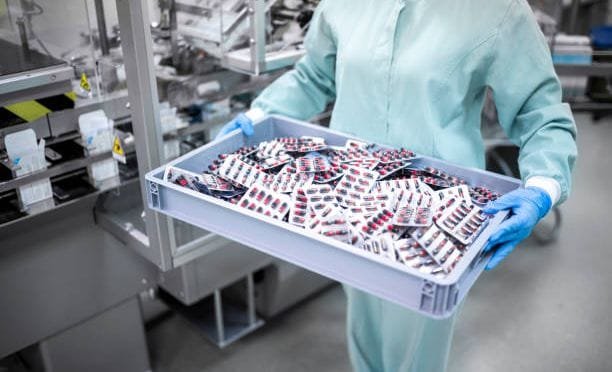
Extreme pollutant concentrations:
Raw effluent from an API or bulk drug manufacturing unit typically presents:
| Parameter | Typical pharma (API) | Typical pharma (formulation | CPCB discharge limit |
|---|---|---|---|
| COD | 5,000–10,000 mg/L | 800–3,000 mg/L | ≤250 mg/L |
| BOD | 2,000–5,000 mg/L | 300–1,200 mg/L | ≤30 mg/L |
| TSS | 500–2,000 mg/L | 200–600 mg/L | ≤100 mg/L |
| TDS | 2,000–8,000 mg/L | 500–2,500 mg/L | ≤2,100 mg/L (inland discharge) |
| pH | 2–12 (extreme swings) | 4–9 | 6.5–8.5 |
| Active pharmaceutical ingredients (APIs) | Present — toxicity varies | Low to moderate | No standard set yet — monitored |
The gap between inlet concentrations and required outlet values is enormous. Reducing COD from 8,000 mg/L to below 250 mg/L requires a multi-stage, technology-stacked treatment train — not a single biological reactor.
Batch variability and shock loads
Pharmaceutical manufacturing runs in batches. Different products, different solvents, different intermediates — each batch produces a different effluent signature. This variability creates hydraulic and organic shock loads that standard ETPs, designed for steady-state flow, cannot handle reliably without adequate equalization.
Antibiotic residues and AMR risk
Effluent from antibiotic manufacturing contains Active Pharmaceutical Ingredients at concentrations that suppress the very microbial populations needed for biological treatment. This is a documented regulatory concern: CPCB’s 2024 advisory specifically flagged API cluster effluent as a contributor to Antimicrobial Resistance (AMR). Several SPCBs are now requiring antibiotic residue monitoring as a condition of CTO renewal for pharma units.
CPCB Discharge Norms for Pharmaceutical Units (2026)

Pharmaceutical effluent discharge in India is governed under Schedule VI of the Environment (Protection) Rules, 1986. The standards apply to all pharma manufacturing units and are enforceable by both CPCB and the relevant State Pollution Control Board (SPCB). Your CTO specifies the applicable standard — always use whichever is stricter between CPCB and your SPCB.
Core effluent parameters — pharma-specific limits
| Parameter | Inland surface water | Public sewer | Land disposal |
|---|---|---|---|
| pH | 6.5–8.5 | 6.5–9.0 | 6.0–9.0 |
| BOD (5-day, 20°C) | ≤30 mg/L | ≤350 mg/L | ≤100 mg/L |
| COD | ≤250 mg/L | ≤600 mg/L | ≤400 mg/L |
| TSS | ≤100 mg/L | ≤600 mg/L | ≤200 mg/L |
| TDS | ≤2,100 mg/L | Not prescribed | ≤2,100 mg/L |
| Oil and grease | ≤10 mg/L | ≤20 mg/L | ≤10 mg/L |
| Ammoniacal nitrogen | ≤50 mg/L | ≤50 mg/L | ≤50 mg/L |
| Phenols | ≤1 mg/L | ≤5 mg/L | ≤1 mg/L |
| Sulphates | ≤1,000 mg/L | ≤1,000 mg/L | ≤1,000 mg/L |
Source: CPCB Schedule VI, Environment Protection Rules, 1986 (as amended). Always verify against your specific CTO conditions — SPCBs including MPCB (Maharashtra), GPCB (Gujarat), and TNPCB (Tamil Nadu) apply stricter COD and TDS limits for pharma industrial clusters.
Additional compliance obligations for pharma units
- Online Continuous Effluent Monitoring System (OCEMS): Mandatory for all Red category industries (pharma is Red category). Must transmit real-time data to CPCB/SPCB servers.
- Form V annual submission: All units subject to EPA rules must submit annual environmental compliance returns — regardless of size.
- Consent to Establish (CTE) and Consent to Operate (CTO): ETP design, capacity, and technology must be pre-approved. Mid-life technology upgrades require fresh CTO amendment.
- Hazardous waste authorisation: ETP sludge from pharma units is categorised as hazardous waste under the Hazardous and Other Wastes Rules, 2016 and must be disposed at an authorised TSDF.
- Water balance and ZLD reports: Required by GPCB, TNPCB, and several other SPCBs for large pharma units as a condition of CTO.
MPCB note for Maharashtra-based pharma units
MPCB has applied stricter COD limits (≤150 mg/L) and TDS limits for units in notified industrial clusters including Tarapur, Patalganga, and Ambernath-Badlapur MIDC. If your plant is in Maharashtra, your CTO COD limit may be lower than the CPCB national standard. Verify your CTO document before designing your ETP.
When Is ZLD Mandatory for Pharma Units in India?
Zero Liquid Discharge (ZLD) means no treated effluent leaves the facility boundaries — all water is recovered and reused internally. For pharma units in India, ZLD is not universally mandatory, but the conditions triggering it are increasingly common.
ZLD is mandatory if any of these apply to your unit
| Trigger condition | Implication |
|---|---|
| API / bulk drug manufacturing unit | CPCB mandates ZLD for API plants as a licensing condition. Applies nationally. |
| Located in a critically polluted industrial cluster (CEPI score > 70) | MoEF&CC Notification 2014 mandates ZLD for industries in notified critically polluted areas. Check CPCB’s CEPI list. |
| SPCB-specific notification — Gujarat (GPCB), Tamil Nadu (TNPCB), Telangana | These SPCBs mandate ETP + ZLD as a CTO condition for large pharma and chemical units. |
| Effluent TDS > 5,000 mg/L | High TDS streams cannot be discharged to inland water. ZLD via MEE is the only compliant path. |
| NGT order applicable to your plant or cluster | NGT has issued plant-specific and cluster-specific closure/upgrade orders. Check the NGT case registry. |
Even where ZLD is not yet mandatory — plan for it
Regulatory tightening is directional: CPCB has progressively reduced COD limits since 2010 and OCEMS mandates have been extended to more categories each year. API plants in Gujarat and Tamil Nadu that were not ZLD-mandated in 2020 now are. The cost of retrofitting ZLD onto an existing ETP is 2–3× higher than designing for ZLD from day one. Any pharma ETP commissioned today should be designed with ZLD compatibility as a future upgrade path.
ZLD cost benchmark
ZLD-capable ETP capital cost is typically 3–5× that of a standard compliant ETP for the same flow. However, freshwater savings (40–60% reduction in intake), elimination of discharge consents, and avoidance of shutdown risk typically yield payback in 3–5 years for plants in water-stressed states
Pharma ETP Treatment Train: How the Process Works
No single technology treats pharmaceutical effluent to CPCB discharge standards. The required treatment is a sequential cascade — each stage reducing the pollutant load to a level the next stage can handle.
| Stage | Process | Technologies | Achieves | Why Pharma needs this |
|---|---|---|---|---|
| 1 | Equalisation & Pre-treatment | Collection/equalisation tank, screening, pH correction, oil-grease trap | Flow and load stabilisation, pH 6.5–8.5 | Batch manufacturing creates shock loads and extreme pH. No biological stage can handle this without equalisation. |
| 2 | Primary Treatment | Coagulation-flocculation, DAF or tube settlers | TSS < 100 mg/L, COD reduction ~30% | Removes colloidal organics and heavy metals before biology. DAF critical for high-surfactant pharma effluent. |
| 3 | Secondary Biological Treatment | MBBR, Activated Sludge Process, UASB (for high-strength) | BOD < 30 mg/L, COD reduction 70–80% | Core degradation of biodegradable organics. UASB for high-COD API streams. MBBR for stable performance and low footprint. |
| 4 | Advanced / Tertiary Treatment | Electro-Fenton, Electro-Oxidation, AOP (ozone/UV/Fenton), Activated Carbon | COD < 250 mg/L, destruction of refractory APIs and solvents | Biological treatment cannot break down non-biodegradable APIs, certain solvents, or dye intermediates. Advanced oxidation or electrochemical processes are required for final COD reduction. |
| 5 | UF + RO (for ZLD path) | Ultrafiltration membranes, Reverse Osmosis | TDS < 100 mg/L, 90–95% water recovery | Required for ZLD. RO permeate is reused. RO reject goes to MEE for concentration. |
| 6 | ZLD — Evaporation | Multi-Effect Evaporator (MEE), Mechanical Vapour Recompression (MVR), ATFD | Zero liquid discharge, salt/sludge to TSDF | Required for API plants and critically polluted areas. MEE handles the high-TDS RO reject stream. |
Where IONTREAT fits in the treatment cascade
SUSBIO’s IONTREAT electrochemical ETP system is designed to handle Stage 4 — the advanced treatment requirement that standard biological systems cannot meet. IONTREAT integrates Electro-Fenton, Electro-Coagulation, Electro-Oxidation, Electro-Flotation, DAF, and UF membrane polishing in a single packaged unit.
What IONTREAT does in a pharma ETP Biological treatment brings COD down to 400–800 mg/L. IONTREAT’s electrochemical oxidation stages bring it below 250 mg/L — the CPCB discharge limit — by destroying the refractory, non-biodegradable organic compounds that biology cannot break down. It also significantly reduces chemical consumption compared to conventional chemical oxidation ETPs. →IONTREAT ETP system |
Choosing the Right ETP Technology for Your Pharma Plant
The correct ETP design depends on three variables: your effluent type (API vs. formulation), your discharge destination (inland water vs. ZLD), and your plant’s daily flow volume. This table maps common pharma plant types to the recommended treatment configuration.
| Plant Type | Flow (KLD) | Required treatment | Recommended configuration |
|---|---|---|---|
| API / bulk drug | 10–50 KLD | ZLD mandated | Equalisation + DAF + MBBR + Electro-Oxidation (IONTREAT) + UF + RO + MEE |
| API / bulk drug | 50–200 KLD | ZLD mandated | Equalisation + DAF + UASB + MBBR + AOP/Electrochemical + UF + RO + MEE/MVR |
| Formulation (tablets, capsules) | 5–25 KLD | Inland discharge | Equalisation + Coagulation-DAF + MBBR/ASP + UF polishing + OCEMS |
| Formulation (injections, liquids) | 10–50 KLD | Inland or sewer | Equalisation + DAF + MBBR + Electro-Coagulation/Fenton (for residual COD) + UF |
| Mixed — API + formulation | 25–100 KLD | ZLD or near-ZLD | Segregated streams: high-COD API stream → UASB → EC/EO; low-COD formulation stream → MBBR. Combined tertiary + RO + MEE |
| CETP member — pre-treatment only | Any | Meet CETP inlet norms | Equalisation + pH correction + primary coagulation to bring effluent to CETP inlet specifications |
Technology comparison for the advanced treatment stage
| Advanced treatment technology | COD removal | Operating Cost | Suited For |
|---|---|---|---|
| Electrochemical (IONTREAT) — EC + EF + EO | Up to 90% additional COD removal post-biology | Reduced chemical consumption vs. conventional | Pharma, dye, solvent, API effluent. Refractory COD. No chemical addition needed for primary stages. |
| Chemical Fenton / AOP (H₂O₂ + catalyst) | 60–80% additional COD | High — H₂O₂ and catalyst ongoing costs | Refractory organics but high reagent cost at scale. Sludge generation concern. |
| Ozonation + UV | 50–70% colour and COD | Very high energy and capital | Colour removal, pharmaceutical micropollutants. High OPEX. |
| Activated carbon adsorption | Polishing only — 20–40% | Medium — carbon replacement cost | Final polishing post-biological. Cannot handle high COD loads alone. |
| MBR (Membrane Bioreactor) | Biological only — does not destroy refractory COD | High — membrane replacement and energy | Improves biological effluent clarity. Does not replace need for advanced oxidation for pharma COD. |
Sizing a Pharma ETP: How to Calculate Your Required Capacity
ETP capacity is determined by daily effluent volume, not production output. Pharma units commonly undersize their ETPs at commissioning and face non-compliance as production scales. Use this framework:
Step 1 — Calculate your daily effluent generation
- For formulation plants: 3–6 KL of effluent per 1,000 kg of product (varies by batch type and CIP volume)
- For API plants: 10–30 KL per 1,000 kg of API, depending on solvent recovery efficiency
- Add domestic wastewater: 45 LPCD × number of plant employees
- Add safety factor: ×1.3 for peak batch days
Step 2 — Classify your effluent streams
Pharma plants should segregate effluent streams at source:
- High-COD process streams (reactor wash, mother liquors) → needs advanced treatment
- Moderate-COD cleaning streams (CIP, solvent-free wash) → biological treatment adequate
- Low-COD utility streams (cooling tower blowdown, boiler blowdown) → primary treatment
- Domestic sewage → separate STP or combined biological treatment
Mixing these streams before treatment forces your ETP to treat the entire volume at high-strength specifications — significantly increasing capital and operating cost. Segregation and staged treatment is both technically correct and cost-optimal.
Step 3 — CPCB requirement: mandatory ETP for > 25 KLD
Any pharma unit generating more than 25 KLD of process effluent must have a dedicated ETP. Units below 25 KLD may be eligible for CETP membership in their industrial cluster, depending on SPCB provisions.
Key Questions to Ask Any ETP Vendor — Before You Sign
ETP procurement for a pharma plant is a high-stakes, technically complex decision. These are the questions that separate a compliant, long-running system from one that creates regulatory problems within 18 months
| Question To Ask | What a good answer looks like |
|---|---|
| Has your ETP been designed specifically for pharmaceutical effluent — or are you adapting a generic system? | Specific design with effluent characterisation data from similar pharma plant. Not a generic MBBR or ASP system. |
| Can you share performance data (COD inlet to outlet) from a pharma installation at similar capacity? | Actual data from a reference plant. Not specifications, not projections. |
| What happens to my ETP’s performance when batch type changes between products? | Vendor should explain equalisation strategy and load-buffering approach for batch variability. |
| Does your system include provisions for OCEMS integration? | Yes — with output compatible with CPCB/SPCB data transmission formats. |
| What is the sludge generation rate and disposal pathway? | KLD of sludge per 100 KLD treated, classified as hazardous or non-hazardous, with TSDF tie-up details. |
| Is your system ZLD-ready or ZLD-upgradable? | Clear answer on whether RO + MEE can be added as a phase-2 upgrade without rebuilding primary stages. |
| What is included in post-commissioning support and what is the response time for CPCB compliance failures? | Named SLA with specific escalation path and remediation timeline. |
Common Compliance Failures in Pharma ETPs — and What Causes Them
| Failure | Root Cause | Prevention |
|---|---|---|
| COD exceedance at outlet | Advanced treatment stage absent or undersized. Biology alone cannot reach ≤250 mg/L for API effluent. | Design ETP with electrochemical or AOP stage from day 1. Do not rely on biological treatment alone for API streams. |
| OCEMS data gaps / transmission failures | Inadequate integration between ETP control panel and monitoring system. | Specify OCEMS integration as a deliverable in the ETP contract, not an afterthought. |
| ETP shutdown during product changeover | Equalisation tank too small to buffer batch variability. | Size equalisation tank at ≥2× peak daily volume. This is the most commonly undersized component. |
| Sludge overflow / disposal violations | Sludge generation underestimated. No authorised TSDF contract. | Model sludge generation at design stage. Secure TSDF authorisation before CTO application. |
| CTO non-renewal after upgrade | Technology changed post-CTO without SPCB consent amendment. | Any ETP technology change — even replacement of a component — requires SPCB intimation and often CTO amendment. |
| Antibiotic/API residue in outlet | No AOP or advanced oxidation in treatment train. | For antibiotic manufacturing units: specify Advanced Oxidation Process (or electrochemical EO) as mandatory stage. |
IONTREAT: SUSBIO's Electrochemical ETP for Pharma Applications
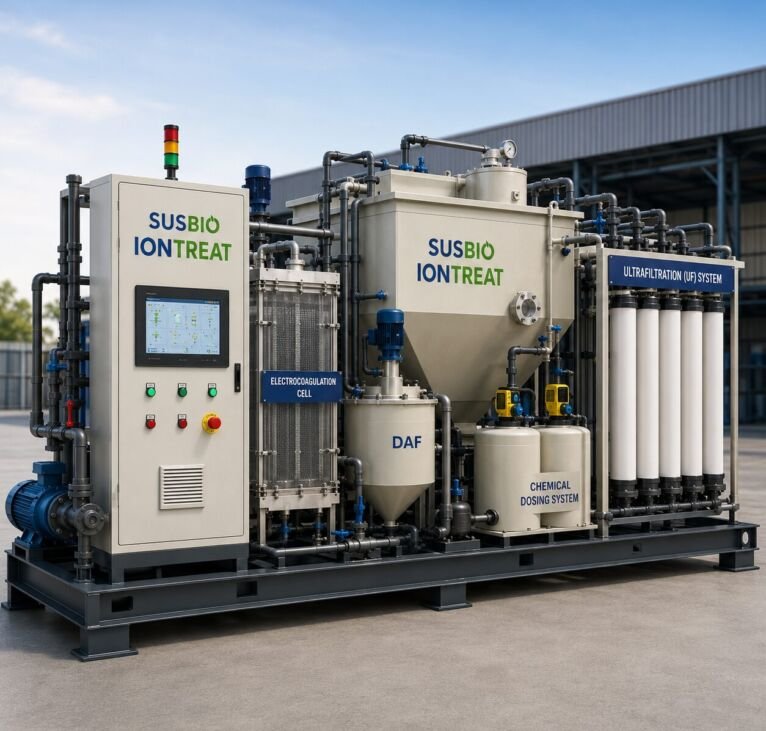
Conventional pharma ETPs rely on high chemical consumption — coagulants, H₂O₂, Fenton’s reagent — to break down refractory COD. SUSBIO IONTREAT replaces or significantly reduces these chemical inputs using electrochemical processes that achieve the same — and in many cases, better — treatment outcomes.
| Process | What it does in pharma effluent | Benefit vs. chemical equivalent |
|---|---|---|
| Electro-Coagulation (EC) | Destabilises colloidal organics, APIs, and heavy metals through in-situ coagulant generation | Eliminates addition of alum/PAC chemicals. Lower sludge volume. |
| Electro-Fenton (EF) | Generates hydroxyl radicals to oxidise and break down refractory pharmaceutical compounds and solvents | Significantly reduces H₂O₂ dosing vs. chemical Fenton. More controllable. |
| Electro-Oxidation (EO) | Direct electrochemical oxidation of non-biodegradable APIs, dyes, and surfactants at electrode surface | Handles compounds that biological or chemical Fenton cannot fully degrade. |
| Electro-Flotation (EF) | Generates microbubbles in-situ for solids separation | Replaces DAF chemical stage in some configurations. |
| UF Membrane Polishing | Final removal of residual suspended solids and colloidal matter | Produces consistent outlet quality for OCEMS compliance. |
| IONTREAT specification | Value |
|---|---|
| Capacity range | 10 KLD to 1 MLD |
| COD treatment performance | Post-biological COD reduced to ≤250 mg/L (CPCB inland standard) |
| Chemical consumption | Reduced vs. conventional chemical ETP |
| Footprint | Compact packaged unit — suitable for constrained pharma plant sites |
| OCEMS compatibility | Yes — real-time monitoring output compatible with CPCB/SPCB data formats |
| ZLD upgrade path | UF outlet feeds RO + MEE for ZLD compliance |
| Industries served | Pharma (API + formulation), dyes and intermediates, chemical manufacturing, food processing |
Talk to SUSBIO about your pharma ETP requirement
IONTREAT is available for site-specific design, supply, installation, and AMC. For pharma ETP enquiries — including CPCB compliance audits for existing ETPs — contact SUSBIO → [link to /contact-us/]
FAQ — Pharma ETP Compliance in India
Is ZLD mandatory for all pharmaceutical units in India?
No — ZLD is mandatory for API/bulk drug manufacturing units nationally, and for all pharma units located in notified critically polluted industrial areas. Formulation units discharging to inland water are typically required to meet CPCB discharge standards (COD ≤250 mg/L, BOD ≤30 mg/L) without full ZLD, unless an SPCB-specific condition applies. However, given the direction of regulatory tightening, designing for ZLD-upgradability is strongly recommended even where not currently mandatory.
What is the CPCB COD limit for pharmaceutical effluent discharge to inland water?
The CPCB Schedule VI general limit is COD ≤250 mg/L for discharge to inland surface water. However, several SPCBs — notably MPCB (Maharashtra) for pharma clusters — have applied stricter limits (≤150 mg/L) in specific notifications. Always verify the limit in your Consent to Operate (CTO) document, which takes precedence.
Can a standard biological MBBR ETP meet CPCB norms for an API manufacturing plant?
No. Biological treatment alone (MBBR, ASP, SBR) achieves 70–80% COD reduction. For an API plant with inlet COD of 6,000–10,000 mg/L, a biological outlet still contains 1,200–3,000 mg/L COD — far above the ≤250 mg/L CPCB limit. A secondary advanced treatment stage — electrochemical oxidation, AOP, or activated carbon — is mandatory to bridge this gap.
What happens to ETP sludge from a pharma plant?
ETP sludge from pharmaceutical manufacturing is classified as hazardous waste under the Hazardous and Other Wastes (Management and Transboundary Movement) Rules, 2016. It must be handled, stored, transported, and disposed only at a CPCB-authorised Treatment, Storage, and Disposal Facility (TSDF). Unauthorised disposal — including mixing with municipal solid waste — attracts penalties and criminal prosecution under the Environment Protection Act.
How long does it take to install a pharma ETP?
A packaged electrochemical ETP (10–100 KLD) takes 4–8 weeks from order to commissioning. A conventional civil ETP at the same scale takes 3–6 months. For greenfield pharma plants, ETP commissioning must precede production — so ETP lead time directly affects your plant’s CTO and commercial launch date. Packaged systems significantly reduce this risk.
Does SUSBIO offer CPCB compliance audits for existing pharma ETPs?
Yes. SUSBIO offers site assessments for pharma ETPs that are underperforming or facing SPCB notices, including inlet/outlet testing, gap analysis against CTO conditions, and a remediation plan. Contact us to schedule an assessment.
Conclusion
Pharmaceutical effluent treatment in India is not a checkbox exercise — it is an ongoing compliance obligation with real consequences for plant operations, export licensing, and CTO renewal. The regulatory direction is clear: CPCB is tightening limits, OCEMS mandates are expanding, and ZLD requirements are moving from API-only to broader pharma categories.
The plants that get this right share three things: they designed their ETP for their actual effluent profile (not a generic system), they included an advanced treatment stage capable of handling refractory COD, and they built in ZLD-upgrade capability even when it wasn’t yet mandatory.
A standard biological ETP will not meet CPCB’s ≤250 mg/L COD limit for API manufacturing effluent. Electrochemical treatment — combining Electro-Coagulation, Electro-Fenton, and Electro-Oxidation — is the most practical and chemically efficient way to bridge the gap between biological outlet quality and discharge compliance for pharma wastewater.
If your pharma plant is facing an SPCB notice, planning a capacity expansion, or commissioning a new ETP, SUSBIO’s IONTREAT system is designed specifically for this requirement. [Get in touch with our team →] for a site-specific assessment.

1 Comments
[…] ETP Solution:Customized treatment systems that incorporate advanced technologies such as reverse osmosis (RO), activated carbon filtration, and chemical neutralization are used to treat complex effluents effectively. […]