

Commercial laundries generate wastewater with BOD levels that often exceed 200-400 mg/L and COD concentrations that reach 800-1200 mg/L. A laundry effluent treatment plant becomes essential for regulatory compliance. Facilities without a reliable system risk pricey penalties, environmental harm, and operational shutdowns. Hospital laundries face additional challenges due to biological contamination from patient linens.
This piece walks you through the laundry wastewater treatment process and explains what effluent treatment plant technology is. You’ll find core components of laundry ETP systems and step-by-step treatment stages. We show you how ETP for laundry facilities achieves up to 95% pollutant removal efficiency and provide practical strategies for meeting 2026 compliance standards while reducing operational costs through laundry water treatment and recycling.
Understanding Laundry Wastewater Contamination and Regulatory Requirements
Chemical Contaminants in Laundry Effluent
Researchers who monitored laundry discharge water identified over 160 chemical substances. Five metals were always present: aluminum, copper, iron, strontium and zinc. Anionic and cationic surfactants from detergents create the main pollution load. Phosphates account for 35-75% of detergent composition in many formulations. Linear alkylbenzene sulfonates concentrations range from 12.24 to 1,023.7 mg/L in commercial facilities. Bleaching agents with chlorine compounds, fabric softeners, optical brighteners and enzymes persist through conventional drainage systems as additional contaminants.
Physical Pollutants and Suspended Solids
Microfibers released during washing cycles pose the most important filtration challenges for laundry ETP systems. These synthetic textile fragments act as carriers for heavy metals and toxic chemicals. They accumulate in both treatment equipment and receiving water bodies. Suspended solids from soil deposits, oils from industrial garments and lint create turbidity issues. Municipal laundry operations showed pH levels between 9-10, total dissolved solids of 600-800 mg/L and total suspended solids of 60-80 mg/L.
2026 CPCB Discharge Standards and BOD/COD Limits
The Central Pollution Control Board mandates biochemical oxygen demand below 30 mg/L and chemical oxygen demand under 250 mg/L for inland surface water discharge. But stricter enforcement trends show facilities must now achieve BOD and TSS below 10 mg/L with COD under 50 mg/L for municipal sewer connections. State pollution control boards have tightened standards where BOD limits dropped from previous 100 mg/L thresholds to current 30 mg/L requirements. The pH range must remain between 5.5-9.0. Total suspended solids cannot exceed 100 mg/L for most discharge destinations.
Financial Penalties for Non-Compliance
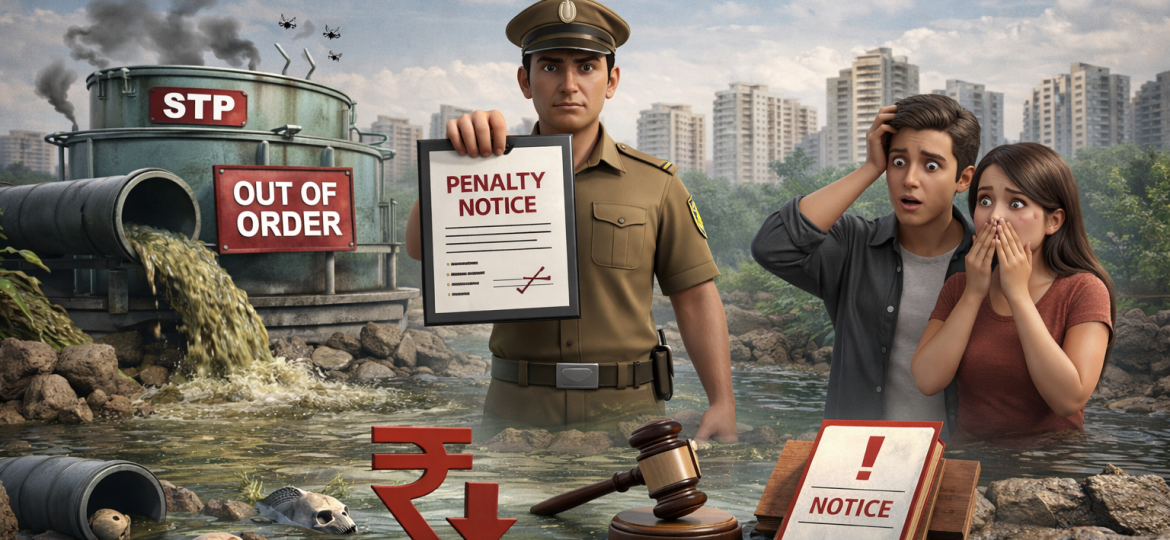
Non-compliance violations now cost facilities over INR 4,219,022.54 per day, per violation. Enforcement actions have resulted in substantial penalties. Himachal Pradesh imposed Rs 2.82 crore in fines on 12 treatment plants, with individual penalties reaching Rs 40.9 lakh. Delhi authorities issued Rs 2.89 crore in environmental compensation to 15 facilities that failed prescribed standards. Repeat offenses trigger penalties ranging from Rs 5 lakhs to Rs 25 lakhs. Immediate production shutdowns and facility closure notices follow.
Environmental Impact of Untreated Laundry Wastewater
Phosphate discharge accelerates eutrophication in receiving water bodies and stimulates excessive algal growth that depletes dissolved oxygen levels. Surfactants damage the protective mucus layer on fish and reduce their defense against bacteria and parasites. They block oxygen uptake capacity through gill damage. Microfibers persist in aquatic ecosystems and release plasticizers. They absorb persistent organic pollutants that biomagnify through food chains. Even low surfactant concentrations of 5 ppm can disrupt fish reproduction by damaging eggs.
Core Components of Laundry Effluent Treatment Plant Systems
What is Effluent Treatment Plant and How It Works
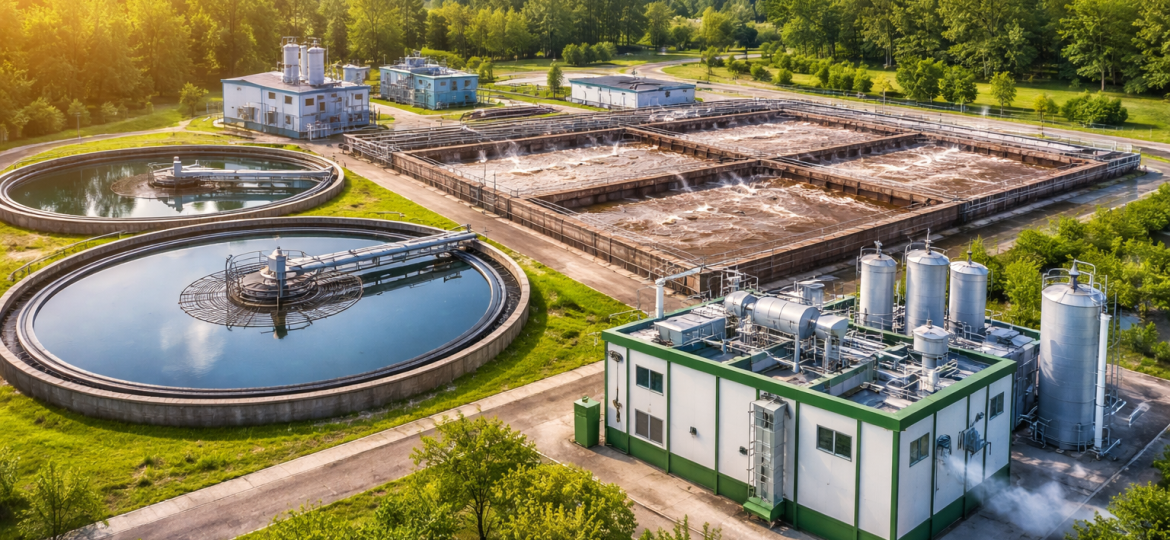
An effluent treatment plant treats industrial wastewater and removes harmful chemicals, organic matter, heavy metals and pollutants before discharge or reuse. The laundry ETP involves physical, chemical and biological processes. These include preliminary treatment (removing large solids through screening), primary treatment (sedimentation with coagulants), secondary treatment (biological breakdown using microorganisms), tertiary treatment (filtration and disinfection) and sludge handling.
Screening and Equalization Tank Setup
Flow equalization dampens diurnal variations and achieves constant flow rates through downstream processes while blending wastewater constituents for uniform organic and nutrient loading. Equalization basins are installed after preliminary screening to manage variable discharge rates from laundry operations. The tank requires compressed air diffusers for continuous aeration. This prevents septicity and keeps solids suspended. Retention time ranges from 4 to 8 hours. Aeration provides pre-treatment benefits and reduces organic load on main biological reactors.
Chemical Dosing and Coagulation-Flocculation Process
Conventional metal-based coagulants include aluminum sulfate, ferric chloride and polyaluminum chloride. Ferric chloride at 1,000 mg/L with anionic flocculant achieved optimal conditions for detergent wastewater and increased biodegradability through boosted BOD5/COD ratios. Coagulation efficiency depends on pH. Proper levels influence hydrolysis and polymerization reactions of aluminum and iron ions. The process destabilizes colloidal particles into sizeable flocs through sweep-floc coagulation, adsorption and bridging mechanisms.
Biological Treatment Methods (MBBR and Activated Sludge)
Moving bed bioreactors filled with Kaldnes K5 carriers (specific area 800 m2/m3) achieved BOD5 removal of 95-98% and COD removal of 89-94% in aerobic conditions. Activated sludge produces higher quality effluent than biofilters for laundry applications. Industrial laundry facilities benefit from MBR systems that combine biological treatment with membrane clarification. External tubular membranes proved stronger than submerged alternatives.
Tertiary Filtration and Disinfection Systems
Tertiary filtration targets 10 ppm BOD and suspended solids through granular media systems using silica sand, anthracite or activated carbon. UV disinfection exposes effluent to UV-C radiation (200-280 nm) and causes photochemical damage to microbial DNA without chemical addition. Chlorination remains common but produces disinfection byproducts like trihalomethanes.
Sludge Management and Dewatering Technology
Filter presses achieve 35-45% dry solids concentrations by applying 7-20 bar pressure over 1-2 hours. Belt filter presses produce 15-20% solids cake, while screw press systems reach 25% dry solids with minimal energy consumption.
Step-by-Step Laundry Wastewater Treatment Process
Inlet Collection and Debris Screening
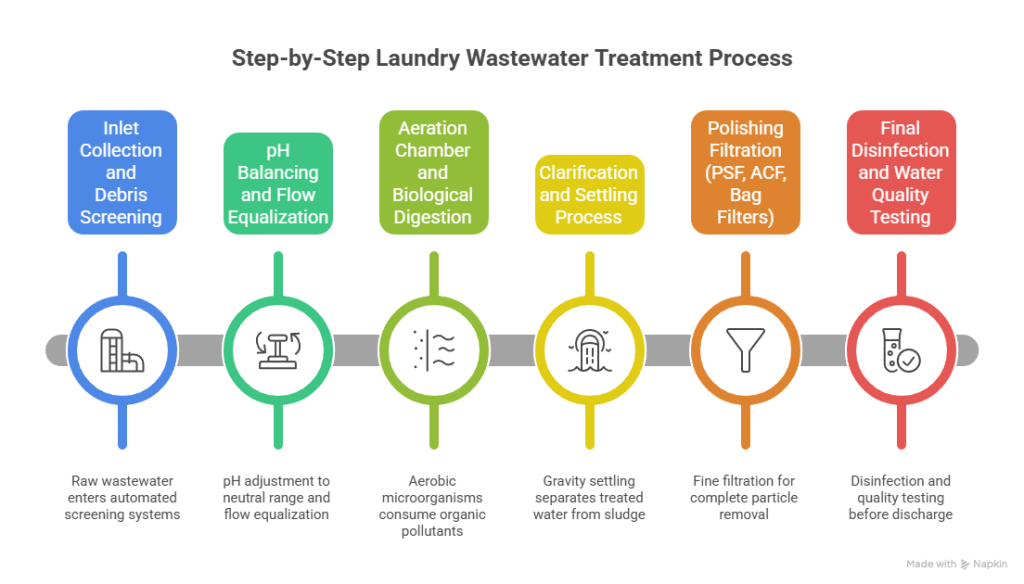
Raw laundry wastewater enters through automated screening systems that remove large debris, lint and fabric particles. Bar screens with spacing between 10-80 mm capture coarse materials. Fine screening targets particles down to 6 mm. The collection tank equalizes flow variations and provides buffer storage during peak discharge periods.
pH Balancing and Flow Equalization
Laundry wastewater often arrives highly alkaline due to detergents. This requires pH adjustment to a neutral range of 6-9. Automated pH control systems continuously monitor levels and dose acidic or caustic chemicals therefore. The equalization tank blends multiple batches and allows acid and caustic wash cycles to self-neutralize while maintaining 4-8 hour retention times.
Aeration Chamber and Biological Digestion
Extended aeration promotes biological digestion where aerobic microorganisms consume organic pollutants. Oxygen supplied through diffusers enables bacteria to break down contaminants. BOD and COD reduce by a lot through microbial activity. Biological oxidation converts organic matter into carbon dioxide, water and biomass.
Clarification and Settling Process
Gravity settling separates treated water from biological sludge over 2-4 hours. Clarifiers remove 50-60% of suspended solids through sedimentation and produce clarified effluent with suspended solids below 20-30 mg/L. The settled sludge returns to biological reactors or proceeds to dewatering.
Polishing Filtration (PSF, ACF, Bag Filters)
Pressure sand filters remove fine suspended solids. Activated carbon filters eliminate color, odor and organics. Bag filters ensure final polishing to achieve less than 5 mg/L TSS. Polishing systems typically achieve 95-99% particle removal efficiency.
Final Disinfection and Water Quality Testing
UV radiation or chlorine disinfection eliminates remaining pathogens before discharge or reuse. Treated water meets discharge standards with BOD below 30 mg/L and COD under 250 mg/L for safe environmental release.
Ensuring Compliance and Avoiding Environmental Violations in 2026
Meeting State Pollution Control Board Standards
State Pollution Control Boards issue consent to establish (CTE) and consent to operate (CTO) based on environmental compliance criteria. We must get CTO before operations commence. This document defines permissible parameter values for water emissions. SPCBs conduct regular inspections of treatment plants and enforce pollution control measures. They take legal action against non-compliant facilities.
Automated Monitoring and Up-to-the-Minute Data Logging
Up-to-the-minute monitoring systems track pH, turbidity, TSS, BOD, and COD through IoT-enabled sensors. SCADA integration captures continuous equipment performance against designated set-points. The system generates alerts for parameter deviations. Large facilities above 50 KLD capacity must install online sensors with data linked to SPCB central servers.
Water Reuse Applications That Reduce Freshwater Dependency
Treated water from laundry ETP systems supports toilet flushing, landscape irrigation, floor washing, and cooling tower makeup water. Moderately treated wastewater serves non-potable applications. Advanced treatment through membrane filtration enables reuse in laundry operations. Water reuse provides a reliable supply that drought restrictions don’t affect.
Cost Savings Through Treated Water Recycling
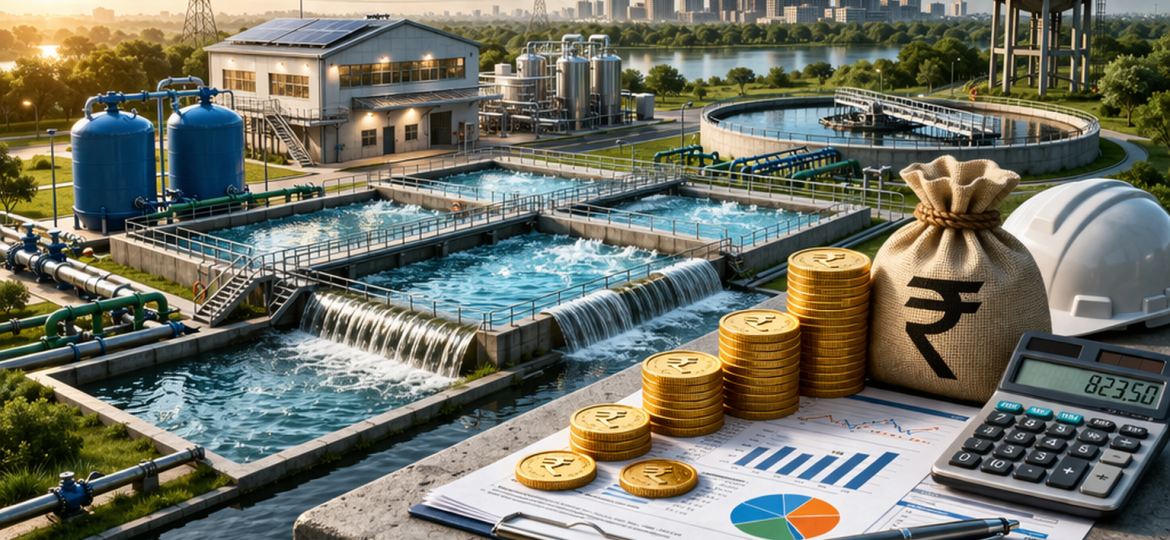
Treatment costs vary by a lot based on technology selection. Photo-Fenton processes cost 6.72 € per cubic meter. Biological filtration with granular activated carbon achieves 0.71 € per cubic meter. Facilities achieve 60-80% reduction in water costs through recycling and eliminate discharge fees.
Maintenance Requirements That Ensure Long-Term Compliance
Daily tasks include checking pumps, blowers, and water quality parameters. Weekly maintenance covers filter cleaning and screen maintenance. Tank inspection happens weekly. Monthly activities involve sensor calibration, pipeline inspection, and sludge removal verification. Annual overhauls address motor maintenance and membrane replacement.
Selecting the Right ETP Capacity for Your Facility
Capacity specification depends on daily wastewater generation rates, measured in cubic meters per day or per hour. Selection criteria include current discharge volumes and future expansion plans. This ensures flexible treatment capability.
Conclusion
Laundry effluent treatment plants remain essential for avoiding penalties exceeding INR 42 lakh and meeting 2026 CPCB standards. Throughout this piece, we explored core ETP components from screening tanks to biological treatment and tertiary filtration. Properly designed systems achieve 95% pollutant removal efficiency. They enable 60-80% water cost reductions through recycling. Your facility can maintain compliance and achieve green operations with automated monitoring and appropriate capacity selection.
Key Takeaways
Commercial laundries face stringent 2026 regulations with BOD limits below 30 mg/L and potential penalties exceeding INR 42 lakh per violation, making proper effluent treatment systems critical for compliance and cost control.
- Install comprehensive ETP systems with screening, biological treatment, and tertiary filtration to achieve 95% pollutant removal efficiency • Implement automated monitoring with real-time sensors for pH, BOD, and COD to ensure continuous compliance with SPCB standards • Leverage water recycling to reduce freshwater costs by 60-80% while meeting non-potable reuse applications like irrigation and cooling • Select proper capacity based on daily discharge volumes and future expansion plans to avoid costly system upgrades • Maintain regular operations through daily pump checks, weekly filter cleaning, and monthly sensor calibration for long-term compliance
Investing in proper laundry effluent treatment technology not only prevents environmental violations but transforms wastewater management into a cost-saving opportunity through water recycling and operational efficiency.
Frequently Asked Questions
Q1. What pollutants are commonly found in laundry wastewater?
Laundry wastewater contains over 160 chemical substances including surfactants from detergents, phosphates (35-75% of detergent composition), metals like aluminum, copper, iron, strontium, and zinc, bleaching agents with chlorine compounds, fabric softeners, and microfibers from synthetic textiles. Physical pollutants include suspended solids, oils, and lint that create turbidity issues.
Q2. What are the discharge standards for laundry effluent in 2026?
The 2026 standards require biochemical oxygen demand (BOD) below 30 mg/L and chemical oxygen demand (COD) under 250 mg/L for inland surface water discharge. For municipal sewer connections, stricter limits apply with BOD and TSS below 10 mg/L and COD under 50 mg/L. The pH must remain between 5.5-9.0, with total suspended solids not exceeding 100 mg/L.
Q3. How does a laundry effluent treatment plant work?
A laundry ETP operates through multiple stages: preliminary screening removes large debris and lint, equalization tanks balance flow and pH levels, biological treatment uses microorganisms to break down organic matter, clarification separates solids through settling, tertiary filtration polishes the water using sand and carbon filters, and final disinfection eliminates pathogens before discharge or reuse.
Q4. What are the financial penalties for non-compliance with wastewater discharge standards?
Non-compliance violations can cost facilities over INR 42 lakh (4.2 million rupees) per day per violation. Recent enforcement actions have resulted in substantial penalties, with individual facilities facing fines ranging from Rs 5 lakhs to Rs 40.9 lakhs. Repeat offenses trigger immediate production shutdowns and facility closure notices.
Q5. Can treated laundry wastewater be reused, and what are the cost benefits?
Yes, treated laundry wastewater can be reused for toilet flushing, landscape irrigation, floor washing, and cooling tower makeup water. Advanced treatment enables reuse in laundry operations. Facilities achieve 60-80% reduction in water costs through recycling while eliminating discharge fees, with treatment costs ranging from 0.71 to 6.72 euros per cubic meter depending on the technology used.