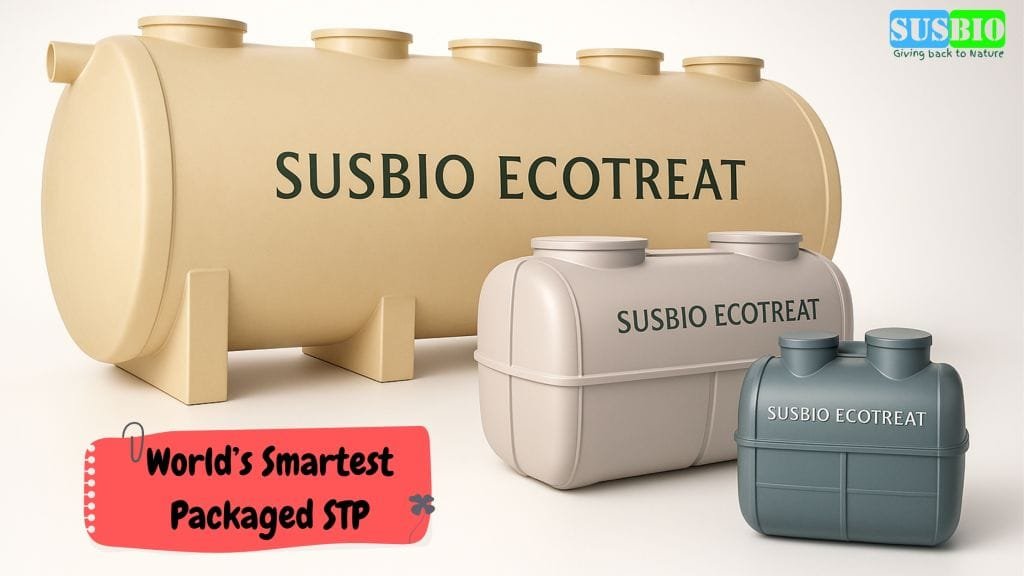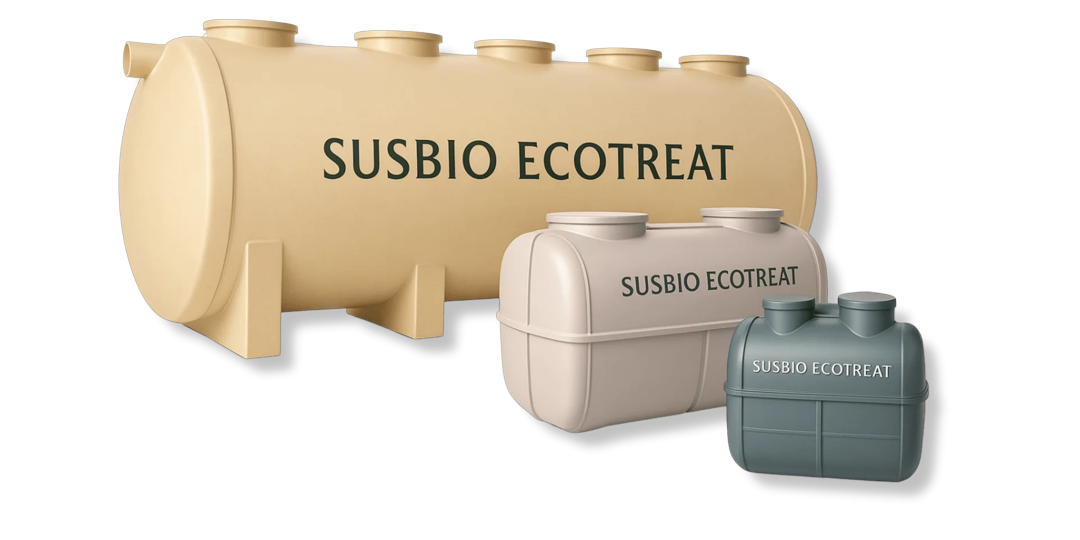


SUSBIO ECOTREAT is an Anaerobic + MBBR packaged sewage treatment plant built for Chennai’s chronic water stress, its fast-growing peri-urban corridors, and Tamil Nadu Pollution Control Board (TNPCB) compliance requirements. Since 2013, SUSBIO has delivered 500+ installations across 24 Indian states and exports to 8 countries — combining dual-stage biological treatment with a compact, prefabricated design that installs in days, not months.
This page covers what Chennai’s wastewater treatment market actually requires, how SUSBIO ECOTREAT is engineered to meet it, and what to evaluate before choosing a packaged STP manufacturer in the city.
For a detailed look at the broader Chennai and Tamil Nadu wastewater challenge, see our complete guide on sewage treatment in Chennai and Tamil Nadu.
Chennai's Wastewater Reality — Why Standard STPs Fall Short
Chennai is one of India’s most water-stressed metropolitan cities — almost entirely dependent on the Cauvery river and a network of reservoirs that periodically run dry. In that context, wastewater treatment isn’t just a compliance requirement: treated effluent is a recoverable resource, and every litre reused directly offsets the city’s acute freshwater deficit.
CMWSSB’s sewerage network doesn’t reach Chennai’s fastest-growing corridors. The OMR (Old Mahabalipuram Road) IT corridor, GST Road industrial belt, ECR residential stretch, and peri-urban areas including Tambaram, Sholinganallur, and Perungalathur are growing rapidly outside Chennai’s centralized sewerage network. Projects in these zones have no municipal connection option — on-site packaged STPs are the only viable compliance path.
Chennai’s sensitive receiving bodies raise the compliance bar. The Cooum and Adyar rivers, and the Buckingham Canal, are classified as sensitive receiving bodies under TNPCB norms. Projects discharging into or near these catchments are held to stricter effluent standards than general inland discharge — a compliance reality that affects a large portion of Chennai’s urban and peri-urban projects.
Chennai’s industrial mix generates complex effluent. Sriperumbudur’s auto manufacturing hub, the Manali petrochemical complex, OMR’s IT campuses, and Chennai’s textile and food processing units each produce distinct effluent profiles. A purely domestic-focused STP often underperforms when industrial-adjacent wastewater enters the stream.
Water reuse has direct economic value in Chennai. Treated effluent meeting TNPCB standards is suitable for landscaping, toilet flushing, cooling tower makeup, and industrial process water — reducing dependence on tanker water supply, which is a significant operational cost for Chennai’s commercial and industrial projects during summer months.
TNPCB Compliance — What Chennai Projects Actually Need to Meet
TNPCB enforces two tiers of effluent discharge standards under the Water (Prevention and Control of Pollution) Act, 1974:
| Parameter | General Inland Discharge | CPCB Class A (Reuse/Sensitive Water Bodies) |
|---|---|---|
| pH | 6.5 – 8.5 | 6.5 – 8.5 |
| BOD | ≤ 30 mg/L | ≤ 10 mg/L |
| COD | ≤ 250 mg/L | ≤ 50 mg/L |
| Total Suspended Solids (TSS) | ≤ 100 mg/L | ≤ 10 mg/L |
| Fecal Coliforms | — | ≤ 230 MPN/100 mL |
Projects near the Cooum River, Adyar River, or Buckingham Canal catchments — and projects intending to reuse treated water — must meet Class A standards. SUSBIO ECOTREAT is CPCB Class A compliant throughout its capacity range.
SUSBIO ECOTREAT — Engineered for Chennai's Constraints
SUSBIO ECOTREAT moves wastewater through oil and grease separation, sedimentation, anaerobic contact media, MBBR biofilm treatment, secondary sedimentation, and disinfection — removing BOD, COD, suspended solids, and pathogens through purely biological dual-stage treatment to produce effluent meeting TNPCB Class A standards and suitable for non-potable reuse.
Technical specifications
| Spec | Detail |
|---|---|
| Capacity range | 1–500 KLD |
| Construction | Fiber-reinforced plastic (FRP), corrosion-resistant |
| Treatment technology | Anaerobic + MBBR (dual-stage biological) |
| Energy use | Up to 70% less electricity than conventional STPs |
| Installation time | Typically weeks, prefabricated plug-and-play |
| Footprint | Compact, underground-installation capable |
| Operational lifespan | 15–25 years with minimal maintenance |
| Operation | Fully automated, no dedicated on-site operator required |
SUSBIO ECOTREAT vs. Conventional STPs
| Factor | SUSBIO ECOTREAT | Conventional STP |
|---|---|---|
| Installation time | Days | Months |
| Land requirement | Compact — fits constrained urban and industrial plots | Extensive civil works required |
| Energy consumption | 70% less electricity | High operational power draw |
| TNPCB Class A compliance | Built in from design | Often requires retrofitting |
| Effluent reuse suitability | Meets Class A — suitable for landscaping, flushing, cooling | Often requires additional tertiary treatment |
| Automation | Fully automated | Manual/semi-automatic |
| Suitability for pharma/industrial mixed effluent | Strong fit via MBBR biofilm process | Often underperforms on variable COD loads |
| Odour and noise | Enclosed, odour-controlled | Open systems can generate odour issues |
Where SUSBIO ECOTREAT Is Used in Chennai
IT campuses and tech parks (OMR corridor) — Quiet, enclosed, automated operation suits high-occupancy IT campuses where wastewater infrastructure must run reliably without on-site technical staff. Compact footprint fits the constrained plot sizes typical along OMR.
Residential complexes and gated communities — Fast-growing residential developments across Sholinganallur, Perungalathur, Tambaram, and ECR corridor need low-maintenance STPs outside the CMWSSB network. SUSBIO ECOTREAT’s automated operation suits societies without dedicated wastewater teams.
Auto and industrial units (Sriperumbudur, GST Road) — Handles variable BOD/COD loads from manufacturing and processing units. Compact footprint suits constrained industrial plot sizes in Sriperumbudur and the GST Road corridor.
Hotels and hospitality — Odour-free, low-noise enclosed operation suits Chennai’s hospitality sector, where guest experience and consistent TNPCB compliance both need to be maintained reliably.
Hospitals and healthcare facilities — Consistent effluent quality with integrated disinfection, meeting the enhanced requirements healthcare facilities face under TNPCB guidelines.
Educational institutions — Automated, low-maintenance operation suits Chennai’s university campuses and schools where staffing a wastewater system isn’t practical.
Choosing a Sewage Treatment Plant Manufacturer in Chennai — What Actually Matters
1. TNPCB Class A compliance built in, not retrofitted. Chennai’s sensitive receiving bodies — Cooum, Adyar, Buckingham Canal — mean many projects are held to Class A standards by default. A system designed to meet Class A from the start costs less to maintain during TNPCB consent renewals than one requiring modifications to comply.
2. Effluent quality suitable for reuse — not just discharge. In a city with Chennai’s water stress and tanker dependency, treated water reuse has direct, quantifiable value. An STP producing Class A effluent suitable for landscaping, flushing, and cooling reduces operational costs over a 15–25 year lifespan in ways a cheaper, lower-quality system cannot.
3. Installation speed for Chennai’s fast-moving development corridors. OMR, GST Road, and ECR projects routinely need wastewater infrastructure operational before handover. Ask for specific day-ranges for your project’s capacity — not generic “fast installation” marketing language.
4. Total cost of ownership, not sticker price. At 70% less electricity than conventional STPs, SUSBIO ECOTREAT’s operational savings compound significantly over a 15–25 year lifespan. Maintenance labour and operational reliability dominate lifetime STP costs — a fully automated system changes that equation substantially.
5. After-installation support in Chennai. Service response time and spare parts availability matter more over a 20-year operational lifespan than almost any other factor. Clarify AMC terms and service coverage before commitment.
Serving Chennai and Tamil Nadu
SUSBIO serves projects across Chennai, the OMR/GST/ECR corridors, Sriperumbudur, and broader Tamil Nadu. For projects in Coimbatore, see our packaged STP manufacturer page for Coimbatore. For the full Tamil Nadu and Chennai wastewater context, see our sewage treatment guide for Chennai and Tamil Nadu.
Frequently Asked Questions
Q1: Does SUSBIO ECOTREAT comply with TNPCB discharge standards for Chennai?
Yes. SUSBIO ECOTREAT is CPCB Class A compliant throughout its capacity range, meeting TNPCB’s strictest discharge standards — BOD ≤10 mg/L, COD ≤50 mg/L, TSS ≤10 mg/L, pH 6.5–8.5 — through its dual-stage Anaerobic + MBBR biological treatment process.
Q2: Why do projects on Chennai’s OMR, GST Road, and ECR corridors need on-site STPs?
These fast-growing corridors sit largely outside the CMWSSB centralized sewerage network. Projects in Sholinganallur, Perungalathur, Tambaram, and Sriperumbudur cannot connect to municipal infrastructure — a packaged STP is the only practical path to TNPCB compliance for residential, commercial, and industrial developments in these areas.
Q3: How does SUSBIO ECOTREAT help projects near the Cooum and Adyar rivers meet TNPCB standards?
Projects discharging into or near the Cooum River, Adyar River, or Buckingham Canal catchments are required to meet TNPCB’s Class A standards — the stricter tier. SUSBIO ECOTREAT is CPCB Class A compliant throughout, preventing BOD, COD, and suspended solids from entering these sensitive receiving bodies and supporting TNPCB compliance during inspections.
Q4: Can SUSBIO ECOTREAT’s treated water be reused in Chennai’s water-scarce conditions?
Yes. Effluent meeting TNPCB Class A standards is suitable for non-potable reuse including landscaping, toilet flushing, cooling tower makeup, and industrial process water — directly reducing tanker water dependency, which is a significant operational cost for Chennai’s commercial and residential projects during summer months.
Q5: How energy-efficient is SUSBIO ECOTREAT compared to conventional STPs in Chennai?
SUSBIO ECOTREAT consumes 70% less electricity than conventional sewage treatment systems. Over a 15–25 year operational lifespan, this translates into substantial power cost savings — compounding into real financial benefit for Chennai’s IT campuses, industrial units, and large residential complexes.
Q6: How quickly can SUSBIO ECOTREAT be installed in Chennai?
SUSBIO ECOTREAT’s prefabricated, plug-and-play design installs within days of arriving on site, with minimal civil work required — significantly faster than conventional STP construction timelines of several months. This suits Chennai’s fast-moving development corridors where projects need wastewater infrastructure operational before handover.
Q7: Is SUSBIO ECOTREAT suitable for Chennai’s auto and industrial units in Sriperumbudur?
Yes. The Anaerobic + MBBR biological treatment process handles variable BOD/COD loads from auto manufacturing and light industrial operations. Its compact footprint suits the constrained plot sizes common in Sriperumbudur and the GST Road industrial belt.
Q8: What capacity range does SUSBIO ECOTREAT cover for Chennai projects?
SUSBIO ECOTREAT spans 1–500 KLD, covering individual residential complexes, boutique hotels, large IT campuses, auto manufacturing facilities, and hospitals within a single product family.
Q9: Does SUSBIO ECOTREAT require a dedicated on-site operator in Chennai?
No. The system is fully automated, reducing both labor costs and the need for specialized on-site technical staff — relevant for OMR IT campuses, educational institutions, and residential complexes along Chennai’s growth corridors without dedicated wastewater operations teams.