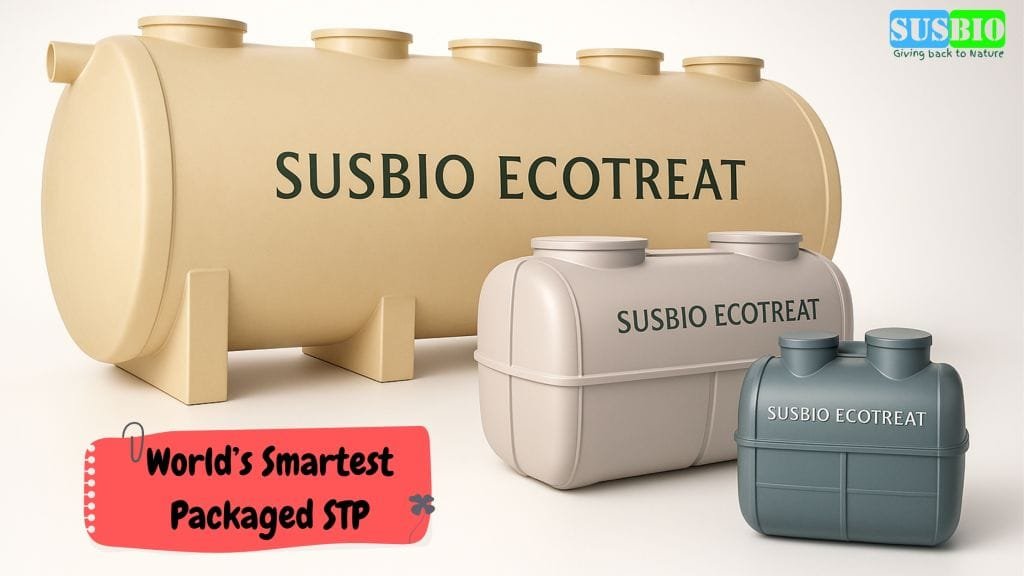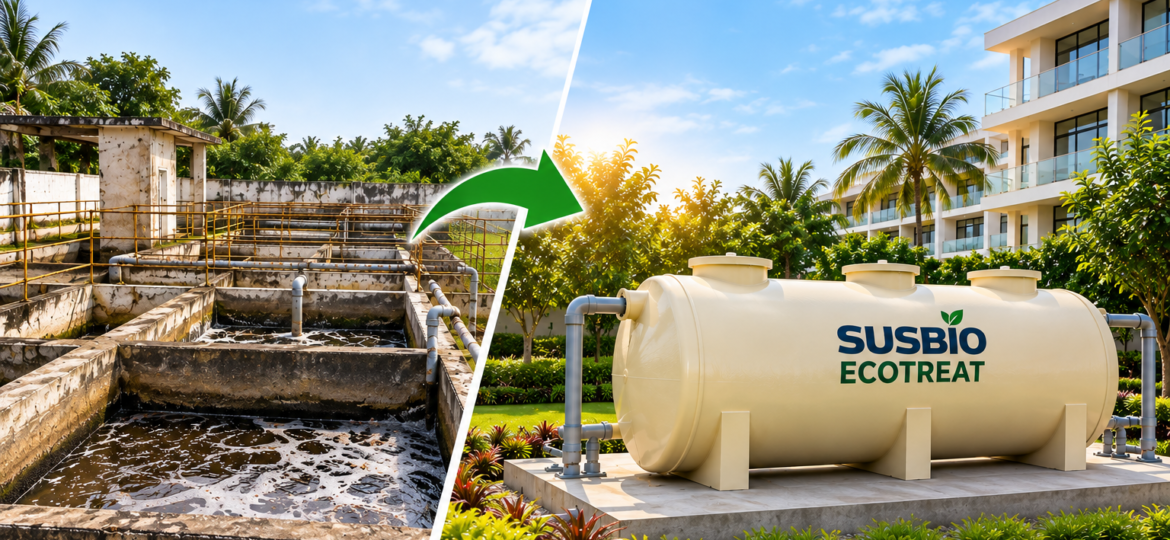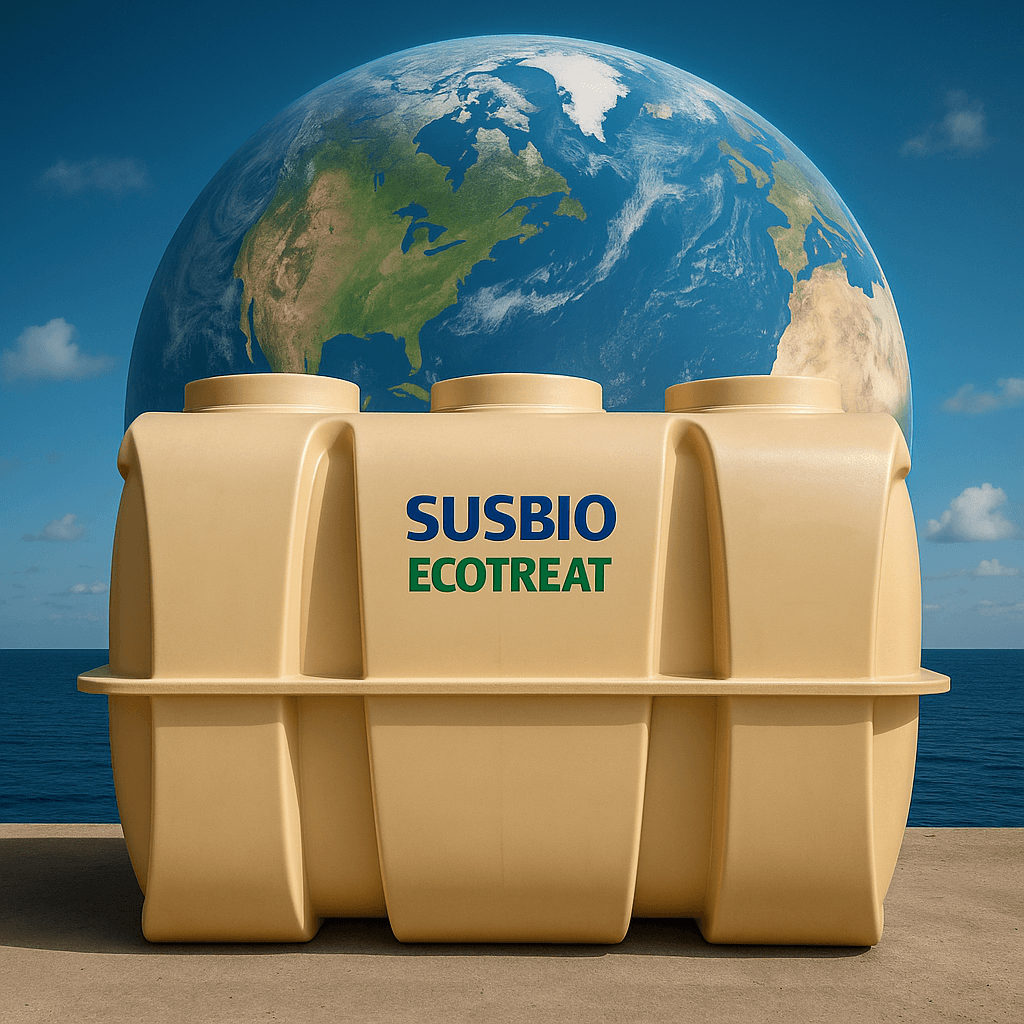


SUSBIO ECOTREAT is an Anaerobic + MBBR packaged sewage treatment plant purpose-built for Abu Dhabi’s climate, regulatory environment, and rapid development pace. Since 2013, SUSBIO has delivered 500+ installations across 24 Indian states and 8 countries — including the UAE — combining dual-stage biological treatment with a compact, prefabricated design that’s ready to install in weeks, not months.
This page covers what Abu Dhabi’s sewage treatment market actually requires, how SUSBIO ECOTREAT is engineered to meet it, and what to evaluate before choosing a supplier.
Abu Dhabi's Wastewater Reality — Why Standard STPs Often Fall Short
Abu Dhabi treats wastewater at significant scale. The emirate processes more than 500,000 cubic meters of wastewater daily to standards suitable for reuse in irrigation and landscaping, and over 93% of Abu Dhabi’s wastewater is now recycled — with more than 60% of treated effluent used to irrigate green spaces. As of January 2025, Abu Dhabi implemented updated Water Quality Regulations under the Department of Energy, applying stricter, legally binding monitoring and compliance requirements across residential, commercial, and industrial users.
That scale and regulatory tightening create specific, practical problems for individual projects:
Infrastructure is already running above design capacity. The Al-Mafraq treatment plant, originally designed for 360,000 cubic meters per day, has handled peaks of 475,000. Al-Zakher in Al-Ain processes more than double its designed capacity. This kind of strain pushes new developments toward decentralized, on-site solutions rather than relying solely on municipal capacity.
Land and buffer-zone constraints limit siting options. Urban and coastal sites in Abu Dhabi have limited space for large conventional plants, and buffer-zone requirements between treatment units and residential property can eliminate conventional STPs as an option in dense developments.
Conventional construction timelines don’t match Abu Dhabi’s development pace. Traditional STP construction can take months to years. New communities, resorts, and commercial developments routinely need wastewater infrastructure operational long before that timeline allows.
SUSBIO ECOTREAT — Engineered for These Exact Constraints
SUSBIO ECOTREAT uses a two-stage Anaerobic + MBBR (Moving Bed Biofilm Reactor) treatment process, moving wastewater through oil/grease separation, sedimentation, anaerobic contact media, MBBR biofilm treatment, secondary sedimentation, and disinfection — removing organic pollutants, nutrients, and pathogens to produce effluent suitable for reuse.
Technical specifications
| Spec | Detail |
|---|---|
| Capacity range | 1–500 KLD |
| Construction | Fiber-reinforced plastic (FRP), corrosion-resistant |
| Treatment technology | Anaerobic + MBBR (dual-stage biological) |
| Energy use | Up to 70% less electricity than conventional STPs |
| Installation time | Typically weeks, prefabricated plug-and-play |
| Footprint | Compact, underground-installation capable |
| Operational lifespan | 15–25 years with minimal maintenance |
| Operation | Fully automated, no dedicated on-site operator required |
SUSBIO ECOTREAT vs. Conventional STPs
| Factor | SUSBIO ECOTREAT | Conventional STP |
|---|---|---|
| Installation time | Weeks | Months to years |
| Land requirement | Minimal, underground-capable | Extensive, large buffer zones |
| Energy consumption | Up to 70% less | High |
| Automation | Fully automatic | Manual/semi-automatic |
| Maintenance | Low, remote-monitored | High, on-site staff required |
| Water reuse capability | High (tertiary treatment) | Often limited |
| Suitability for dense urban Dubai sites | Strong fit | Often impractical |
Where SUSBIO ECOTREAT Is Used in Abu Dhabi
Hotels and resorts — Silent, odorless operation and compact installation suit hospitality projects where guest experience and limited land are both priorities.
Residential towers and villa communities — Underground or space-efficient above-ground installation fits both high-density towers and individual villa plots without sacrificing usable land.
Commercial and retail developments — Tertiary-treated output supports landscaping and non-potable reuse, contributing to green building certification targets.
Industrial and remote-site facilities — Handles variable load profiles reliably with minimal on-site staffing requirements, suited to remote or industrial-zone locations and PPP-driven infrastructure projects.
Choosing a Sewage Treatment Plant Manufacturer in Abu Dhabi — What Actually Matters
Most comparisons in this market focus on upfront price. That’s the wrong starting point. Evaluate suppliers on:
1. Regulatory design fit, not just regulatory compliance. A system designed from the outset around the Department of Energy’s updated Water Quality Regulations, buffer-zone constraints, and effluent quality standards (BOD, COD, pH, TSS, pathogens) will cost less to defend during approvals than one adapted after the fact.
2. Total cost of ownership over 15–25 years, not sticker price. Energy consumption and maintenance labor are the two largest recurring costs in an STP’s lifecycle. A system using 70% less electricity and requiring no dedicated operator compounds into substantial savings well beyond any initial price difference.
3. Actual installation speed for your timeline. “Fast installation” claims vary widely. Ask for specific day-ranges tied to capacity and site conditions, not generic marketing language.
4. Manufacturing experience with FRP construction specifically. FRP performance in Gulf heat and humidity depends on manufacturing quality — ask about installation track record in similar climate conditions, not just years in business generally.
5. What happens after installation. Remote monitoring, spare parts availability, and response time for service issues matter more over a 20-year lifespan than almost any other factor.
Our Commitment to Abu Dhabi's Water Future
SUSBIO designs, manufactures, and supports sewage treatment systems for residential, commercial, and industrial projects across Abu Dhabi and the wider UAE. Our approach stays consistent across every project: deliver compliant, energy-efficient, low-maintenance treatment that supports Abu Dhabi’s water reuse goals without the lead times conventional construction requires.
Frequently Asked Questions
Q1: Does SUSBIO ECOTREAT meet Abu Dhabi’s Water Quality Regulations?
Yes. SUSBIO ECOTREAT delivers tertiary-level treatment and is designed to meet or exceed discharge standards for BOD, COD, pH, TSS, and pathogens under the Department of Energy’s updated Water Quality Regulations.
Q2: How does SUSBIO ECOTREAT handle Abu Dhabi’s land and buffer-zone constraints?
Its compact, modular footprint and underground installation option help projects work within buffer-zone and space requirements that can otherwise restrict siting for conventional plants in urban or coastal areas.
Q3: How much electricity does SUSBIO ECOTREAT save compared to conventional STPs?
SUSBIO ECOTREAT uses up to 70% less electricity than conventional sewage treatment plants, a significant factor in total ownership cost given regional energy pricing.
Q4: Can treated water from SUSBIO ECOTREAT support Abu Dhabi’s water reuse targets?
Yes. Its tertiary treatment output is suitable for irrigation, landscaping, and industrial reuse, supporting Abu Dhabi’s existing 93%+ wastewater recycling rate and the UAE’s broader Water Security Strategy 2036.
Q5: How long does installation typically take in Abu Dhabi?
Thanks to its prefabricated, plug-and-play design, SUSBIO ECOTREAT typically installs in weeks rather than the months required for conventional construction — important given Abu Dhabi’s fast-paced development timelines.
Q6: Is SUSBIO ECOTREAT suitable for hotels and resort projects in Abu Dhabi?
Yes. Its compact, low-maintenance, and fully automated operation suits hotels and resorts, where space is limited and uninterrupted guest experience is a priority.
Q7: What’s the difference between SUSBIO ECOTREAT and SUSBIO SBR?
ECOTREAT uses continuous Anaerobic + MBBR treatment, while SBR uses timed batch cycles for aerobic treatment. They’re distinct technologies suited to different project requirements — SUSBIO manufactures both.
Q8: How long does a SUSBIO ECOTREAT system last in Abu Dhabi’s climate?
Built from fiber-reinforced plastic (FRP), the system is designed for a 15–25 year operational lifespan with minimal maintenance, even under Abu Dhabi’s high-heat, high-humidity conditions.
Q9: Does SUSBIO ECOTREAT require a dedicated on-site operator?
No. The system is fully automated with remote monitoring capability, reducing both labor costs and the need for specialized on-site staff over its operational life — particularly valuable for remote or PPP-driven projects.
Q10: What capacities does SUSBIO ECOTREAT cover for Abu Dhabi projects?
SUSBIO ECOTREAT spans 1–500 KLD, covering everything from individual villas to large commercial and industrial developments within a single product family.