

You are about to spend ₹5 lakhs to ₹2 crore on a system that will run every day for the next 20+ years, determine whether your building passes Occupancy Certificate inspections, and decide whether you ever face an NGT notice.
That is what a sewage treatment plant purchase actually is. Not a commodity procurement. Not a price comparison exercise. A decision with decade-long consequences.
Yet most developers, RWAs, hotel owners, and facility managers still choose their STP manufacturer the same way they buy office furniture — by comparing the three lowest quotes. The result: systems that fail within 18 months, effluent that never meets CPCB norms, maintenance bills that dwarf the original purchase cost, and — increasingly — SPCB notices and NGT proceedings.
This guide gives you the framework to choose correctly. It covers the 7 criteria that genuinely separate a reliable STP manufacturer from an unreliable one, a direct manufacturer comparison, and SUSBIO’s presence across India’s major cities — so you can make a decision you won’t regret.
What Makes a Good STP Manufacturer in India?
A reliable sewage treatment plant manufacturer in India must demonstrate: CPCB product approval (not just installation compliance), a proven installed base of 100+ projects with documented performance data, a defined post-installation AMC and service network, transparent effluent quality guarantees (BOD, COD, TSS in writing), and an engineering team that sizes the STP to your actual sewage load — not a standard catalogue size. Any manufacturer that cannot meet all five of these criteria is a compliance risk, not a partner.
1. Why Most STP Purchases Go Wrong in India
India has hundreds of companies claiming to manufacture sewage treatment plants. The market ranges from ISO-certified engineering firms with 20+ years of track record to traders who assemble standard components in a shed and badge them as ‘packaged STPs.’ The price difference between these two extremes can be as small as 15–20% on the initial quote.
The real cost difference emerges over 3–5 years. Here is what the post-purchase reality looks like for a poorly specified STP:
| What Goes Wrong | Typical Timeline | Typical Cost |
|---|---|---|
| Effluent fails CPCB BOD/COD test at first inspection | Month 3–6 post-commissioning | ₹50,000–2,00,000 in retrofits |
| Blower / aerator failure requiring replacement | Month 8–18 (cheap components) | ₹30,000–1,50,000 + downtime |
| Odour complaints from residents / neighbours | Ongoing from day 1 if undersized | Relationship damage, potential legal |
| SPCB show-cause notice for non-compliant discharge | Year 1–2 | ₹1 lakh/day potential penalty + legal fees |
| STP abandoned / replaced entirely | Year 2–3 | Full CAPEX written off; new purchase required |
The cheapest STP on day zero is often the most expensive STP by year three. The 7 criteria below are your protection against this outcome.
2. The 7 Criteria for Evaluating Any STP Manufacturer in India
Criterion 1: CPCB Product Approval — Not Just Installation Compliance
There is a critical difference between a manufacturer whose STP products carry CPCB product-level approval, and a manufacturer who claims to install to CPCB norms. The latter means nothing. CPCB product approval is issued at the product / model level by the Central Pollution Control Board, certifying that the specific STP design has been independently tested and verified to meet Class A discharge standards.
Ask every manufacturer directly: ‘Do your STP units carry CPCB product-level approval on each model, or just installation compliance?’ A product-approved unit gives you legal protection during SPCB inspections and NGT proceedings that installation-compliant units do not.
SUSBIO ECOTREAT: Every unit in the ECOTREAT range carries CPCB product-level approval. This is the only certification that provides real legal protection during SPCB inspections. |
Criterion 2: Installed Base — Real Projects, Not Brochure Claims
Any manufacturer can claim ‘500+ projects’ in a brochure. Ask for verifiable evidence: a project list with client name, location, capacity, and year. Contact at least 3 references in your sector (residential, hospitality, industrial — whichever applies to your project). Ask those references specifically about: (a) whether the STP met BOD/COD norms at the first SPCB test, (b) how quickly the manufacturer responded to post-commissioning issues, and (c) whether the STP still operates correctly today.
A manufacturer with 50 proven, referenceable installations is safer than one claiming 500 with no verifiable trail.
SUSBIO ECOTREAT: 500+ verified installations across 24 Indian states since 2013. Project references available on request across residential, hospitality, healthcare, institutional, and industrial sectors. |
Criterion 3: Technology — What Is Actually Treating Your Sewage
The biological treatment stage is the heart of the STP. This is where BOD and COD reduction actually happens. Different technologies deliver vastly different results:
| Technology | Typical BOD Output | Energy Intensity | Best For |
|---|---|---|---|
| Anaerobic + MBBR (ECOTREAT) | < 10 mg/L (reuse grade) | Very low — 90% less than ASP | 2–500 KLD; all sectors |
| MBBR only (single-stage) | 15–25 mg/L typical | Moderate | Medium residential |
| SBR | 10–15 mg/L | Moderate-high | 50–500 KLD large complexes |
| Extended Aeration / ASP | 20–40 mg/L — often fails Class A | Very high | 500 KLD+ municipal |
| Septic tank + soak pit | 100–300+ mg/L — grossly non-compliant | None — but leaches to groundwater | Not legal for any commercial project |
Warning: Several manufacturers in the Indian market sell ‘MBBR’ systems that use severely undersized media volumes and inadequate aeration — delivering BOD of 30–60 mg/L while claiming Class A compliance. Always request the MBBR media surface area calculation and the guaranteed BOD/COD specification in the purchase agreement.
Criterion 4: Construction Material — FRP vs RCC vs MS
The STP vessel and internals must survive 20+ years of continuous exposure to corrosive wastewater. Material selection is not cosmetic — it is a structural and operational question:
| Material | Advantages | Limitations |
|---|---|---|
| FRP (Fibre Reinforced Plastic) | Corrosion-proof, UV-stable, 25+ year life, factory-manufactured under QC, no civil work needed, underground/above-ground both possible | Higher unit cost than MS; not field-modifiable after manufacture |
| RCC (Civil Construction) | Lower material cost, familiar to local contractors | Dependent on local construction quality; cracks over time; 3–6 months build time; no factory QC |
| MS (Mild Steel) | Cheapest option | Corrodes within 3–5 years in wastewater; structural failure risk; short life cycle; not recommended |
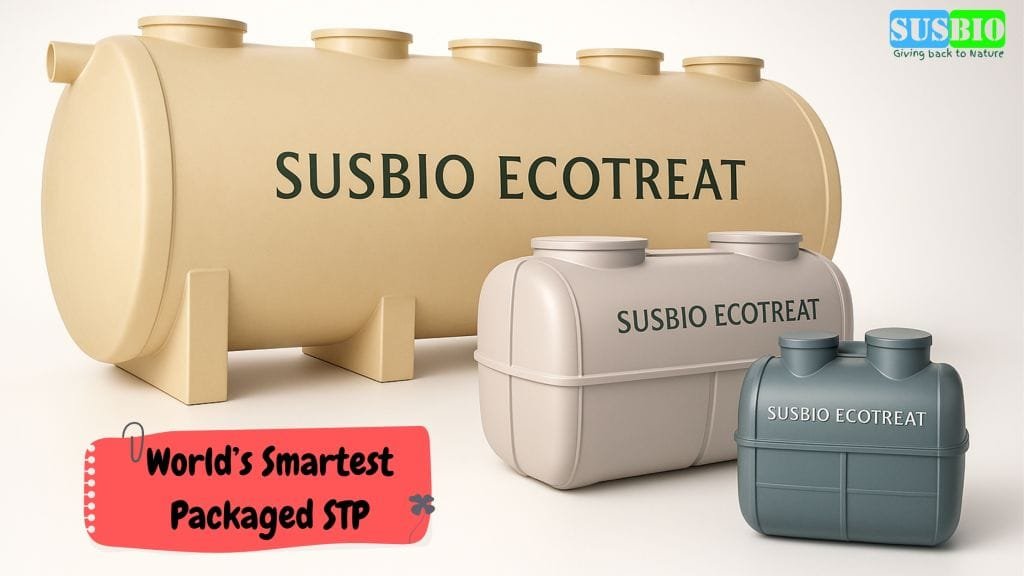
SUSBIO ECOTREAT: 100% FRP construction. Every vessel is factory-manufactured at SUSBIO’s Pune facility, pressure-tested, and dispatched only after QC sign-off. Rated 25+ year design life.
Criterion 5: Warranty and AMC — What Happens After Installation
An STP is not a one-time purchase. It is a 20-year operating relationship with your manufacturer. The warranty terms and Annual Maintenance Contract (AMC) structure tell you more about a manufacturer’s confidence in their product than any brochure claim.
Ask specifically: What does the warranty cover? Is media (biological carriers) included? What is the response SLA for breakdown calls? Is the AMC price fixed or variable? Does the manufacturer have service engineers based in your city, or do they fly someone from head office?
| Warranty / Service Factor | Industry Typical | SUSBIO ECOTREAT |
|---|---|---|
| Module warranty | 1–3 years (equipment only) | 10 years — India’s longest |
| Service commitment | 1–2 years post-warranty | Lifetime service commitment |
| Service network | Head office only; travel charges apply | Pan-India — Goa, Pune, Mumbai, plus field teams |
| Response SLA | 48–72 hours typical | 24-hour response commitment |
| AMC structure | Often undefined; price rises annually | Defined, documented AMC with fixed scope |
Criterion 6: Engineering Depth — Sizing vs Catalogue Selling
A genuine STP manufacturer sizes every system to the actual project. This means: calculating sewage generation using CPHEEO per-capita norms for your specific building type, verifying the organic load (BOD/COD) characteristics of your sewage, checking inlet conditions (fat/oil/grease loads from kitchens, chemical loads from hospitals or labs), and confirming the hydraulic retention time (HRT) and sludge retention time (SRT) in the biological reactor.
A trader or catalogue seller gives you a price for ‘100 KLD MBBR STP’ without any of this. You get a box that may or may not treat your actual wastewater. A manufacturer gives you an engineered design document before you pay.
What to ask: • Can you provide the process design calculation for our project — including HRT, SRT, MBBR media volume, and aeration rate? • Will you test a sample of our sewage before finalising the design?’ • What BOD and COD outlet values do you guarantee in writing in the purchase agreement? |
Criterion 7: Compliance Support — Beyond the Hardware
Buying the STP is only the beginning. You need: CPCB/SPCB consent documentation support, test reports from NABL-accredited laboratories, as-built drawings for OC submission, operator training for your building staff, O&M manuals, and help responding to SPCB notices if they arrive.
Most packaged STP traders provide none of this. A manufacturer with genuine compliance infrastructure does.
SUSBIO ECOTREAT includes: • CPCB product approval documentation for SPCB CTO submissions • NABL lab test reports from commissioning • As-built drawings and process flow diagrams • Operator training at commissioning • O&M manual and spares guidance • Technical support for SPCB correspondence |
3. The 12-Point STP Manufacturer Evaluation Checklist
Use this checklist before signing any STP purchase agreement. Any manufacturer who refuses to answer these questions or cannot provide the documentation is a red flag.
| # | Question to Ask / Document to Request | SUSBIO Answer |
|---|---|---|
| 1 | Do your STP units carry CPCB product-level approval (not just installation compliance)? | ✅ Yes — product-level on all ECOTREAT units |
| 2 | Can you provide a verified list of 10 installed projects in my sector with client contact details? | ✅ Yes — 500+ projects, references available |
| 3 | What are your guaranteed outlet BOD, COD, and TSS values — in writing, in the contract? | ✅ BOD <10, COD <50, TSS <20 mg/L — contractually guaranteed |
| 4 | What is the construction material of the vessel and expected design life? | ✅ 100% FRP — 25+ year design life |
| 5 | What is the module warranty period and what does it cover? | ✅ 10-year module warranty |
| 6 | Do you have service engineers based in my city or state? | ✅ Pan-India — Goa, Pune, Mumbai + field network |
| 7 | Can you provide the process design calculation specific to my project? | ✅ Yes — engineering document provided pre-sale |
| 8 | What is your response time for breakdown calls under AMC? | ✅ 24-hour response commitment |
| 9 | Will you provide NABL lab test reports at commissioning? | ✅ Yes — standard in commissioning package |
| 10 | Do you provide as-built drawings suitable for OC / SPCB submission? | ✅ Yes — included in delivery |
| 11 | Is the STP factory-manufactured and pre-tested before dispatch? | ✅ Yes — every unit pressure-tested at Pune factory |
| 12 | Can the STP be installed underground or above-ground based on our site requirements? | ✅ Both modes available — underground or above-ground |
4. Why SUSBIO Is India's Most Trusted Packaged STP Manufacturer
SUSBIO (Sustainable Biosolutions Pvt. Ltd.) was founded in Goa in 2013 by Akshat Tyagi and Raghavendra Suryavanshi during their postgraduate studies at BITS Pilani. The founding question was simple: why does India not have a packaged, genuinely CPCB-compliant STP for the building market that is as easy to install as a diesel generator and as reliable as a bore well pump?
Thirteen years and 500+ installations later, SUSBIO ECOTREAT is that answer — deployed across every building type, every major Indian state, and exported to multiple countries.
| What SUSBIO Delivers | What Others Typically Offer |
|---|---|
| Anaerobic + MBBR dual-stage — BOD <10 mg/L guaranteed | Single-stage MBBR or extended aeration — BOD 20–40 mg/L |
| CPCB product approval on every unit | Installation compliance only — no product approval |
| Factory-manufactured FRP — 25+ year life, pre-tested before dispatch | Site-assembled or MS construction — 5–10 year life |
| 3–5 day installation — no civil work | 3–6 months civil construction |
| 10-year module warranty — longest in India | 1–3 year warranty typical |
| Lifetime service commitment | Post-warranty support not guaranteed |
| 90% less electricity than ASP/extended aeration | High energy consumption — 24/7 blower operation |
| 500+ installed — referenceable across all sectors | Claims rarely verifiable; limited reference base |
5. SUSBIO’s Presence Across India’s Major Cities
SUSBIO serves clients across all 24+ states of India with manufacturing in Pune and service networks across every major region. Here is what SUSBIO’s presence looks like in India’s four major commercial markets — and why local knowledge matters for STP compliance.
Mumbai — MAHARASHTRA POLLUTION CONTROL BOARD (MPCB) Compliance
Mumbai generates approximately 2,700–3,000 million litres of sewage daily, with MCGM operating eight STPs across seven zones for the city’s centralised sewage. For buildings — apartments, hotels, commercial complexes, hospitals — on-site STP installation is mandatory under Maharashtra’s building regulations and MPCB consent conditions.
MPCB enforces CPCB Class A norms and additionally requires Consent to Establish (CTE) and Consent to Operate (CTO) from MPCB for all building-level STPs. Mumbai’s dense urban environment creates specific installation challenges: extreme space constraints in high-rise basements, high water table in coastal and low-lying areas, and the need for silent, odour-controlled operation in residential buildings.
SUSBIO in Mumbai: • Office: GD-05, Suyog Industrial Estate, Vikhroli West, Mumbai • Installations across residential complexes, hospitality properties, hospitals, and industrial facilities in Mumbai, Thane, Navi Mumbai, and Pune • ECOTREAT underground units address Mumbai’s basement space constraints; silent diaphragm pumps meet residential noise requirements • Full MPCB CTO documentation support included with every installation |
Pune — MPCB Industrial Compliance
Pune’s rapid growth as an IT, manufacturing, and automotive hub has generated strong demand for industrial and institutional STPs. MPCB Pune circle enforces strict compliance across Pimpri-Chinchwad MIDC, Chakan, Ranjangaon, and other industrial clusters. New residential townships in Pune’s periphery (Hinjewadi, Wakad, Baner, Kharadi) all require MPCB-compliant STPs for OC issuance.
SUSBIO’s Pune facility at Vasuli MIDC, Chakan is the manufacturing base for all ECOTREAT units — meaning the fastest delivery times, the most responsive service team, and the most detailed knowledge of MPCB Pune’s specific compliance requirements are all concentrated here.
SUSBIO in Pune: • Manufacturing: V130, Vasuli MIDC, Chakan, Pune 410510 • Factory service team on-site — fastest response times in India for Pune-area clients • Installations across IT parks, MIDC industrial facilities, residential townships, hospitals, and educational institutions in Pune and PCMC area • In-depth knowledge of MPCB Pune CTE/CTO procedures and compliance timelines |
Bangalore — KARNATAKA STATE POLLUTION CONTROL BOARD (KSPCB) Compliance
Bangalore is India’s fastest-growing city and one of the most actively enforced STP markets. KSPCB has issued notices to hundreds of housing societies and commercial complexes for non-functional or non-compliant STPs. The city’s IT corridor (Whitefield, Electronic City, Sarjapur Road, Outer Ring Road) has generated massive demand for reliable STPs in large residential gated communities and IT campuses.
KSPCB requires CPCB-compliant effluent quality and has begun requiring Online Continuous Effluent Monitoring Systems (OCEMS) for larger STPs. Bangalore’s unique challenge is the city’s geography — many areas are on elevated terrain with challenging ground conditions — and the extreme density of new residential construction, which requires compact, low-maintenance systems.
SUSBIO in Bangalore: • Active project base across Whitefield, Electronic City, Sarjapur, Outer Ring Road, Hebbal, and central Bangalore • ECOTREAT’s compact footprint (40% less space than civil STP) addresses Bangalore’s land-cost constraints • KSPCB documentation and OCEMS integration support available • Reference installations available across gated communities, IT campuses, hospitals, and hospitality in Bangalore |
Hyderabad — Telangana State PCB (TSPCB) Compliance
Hyderabad’s growth as a pharma, IT, and manufacturing hub has created strong demand for both building-level STPs and industrial ETPs/STPs. TSPCB has increased enforcement substantially since 2023, particularly in the Genome Valley pharma cluster, Patancheru industrial area, and the HMDA development zone around Outer Ring Road.
New residential layouts in HMDA jurisdiction require STP installation as a precondition for layout approval. Hyderabad’s flat terrain and high groundwater table in some areas make underground FRP installation technically preferable to RCC civil tanks.
SUSBIO in Hyderabad: • Installations across pharma facilities, IT campuses, residential gated communities, and hospitality properties in Hyderabad and Secunderabad • Experience with TSPCB consent documentation for industrial and commercial clients • Underground ECOTREAT units appropriate for Hyderabad’s high groundwater table areas • Reference clients available in pharma, residential, and institutional sectors |
6. Which SUSBIO Product Is Right for Your Project?
SUSBIO offers four product lines. The right choice depends on your project type, capacity, and specific sewage characteristics.
| Project Type | Recommended Project | Capacity Range | Key Reason | Compliance |
|---|---|---|---|---|
| Residential complex / housing society | SUSBIO ECOTREAT | 5 – 300 KLD | Compact, silent, no operator required — ideal for gated communities | CPCB Class A |
| Hotel / resort / service apartment | SUSBIO ECOTREAT | 10 – 200 KLD | Handles variable occupancy load; silent operation for guest comfort | CPCB Class A |
| Hospital / healthcare facility | SUSBIO ECOTREAT | 5 – 200 KLD | High BOD removal; disinfection upgrade available for healthcare sewage | CPCB Class A |
| Industrial facility (domestic sewage) | SUSBIO ECOTREAT | 10 – 500 KLD | Handles high-load factory sewage with canteen and washroom inputs | CPCB / SPCB norms |
| Industrial process effluent (ETP) | SUSBIO ETP | Custom | Pharma, textile, food processing, vehicle washing — ZLD capable | PCB discharge norms |
| Large institution / township (500 KLD+) | SUSBIO SBR | 50 – 500 KLD | Proven batch process for high-volume applications | CPCB Class A |
7. Frequently Asked Questions About STP Manufacturers in India
1. How do I verify if an STP manufacturer is CPCB approved in India?
Ask the manufacturer to share the CPCB product approval certificate for the specific STP model you are purchasing. The certificate should be issued by the Central Pollution Control Board (not a state PCB), reference the specific product model, and ideally include test data from an independent NABL-accredited laboratory. If a manufacturer cannot produce this document, they do not have product-level CPCB approval — regardless of what their marketing materials claim.
2. What is the difference between a packaged STP manufacturer and a civil STP contractor?
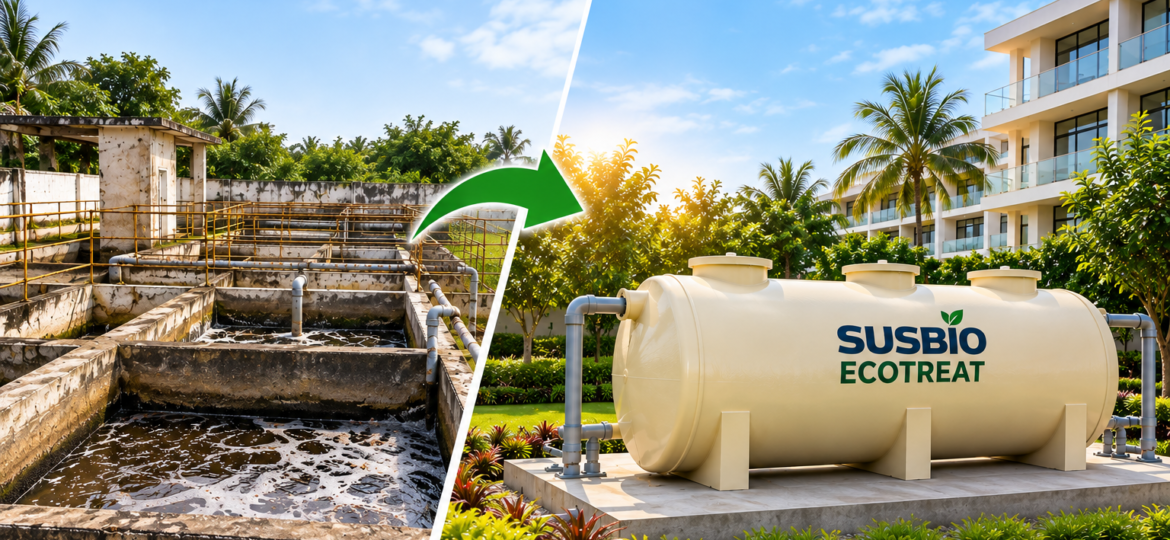
A packaged STP manufacturer designs, manufactures, and dispatches a factory-built, pre-tested STP system ready for site installation. The unit arrives complete — the only site work required is connecting inlet/outlet pipes and electrical connections. A civil STP contractor builds the treatment plant on-site using RCC tanks and separate equipment components. Civil STPs take 3–6 months to build, require significant civil supervision, and deliver variable quality depending on local contractor skill. Packaged STPs like SUSBIO ECOTREAT take 3–5 days to install and deliver consistent, factory-verified performance.
3. Which STP manufacturer is best for a residential apartment complex in India?
For residential apartment complexes in the 10–300 KLD range, a packaged Anaerobic + MBBR manufacturer like SUSBIO is typically the best choice. Residential STPs require: CPCB Class A compliance (BOD <10 mg/L), silent operation for resident comfort, no full-time operator (fully automated), minimal space (underground installation preferred), and a manufacturer with a residential-sector service network. SUSBIO ECOTREAT meets all these requirements and is deployed in 200+ residential complexes across India.
4. Can the same STP manufacturer handle both domestic sewage and industrial effluent?
For most industrial facilities, domestic sewage (from washrooms, canteens, and offices) and industrial process effluent (from the production process itself) must be treated separately. Domestic sewage is treated in an STP; process effluent is treated in an ETP (Effluent Treatment Plant). SUSBIO designs and manufactures both — ECOTREAT for domestic sewage (STP) and a custom ETP range for industrial process effluent in pharma, textile, food processing, and vehicle washing applications.
5. What should I look for in an STP Annual Maintenance Contract (AMC)?
A good STP AMC should include: defined number of quarterly service visits, response time SLA for breakdown calls (target: 24 hours), a list of components covered under the AMC, consumables included vs billed separately (air diffusers, MBBR media top-up if needed), effluent quality monitoring (regular BOD/COD testing), and a fixed annual price with a defined escalation clause. Avoid AMCs that are vague about response times, exclude key components, or have no defined service visit schedule.
Ready to Choose the Right STP Manufacturer for Your Project?
SUSBIO has been manufacturing, installing, and servicing packaged sewage treatment plants across India since 2013. With 500+ installations, India’s longest STP warranty (10 years), and a lifetime service commitment, SUSBIO ECOTREAT is the choice that protects your investment, your compliance, and your project — for decades.
Get a free STP sizing recommendation, project-specific quote, and CPCB documentation guide Visit susbio.in/contact-us/ | +91 88889 80197 | info@susbio.in Goa HQ | Pune Manufacturing | Mumbai Office | Pan-India Service |