

Water recycling has become a vital solution as our planet’s freshwater resources face increasing strain. Earth might be mostly covered by water, but we can use only a small percentage of it to drink, bathe, and grow food. The world’s population keeps growing and needs more water, but the supply will likely stay the same.
Water recycling helps solve current shortages and creates a path toward green practices. The western United States shows this need clearly. These drought-affected regions now depend more on reused water. The benefits to our environment are also substantial. The process uses less energy than finding and treating fresh water. Local recycling saves even more energy by cutting down on pumping and transportation costs. This method also takes pressure off aquifers by using reclaimed water instead of extracting fresh supplies.
This piece will get into how water reclamation systems work. We’ll look at the benefits for cities and industries, and showcase successful water recycling projects worldwide.
Understanding Water Reclamation and Reuse
Water reclamation marks a radical alteration in our water resource management. We no longer see used water as waste but as a renewable asset that can be processed and used again and again.
Definition of reclaimed and recycled water
Reclaimed water is wastewater that has been treated and purified to use again. Recycled water typically means treated domestic wastewater that gets used multiple times before returning to the water cycle. People often use these terms interchangeably based on their location. The main difference is that water becomes “reclaimed” after treatment makes it usable, but it’s not “recycled” until someone actually puts it to use.
The treatment process works with several water sources such as municipal wastewater, stormwater, and rainwater. The treatment level changes based on how people plan to use it – some uses need more thorough purification than others.
Difference between potable and non-potable reuse
The key difference in water reuse lies between potable and non-potable applications. Potable reuse creates water that meets or exceeds federal and state drinking water standards, making it safe to drink. Right now, more than 70 drinking water reuse projects serve over 8 million people each day in the United States.
Non-potable reuse creates water that’s not meant for drinking but works well for irrigation, industrial processes, toilet flushing, and similar uses. This includes water used to irrigate landscapes, support agriculture, cool industrial equipment, and recharge groundwater.
Potable reuse falls into two categories:
- Indirect Potable Reuse (IPR): Treated water mixes with environmental systems like rivers, reservoirs, or groundwater basins before reuse
- Direct Potable Reuse (DPR): Water goes straight into potable water supply systems
Role of water reclamation in sustainable water management
Water reclamation brings many benefits to environmentally responsible water management. It creates a reliable, locally-controlled water supply that reduces our dependence on groundwater and surface water sources. This essentially creates a new water source where none existed before.
Water reclamation reduces diversion from sensitive ecosystems and can lower nutrient loads from untreated wastewater. It also helps replenish depleted water sources and maintain wetland habitats.
Communities facing water shortages find that reclamation offers a practical solution that mirrors nature’s water cycle, just faster. Many communities already practice unplanned potable reuse when their water intakes draw supplies downstream from wastewater treatment facilities.
Core Processes in Water Reclamation Systems
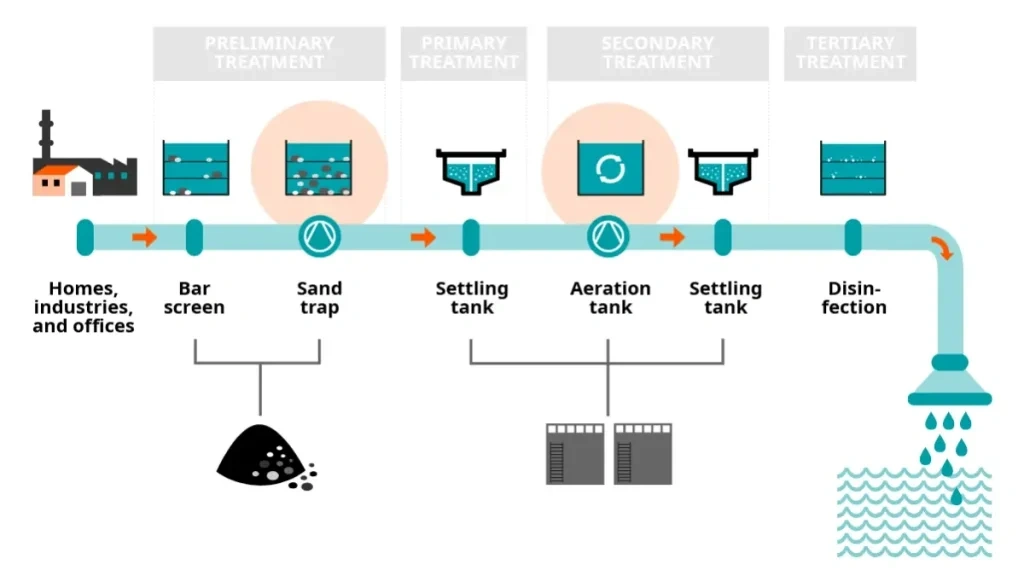
The water recycling process relies on multi-stage treatment methods. Each stage has a specific role to turn wastewater into reusable water.
Primary treatment: sedimentation and screening
Physical separation forms the foundation of water reclamation during primary treatment. The first stage uses screening to remove large debris while grit chambers extract heavier materials. The water then flows into sedimentation tanks where gravity does its work – heavier solids sink as sludge while oils and grease float up for skimming. A well-laid-out primary treatment system removes 50-60% of suspended solids and 25-40% of the biochemical oxygen demand (BOD). This stage protects downstream equipment from damage and prevents clogging.
Secondary treatment: biological filtration and aeration
The secondary treatment stage utilizes biological processes to break down organic matter and nutrients. Activated sludge, the most common method, holds wastewater in tanks under varying oxygen conditions where bacteria consume organic pollutants. Aeration provides oxygen to microorganisms which boosts their growth and activity. The treated solids settle out in secondary clarifiers after biological treatment. When done right, secondary treatment removes 85-95% of both BOD and suspended solids and improves water quality substantially.
Tertiary treatment: reverse osmosis and UV disinfection
Advanced processes like reverse osmosis (RO) and ultraviolet (UV) disinfection lift water quality during tertiary treatment. RO uses semipermeable membranes that block pathogens completely, making it a prominent choice for potable reuse. UV disinfection damages microorganisms’ DNA and destroys up to 99.99% of pathogens without chemicals. The water meets strict quality standards for its intended reuse application through tertiary treatment.
Advanced oxidation and membrane filtration technologies
Modern technologies have changed water recycling capabilities completely. Membrane filtration has microfiltration (MF), ultrafiltration (UF), nanofiltration (NF), and RO – with RO separating particles including bacteria and monovalent ions up to 99.5%. Advanced oxidation processes (AOPs) create reactive species like hydroxyl radicals that decompose persistent contaminants. These technologies deliver exceptional purification that makes water suitable for even the most demanding reuse applications.
Key Benefits of Water Reuse in Urban and Industrial Settings
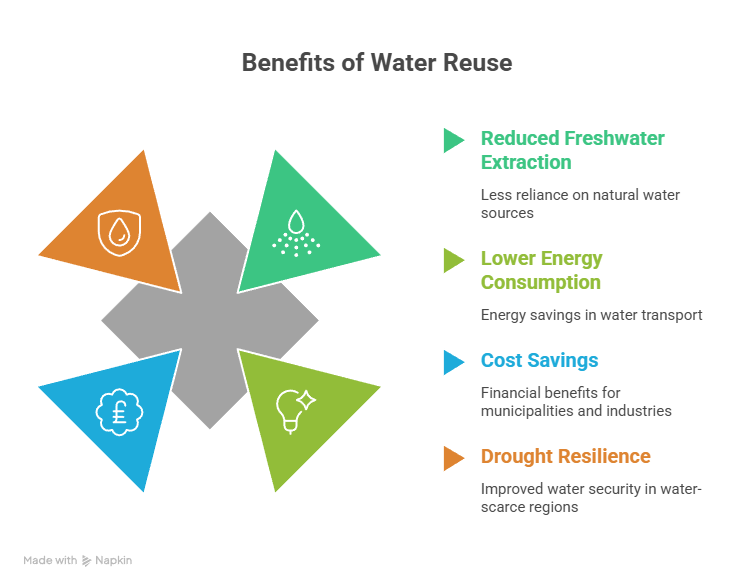
Water reuse systems provide real benefits to industries and communities of all sizes, particularly in regions that face water shortages.
Reduced freshwater extraction from aquifers
Water recycling takes pressure off natural resources. Reused wastewater serves as an alternative supply that reduces the amount of freshwater we take from lakes, rivers, and underground sources. The city of Hyderabad faces a water deficit of about 300 MLD, but recycling initiatives help save equivalent amounts of freshwater. California’s reclaimed water could contribute 2.2 billion cubic meters each year by 2040, which would cut down extraction by a lot.
Lower energy consumption in water transport
Local water recycling uses less energy than traditional methods. Water reuse systems use about half the energy of seawater desalination. Water transport over 100 km with 250 meters elevation gain uses roughly 2.5 kWh/m³, but local recycling eliminates these energy costs. Non-potable recycled water can cost as little as INR 27 per cubic meter compared to INR 42.19 for desalination.
Cost savings for municipalities and industries
Water recycling saves money. A carbon-based treatment system costs less (INR 33.75/m³) than reverse osmosis systems (INR 45.57/m³). Facilities that recycle water can save thousands to hundreds of thousands in utility fees each year. A development in San Jose will save over INR 12.6 million in utility fees by recycling nearly 11 million gallons yearly.
Improved drought resilience and water security
Water reuse creates reliable supplies in water-stressed regions. About 36% of people worldwide live in water-scarce areas. The oldest direct potable reuse facility in Windhoek, Namibia has operated since 1968 and now supplies over 25% of the city’s water, showing how reliable these systems can be long-term.
Applications of Recycled Water Across Sectors
Recycled water proves its worth as a sustainable resource in many sectors of all sizes.
Irrigation of parks, golf courses, and agriculture
Recycled water’s largest use comes from irrigation, which makes up about 70% of all recycled water use in San Diego County. Agriculture benefits significantly from this approach and can cut water use by up to 30% through smart reuse strategies. Maryland’s Coastal Plain farms can meet their crop water needs during wet years and partially during moderate and dry years with recycled water. This practice reduces their dependence on aquifers by 56% and 30% respectively. The nutrients that remain in recycled water help support regenerative land management and cut down fertilizer needs.
Industrial cooling and process water reuse
Industries have found great success with water recycling programs. Saudi Arabian facilities switched from groundwater to municipal reclaimed water in cooling towers. This change boosted water efficiency and made economic sense with a 27% drop in water usage. Chevron’s Richmond refinery receives about 7.5 million gallons of recycled water daily from East Bay Municipal Utility District in California. This supply lets operations continue smoothly even during drought restrictions. A European poultry slaughterhouse cut its water footprint by 40-50% after installing water reuse systems.
Toilet flushing and greywater reuse in buildings
Greywater makes up 50–80% of total household wastewater, which makes it perfect to recycle on-site. Households could save roughly 50 liters of drinking water daily by using greywater for toilet flushing, reducing consumption by 29-35% [46,47]. These systems need proper care, especially for toilet flushing. Regular filtration prevents clogging, and disinfection helps control odors.
Groundwater recharge and indirect potable reuse
Recycled water helps recharge groundwater in several ways. It fights declining groundwater levels, blocks saltwater intrusion, and stores water for future needs. Orange County Water District’s Groundwater Replenishment System produces 86.3 million cubic meters of reclaimed water yearly to recharge aquifers. The original indirect potable reuse uses natural buffers like groundwater aquifers. These provide natural filtration before water enters drinking supply systems.
Water recycling projects in arid regions
Water recycling becomes crucial in arid regions. Singapore’s NEWater program shows how treated wastewater can serve both industrial and drinking needs. Abu Dhabi generates about 340 million cubic meters of treated wastewater annually. Using this water to recharge aquifers costs between AED 1.2-1.8 per cubic meter. This proves more budget-friendly than desalinated water, which costs AED 6-8 per cubic meter. These projects help secure water supplies in places where traditional sources run scarce.
Conclusion
Water reclamation and reuse are key solutions to our growing global water challenges. We now see how treating wastewater as a renewable resource creates sustainable water management opportunities. The multi-stage treatment processes turn unusable water into a valuable resource through primary sedimentation and advanced membrane filtration.
Water recycling offers more than just freshwater conservation. Communities save energy by reusing water locally instead of moving it over long distances. Both municipalities and industries cut costs while reducing their environmental impact. Communities that implement water reuse systems become more resilient to drought and water insecurity.
Reclaimed water shows its versatility in many sectors. Farmers utilize recycled water in agricultural irrigation and cut freshwater use by up to 30% while getting benefits from leftover nutrients. Industrial facilities reduce operating costs through mutually beneficial reuse programs. Residential buildings can also cut their drinking water use by installing greywater systems for toilet flushing.
Water reclamation marks a fundamental change in water resource management. It recognizes freshwater’s limits while using technology to meet growing needs. This approach tackles today’s water challenges and creates sustainable water cycles for future generations. Water recycling has become crucial to responsible water management in our increasingly water-stressed world.
Key Takeaways
Water reclamation transforms wastewater into a renewable resource through multi-stage treatment processes, offering sustainable solutions to global water scarcity challenges.
• Water recycling reduces freshwater extraction by up to 56% while consuming half the energy of seawater desalination
• Multi-stage treatment processes remove 99.99% of pathogens through reverse osmosis and UV disinfection technologies
• Industrial facilities save hundreds of thousands annually through water reuse, with some reducing consumption by 40-50%
• Agricultural irrigation with recycled water cuts freshwater use by 30% while providing beneficial nutrients for crops
• Greywater systems in buildings can reduce household potable water consumption by 29-35% through toilet flushing reuse
Water reclamation creates drought-proof supplies and enhances water security, particularly in arid regions where traditional sources are limited. From Singapore’s NEWater program to California’s groundwater replenishment systems, successful implementations worldwide demonstrate that treating wastewater as a valuable resource rather than waste is essential for sustainable water management in our increasingly water-stressed world.
Frequently Asked Questions
Q1. What is water reclamation and reuse?
Water reclamation and reuse involve treating and repurposing wastewater for various applications, such as irrigation, industrial processes, and even drinking water. This process transforms what was once considered waste into a valuable, renewable resource.
Q2. What are the main benefits of water reclamation?
Water reclamation offers numerous benefits, including reduced freshwater extraction from natural sources, lower energy consumption in water transport, significant cost savings for municipalities and industries, and improved drought resilience and water security.
Q3. How does water recycling contribute to environmental conservation?
Water recycling helps conserve natural resources by reducing the need for freshwater extraction. It also prevents pollution by decreasing the amount of wastewater discharged into the environment and conserves energy by reducing the need for water transportation over long distances.
Q4. What are some common applications of recycled water?
Recycled water has various applications across sectors, including irrigation of parks, golf courses, and agricultural land; industrial cooling and process water; toilet flushing in buildings; groundwater recharge; and as a sustainable water source in arid regions.
Q5. How effective are water reclamation processes in purifying water?
Modern water reclamation processes are highly effective in purifying water. Advanced treatments like reverse osmosis and UV disinfection can remove up to 99.99% of pathogens, making the water safe for various uses, including potable purposes in some cases.