

India treats just 28% of the sewage its cities generate every day. Urban areas produce over 72,000 million litres of wastewater daily — and nearly three-quarters of it flows untreated into rivers, lakes, and land. The environmental cost is visible. The economic cost is less obvious but equally real: treated wastewater, properly managed, could substitute freshwater across irrigation, industry, and urban services at a fraction of the cost of sourcing fresh water.
The policy response to this gap accelerated significantly between 2025 and 2026. The Central Pollution Control Board tightened STP discharge standards. The Ministry of Jal Shakti introduced its 20% reuse mandate. And across 2026, multiple Indian states — Uttar Pradesh, Odisha, Uttarakhand, and Maharashtra — notified dedicated safe reuse policies that go substantially further than the national baseline.
This guide covers the current policy landscape as of June 2026: what the central mandates require, what each major state has notified, what compliance means practically for bulk users and developers, and what technology options exist to meet these standards efficiently.
We have been commissioning sewage treatment plants across India since 2013. This is not a regulatory summary written at a distance — it is a field perspective from engineers who work with these compliance requirements every day.
Why 2026 Is a Turning Point for Wastewater Reuse in India
The Treatment Gap
India’s urban centres generate over 72,000 MLD of sewage. Installed treatment capacity covers roughly 31,841 MLD — and actual operating capacity is lower still. The 72% that goes untreated doesn’t disappear: it enters the Yamuna, the Ganga, and hundreds of smaller rivers. It contaminates groundwater. It reduces the usable freshwater supply even as demand from a 1.4 billion population continues to grow.
India’s per capita water availability has dropped from 5,200 cubic metres in the 1950s to approximately 1,545 cubic metres today. At 1,700 cubic metres, a country is considered water-stressed. India is approaching that threshold nationally, with significant regions already below it.
The Policy Shift
For most of the 2000s and 2010s, India’s wastewater policy focused on treatment — getting sewage processed to a minimum standard before discharge. The 2025–2026 policy wave marks a fundamental reorientation: treated wastewater is now being positioned as a resource to be used, not a problem to be disposed of.
This is the difference between linear water management (extract, use, discharge) and circular water management (extract, use, treat, reuse). The National Framework on Safe Reuse of Treated Water published by NMCG in 2022–23 established this framing at the national level. State policies announced in 2026 are now operationalising it.
The Business Case
Treating and reusing wastewater costs a fraction of desalinated water or groundwater extraction at scale. Industrial cooling water sourced from treated municipal sewage costs 10–20 times less than desalinated water. Agricultural reuse can meaningfully reduce groundwater extraction in water-stressed districts. For residential developments, dual plumbing that recycles treated water for flushing reduces freshwater demand by 30–40%.
Central Policy Framework — What CPCB and Jal Shakti Require
CPCB 2025 Discharge and Reuse Standards
The Central Pollution Control Board has established mandatory outlet quality standards for all STPs. These are not aspirational targets — they are discharge norms that STPs must meet continuously, with online monitoring mandatory for plants above 50 KLD:
| Parameter | CPCB Standard |
|---|---|
| pH | 6.5 – 8.5 |
| BOD (5 day, 27°C) | ≤ 10 mg/L |
| COD | ≤ 50 mg/L |
| Total Suspended Solids | ≤ 10 mg/L |
| Ammoniacal Nitrogen | ≤ 5 mg/L |
| Total Nitrogen | ≤ 10 mg/L |
| Fecal Coliform | ≤ 100 MPN/100 mL |
Source: CPCB discharge standards under NGT Order OA 1069/2018; CPCB STP Guidelines 2025.
Ministry of Jal Shakti: 20% Reuse Mandate
The Union Ministry of Jal Shakti requires all cities to recycle and reuse at least 20% of their water consumption. This is embedded across multiple national programmes:
- The 2016 Power Tariff Policy requires thermal power plants within 50 km of a functioning STP to use treated sewage for cooling rather than fresh water.
- Swachh Bharat Mission 2.0 (2021) mandates zero untreated wastewater discharge from urban areas.
- AMRUT 2.0 (2021) requires cities above 10,000 population to meet 20% of city water demand and 40% of industrial water demand through recycled water.
- National Mission for Clean Ganga has set targets of 50% reuse by 2025 and complete reuse by 2050 in areas with functioning STPs.
Liquid Waste Management Rules 2024 — Effective October 2025
The Liquid Waste Management Rules 2024 introduced specific reuse timelines for bulk users:
- New residential societies must achieve 20% water recycling by 2027 and 50% by 2030–31.
- Bulk consumers — entities using more than 5,000 litres daily — must treat and reuse at least 20% of wastewater by 2027–28, rising to 50% by 2031.
State Policies — What Each Major State Has Notified in 2026
This section reflects the 2026 picture, which diverges significantly from 2025. Multiple states have notified dedicated safe reuse policies in the first half of 2026 that substantially advance the national framework. Three of these — Uttar Pradesh, Odisha, and Uttarakhand — are new policies announced in 2026 that were not in place when this guide was first published.
| State | Policy/Year | Key Target | Status (2026) |
|---|---|---|---|
| Uttar Pradesh | Safe Reuse of Treated Water Policy 2026 | 50% reuse by 2030 where STPs exist; 100% by 2045 statewide | Approved March 2026 |
| Odisha | Policy on Reuse of Treated Used Water 2026 | 20% reuse within 6 months of STP commissioning; 50% by 2036 | Notified April 2026 |
| Uttarakhand | SRTW Policy 2026 | Non-potable reuse across industry, construction, urban landscaping | Notified March 2026 |
| Gujarat | Policy for Reuse of Treated Wastewater 2018 | 70% reuse by 2025; 100% by 2030 | Active — Surat at 30%+ reuse |
| Karnataka | Urban Wastewater Reuse Policy 2017 | Sell 50% of treated water from on-site STPs for non-potable use | Active — mandatory for 50+ unit complexes |
| Maharashtra | Safe Reuse and Management Policy 2025 | 30% recycled water reuse within 5 years; prioritise thermal plants | Active 2025 |
| Delhi | Delhi Jal Board Reuse Framework | 60% reuse target; currently at 12.5% (405 MLD) | In progress |
Uttar Pradesh — Safe Reuse of Treated Water Policy 2026 (March 2026)
India’s largest state by population approved this policy in March 2026 with technical support from the Centre for Science and Environment. The roadmap is in five phases:
- 50% safe reuse of treated water by 2030 in areas where STPs are already operational.
- 100% reuse in those same areas.
- 30% reuse by 2030 in areas where STPs do not yet exist or are non-operational.
- 50% reuse by 2035 in those areas.
- 100% reuse by 2045 statewide.
Priority sectors for reuse are agriculture, industry, construction, and urban landscaping. The policy explicitly frames wastewater as a resource and positions UP as a model for other states to emulate.
Odisha — Policy on Reuse of Treated Used Water 2026 (April 2026)
Odisha notified its urban wastewater reuse policy in April 2026 with some of the most specific timelines of any state. In cities where sewerage systems and STPs are already operational, 20% reuse must be achieved within six months of policy notification. The statewide target is 100% collection, conveyance, and treatment across all Urban Local Bodies by 2030, with 20% reuse by 2030 and 50% reuse by 2036. The policy aligns with NMCG’s National Framework on Safe Reuse of Treated Water 2023 and AMRUT 2.0 objectives.
Uttarakhand — SRTW Policy (March 2026)
Uttarakhand officially notified its Safe Reuse of Treated Water policy in March 2026. The policy provides a regulatory framework for treated wastewater reuse for non-potable purposes: industrial processes, construction, park irrigation, and urban landscaping. It defines responsibilities across government departments, Urban Local Bodies, and industries. Given Uttarakhand’s position upstream of major Gangetic tributaries, this policy has significance beyond the state’s borders.
Gujarat
Gujarat’s 2018 Policy for Reuse of Treated Wastewater set a target of 70% reuse by 2025 and 100% by 2030. Surat Municipal Corporation already reuses more than 30% of its treated wastewater. Gujarat remains the benchmark state for industrial reuse of treated water.
Karnataka
Karnataka’s 2017 Urban Wastewater Reuse Policy requires apartment complexes above 50 units and commercial buildings above 2,000 sq.m to install their own STPs and sell 50% of treated water for non-potable uses. Full implementation across Bengaluru’s apartment stock could meet 26% of the city’s water demand.
Maharashtra
Maharashtra’s Safe Reuse and Management of Treated Wastewater Policy 2025 prioritises routing treated wastewater to thermal power plants and industrial estates. The State Water Policy (2019) requires 30% of recycled water to be reused within five years. Maharashtra’s approach is industrial-first — reducing freshwater consumption in energy and manufacturing sectors before addressing agricultural and residential reuse.
Delhi
Delhi currently reuses approximately 12.5% (405 MLD) of treated wastewater, primarily for gardens and lake recharge through the Delhi Jal Board. The target is 60%. Delhi’s challenge is infrastructure — getting treated water from STP locations to reuse points requires dedicated distribution networks that are still being built.
Compliance Requirements — What Bulk Users and Developers Must Do
Who Qualifies as a Bulk User
Any entity consuming more than 5,000 litres per day, or generating more than 10 kg of BOD per day, is classified as a bulk user under current CPCB and Liquid Waste Management Rules frameworks. In practice this covers:
- Residential complexes above 50 dwelling units or 2,000 sq.m built-up area (threshold varies by state).
- Commercial buildings above 2,000 sq.m (offices, hotels, hospitals, malls).
- Industrial facilities generating domestic sewage.
- Institutional campuses (schools, colleges, hospitals) above specified thresholds.
What Bulk Users Must Do
- Install an STP meeting CPCB outlet quality standards.
- For plants above 50 KLD, install OCEMS (Online Continuous Emission Monitoring System) sensors for BOD, COD, TSS, pH, and flow with data linked to the State Pollution Control Board’s server.
- Reuse treated water for toilet flushing, landscaping, cooling, and construction activities.
- Maintain dual plumbing to separate treated water supply from potable water.
- Submit monthly compliance reports to the relevant State Pollution Control Board and upload data to CPCB’s online portal.
Penalties for Non-Compliance
The National Green Tribunal has imposed fines exceeding Rs 80,000 crore cumulatively on states and ULBs for inadequate wastewater treatment. Individual facility penalties under the Environment Protection Act can result in operational suspension, financial penalties, and in persistent cases, criminal prosecution. Post the 2026 CPCB discharge norms tightening, enforcement has intensified — particularly in metro cities and along the Ganga and its tributaries.
Building Permit Implications
Environmental clearance for large-scale developments now requires STP installation and a treated water reuse plan as a condition of approval. Without a functioning, compliant STP, Occupancy Certificates cannot be issued in most major cities. This has made STP compliance a critical path item for real estate development timelines, not an afterthought.
Technology Options for Meeting 2026 Compliance Standards
Choosing the Right Technology
Three biological treatment technologies dominate India’s packaged STP market. Each has different performance characteristics suited to different applications:
| Technology | Outlet Quality | Load Variation Tolerance | Energy Use | Best For |
|---|---|---|---|---|
| MBBR | BOD < 10 mg/L | Excellent | Moderate | Variable loads — apartments, hotels, institutions |
| SBR | BOD < 10 mg/L | Moderate | Lower | Consistent daily flows |
| MBR | BOD < 5 mg/L | Low | Higher | Where very high reuse quality is required |
For most residential, hospitality, and institutional applications in India, Anaerobic + MBBR dual-stage technology is the most practical choice. The anaerobic stage handles the bulk organic load without energy input. The MBBR stage polishes to CPCB outlet standards. The combination delivers consistent compliance without the high energy costs of MBR or the cycle-timing sensitivity of SBR.
What SUSBIO ECOTREAT Delivers
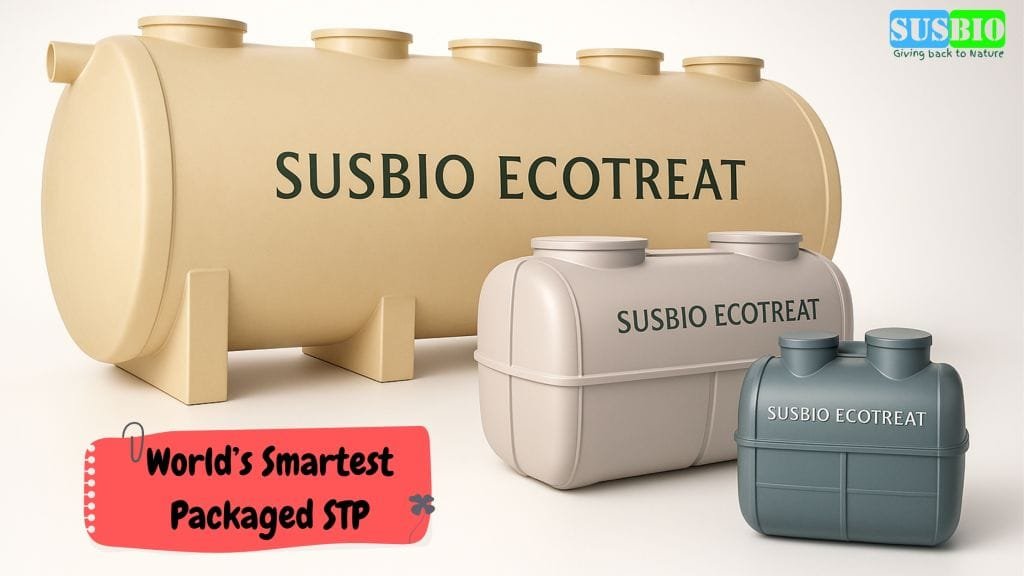
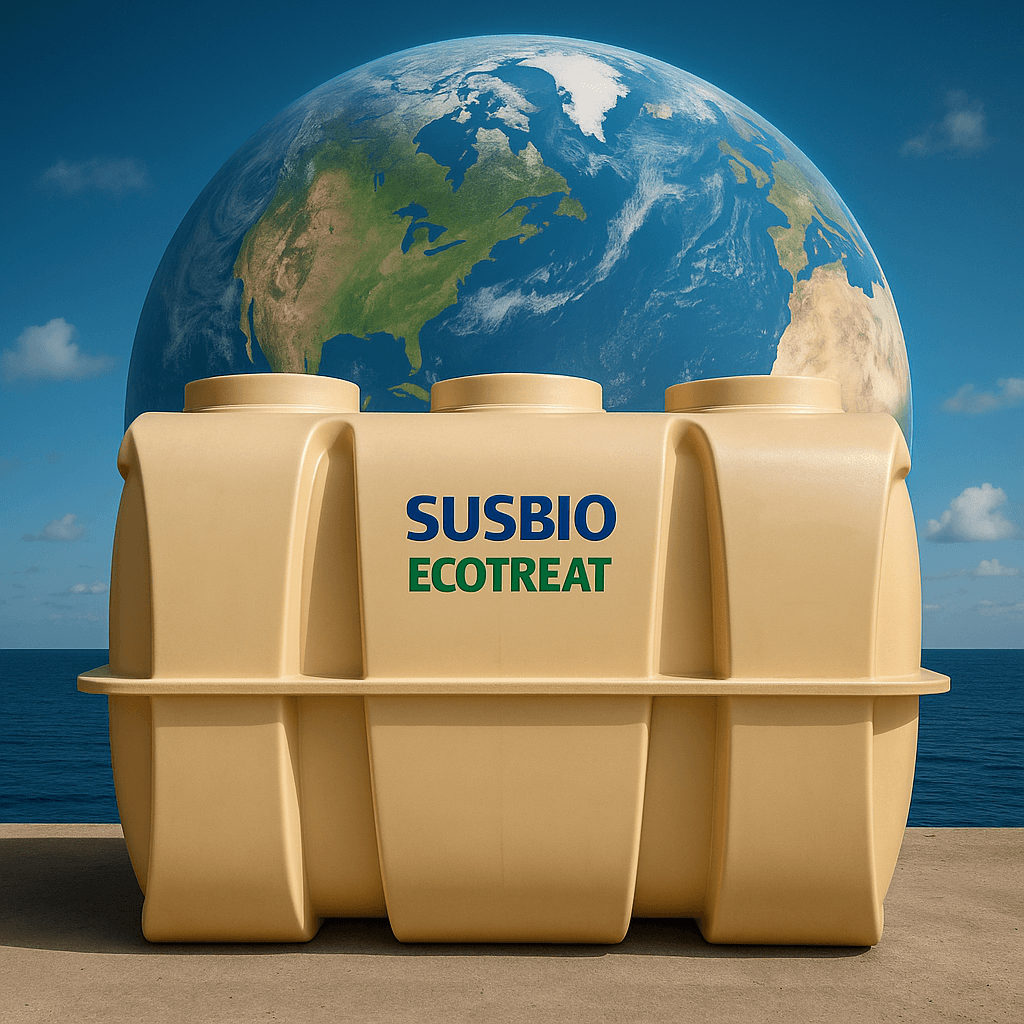
SUSBIO ECOTREAT is a prefabricated FRP packaged STP using Anaerobic + MBBR technology. It is manufactured at Vasuli MIDC, Chakan, Pune, tested before despatch, and installs in 3–5 days. Key compliance-relevant capabilities:
- Outlet BOD < 10 mg/L, COD < 50 mg/L, TSS < 10 mg/L — meeting CPCB Class A standards and OCEMS requirements.
- Built-in sensor integration for BOD, COD, TSS, pH, and flow — the exact parameters CPCB’s online monitoring mandate requires.
- 70% less electricity than conventional STPs.
- Fully automatic operation — no dedicated operator required.
- Capacity 1 KLD to 500 KLD.
- 500+ active installations across 24 Indian states.
Contact: info@susbio.in | +91 88889 80197
Financial Incentives for Wastewater Reuse Projects
Capital Subsidies
Swachh Bharat Mission and National Mission for Clean Ganga provide capital subsidies covering 25% to 70% of STP construction costs for Urban Local Bodies and qualifying projects. These subsidies have made advanced treatment technology accessible to smaller municipalities that would otherwise be limited to basic systems.
Section 35AD Tax Deductions
Under Section 35AD of the Income Tax Act, companies can claim 100% of capital expenditure on wastewater treatment plant installation as a tax deduction in the year of expenditure. Accelerated depreciation on water treatment equipment further improves financial returns on STP investment. MSMEs can access a 2% interest subsidy from the Ministry of MSME on loans up to Rs 1 crore for water treatment facility installation.
PPP and BOT Models
The Hybrid Annuity Model (HAM) has become the dominant financing structure for large municipal wastewater projects. Government pays 40% of capital costs during construction. The remaining 60% plus operational costs are recovered over 15 years against performance benchmarks. HAM has mobilised over Rs 126 billion in India’s wastewater sector. The Nagpur BOT model — where MahaGenCo built and operates a wastewater treatment plant under a 30-year agreement generating Rs 15 crore annually for the municipal corporation — demonstrates the revenue potential of industrial reuse contracts.
Conclusion
India’s wastewater reuse policy landscape in 2026 looks fundamentally different from 2025. A year ago, the conversation was about CPCB standards and whether states would meet national targets. Now, India’s largest state has notified a policy targeting 100% reuse by 2045. Odisha has mandated 20% reuse within six months of STP commissioning. Uttarakhand has created a regulatory framework for safe reuse upstream of the Ganga system. The momentum is real, measurable, and accelerating.
What we see consistently in the field is that compliance failures are almost never about the wrong technology. They happen when STPs are sized on average daily flow without peak load engineering, when plants are commissioned without adequate testing, or when facilities are handed over to management teams with no operator training and no service agreements.
The 2026 OCEMS mandate for plants above 50 KLD has changed the enforcement equation permanently. Your STP’s outlet data is now being transmitted to the SPCB’s server every day. Periodic inspection compliance is no longer the standard — continuous performance is. The question for any bulk user or developer in 2026 is whether their STP was designed and commissioned to actually deliver BOD ≤ 10 mg/L and COD ≤ 50 mg/L continuously — not just on inspection day.
SUSBIO works with residential developers, hospitality operators, hospitals, and industrial facilities across India on STP projects from 1 KLD to 500 KLD. If you are planning a new installation or dealing with a non-compliant existing plant, the right starting point is a conversation with an engineer.
Reach us at info@susbio.in or +91 88889 80197
Frequently Asked Questions
Q1. What are India’s wastewater reuse targets for 2026?
India’s wastewater reuse targets have become significantly more specific since 2025. The Ministry of Jal Shakti mandates all cities to recycle and reuse at least 20% of their water consumption. The Liquid Waste Management Rules 2024 require bulk users to treat and reuse 20% of wastewater by 2027–28, rising to 50% by 2031. At the state level, Uttar Pradesh targets 50% reuse by 2030 in areas with functioning STPs, scaling to 100% by 2045. Odisha mandates 20% reuse within six months of STP commissioning. Gujarat is targeting 100% reuse by 2030. National Mission for Clean Ganga has set 50% reuse across Ganga basin cities by 2025 and complete reuse by 2050.
Q2. Which new state wastewater reuse policies were announced in 2026?
Three major state policies were announced in the first half of 2026, representing a significant acceleration of India’s reuse policy momentum. Uttar Pradesh notified its Safe Reuse of Treated Water Policy 2026 in March, targeting 50% reuse by 2030 in STP-operational areas and 100% by 2045 statewide — supported technically by the Centre for Science and Environment. Uttarakhand notified its SRTW Policy in March 2026, creating a regulatory framework for non-potable reuse for industry, construction, and urban landscaping upstream of the Ganga system. Odisha notified its Policy on Reuse of Treated Used Water 2026 in April, requiring 20% reuse within six months of STP commissioning in operational areas and 50% reuse by 2036. These three policies follow Maharashtra’s Safe Reuse and Management of Treated Wastewater Policy 2025, bringing the total number of states with notified safe reuse frameworks to more than 15 by mid-2026.
Q3. Who is required to install an STP under CPCB guidelines?
Any bulk user consuming more than 5,000 litres daily or generating more than 10 kg of BOD per day must install an STP that meets CPCB outlet quality standards. In practice this covers: residential complexes above 50 dwelling units or 2,000 sq.m built-up area; commercial buildings above 2,000 sq.m including offices, hotels, hospitals, and malls; industrial facilities generating domestic sewage; and institutional campuses above specified thresholds. Exact thresholds vary by state — Karnataka mandates STPs for complexes above 20 dwelling units; KSPCB’s threshold is lower than the national baseline. For plants above 50 KLD, online continuous monitoring (OCEMS) is mandatory with data linked to the State Pollution Control Board’s server. Non-compliance blocks Occupancy Certificate issuance in most major cities.
Q4. What STP technology is recommended for CPCB compliance in India?
Anaerobic + MBBR (Moving Bed Biofilm Reactor) dual-stage technology is recommended for most residential, hospitality, and institutional applications in India. It consistently achieves BOD below 10 mg/L, COD below 50 mg/L, and TSS below 10 mg/L — meeting CPCB Class A discharge standards and OCEMS reporting requirements. It uses 70% less electricity than conventional STPs. MBBR’s biofilm-based treatment handles variable daily loads better than SBR or conventional activated sludge because the biomass is attached to plastic carrier media rather than suspended in liquid — it does not wash out when occupancy drops. This makes Anaerobic + MBBR the most practical technology for India’s apartment complexes, hotels, hospitals, and institutions where daily flow variation is the norm rather than the exception.
Q5. What are the penalties for STP non-compliance in India?
The National Green Tribunal has imposed cumulative fines exceeding Rs 80,000 crore on states and Urban Local Bodies for inadequate wastewater treatment. Individual facility penalties under the Environment Protection Act include operational suspension, disconnection of water and electricity supply, withholding of Occupancy Certificates, revocation of business licenses, and criminal prosecution for persistent violations. KSPCB enforcement actions have included flat fines of Rs 5 lakh for apartments with faulty STPs and fines up to Rs 3 crore for properties with no STP installed at all. The Karnataka High Court has granted interim relief to some affected apartment complexes pending compliance — but enforcement actions are accelerating post the 2026 CPCB discharge norms tightening, particularly in metro cities and along the Ganga and its tributaries.