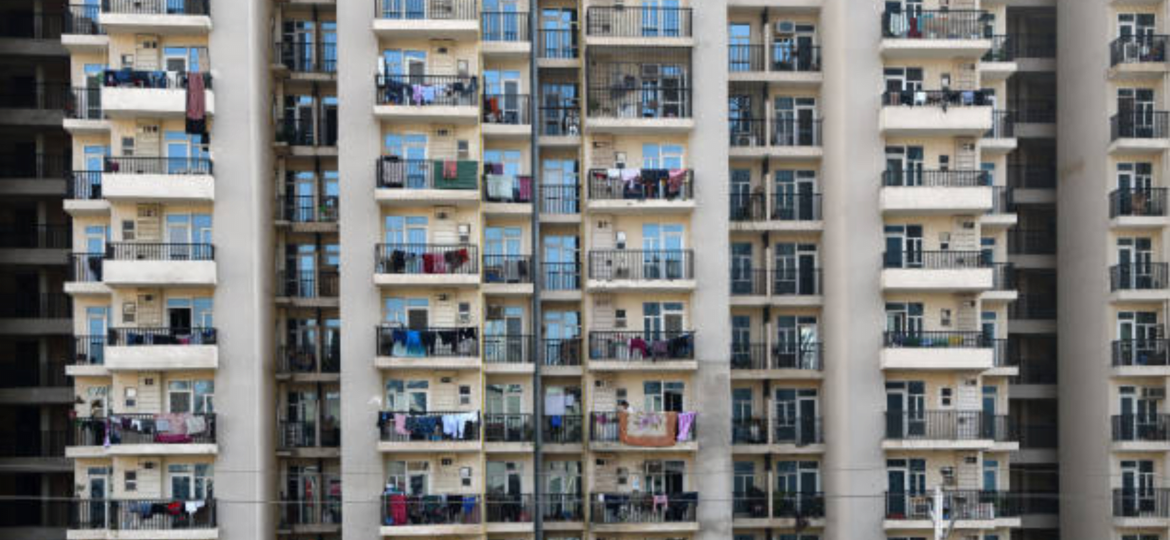


Modern buildings like hotels, hospitals, apartment complexes, and commercial spaces produce thousands of liters of sewage daily. STP installations have become crucial parts of today’s infrastructure. These sewage treatment plants protect our water resources and help create a healthy, eco-friendly environment for everyone. The Central Pollution Control Board of India now requires STPs in buildings that have more than 20 units or serve commercial purposes. This makes it vital for business owners and property managers to understand STP plants and how they work.
STP systems are designed to clean wastewater from kitchens, bathrooms, laundry, and sinks in commercial buildings. Buildings with STP sewage treatment plants see many advantages. They get RERA clearances faster, their property values go up, and tenants feel more confident about the space. The treated water can be employed for many purposes like watering plants, running industrial processes, and flushing toilets. This creates a complete water reuse cycle.
SUSBIO ECOTREAT leads the way as India’s most advanced packaged STP solution. It gives businesses a future-ready answer to their sewage treatment needs. The industrial and commercial uses of STPs are wide-ranging. We’ll look at different types of STP plant technologies, how various sectors use them, and the way these systems help cut down water pollution while promoting water reuse.
This piece will show you everything about setting up STPs in commercial spaces. You’ll learn about the technical details and find the right system that matches your needs.
Understanding Industrial and Commercial STP Applications

Non-residential environments face unique challenges in sewage management as they generate thousands of liters of wastewater daily. Sewage treatment plant systems have then become crucial for commercial and industrial operations throughout India.
What is STP Plant and How It Works in Non-Residential Settings
A sewage treatment plant (STP) removes contaminants from wastewater to make it safe for discharge or reuse. Commercial settings need these plants to handle sewage with complex pollutants from various sources. The treatment process works in three main stages: preliminary treatment removes large solids, primary treatment settles suspended particles, and secondary treatment breaks down organic matter biologically. Advanced systems add tertiary treatment with UV disinfection or chlorination to achieve higher purity. Non-residential STPs must handle higher volumes and changing loads compared to home systems.
STP Plant Full Form and Its Role in Urban Infrastructure
Sewage Treatment Plant (STP) plays a vital role in modern urban infrastructure. These facilities protect municipal systems from untreated sewage overload and prevent groundwater pollution through leaching. Clean wastewater creates healthier environments for commercial occupants by eliminating odors and stopping disease spread. STPs support residential complexes, hotels, malls, industrial parks, and municipal corporations in urban areas. Environmental guidelines now require buildings with 50+ apartments or commercial developments above certain built-up areas to include sewage treatment solutions.
Types of STP Plant Used in Commercial and Industrial Sectors
The commercial and industrial sectors use four main types of STP technologies based on their needs:
- Activated Sludge Process (ASP) – Works best for large residential complexes and municipalities that handle high sewage volumes
- Moving Bed Biofilm Reactor (MBBR) – Uses floating plastic carriers that treat waste efficiently in tight spaces
- Sequential Batch Reactor (SBR) – Time-based treatment that suits hotels, hospitals, and small municipalities with varying loads
- Membrane Bio-Reactor (MBR) – Combines biological treatment with membrane filtration, perfect for locations that need water reuse
SUSBIO ECOTREAT leads the market as India’s most advanced packaged STP. This trailblazing solution meets strict CPCB standards while using minimal space, making it ideal for businesses looking toward the future.
Sector-Wise Use Cases of STP Sewage Treatment Plant
Each business sector faces unique wastewater challenges that need specific STP plant solutions. The right sewage treatment approach and technology depends on what each sector needs.
STP for Hotels, Hospitals, and Malls
Hotel rooms produce 300-500 liters of wastewater daily from guest bathrooms, laundry facilities, kitchens, and spas. The water contains a mix of detergents, food waste, and human waste that needs special treatment. Large resorts with more than 200 rooms can release over 100,000 liters of wastewater daily, which can harm the environment without proper treatment.
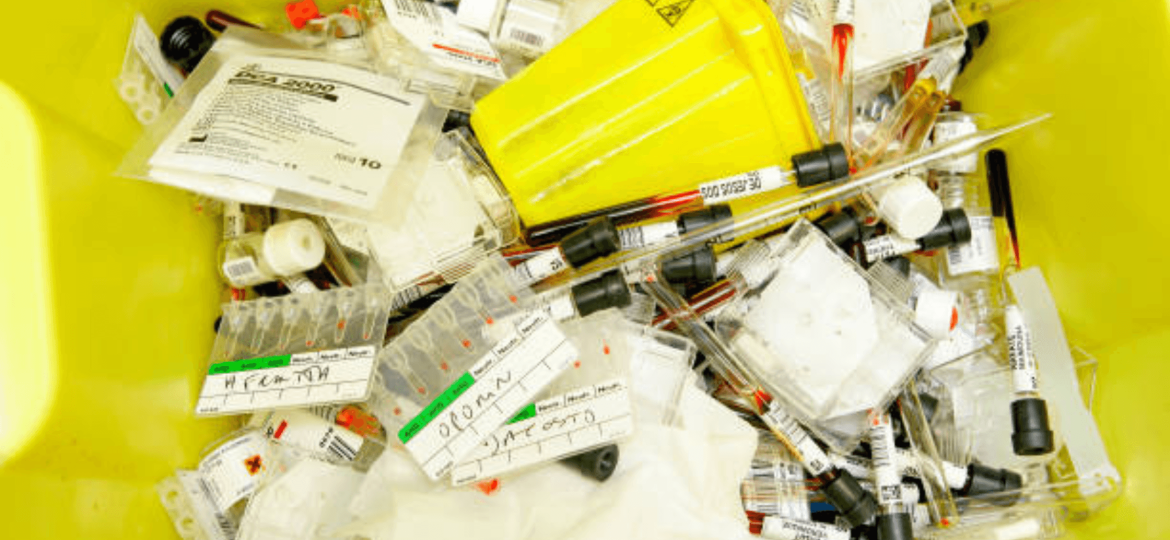
Hospital sewage is even more challenging because it contains:
- Pathogens (bacteria, viruses, fungi)
- Chemical pollutants (detergents, disinfectants, solvents)
- Pharmaceutical residues
- Possibly radioactive waste
A typical 100-bed hospital releases about 40,000–50,000 liters of sewage daily (400-500 liters per bed per day), which needs strong sewage treatment plant systems. MBBR technology works great for these facilities because it takes up less space and handles changing loads well.
STP in Manufacturing and Processing Industries
Industries like textiles, pharmaceuticals, food processing, chemicals, and automobile manufacturing need specialized sewage treatment plant solutions. Each industry’s wastewater has different characteristics, often with chemicals, heavy metals, or high organic loads that need specific treatment methods. Rules state that any industry producing more than 10 KLD of domestic-type sewage must have STPs installed.
STP for Office Complexes and IT Parks
IT parks with thousands of employees produce large amounts of wastewater from restrooms, cooling systems, and cafeterias. SUSBIO ECOTREAT’s packaged STP solutions work great for these facilities because they’re compact and perfect for urban spaces with limited room. Office complexes usually need STPs that can handle different load patterns as occupancy changes throughout the day and week.
STP in Educational Institutions and Campuses
Educational campuses work like small towns and produce wastewater from hostels, cafeterias, laboratories, and administrative buildings. A good stp sewage treatment plant helps these institutions use treated wastewater for landscaping irrigation, toilet flushing, and HVAC cooling systems. This cuts municipal water use by 40-60%, which saves money on operations and shows environmental responsibility. On-site STPs also eliminate the need for external sewage disposal services that can be expensive and unreliable.
Technology Stack in Modern STP Treatment Plants
Modern sewage treatment plants use advanced technologies to handle different types of wastewater. Technological breakthroughs have transformed how industrial and commercial facilities process sewage for safe discharge or reuse.
Moving Bed Biofilm Reactor (MBBR) for Space Efficiency
MBBR technology emerged in the late 1980s and uses special plastic carriers that create surface area for biofilm growth. These carriers float freely in the aeration tank and let microorganisms attach to break down organic matter. MBBR saves remarkable space with a smaller footprint than standard systems. The technology removes the need for sludge recycling, which makes operations simpler. Urban developments with limited space find MBBR an ideal solution because it delivers high treatment efficiency in a compact design.
Membrane Bioreactor (MBR) for High-Quality Effluent
MBR systems blend biological treatment with membrane filtration to produce exceptional quality effluent. The systems reach TSS levels under 1 mg/L, which makes the treated water perfect for reuse. MBR technology needs 50-60% less space than conventional STPs, though it costs more upfront. Industries that focus on water reuse value MBR’s superior effluent quality.
SBR vs ASP: Choosing the Right Biological Process
Sequencing Batch Reactor (SBR) works in batch mode and performs treatment stages one after another in a single tank. Activated Sludge Process (ASP) runs continuously using separate tanks. SBR systems adapt better to changing influent volumes, but need complex controls. ASP is the traditional approach that’s reliable but needs more space. Space limits, load changes, and operational priorities determine which system works best.
Tertiary Treatment: UV, Chlorination, and RO Integration
Tertiary treatment raises water quality beyond secondary treatment by removing remaining impurities. Key methods include:
- Filtration through sand filters or membranes to remove fine particles
- UV disinfection that kills pathogens without chemicals
- Chlorination for bacterial control, though it needs dechlorination before discharge
This stage meets strict environmental standards and prepares water for reuse.
STP Plant Diagram: Visualizing the Process Flow
An STP plant diagram shows how wastewater moves through treatment stages, from initial screening to final discharge. The process flows through screening, grit removal, primary sedimentation, biological treatment, secondary clarification, and tertiary treatment. Visual diagrams help operators track each stage and maintain peak system performance. SUSBIO ECOTREAT stands out as India’s most advanced packaged STP, with a future-ready design optimized for commercial use.
SUSBIO ECOTREAT: Future-Ready Packaged STP for India
SUSBIO ECOTREAT leads India’s market as the most advanced packaged STP plant, bringing state-of-the-art solutions to wastewater management challenges. SUSBIO launched this next-generation system in 2013, and it has quickly become the top choice for businesses looking for future-ready sewage treatment solutions.
Compact Design for Urban and Industrial Constraints
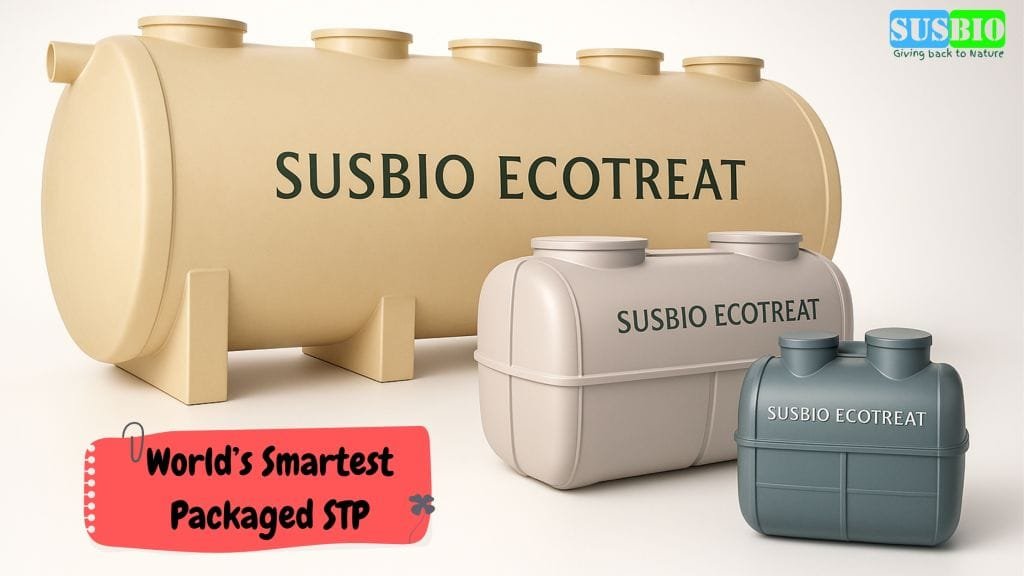
Space constraints pose the biggest problem for sewage treatment plant installations in urban areas. SUSBIO ECOTREAT’s space-efficient design needs substantially less area than conventional systems. The plant’s two modular configurations include capsule type (1-20 KLD) for small establishments and cylinder type (20-500 KLD) for larger complexes. The fiber-reinforced plastic (FRP) construction will give a strong and durable solution while keeping a minimal footprint.
Plug-and-Play Installation with Minimal Civil Work
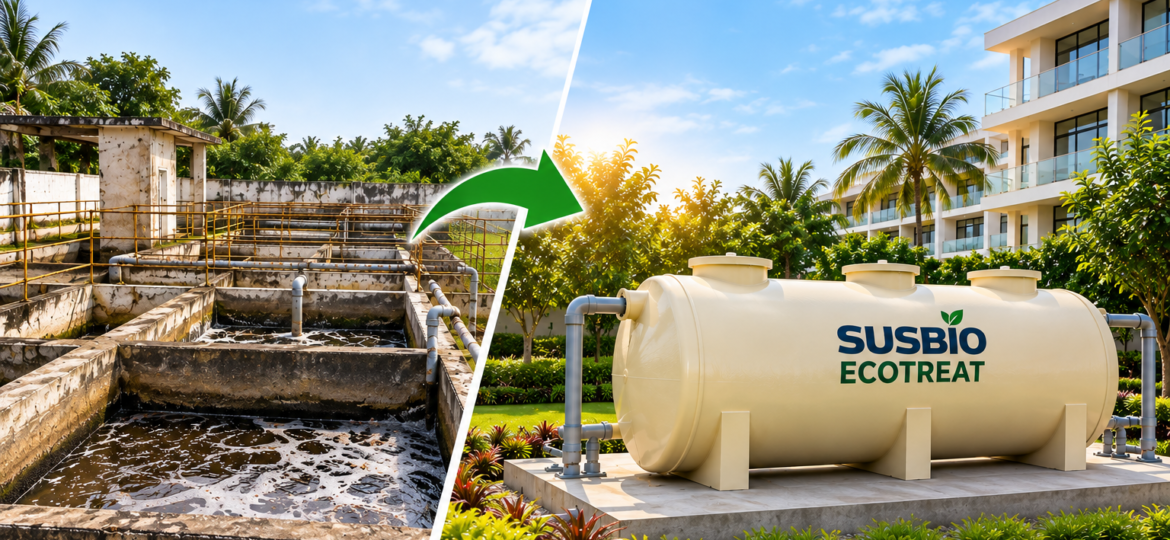
Traditional sewage treatment plants need extensive construction, but SUSBIO ECOTREAT comes as a prefabricated, ready-to-install unit. This plug-and-play design eliminates lengthy on-site construction and reduces installation time and labor costs. The standardized configuration delivers consistent performance across installations while allowing customization based on project needs.
Energy-Efficient Operation with Automated Controls
SUSBIO ECOTREAT uses 90% less electricity than conventional STP treatment plants through smart automation and optimized aeration systems. Advanced control systems monitor and adjust treatment processes automatically, eliminating the need for on-site operators. This automation reduces operational costs and maintains consistent treatment quality whatever the influent variations.
Compliance with CPCB Norms and Remote Monitoring
SUSBIO ECOTREAT meets and exceeds Central Pollution Control Board standards, ensuring regulatory compliance for all installations. The system’s remote monitoring features let operators track performance parameters live. Facility managers can access operational data through mobile applications or dashboards that enable quick interventions and minimize compliance violation risks.
Conclusion
Modern urban infrastructure without doubt needs sewage treatment plants, especially when commercial and industrial facilities generate substantial wastewater volumes. STPs serve many sectors like hotels, hospitals, manufacturing industries, IT parks, and educational institutions. Each sector has unique treatment requirements and waste profiles.
The technological progress in sewage treatment has created several efficient systems. MBBR, MBR, SBR, and ASP offer specific advantages based on application needs. Space efficiency, treatment quality, load handling capability, and operational complexity ended up determining the most suitable technology for each setting.
UV disinfection, chlorination, and RO integration boost water quality and make it suitable for multiple reuse applications. Water recycling reduces freshwater consumption and prevents environmental pollution.
SUSBIO ECOTREAT leads the market as India’s most advanced packaged STP. Its compact design, plug-and-play installation, and energy-efficient operation meet regulatory standards effectively. Businesses can manage wastewater sustainably with minimal space requirements and operational costs using this future-ready solution.
Quality STP systems bring benefits beyond environmental compliance. Water reuse saves costs, boosts property values, and builds tenant confidence. Smart businesses across India see STP investment as more than a regulatory requirement – it’s a strategic choice that delivers long-term economic and environmental returns.
Key Takeaways
Understanding the critical role of sewage treatment plants in commercial and industrial settings is essential for modern businesses facing regulatory requirements and environmental responsibilities.
- Regulatory Compliance is Mandatory: CPCB now requires STPs for buildings with 20+ units or commercial use, making installation essential for legal operation and RERA clearances.
- Technology Selection Matters: Choose MBBR for space efficiency, MBR for high-quality effluent, or SBR for variable loads based on your specific operational requirements.
- Sector-Specific Solutions Required: Hotels need 300-500L capacity per room, hospitals require pathogen treatment, while IT parks benefit from compact designs handling variable occupancy.
- Water Reuse Creates Value: Properly treated wastewater can reduce municipal water demand by 40-60%, significantly lowering operational costs through irrigation and cooling applications.
- Advanced Systems Offer Competitive Advantage: Modern packaged STPs like SUSBIO ECOTREAT provide 90% energy savings, automated controls, and plug-and-play installation with minimal civil work.
Investing in quality STP systems delivers long-term economic returns through water reuse, enhanced property values, and regulatory compliance while demonstrating environmental leadership in your industry.
Frequently Asked Questions
Q1. What are the main applications of sewage treatment plants in commercial settings?
Sewage treatment plants in commercial settings are used to treat wastewater from hotels, hospitals, office complexes, and industrial facilities. They help in removing contaminants, making water safe for discharge or reuse in applications like irrigation, cooling systems, and toilet flushing.
Q2. How do sewage treatment plants benefit businesses?
STPs offer multiple benefits to businesses, including regulatory compliance, smoother RERA clearances, higher property values, and increased tenant confidence. They also enable water reuse, potentially reducing municipal water demand by 40-60% and lowering operational costs.
Q3. What are the key technologies used in modern sewage treatment plants?
Modern STPs utilize technologies such as Moving Bed Biofilm Reactor (MBBR) for space efficiency, Membrane Bioreactor (MBR) for high-quality effluent, and Sequential Batch Reactor (SBR) for handling variable loads. The choice depends on specific requirements like space constraints and treatment quality needs.
Q4. How much wastewater do commercial establishments typically generate?
The amount varies by sector. For instance, hotels generate 300-500 liters of wastewater per occupied room daily, while a 100-bed hospital can produce 40,000-50,000 liters of sewage per day. Large resorts with over 200 rooms may discharge more than 100,000 liters daily.
Q5. What makes SUSBIO ECOTREAT stand out among sewage treatment solutions?
SUSBIO ECOTREAT is recognized as India’s most advanced packaged STP. It offers a compact design suitable for urban constraints, plug-and-play installation with minimal civil work, energy-efficient operation with automated controls, and compliance with CPCB norms. It also features remote monitoring capabilities for real-time performance tracking.