

India’s STP plants are about to see major changes as the Central Pollution Control Board rolls out tough new discharge standards in 2025. The country has built over 1,000 STPs that can treat around 30 million liters per day. However, these facilities don’t deal very well with current needs. CPCB data shows that Indian cities generate over 72,000 million liters of wastewater daily, but only 30% gets proper treatment.
The new rules will revolutionize how STP treatment plants work across the country. They set strict limits on STP parameters – Biochemical Oxygen Demand must stay under 20 mg/l while Chemical Oxygen Demand should not cross ≤250 mg/l. The guidelines also bring sweeping changes to the STP plant process. These changes touch everything from design specs to how plants monitor their operations. Residential societies face a big challenge as the rules now label them as “bulk users”. They must recycle 20% of their water by 2027, and this target jumps to 50% by 2030.
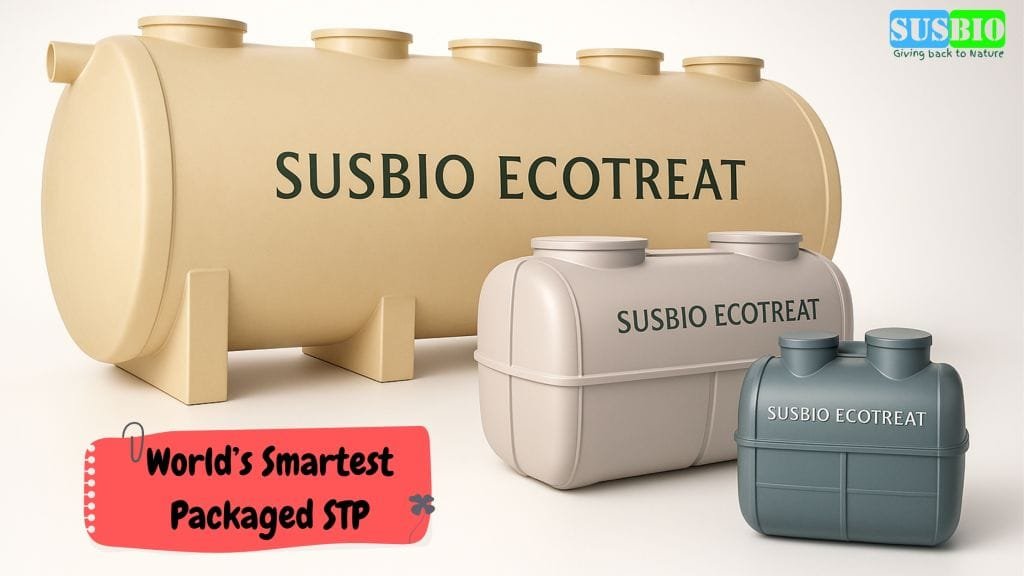
This piece will get into how these new standards will alter India’s wastewater management landscape. We’ll look at technical requirements for different STP plant setups and showcase solutions that work. One such solution is SUSBIO ECOTREAT – an innovative packaged STP built to meet new regulations while delivering better efficiency.
CPCB 2026 Guidelines: What Has Changed for STP Plants
The Central Pollution Control Board (CPCB) will reveal detailed changes to sewage treatment regulations in 2025. These changes will transform how stp plant systems must operate across India. The new regulations show a clear direction toward tougher environmental protection and public health measures.
Revised BOD, COD, and TSS Discharge Limits
The 2025 CPCB guidelines set much stricter stp parameters limits than before. All new sewage treatment plants built after June 1, 2019, must follow these boosted parameters:
| Parameter | New Standard (2025) |
|---|---|
| pH | 6.5–8.5 |
| BOD (5th day) | ≤10 mg/L |
| COD | ≤50 mg/L |
| Total Suspended Solids (TSS) | ≤10 mg/L |
| Fecal Coliform | ≤100 MPN/100 mL |
These requirements are much tighter than before. To name just one example, metropolitan cities’ BOD limit used to be 20 mg/L, but now all facilities must achieve ≤10 mg/L. Existing facilities have five years from the notification date to update their stp treatment plant technologies.
Mandatory Live Monitoring for STPs >50 KLD
The 2025 guidelines bring major changes to monitoring requirements. Every STP with capacity over 50 KLD must now use live monitoring systems with specific technical features:
- Inline sensors for vital parameters including pH, BOD, COD, TSS, and flow rates
- Standard communication protocol (RS 485 with Modbus) for data transmission
- Automated alerts when parameters exceed prescribed limits
- Historical data storage capabilities for up to two years
The rules specify exact technology requirements for each parameter. BOD and COD measurements must use “UV-Vis Spectrophotometry & combustion (Double beam with entire spectrum scanning)” technology. These systems send data directly to CPCB servers, creating new levels of transparency in stp plant process operations nationwide.
New Norms for Ammonical and Total Nitrogen
Previous rules focused on standard parameters like BOD, COD, and TSS. The 2025 guidelines now include strict limits for nitrogen compounds, which can seriously affect the environment:
- Ammonical Nitrogen: ≤5 mg/L
- Total Nitrogen: ≤5 mg/L
These limits are vital since nitrogen compounds can harm water bodies by depleting oxygen and causing harmful algal blooms. The STP plant diagram must now include special biological nitrogen removal processes with nitrification and denitrification stages to meet these standards.
Traditional wastewater systems don’t deal very well with nitrogen removal, so specialized biological approaches are now essential. SUSBIO, a leading STP plant manufacturer, has created their ECOTREAT solution for these challenges. Their packaged STP system uses advanced biological treatment technologies that consistently keep ammonical nitrogen levels below 5 mg/L, making it one of the best packaged STP solutions available today.
These new guidelines mean that organizations must monitor and manage STP treated water parameters carefully. Various types of STP plant setups, from conventional activated sludge to membrane bioreactor systems, need updates to meet these requirements. Solutions like SUSBIO ECOTREAT offer ready-to-use options for organizations looking to comply with minimal operational complexity.
Design and Sizing Requirements for STP Plants in 2026

The 2025 CPCB guidelines have revolutionized design and sizing specifications for STP plants. These technical requirements set exact parameters that wastewater facilities must follow. This applies to all facilities using Activated Sludge Process (ASP), Sequential Batch Reactor (SBR), Membrane Bio Reactor (MBR), or Moving Bed Bio Reactor (MBBR) technologies.
Equalization Tank Capacity: 8-Hour Holding Standard
The equalization tank is the original holding component in the stp plant process. The tank needs a minimum 8-hour retention capacity. This rule applies to all approved treatment technologies. A well-sized equalization tank serves several vital functions:
- It balances sewage flow and quality fluctuations throughout the day
- It maintains consistent loading to downstream treatment units
- It provides pH stabilization for incoming wastewater
- It lets heavy solids settle before biological treatment starts
This 8-hour standard marks a radical alteration in design philosophy that puts system stability ahead of footprint size. A properly sized equalization tank optimizes the stp treatment plant by preventing shock loads that could disrupt biological treatment processes.
Treated Water Tank: 2-Day Storage Mandate
CPCB now requires the treated water holding tank to store at least two full days of output. This calculation uses the STP’s design capacity. The rule applies to all treatment technologies. The extra storage capacity helps in many ways:
- You can verify quality thoroughly before discharge
- You get reliable water supply for reuse
- You can handle flow changes during maintenance
- You have more time for disinfection when needed
SUSBIO ECOTREAT, the best packaged STP available, includes this two-day storage capacity in a compact design. The company’s holding tanks use reinforced membrane technology to prevent contamination during long storage periods.
STP Capacity Based on Peak Load, Not Average Flow
The biggest change in the 2025 guidelines is about plant capacity calculations. STPs must now be sized for peak load instead of average flow rates. This means treatment facilities can handle maximum sewage generation without affecting effluent quality.
CPCB suggests using 135–150 liters per person per day (LPCD) as the standard sewage generation metric for homes. Peak flow rates are typically 20% higher than average rates. Here’s an example:
| Flow Type | Calculation Method | Example (10,000 L/day facility) |
|---|---|---|
| Average Flow | Base calculation | 10,000 L/day |
| Peak Flow | 1.2 × Average Flow | 12,000 L/day |
| Design Capacity | >Peak Flow | 15,000 L/day recommended |
The plant’s hydraulic and treatment capacities must handle these peak loads while meeting stp parameters limits for BOD, COD, and TSS. The detention time formula (Retention Time = Tank Volume ÷ Flow Rate) becomes vital here.
The dimensioning process needs to look beyond simple volume calculations. Most STP components need standard depths – 3.0-3.5 meters for aeration tanks and 4.0 meters for sedimentation basins. SUSBIO ECOTREAT offers a great solution with pre-engineered systems that already factor in these peak load requirements.
The stp plant diagram must show all these sizing requirements while adapting to site-specific needs like topography, climate, maintenance access, and future expansion. Modern STP facilities that follow these design principles can meet the required stp treated water parameters and reduce energy use and operational complexity.
Mandatory Components in a CPCB-Compliant STP Plant
The 2025 CPCB regulations specify structural components that every stp plant in India must have. These components will give a complete treatment efficiency and consistent output quality. Your stp plant process needs these critical elements designed correctly to meet compliance standards.
Screen Chamber and Oil & Grease Trap
A bar screen chamber with 10-12mm size must be the first component of every compliant stp treatment plant. This chamber removes coarse solids and debris. You need clear access to maintain this submersible component. The next step requires an oil and grease trap to remove floating substances. These substances can disrupt biological treatment processes if left unchecked. Both pre-treatment units protect equipment downstream and help the stp plant process run at its best.
Aeration Tank with DO > 4 mg/L
The aeration tank is crucial for biological treatment. CPCB now requires dissolved oxygen levels above 4 mg/L. This is higher than the old standards of 1-3 mg/L. Good aeration leads to:
- Effective breakdown of organic pollutants
- Proper nitrification of ammonia
- Prevention of filamentous bacteria growth
Air blowers need vibration mounts and acoustic enclosures to reduce noise. SUSBIO ECOTREAT leads the market in packaged STP solutions. Their advanced diffused aeration systems keep DO levels steady and use 95% less energy than regular systems.
MBR or Clarifier for Biomass Separation
CPCB guidelines say you must use either a membrane bioreactor (MBR) or clarifier to separate treated water from biomass. MBR technology creates better quality effluent with TSS below 1 mg/L and turbidity under 0.5 NTU. MBR systems need new membranes occasionally but take up 30-50% less space than regular clarifier systems. SUSBIO’s ECOTREAT packaged systems use a conventional clarifier for biomass separation — avoiding the membrane fouling and replacement costs of MBR systems — while still delivering compact stp plant solutions.
Sludge Holding and Dewatering Units
New guidelines make sludge management mandatory. You need a dedicated sludge holding tank to store excess sludge before processing. The rules ban sludge drying beds and filter presses. STPs under 500 KLD must use vertical centrifuge, belt press, or screw press systems. These systems cut down sludge volume and disposal costs. They produce dry cake with 20-40% solids content.
Your stp plant diagram should show all these components in order. SUSBIO, India’s leading stp plant manufacturer, has designed their ECOTREAT system with all required components. Their pre-fabricated, modular design meets the latest stp parameters limits and makes installation simple.
Treated Water Reuse and Dual Plumbing Mandates
The 2025 regulations revolutionize water circularity by requiring mandatory treated water reuse. These mandates establish a closed-loop approach to wastewater management within the stp plant process.
Reuse Applications: Flushing, Irrigation, Cooling
CPCB requires treated wastewater reuse in many non-potable applications. The main applications are:
- Toilet flushing with dual plumbing systems
- Landscape irrigation and horticulture
- Cooling towers for commercial facilities
- Floor washing and construction activities
These requirements match India’s sustainability goals. Urban centers aim to reuse 50% of treated water by 2025 and achieve complete reuse by 2050. SUSBIO ECOTREAT, the best packaged STP solution, blends specialized filtration systems that produce water quality suitable for all required reuse applications.
Signage and Safety for Non-Potable Water
Safety protocols require clear identification of all non-potable water sources through standard signs. These signs must:
- Display international prohibition symbols with red circle/slash
- Show text “Non-potable Water – Do Not Drink / Avoid Contact”
- Use white background with black lettering
- Be present at all non-potable water outlets
Australian Standard AS 2700 requires purple coloring for all fixtures and pipes carrying treated water. This creates clear visual distinction from potable water systems.
Dedicated Reuse Tanks and Plumbing Systems
The stp plant diagram now needs dual plumbing infrastructure and dedicated storage for treated water. Required components are:
- Purple-colored pipes for non-potable distribution
- Dedicated treated water storage tanks
- Clear “Non-potable” markings on all outlets
SUSBIO, India’s leading stp plant manufacturer, blends these requirements naturally in their ECOTREAT systems. They provide complete solutions that comply with the latest water reuse mandates.
SUSBIO ECOTREAT: India’s Leading Packaged STP Solution
SUSBIO leads the STP plant industry with its game-changing ECOTREAT solution that lines up with the 2025 CPCB regulations. The company’s flagship packaged STP stands out as India’s best STP manufacturing solution and tackles compliance challenges through innovative engineering and superior performance metrics.
Plug-and-Play Installation in 2–4 Weeks
Traditional STP treatment plants take 6-12 months for commissioning. SUSBIO ECOTREAT changes this with its modular design that enables installation in just 2-4 weeks. The pre-fabricated system eliminates 80% of onsite civil work that traditional plants need. This quick deployment matters more as facilities nationwide approach their compliance deadlines.
70% Lower Energy Use vs Traditional STPs
SUSBIO ECOTREAT delivers remarkable efficiency by using only 0.3-0.6 kWh/KL compared to conventional STP plant process needs of 1-2 kWh/KL. This 70% power reduction creates operational savings and shrinks the carbon footprint substantially. The company’s proprietary Anaerobic + MBBR technology achieves this efficiency through optimized aeration systems.
IoT Monitoring with Real-Time Dashboard
Each ECOTREAT system includes IoT capabilities that track critical STP parameters limits like BOD, COD, TSS, and flow rates continuously. Facility managers can access up-to-the-minute performance data through accessible dashboards on web and mobile interfaces. The system creates compliance reports automatically for regulatory submissions and sends predictive maintenance alerts to prevent system failures.
Compact Design for Urban and Industrial Use
The STP plant diagram shows ECOTREAT’s space efficiency that uses 60-70% less area than similar conventional systems. This compact design suits urban installations where space gets pricey. The system achieves excellent STP treated water parameters in this smaller footprint and consistently delivers BOD <5 mg/L and TSS <5 mg/L across installations.

Conclusion
India’s wastewater treatment landscape faces a turning point as the 2025 CPCB guidelines approach full implementation. These regulations represent the most complete overhaul of STP standards in decades. They will reshape the scene of how facilities protect our water resources.
Plants across the country must adapt to much stricter discharge parameters. The BOD limit of ≤10 mg/L and COD requirement of ≤50 mg/L have become tighter. Up-to-the-minute data analysis requirements create new transparency. The mandatory water reuse requirements establish a fundamental change from simple waste disposal to resource circularity.
Technical specifications demand full compliance. STP plants must have properly sized equalization tanks and sufficient treated water storage. The treatment capacity should handle peak loads rather than averages. A full picture of component requirements ranges from screen chambers to advanced sludge management systems. This needs expert engineering and careful implementation.
Organizations and residential societies have two options. They can either update their existing systems extensively or choose turnkey solutions engineered for full compliance. SUSBIO ECOTREAT stands out as the best packaged STP solution. It offers great advantages through modular design, 70% reduced energy consumption, and sophisticated IoT monitoring. The system works especially well in urban installations where space is limited.
SUSBIO, India’s best STP manufacturing company, predicted this regulatory change. They developed technology that goes beyond the new standards while making operations simpler. Their ECOTREAT solution combines environmental compliance, cost efficiency, and easier management that organizations just need during this transition.
The 2025 guidelines create short-term adaptation challenges. In spite of that, they ended up pointing toward a greener future. Wastewater changes from an environmental problem into a valuable resource. India takes a big step toward fixing its long-standing water quality issues by implementing these standards with state-of-the-art solutions like SUSBIO ECOTREAT. This builds resilience against future water shortages.
Key Takeaways
India’s 2025 CPCB guidelines represent the most comprehensive transformation of wastewater treatment standards in decades, establishing stricter compliance requirements and mandatory water reuse protocols that will reshape the entire STP industry.
• Stricter discharge limits now mandatory: BOD reduced to ≤10 mg/L and COD to ≤50 mg/L, with real-time monitoring required for all STPs above 50 KLD capacity.
• Design specifications fundamentally changed: STPs must size for peak loads, include 8-hour equalization tanks, and provide 2-day treated water storage capacity.
• Water reuse becomes compulsory: Facilities must implement dual plumbing systems for toilet flushing, irrigation, and cooling applications with proper purple-coded infrastructure.
• Advanced technology solutions available: SUSBIO ECOTREAT offers 70% energy savings, 2-4 week installation, and IoT monitoring in a compact design that exceeds new compliance standards.
• Compliance deadline approaching fast: Existing facilities have a five-year window to upgrade, making immediate action critical for avoiding regulatory penalties and operational disruptions.
The shift from waste disposal to resource recovery represents a fundamental change in India’s approach to water management, with innovative packaged solutions like SUSBIO ECOTREAT providing turnkey compliance pathways for organizations facing these new regulatory challenges.
Frequently Asked Questions
Q1. What are the key changes in India’s 2025 STP plant guidelines?
The new guidelines introduce stricter discharge limits, including BOD ≤10 mg/L and COD ≤50 mg/L. They also mandate real-time monitoring for STPs above 50 KLD, require sizing based on peak loads, and enforce mandatory water reuse through dual plumbing systems.
Q2. How do the new regulations affect STP design and sizing?
The 2025 guidelines require STPs to have equalization tanks with 8-hour holding capacity, treated water tanks with 2-day storage, and overall capacity based on peak load rather than average flow. These changes aim to improve treatment efficiency and system stability.
Q3. What are the mandatory components for a CPCB-compliant STP plant?
A compliant STP must include a screen chamber, oil & grease trap, aeration tank with dissolved oxygen >4 mg/L, MBR or clarifier for biomass separation, and sludge holding and dewatering units. These components ensure comprehensive treatment and meet the new effluent quality standards.
Q4. How does SUSBIO ECOTREAT address the new regulatory requirements?
SUSBIO ECOTREAT is a packaged STP solution that offers rapid installation, 70% lower energy consumption compared to traditional STPs, IoT-based real-time monitoring, and a compact design. It’s engineered to meet and exceed the 2025 CPCB guidelines while simplifying compliance for facilities.
Q5. What are the new requirements for treated water reuse?
The 2025 regulations mandate reuse of treated wastewater for applications like toilet flushing, irrigation, and cooling. Facilities must implement dual plumbing systems with purple-coded pipes for non-potable water, install clear signage, and meet specific water quality standards for each reuse application.