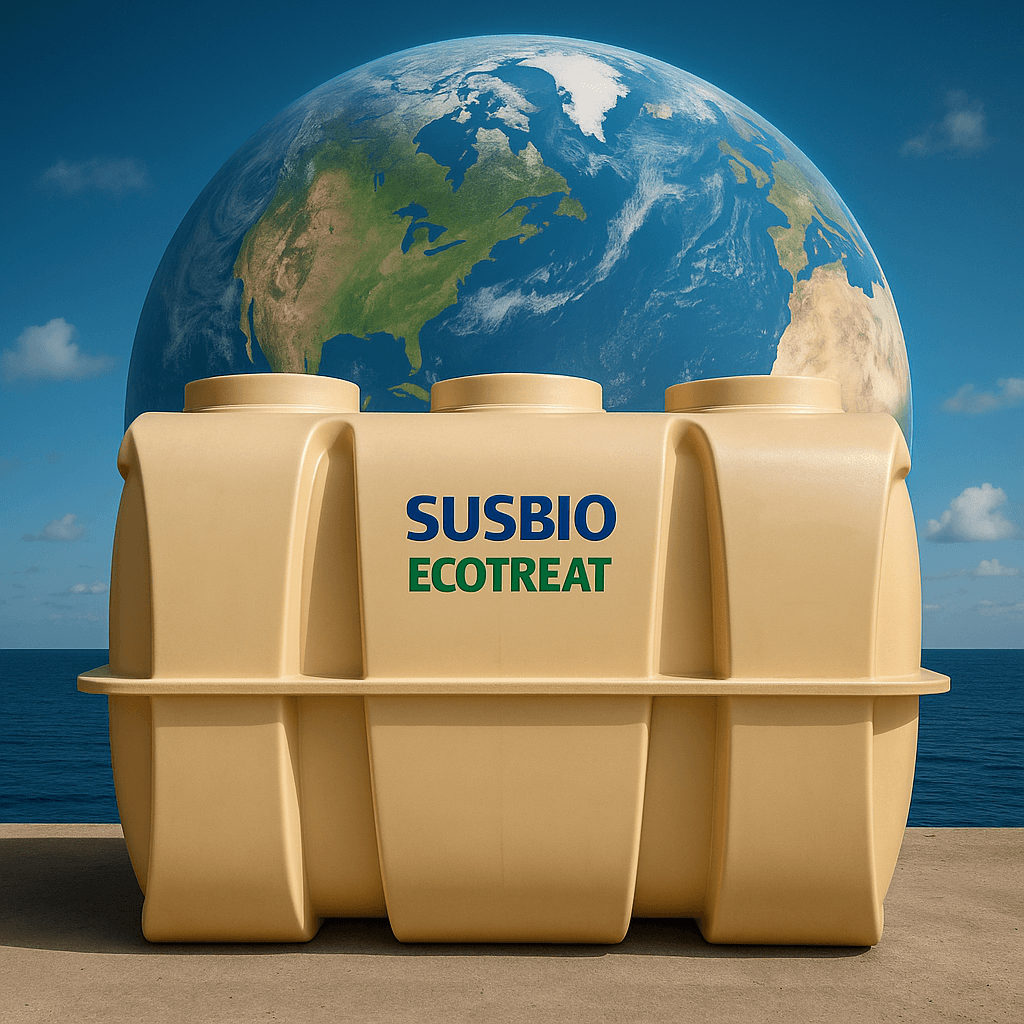


This page covers everything about STP plants in India — what they are, how they work, which technology to choose, how to size one, what it costs, what CPCB requires, and how to pick a manufacturer you won’t regret. Written from 500+ installations across 24 Indian states.
An STP plant — Sewage Treatment Plant — is a system that removes harmful contaminants from domestic wastewater before the water is safely discharged or reused. ‘Domestic wastewater‘ means the water from your toilets, bathrooms, kitchens, and washbasins — everything that goes into the drain in a home, apartment, hotel, hospital, or office.
The treatment process is biological, physical, and chemical. Microorganisms break down organic matter. Physical settling removes solids. Disinfection eliminates pathogens. What comes out — if the plant is built correctly — is treated water meeting CPCB Class A standards: BOD ≤10 mg/L, TSS ≤10 mg/L, Faecal Coliforms ≤100 MPN/100 ml. Safe for flushing, irrigation, and cooling towers.
India generates 72,368 million litres of domestic sewage daily. Only 28% is properly treated. The rest pollutes 296 identified river stretches and degrades groundwater relied upon by hundreds of millions of people. An STP plant — properly designed and maintained — is the direct answer to this.
STP vs ETP vs WTP — The Confusion Clarified
| Term | Treats | Who Needs It | Common Mistake |
|---|---|---|---|
| STP Plant | Domestic sewage — toilets, bathrooms, kitchens | Apartments, hotels, hospitals, schools, offices | Undersizing for actual population |
| ETP Plant | Industrial effluent — chemicals, metals, dyes | Factories, pharma, textiles, food processing | Using an STP where an ETP is needed |
| WTP Plant | Raw surface or borewell water for drinking | Municipal supply, large campuses on borewell | Confusing inlet treatment with outlet treatment |
How an STP Plant Works — Stage by Stage
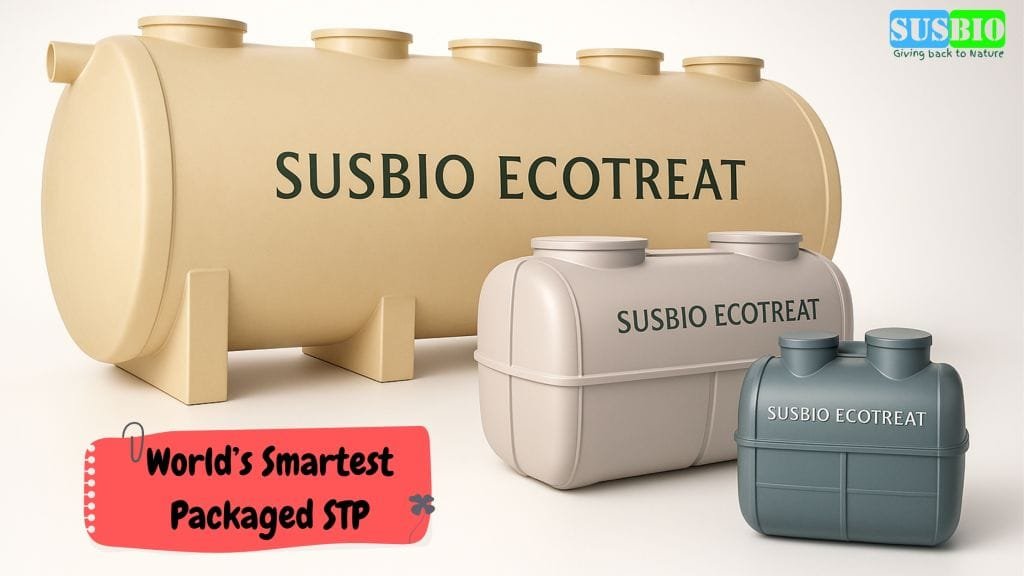
A packaged STP plant like SUSBIO ECOTREAT treats sewage in six sequential stages. Each stage removes a different class of pollutant. Skipping or undersizing any stage results in non-compliant effluent — and that means SPCB notices.
Stage 1 — Screening
Raw sewage enters through a bar screen that captures large solids — plastics, rags, grit. This protects pumps and downstream equipment. In packaged STPs, this is integrated into the inlet chamber.
Stage 2 — Anaerobic Digestion (Primary Biological Treatment)
In SUSBIO ECOTREAT, the sewage enters a sealed anaerobic chamber before any aerobic treatment. Anaerobic bacteria break down complex organic compounds without oxygen, reducing incoming BOD by 40–60%. This is the stage most cheap packaged STPs skip — and it’s why they fail when load spikes on a weekend.
Stage 3 — MBBR (Moving Bed Biofilm Reactor)
The partially treated sewage flows into the MBBR chamber. Free-floating plastic carriers provide a large surface area for aerobic bacteria. These organisms consume remaining BOD and carry out nitrification (converting ammonia to nitrates). The MBBR process is compact, requires no sludge recirculation, and handles load fluctuations far better than activated sludge.
Stage 4 — Secondary Clarifier
Treated water passes into a settling zone where microbial biomass separates. Clarified water moves forward; settled sludge is periodically removed (desludging every 3–6 months for most plants).
Stage 5 — UV Disinfection
A UV lamp eliminates residual pathogens. No chemicals required. Faecal coliform count drops to ≤100 MPN/100 ml — CPCB Class A. The UV lamp is replaced annually under AMC.
Stage 6 — Tertiary Treatment (Optional)
For projects requiring treated water for cooling towers, process water, or LEED certification, a sand filter plus activated carbon unit is added. This polishes turbidity and removes residual colour and odour.
SUSBIO ECOTREAT’s dual-stage Anaerobic + MBBR process is what separates it from single-stage aerobic plants. When a housing society hits peak load on a Saturday evening, a single-stage plant fails. ECOTREAT doesn’t.
STP Plant Technologies — Which One Is Right for Your Project
Five technologies dominate the Indian packaged STP plant market. Here is an honest comparison:
| Technology | How It Works | Capacity Range | Key Strength | Best Application |
|---|---|---|---|---|
| Aerobic biofilm on floating plastic carriers | 2–500 KLD | Compact, no sludge recycle, handles load variation | Best for packaged STPs; used in SUSBIO ECOTREAT | |
| Timed batch: fill → react → settle → decant | 50 KLD+ | Excellent N & P removal, single tank | Good for variable flow; used in SUSBIO SBR | |
| ASP | Continuous aeration + sludge recirculation | 500 KLD+ | High BOD removal, proven technology | Large municipal/industrial plants |
| Biology + membrane filtration combined | 20 KLD+ | Very high effluent quality, compact | Premium reuse applications; high OPEX | |
| FAB / SAFF | Submerged media for fixed biofilm | 10–200 KLD | Moderate cost, good for intermittent load | Common in budget packaged plants |
STP Plant Capacity and Cost in India
Undersizing is the most expensive mistake in the industry. A plant running at 150% capacity produces non-compliant effluent within months. Retrofitting costs 2–3x the original installation. Size correctly the first time.
How to Calculate Capacity — CPHEEO Method
- Residential (urban): 135 litres per person per day (lpcd). Multiply occupants × 135 × 0.80 (wastewater factor) = plant capacity needed.
- Hotels: 135 lpcd for guests staying overnight; 45 lpcd for day visitors.
- Hospitals: 350–450 lpcd depending on bed type (ICU vs general ward).
- Offices / IT parks: 45 lpcd.
- Schools / colleges: 45 lpcd residential; 15–25 lpcd day.
- Restaurants: 70 lpcd per seat full-service; 25 lpcd fast food.
Always add 15–20% buffer and round up to the next standard plant size. An oversized plant costs slightly more upfront but runs reliably. An undersized one costs far more over its lifetime.
Indicative STP Plant Cost in India (SUSBIO ECOTREAT)
| Capacity | Application | Capital Cost (Approx.) | Monthly Operating Cost | SUSBIO Model |
|---|---|---|---|---|
| Villa / small complex | ₹2–4 lakh | ₹3,000–6,000/month | ECOTREAT 5KLD | |
| Small apartment / hotel | ₹4–7 lakh | ₹5,000–10,000/month | ECOTREAT 10KLD | |
| 25 KLD | Mid-size apartment / resort | ₹8–14 lakh | ₹10,000–20,000/month | ECOTREAT 25KLD |
| 50 KLD | Large apartment / hospital | ₹14–22 lakh | ₹18,000–35,000/month | ECOTREAT 50KLD |
| 100 KLD | Township / large hotel | ₹25–40 lakh | ₹30,000–55,000/month | ECOTREAT 100KLD |
| 200 KLD | Large complex / IT park | ₹45–70 lakh | ₹50,000–90,000/month | ECOTREAT 200KLD |
| 500 KLD | SEZ / large township | ₹90 lakh–1.5 cr | ₹1–2 lakh/month | ECOTREAT/SBR |
Note: Capital costs are indicative and vary with civil work requirements, site accessibility, and automation level. AMC is typically 5–8% of capital cost per year. Contact SUSBIO for a project-specific quotation.
CPCB Standards for STP Plants in India
The Central Pollution Control Board sets two relevant standards for STP plant effluent:
- General Standard: BOD ≤30 mg/L, TSS ≤100 mg/L, pH 5.5–9.0. Minimum for discharge to drain or surface water. Treated water cannot be reused under this standard.
- Class A (Reuse Standard): BOD ≤10 mg/L, TSS ≤10 mg/L, Faecal Coliforms ≤100 MPN/100 ml, pH 6.0–9.0. Required for toilet flushing, irrigation, cooling towers. Required for green building certifications (IGBC, LEED, GRIHA). Required in CRZ, coastal, and eco-sensitive zones.
SUSBIO ECOTREAT is designed and certified to CPCB Class A across all capacity sizes from 2 KLD to 500 KLD. Third-party lab reports from operating plants are available on request.
State-Specific STP Plant Norms
- Goa (GSPCB): CRZ restrictions mean any discharge in coastal zones must meet Class A. Packaged FRP plants are the only practical option for most Goa hotel and villa projects.
- Maharashtra (MPCB): Buildings above 20,000 sq.m must have an STP. MPCB actively audits STP performance during OC renewals in Mumbai, Pune, and Nagpur.
- Karnataka (KSPCB): BBMP mandates STP for all buildings above G+4 in BBMP limits. Effluent must meet General Standards; Class A required for reuse.
- Tamil Nadu (TNPCB): Chennai metro strict; OCEMS (online continuous monitoring) required for plants above 100 KLD.
How to Choose an STP Plant Manufacturer in India
The STP plant market has hundreds of vendors. Most buyers choose on price and regret it by year three. Here is what actually determines whether your plant runs for 15 years or fails in three:
| What To Check | Why It Matters | SUSBIO Status |
|---|---|---|
| In-house FRP manufacturing | Vessel quality directly affects plant life. Outsourced vessels show structural failure by year 3–5. | SUSBIO fabricates at own Chakan unit |
| CPCB Class A test reports | Ask for third-party lab reports from installed plants in your state — not a datasheet. | Available for every ECOTREAT model |
| Capacity range | A vendor limited to small units can’t advise you when Phase 2 comes. | SUSBIO: 2 KLD – 500 KLD single range |
| Pan-India service / AMC | Who answers at 11pm when a blower fails? | 9-member field team, 24 states active AMC |
| SPCB documentation package | CTE/CTO dossier, P&IDs, capacity calcs, effluent report — all ready on delivery. | Included with every ECOTREAT supply |
| IoT / remote monitoring | Essential for unstaffed residential and hospitality sites. | Standard on ECOTREAT; SCADA available |
| Export track record | Commercially verifies the product meets standards beyond Indian minimums. | SUSBIO exports to multiple countries |
SUSBIO ECOTREAT — India's Most Deployed Packaged STP Plant
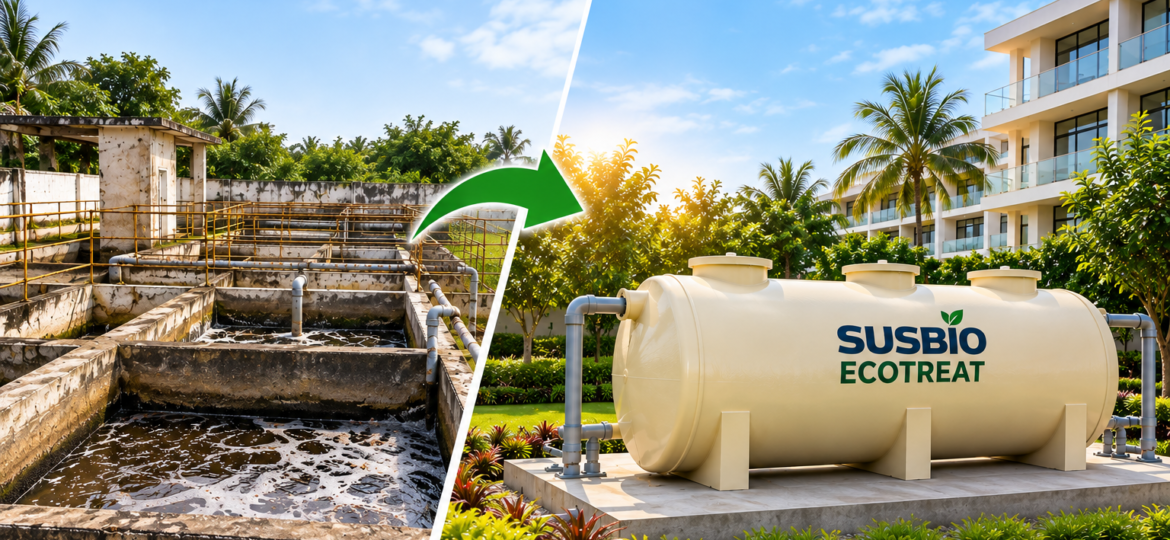
SUSBIO (Sustainable Biosolutions Pvt. Ltd.) was founded in 2013 in Goa. One question: why do packaged STP plants in India fail so often? After studying installed bases across the country, the answer came down to three things — weak biological design (single-stage aerobic), poor FRP quality (outsourced thin-wall vessels), and no service after handover.
ECOTREAT was built to fix all three. Thirteen years and 500+ installations across 24 states later, it’s the benchmark for packaged STP plants in the residential and mid-commercial segment.
- Technology: Dual-stage Anaerobic + MBBR — the only packaged STP in this segment with a dedicated anaerobic first stage. Consistent CPCB Class A output even at peak load.
- Manufacturing: Every vessel fabricated in-house at Vasuli MIDC, Chakan, Pune — not outsourced. Same engineers design and build.
- Range: 2 KLD to 500 KLD, residential to industrial.
- Service: 9-member pan-India field team. Active AMC contracts in 24 states.
- Documentation: Full CTE/CTO dossier, P&ID diagrams, effluent test reports — delivered with the plant.
- Exports: Multiple international markets — commercially verified evidence of performance beyond Indian minimums.
Frequently Asked Questions — STP Plant
Here’s the full FAQ, strengthened for AI-Overview/featured-snippet capture (leading with the direct number/answer in each response) with the lifespan fix applied:
What is an STP plant?
An STP plant — Sewage Treatment Plant — is a system that removes biological, chemical, and physical contaminants from domestic wastewater (from toilets, bathrooms, kitchens) to produce treated water safe for discharge or reuse. In India, STPs are mandatory for all residential projects above 50 units under CPCB norms.
What is the full form of STP plant?
STP stands for Sewage Treatment Plant. It is sometimes written as WWTP (Wastewater Treatment Plant) or PSTP (Packaged Sewage Treatment Plant) when referring to prefabricated, factory-built units like SUSBIO ECOTREAT.
What is the cost of an STP plant in India?
Indicative capital costs: ₹2–4 lakh for 5 KLD; ₹8–14 lakh for 25 KLD; ₹14–22 lakh for 50 KLD; ₹25–40 lakh for 100 KLD; ₹90 lakh–1.5 crore for 500 KLD. Operating costs (electricity + AMC + consumables) typically run ₹3,000–₹1,00,000/month depending on size. Compare total cost of ownership — not just capital price.
How long does it take to install a packaged STP plant?
For SUSBIO ECOTREAT: civil preparation 2–4 weeks, fabrication runs parallel, on-site installation 3–7 days after delivery. Biological startup (microbial culture establishing in MBBR media) takes 4–6 weeks before CPCB Class A output is consistently achieved. Total: 8–12 weeks from order to stable operation.
What is the difference between STP and ETP?
STP (Sewage Treatment Plant) treats domestic wastewater from toilets, bathrooms, and kitchens. ETP (Effluent Treatment Plant) treats industrial process wastewater containing chemicals, heavy metals, dyes, or high-COD streams. A factory needs both: an STP for canteen and toilet sewage, and an ETP for process effluent. SUSBIO makes both — ECOTREAT for STP, IONTREAT for industrial ETP.
Which STP plant technology is best for a residential complex?
For residential applications in India, Anaerobic + MBBR (as used in SUSBIO ECOTREAT) is the most robust choice. The anaerobic first stage handles the variable loads typical of housing societies (heavy weekends, light weekdays) before the MBBR stage polishes to CPCB Class A. Single-stage aerobic plants — common in low-cost packaged units — struggle with load variation and often fail SPCB tests.
Does an STP plant require a full-time operator?
No — for SUSBIO ECOTREAT units below 50 KLD, no full-time operator is required. The plant runs automatically. A monthly service visit (covered under AMC) handles routine checks: blower inspection, pump lubrication, UV lamp check, effluent sampling. For plants above 100 KLD, a part-time operator or regular service visits are recommended.
Can STP plant treated water be reused?
Yes — if the plant meets CPCB Class A (BOD ≤10 mg/L, TSS ≤10 mg/L, Faecal Coliforms ≤100 MPN/100ml). SUSBIO ECOTREAT is certified Class A. Treated water can be reused for toilet flushing, garden irrigation, car washing, and cooling towers. A 200-unit apartment complex typically saves 30,000–40,000 litres of fresh water per day through STP reuse.
How do I get SPCB consent for my STP plant?
You need Consent to Establish (CTE) before construction and Consent to Operate (CTO) after commissioning. Required documents: plant drawings, CPHEEO-based capacity calculations, effluent quality undertaking, and (in most states) a commissioning test report. SUSBIO provides the complete CTE/CTO documentation package with every ECOTREAT installation — P&IDs, process flow charts, capacity calculations, and first-month lab report included.
What is the lifespan of an FRP packaged STP plant? (changed)
A well-fabricated FRP vessel has a structural life of 45–50 years. Mechanical and electrical components (blowers, pumps, UV lamps) have shorter lives — 3–8 years — and are replaceable. The variable is FRP quality: SUSBIO’s in-house Chakan fabrication unit uses resin formulations specific to continuous wastewater immersion. ECOTREAT units from 2013 are still in operation.