

India faces a staggering wastewater crisis as modern sewage treatment continues to advance. The Central Pollution Control Board reports that urban areas generate over 72,000 million liters of wastewater daily, yet treatment remains nowhere near adequate at less than 30%. Public health faces most important risks from aging wastewater infrastructure.
Modern sewage treatment plants have emerged as environmentally responsible solutions while traditional systems struggle to keep up. Smart technologies now drive wastewater treatment in India beyond simple purification. These systems ensure optimal water reuse, minimize energy consumption, and recover valuable resources. Urban areas generate nearly 60% of India’s total wastewater volume, which makes groundbreaking modern sewage treatment methods crucial.
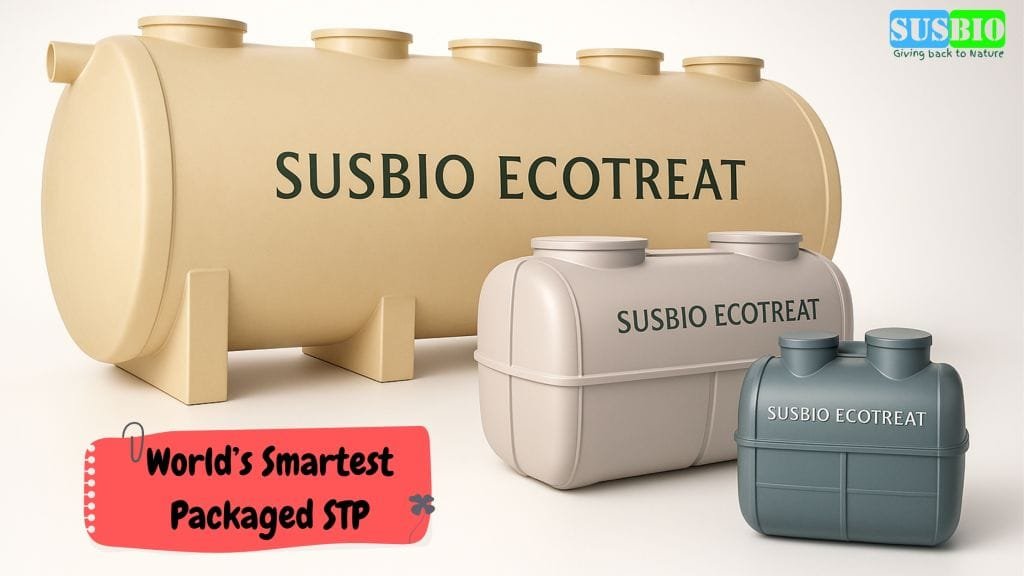
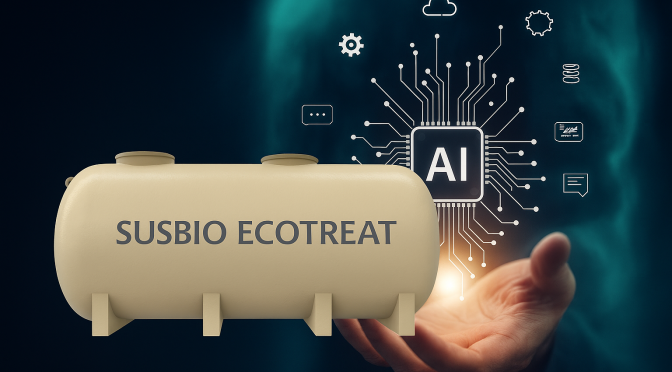
Smart water network modeling breakthroughs show promise for tomorrow’s challenges. Experts project the global smart water market to reach $22.4 billion by 2026. Technologies that enable immediate monitoring and unprecedented efficiency drive this growth. SUSBIO ECOTREAT leads this development with energy-efficient blowers and pumps that use 90% less energy than conventional plants.
This piece gets into how modern sewage treatment adapts to meet India’s 2025 regulatory standards. The technological breakthroughs behind this change and practical solutions for sustainable wastewater management take center stage. The complete transformation in sewage treatment technology spans from IoT-enabled sensors that monitor critical parameters immediately to systems that cut energy use by 30-40% while producing reusable water.
India’s Wastewater Challenge and the Need for Modern STPs
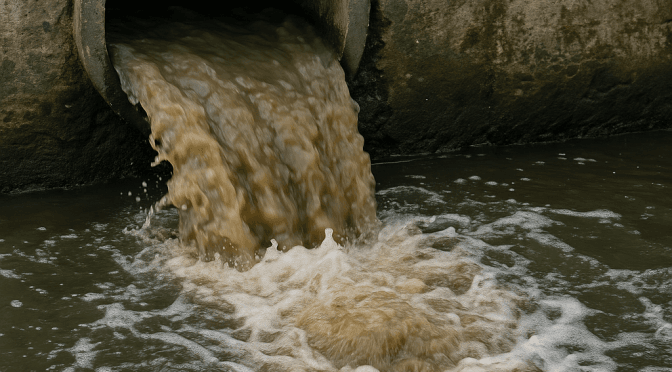
India faces a massive wastewater crisis that needs immediate action. Urban centers are growing faster than ever, and the wastewater systems don’t deal very well with these rising pressures.
Urban Wastewater Generation: 72,000 MLD and Rising
Urban areas in India produce about 72,000 million liters per day (MLD) of wastewater, but treatment facilities lag substantially behind. Only 30% of this huge volume gets proper treatment. More than 50,000 MLD of untreated sewage flows straight into water bodies. The economic toll is heavy – water-related diseases cost our economy about ₹4,400 crore each year in lost productivity and medical expenses.
CPCB 2025 Discharge Norms and Liquid Waste Management Rules
The Central Pollution Control Board has set strict 2025 discharge norms that have altered the map of regulations. These standards require:
- BOD reduction to ≤10 mg/L (previously 30 mg/L)
- COD levels must not exceed 50 mg/L
- TSS limits set at ≤20 mg/L
- Total nitrogen restricted to ≤10 mg/L
The new Liquid Waste Management Rules go beyond compliance. They focus on resource recovery, reuse applications, and energy efficiency for green operation. Plants must now provide immediate monitoring and public data disclosure, which changes their basic operation.
Why Traditional STPs Fall Short in 2025
The biggest problem with conventional sewage treatment plants is their inability to meet these new standards. They use too much energy – about 1.5 kWh/m³ – making them too expensive to run long-term. These systems also perform poorly when load conditions change, which leads to frequent violations.
Old plants take up too much space, which doesn’t work in crowded urban areas where land is scarce. Their design goes against modern circular economy principles because they can’t recover resources and create sludge that’s hard to manage.
SUSBIO ECOTREAT solves these issues with its advanced packaged STP design. It uses just 0.1–0.2 kWh/m³ and consistently meets the strict 2025 norms. This solution provides the flexibility and efficiency that India’s evolving wastewater treatment needs.
Modular and Decentralized Systems: The Shift in 2025
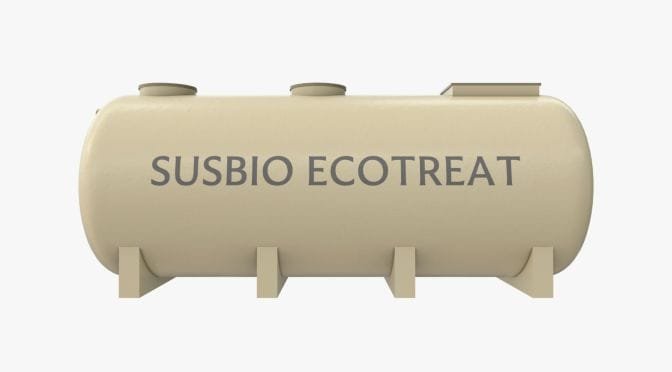
The digital world of wastewater management is changing faster, and modular and decentralized solutions are now the life-blood of modern sewage treatment infrastructure for 2025 and beyond.
Prefabricated STPs for Urban and Rural Deployment
Prefabricated Sewage Treatment Plants have radically altered how we tackle wastewater challenges. These pre-engineered, factory-assembled systems can be deployed quickly in crowded urban areas and remote rural locations. Traditional plants need extensive civil works, but these adaptable solutions come ready to use and cut installation time from months to just weeks. Their flexible architecture lets municipalities and businesses add treatment capacity as their needs grow. SUSBIO ECOTREAT shows this approach with its prefabricated, modular FRP design built for India’s infrastructure challenges, making it the most advanced packaged STP solution available today.
Dual-Treatment Systems: Anaerobic + Aerobic Integration
A single treatment system now combines anaerobic and aerobic processes, marking a major technological breakthrough. This hybrid approach delivers better results by addressing the limitations of each method. The combined systems show improved efficiency for nitrogen removal and better biodegradation capabilities. The dual-treatment process uses 30-40% less energy than conventional methods, mainly through potential bioenergy recovery from anaerobic digestion. SUSBIO ECOTREAT uses this dual methodology and ensures detailed wastewater purification through sequential treatment stages that remove pollutants effectively.
Compact Footprint and Plug-and-Play Installation
Space efficiency defines next-generation sewage treatment. Modern compact systems need 75% less space than traditional plants. They work perfectly in:
- Space-constrained urban environments
- Rooftops and basements in residential complexes
- Temporary locations requiring mobile solutions
The plug-and-play design reduces construction needs, makes logistics simpler, and performs reliably from day one. This approach cuts capital costs and speeds up return on investment through faster commissioning periods.
SUSBIO ECOTREAT: India’s Most Advanced Packaged STP
SUSBIO ECOTREAT emerges as India’s solution to next-generation wastewater management and represents a notable advancement in packaged sewage treatment technology.
Energy Use: 0.1–0.2 kWh/m³ vs Traditional 1.5 kWh/m³
The system delivers exceptional energy efficiency and consumes only 0.1–0.2 kWh/m³ compared to conventional systems that need 1.5 kWh/m³. This 90% reduction in power usage leads to operational cost savings and a smaller carbon footprint. The system’s proprietary bioreactor design maximizes oxygen transfer while minimizing energy input.
Up-to-the-Minute Monitoring with IoT Sensors
SUSBIO’s reliable infrastructure has advanced IoT sensors that track significant parameters like dissolved oxygen, pH, MLSS, and flow rates continuously. This immediate data enables quick adjustments, proactive maintenance, and performance optimization. Users can access operational metrics instantly from anywhere through the cloud-based dashboard.
Compliance with CPCB 2025 Norms: BOD ≤ 10 mg/L
The system achieves BOD levels below 10 mg/L consistently and meets stringent CPCB 2025 standards. The multi-stage treatment process reduces COD to under 50 mg/L and TSS below 20 mg/L. These results ensure regulatory compliance today while preparing for future requirements.
Case Study: Goa Villas and 150,000 Liters/Month Reuse
A luxury villa project in Goa adopted SUSBIO ECOTREAT and reused 150,000 liters of treated water monthly for landscaping. This solution eliminated groundwater extraction for irrigation and maintained lush gardens year-round.
Odor-Free, Silent Operation in Premium Spaces
The system proves valuable in high-end applications with its silent and odor-free operation. Its sealed design and advanced biological process prevent methane release and sulfurous compounds. These features make it ideal for installation near occupied spaces without causing any disturbance.
Overcoming Barriers and Scaling for the Future
Modern sewage treatment plants like SUSBIO ECOTREAT have made technical progress, yet many barriers still prevent their widespread adoption across India.
Tackling Public Perception with Transparent Data
The public’s acceptance plays a vital role in water reuse success. People tend to prefer using recycled water for non-contact purposes such as toilet flushing and construction rather than direct consumption. Medical professionals and experts must endorse these initiatives to build trust. The process also needs clear monitoring systems and open data sharing.
Financing Models: Green Bonds and Capital Subsidies
New financial tools help develop infrastructure in multiple ways. Vadodara Municipal Corporation made history by issuing Asia’s first certified green municipal bond in 2024. This initiative raised ₹100 crore for wastewater management. States also support this cause by offering 50% capital subsidies – up to ₹5 crore for Effluent Treatment Plants and ₹10 crore for Zero Liquid Discharge systems. These financial tools make advanced systems like SUSBIO ECOTREAT affordable even for smaller municipalities.
Digital STP Portals and Single-Window Clearances
The government launched the National Single Window System after Budget 2020-21 announcements to simplify approvals from central and state departments. This unified platform eliminates the need to visit multiple agencies and provides timely clearances that speed up STP deployment.
Zero Liquid Discharge (ZLD) and Water Credit Markets
ZLD technology recovers all water while converting contaminants into solid waste. Water Resource Credits (WRCs) create market incentives where each WRC equals 1000 cubic meters of reused water. Companies can trade these credits, which promotes resource recovery and supports SUSBIO ECOTREAT’s circular economy approach.
Conclusion
India faces a critical wastewater crisis with its current sewage treatment infrastructure. Less than 30% of 72,000 MLD urban wastewater gets proper treatment. The situation needs immediate action through state-of-the-art solutions.
SUSBIO ECOTREAT has emerged as India’s most advanced packaged STP that tackles these challenges with its revolutionary design. The system shows remarkable efficiency by using only 0.1-0.2 kWh/m³ of energy. Traditional systems use 1.5 kWh/m³. This 90% reduction in energy use helps meet strict CPCB 2025 norms consistently.
Modular and decentralized systems are without doubt the future of wastewater management. These ready-to-use solutions can be deployed quickly and need minimal space. Their plug-and-play setup works well in both crowded cities and rural areas. On top of that, they combine anaerobic and aerobic processes for better treatment while using substantially less energy.
Green municipal bonds and capital subsidies now make these advanced systems affordable even for smaller towns. Single-window clearances help speed up the implementation process.
Clear data sharing and expert backing can help change public perception. Water Resource Credits and Zero Liquid Discharge technologies create market incentives that match SUSBIO ECOTREAT’s circular economy approach perfectly.
SUSBIO ECOTREAT’s self-operating plants offer solutions that go beyond just meeting standards as India approaches 2025. These systems turn wastewater from an environmental problem into a valuable resource. They support water security and protect public health. The technology to solve tomorrow’s wastewater challenges exists today – we just need to welcome it.
Key Takeaways
India’s wastewater crisis demands immediate action, with modern sewage treatment plants offering revolutionary solutions that transform environmental challenges into sustainable opportunities.
- Energy Revolution: Modern STPs like SUSBIO ECOTREAT consume 90% less energy (0.1-0.2 kWh/m³) compared to traditional plants (1.5 kWh/m³)
- Regulatory Compliance: New CPCB 2025 norms require BOD ≤10 mg/L, driving the need for advanced treatment technologies with real-time monitoring
- Modular Solutions: Prefabricated, plug-and-play systems enable rapid deployment in 75% less space, perfect for urban constraints
- Financial Viability: Green bonds and 50% capital subsidies make advanced treatment systems accessible to municipalities of all sizes
- Resource Recovery: Zero Liquid Discharge technology and Water Resource Credits create market incentives for treating wastewater as valuable resource
The shift toward self-operating, IoT-enabled treatment plants represents more than technological advancement—it’s a fundamental transformation from waste disposal to resource recovery, ensuring India’s water security while meeting stringent environmental standards.
Frequently Asked Questions
Q1. What are the main advantages of modern sewage treatment plants like SUSBIO ECOTREAT?
Modern sewage treatment plants offer significant energy savings, consuming only 0.1-0.2 kWh/m³ compared to traditional plants that use 1.5 kWh/m³. They also provide real-time monitoring, ensure compliance with strict environmental norms, and operate silently without odors.
Q2. How do modular and decentralized sewage treatment systems benefit urban areas?
Modular and decentralized systems require up to 75% less space than traditional plants, making them ideal for congested urban environments. They offer rapid deployment, scalability, and can be installed in locations like rooftops and basements, providing flexible solutions for growing cities.
Q3. What are the new CPCB 2025 discharge norms for sewage treatment plants?
The CPCB 2025 norms require BOD levels to be reduced to ≤10 mg/L, COD levels not exceeding 50 mg/L, TSS limits set at ≤20 mg/L, and total nitrogen restricted to ≤10 mg/L. These standards are more stringent than previous regulations and aim to improve water quality significantly.
Q4. How are modern sewage treatment plants addressing energy efficiency?
Advanced sewage treatment plants are incorporating dual-treatment systems that integrate anaerobic and aerobic processes. This approach can reduce net energy consumption by 30-40% compared to conventional methods, while also enabling potential bioenergy recovery from anaerobic digestion.
Q5. What financial mechanisms are available to support the implementation of advanced sewage treatment plants?
Several financial innovations are supporting the adoption of modern sewage treatment plants. These include green municipal bonds, capital subsidies of up to 50% for effluent treatment plants, and the introduction of Water Resource Credits. These mechanisms make advanced systems more financially viable for municipalities and industries.