

The right restaurant wastewater treatment system affects your compliance status and operational costs. Restaurants generate large amounts of wastewater that contains food particles, fats, oils, and grease. Restaurant wastewater can vary based on the type of cuisine, which affects the treatment approach needed. A wastewater treatment plant for restaurant operations will ensure your discharge meets regulatory standards. It can potentially reduce water consumption through recycling. Various systems treat wastewater, such as grease traps, restaurant STP (sewage treatment plants), restaurant ETP (effluent treatment plants), and advanced biological reactors.
This piece walks you through understanding your wastewater characteristics and compliance requirements. We’ll cover available treatment technologies and the factors for selecting a restaurant water treatment system that balances regulatory needs with cost efficiency.
Understanding Restaurant Wastewater Characteristics and Challenges

Restaurant wastewater composition varies based on establishment size, meal types prepared, and cleaning water usage patterns. Understanding these characteristics helps in selecting appropriate treatment systems that can handle the specific pollutant loads.
High Organic Matter and BOD Levels
Kitchen wastewater contains much higher organic content compared to typical municipal sewage. Total COD concentrations range from 1250 to 5363 mg/l, well above the 500 to 1200 mg/l range found in municipal sewage. Starch, proteins, and fats released during food preparation create this elevated organic load.
Biochemical oxygen demand represents the oxygen microorganisms need to decompose organic matter. BOD limits for restaurant discharge to sewer systems fall around 250 to 300 mg per liter. Direct environmental discharge requires much lower levels, around 10 mg per liter. Total nitrogen levels in food service establishment effluents range from 24 to 79 mg/l. Ammonia concentrations sit between 0.7 and 7.4 mg/l, suggesting most nitrogen derives from organic material rather than ammonia.
Fats, Oils, and Grease (FOG) Content
FOG concentrations in restaurant wastewater range from 92 to 1067 mg/l, with carbohydrate content between 202 and 3997 mg/l and protein levels from 146 to 477 mg/l. These lipid-rich compounds come from solid and liquid animal fats, vegetable oils, cooking fats, and sauces. FOG presents as nonpolar glycerol esters, insoluble in water, causing major treatment challenges.
The effect is severe. FOG accounts for 50% of sewer blockages in Ireland, 55% in Scotland, 60% in both the UK and Hong Kong, and reaches 70% in Malaysia. FOG enters drainage systems and mixes with food waste. It congeals and forms deposits through agglomeration, crystallization, and saponification processes.
pH Fluctuations from Cleaning Chemicals
Restaurant wastewater exhibits notable pH variations depending on the source. Potwash sink wastewater maintains a neutral pH range of 6.8 to 7.3. Dishwasher effluents reach alkaline levels between 10.5 and 12.0 due to sodium hydroxide in dishwasher detergents. These fluctuations affect biological treatment processes and equipment integrity.
Variable Flow Rates and Loading Patterns
Loading refers to pollutant quantities entering treatment systems, measured through BOD, total suspended solids, and flow rate. Restaurants experience loading variations from peak seasons, special events, and off-peak periods. Systems must adapt to sudden surges without compromising treatment quality.
Regulatory Compliance Requirements for Restaurant Wastewater
Regulatory frameworks governing restaurant wastewater discharge vary across jurisdictions, yet the mechanisms remain consistent: preventing infrastructure damage and protecting receiving water bodies. Facilities that discharge wastewater to public sanitary sewers must comply with rules the agency operating the collection system and wastewater treatment plant has set.
Local Discharge Standards and Permit Requirements
Restaurants producing fats, oils, and grease require wastewater discharge permits or authorizations to discharge to sewer systems. School kitchens, cafes, butcher shops, delicatessens, hospitals, nursing homes, and hotels with dishwashing capabilities must meet pretreatment requirements. Restaurants with occupancies of 50 or more persons shall have an interceptor rather than a grease trap unless space limitations prevent interceptor installation.
BOD, TSS, and FOG Concentration Limits
Discharge limits differ based on destination. Public sewers have BOD limits that reach 350 mg/L and TSS limits that extend to 600 mg/L. Oil & grease limits stand at 20 mg/L. FOG concentration limits vary substantially by location: Littleton, Colorado permits 200 mg/L and Lexington, Kentucky allows 100 mg/L, while Lakehaven, Washington restricts FOG to 50 mg/L. Los Angeles accepts 600 mg/L for dispersed oil and grease. Temperature restrictions range from 85°F to 140°F. pH is managed to keep between 5 to 10 standard units.
Pre-treatment Requirements Before Municipal Discharge
Grease interceptors require minimum sizes of 1,000 gallons. Entire kitchens including dishwashers must drain to the interceptor. Restaurants cannot use garbage grinders that discharge into sewer systems.
Monitoring and Reporting Obligations
Testing procedures require three grab samples per day for three consecutive days. Samples must be collected no less than 20 minutes apart. Facilities must maintain records of pretreatment facility cleaning and FOG reduction programs. Sample collection timing matters, as results vary based on restaurant operating hours and cleaning practices.
Treatment System Options for Restaurant Wastewater
Several treatment technologies address restaurant wastewater challenges. Each offers distinct advantages for specific operational contexts.
Grease Traps and Interceptors as Main Treatment
Grease traps operate through gravity separation. Wastewater enters and slows, which allows FOG to float while solids settle. Current standards require grease interceptors to remove a minimum of 90% of incoming FOG. But commercial grease interceptors do not remove FOG in full and discharge high concentrations of extra-long fatty acids attributed to microbial activity and triglyceride hydrolysis within the unit. Establishments using automatic dishwashers produce up to 80.4% of particles measuring 45 micrometers or smaller. Handwash operations generate only 36.9% in this size range. Passive units require emptying at 25% capacity to maintain effectiveness.
Two-Chamber Septic Tank Systems
Septic tanks provide anaerobic treatment with detention periods of 24 to 48 hours. Systems with proper design remove 40-50% BOD and 50-70% TSS. Two-chamber configurations position the first chamber at twice the capacity of the second chamber for better settling. Desludging should occur half-yearly or yearly and leave at least 25 mm sludge depth as seeding material.
Sequencing Batch Reactor (SBR) Technology
SBR systems treat wastewater in five sequential stages: fill, react, settle, decant and idle. The combined ST-SBR configuration achieves 86.72% to 98.63% efficiency in removing organic components when coupled with a two-chamber septic tank. Optimal hydraulic retention time stands at 24 hours with 14 L/min aeration rate.
Activated Sludge Treatment Plants
Activated sludge processes use aeration and biological floc to oxidize organic pollutants. Systems produce 70-100 grams of waste activated sludge per cubic meter of wastewater treated.
Membrane Bioreactor (MBR) Systems
MBR technology combines membrane filtration with biological treatment. This offers pollutant removal with a smaller footprint. Systems achieve up to 50% footprint reduction compared to conventional treatment. MBR produces high-quality effluent suitable for water reuse applications.
Choosing the Right System: Key Selection Factors
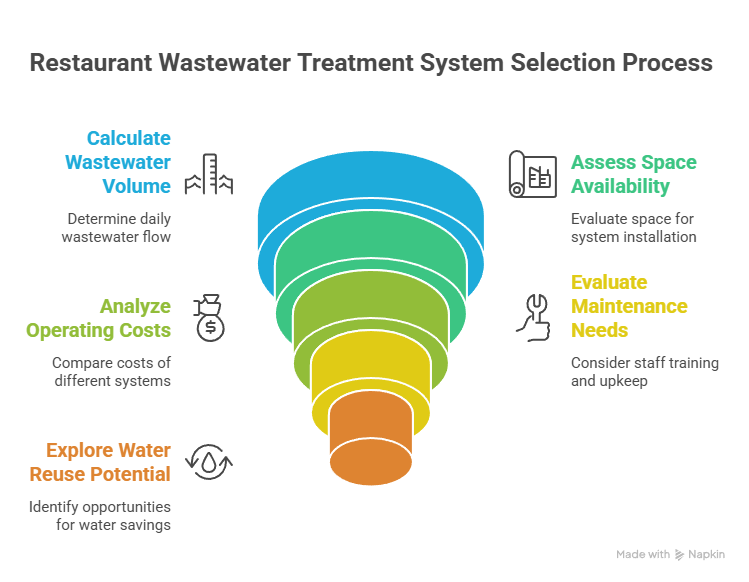
Selecting an appropriate restaurant wastewater treatment system requires evaluating five critical parameters that determine both regulatory compliance and financial viability.
Daily Wastewater Volume and Flow Calculations
Accurate flow estimation is the foundation of system sizing. Restaurants generate 2-4 gallons of wastewater per meal served. Design flow calculations multiply occupancy by per-capita contribution (250 occupants x 5 gpd/occupant + 10 employees x 25 gpd/employee = 1,500 gpd). State regulations may specify 40 gpd per seat when you have full-service restaurants or 20 gpd per seat when you have single-service establishments.
Space Availability and Installation Requirements
Small-scale restaurant ETP systems treating up to 50 KLD fit within 500-1000 square feet. Medium-scale systems (50-200 KLD) require 2000-5000 square feet depending on technology. MBR systems occupy smaller footprints but need space for maintenance equipment.
Operating Costs vs Capital Investment Analysis
Activated sludge systems demonstrate annual O&M costs 109% higher than integrated anaerobic-aerobic systems. Per unit treatment costs vary: integrated systems at USD 1.10/m³, activated sludge at USD 1.36/m³ and stabilization ponds at USD 1.46/m³.
Maintenance Requirements and Staff Training Needs
Restaurant STP operators need proper qualifications through structured training programs. Septic systems need professional inspection at least once a year, with pumping every 3-5 years. Wastewater treatment plants need continuous attention due to operational problems from untrained manpower.
Water Reuse Potential and Cost Savings
Water-efficient practices decrease a restaurant’s operating costs by about 11 percent. Water consumption ranges from 6 to 29 gallons per meal, making reuse systems especially valuable when you have high-volume establishments.
Conclusion
You need to select the right wastewater treatment system for your restaurant. This balances regulatory compliance with operational efficiency. We got into how wastewater characteristics like FOG and BOD levels determine treatment needs. Available technologies range from grease traps to advanced MBR systems. Critical selection factors include volume calculations and space requirements along with cost analysis. Evaluate these parameters and you can implement a solution that meets discharge standards. Long-term operational expenses reduce through water reuse opportunities.
Key Takeaways
Restaurant wastewater treatment is crucial for regulatory compliance and cost management, requiring careful system selection based on your establishment’s specific needs and discharge requirements.
- Calculate daily wastewater volume accurately – Restaurants generate 2-4 gallons per meal served, requiring proper flow estimation for correct system sizing and compliance.
- FOG removal is critical for compliance – Fats, oils, and grease cause 50-70% of sewer blockages globally and require specialized treatment with 90% minimum removal efficiency.
- Match treatment technology to space and budget – Small-scale systems (up to 50 KLD) need 500-1000 sq ft, while MBR systems offer 50% smaller footprints but higher costs.
- Consider water reuse for cost savings – Implementing water-efficient practices and reuse systems can decrease restaurant operating costs by approximately 11 percent.
- Plan for ongoing maintenance requirements – Systems need professional inspection annually, regular pumping every 3-5 years, and trained operators to maintain effectiveness and avoid costly violations.
The right treatment system transforms wastewater management from a compliance burden into a cost-saving opportunity while protecting local infrastructure and environment.
Frequently Asked Questions
Q1. What are the typical BOD and TSS discharge limits for restaurant wastewater?
For discharge to public sewers, BOD limits typically reach 350 mg/L and TSS limits extend to 600 mg/L. However, direct environmental discharge requires significantly lower levels, with BOD commonly restricted to 10 mg/L. FOG concentration limits vary by location, ranging from 50 mg/L to 600 mg/L depending on local regulations.
Q2. How much wastewater does a restaurant typically generate per day?
Restaurants typically generate 2-4 gallons of wastewater per meal served. For system sizing, full-service restaurants may use calculations of 40 gallons per day per seat, while single-service establishments use approximately 20 gallons per day per seat. Water consumption can range from 6 to 29 gallons per meal depending on the establishment type.
Q3. What is the minimum FOG removal efficiency required for grease interceptors?
Current standards require grease interceptors to remove a minimum of 90% of incoming fats, oils, and grease (FOG). However, it’s important to note that even with this efficiency, commercial grease interceptors do not remove FOG entirely and still discharge some concentration of fatty acids.
Q4. How often should restaurant wastewater treatment systems be maintained?
Grease traps should be emptied when 25% full to maintain effectiveness. Septic systems need professional inspection at least annually, with pumping required every 3-5 years. Two-chamber septic tanks should be desludged half-yearly or yearly, leaving at least 25 mm of sludge depth as seeding material.
Q5. Can treated restaurant wastewater be reused to reduce operating costs?
Yes, implementing water-efficient practices and reuse systems can decrease restaurant operating costs by approximately 11 percent. Advanced treatment systems like Membrane Bioreactor (MBR) technology produce high-quality effluent suitable for water reuse applications, making them particularly valuable for high-volume establishments that consume significant amounts of water.