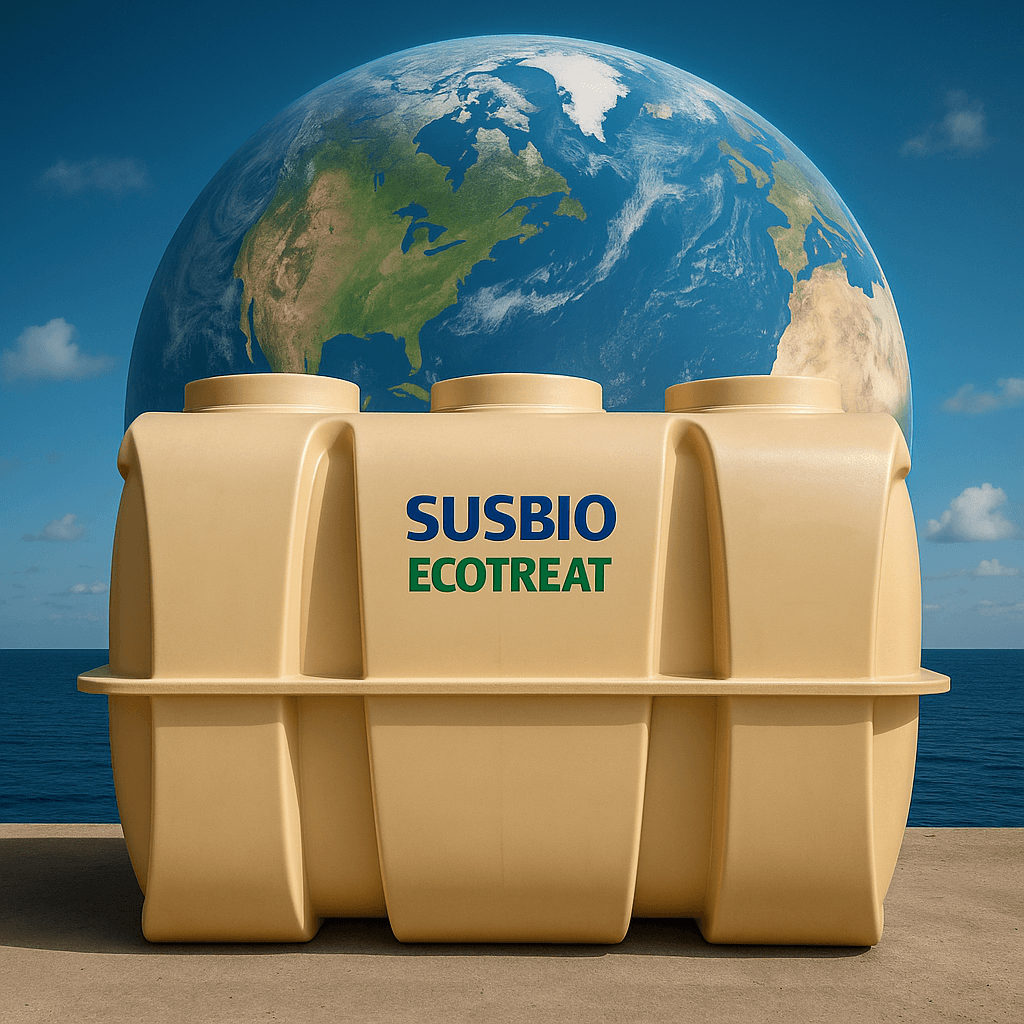


Saudi Arabia wants to achieve 100% reuse of treated wastewater by 2025. The Kingdom’s sewage treatment plant initiatives are changing its approach to water management. These projects create environmentally responsible solutions for a water-scarce region.
Water Treatment Plants in Saudi Arabia currently treat about 50% of the total wastewater. This number is changing faster now. The country has established itself as a global leader with a market value of USD 4.69 Billion. This makes it the third largest water reuse market globally, right after China and the US. Saudi Arabia’s Water and Wastewater Treatment Market should grow substantially. The market value will rise from US$ 4.03 billion in 2024 to US$ 7.43 billion by 2033, with a compound annual growth rate of 7.05%. These numbers show an urgent need for STP plant solutions and reliable sewage treatment plant suppliers in Saudi Arabia.
The Kingdom’s Vision 2030 emphasizes water reuse, conservation, and environmentally responsible development. Modern Sewage Treatment Plants in Saudi Arabia now treat wastewater effectively. This enables safe reuse for irrigation, industrial processes, and residential applications. Aqua Arabia’s mission focuses on delivering clean water in a friendly environment. High operating costs and skills gaps present challenges. Yet, Saudi Arabia’s water security future depends on advanced sewage treatment technologies and environmental compliance.
This piece explores everything about sewage treatment plants in Saudi Arabia. You’ll learn about choosing the right suppliers and understanding compliance standards for 2025 and beyond.
Why Sewage Treatment is Critical for Saudi Arabia’s Future
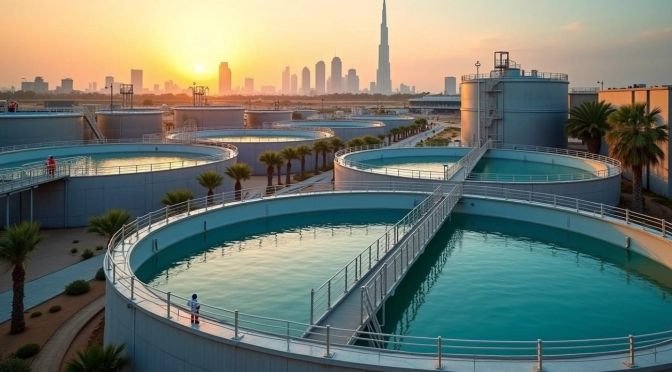
The lack of water stands as one of Saudi Arabia’s biggest challenges today. The Kingdom sees some of the world’s lowest rainfall, with yearly precipitation reaching just 100mm compared to the world average of 990mm. The search for eco-friendly water management solutions has become vital for national growth.
Urbanization and Water Scarcity Challenges
Saudi Arabia faces mounting water demands due to rapid urban growth. The country’s urban areas now house 84% of its population, which puts enormous strain on water resources. Saudi citizens use much more water than the global norm – 265 liters daily versus the typical 180-200 liters worldwide. This mix of urban expansion and high water use makes advanced sewage treatment plants crucial for Saudi Arabia’s sustainable future.
Vision 2030 and the Push for Water Reuse
Vision 2030, now 7 years old, sets bold targets for water management. The plan wants to treat and reuse all municipal wastewater by 2025. This smart move will help reduce dependence on power-hungry desalination while building a circular water economy. The National Water Strategy 2030 also focuses on better water resource distribution through wastewater treatment. The treated water serves non-drinking purposes like cooling industrial equipment, watering landscapes, and supporting agriculture.
STP Plant Full Form and Its Role in Water Security
The Sewage Treatment Plant (STP) is the life-blood of Saudi Arabia’s water security plan. These facilities clean and purify wastewater, turning waste into a valuable asset. Modern STPs use multiple treatment stages to meet strict quality standards for safe reuse.
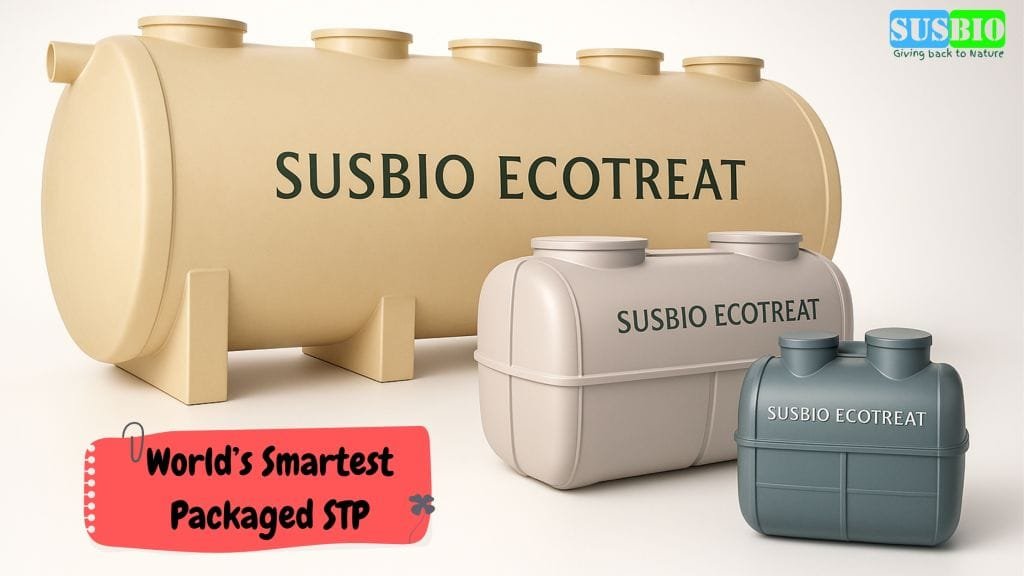
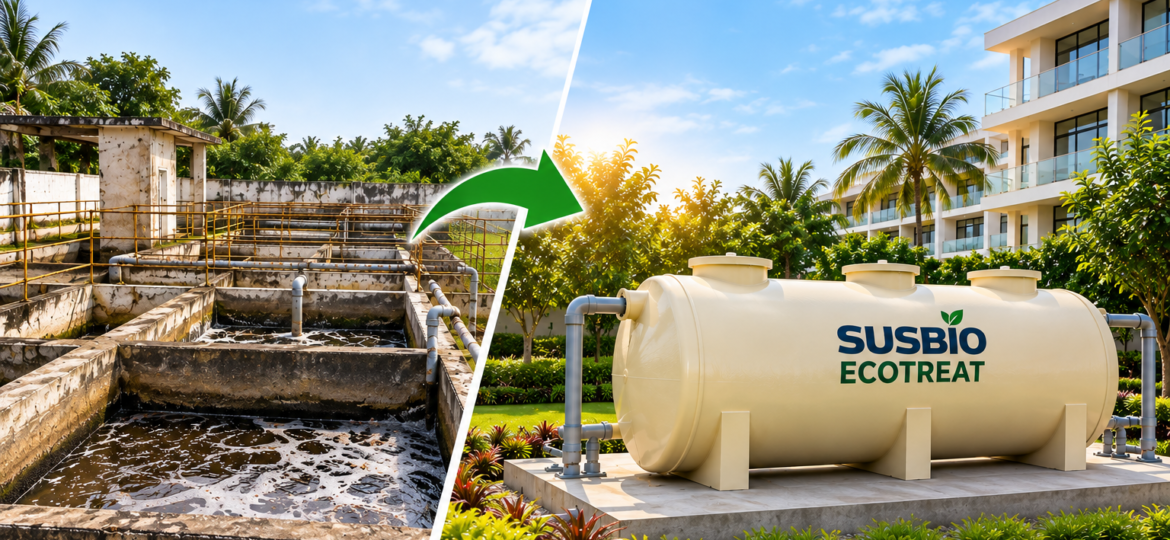
SUSBIO ECOTREAT, India’s most advanced packaged STP, offers technology that matches Saudi Arabia’s sustainability goals perfectly. These compact, modular systems are a great way to get efficient treatment while keeping running costs low. This matters greatly to sewage treatment plant suppliers in Saudi Arabia who want economical solutions for the region’s unique challenges.
Packaged and Compact STP Solutions for Modern Projects
Saudi projects today face unique challenges in implementing wastewater solutions. New developments struggle with space constraints, high energy costs, and maintenance issues that make sewage management complex. Packaged sewage treatment plants provide efficient alternatives that solve these problems.
SUSBIO ECOTREAT: India’s Most Advanced Packaged STP
SUSBIO ECOTREAT brings a new era in packaged sewage treatment technology. This innovative system uses durable fiber-reinforced plastic and combines anaerobic and aerobic treatment processes for superior wastewater purification. Saudi projects benefit from its prefabricated, plug-and-play design that allows quick setup with minimal site disruption.
Key features include:
- Advanced dual treatment process ensuring high-quality output
- Resilient FRP construction that withstands harsh desert conditions
- Fully automatic operation without dedicated staff
- Customizable capacities ranging from 1-500 KLD
Modular STPs for Villas, Hotels, and Commercial Use
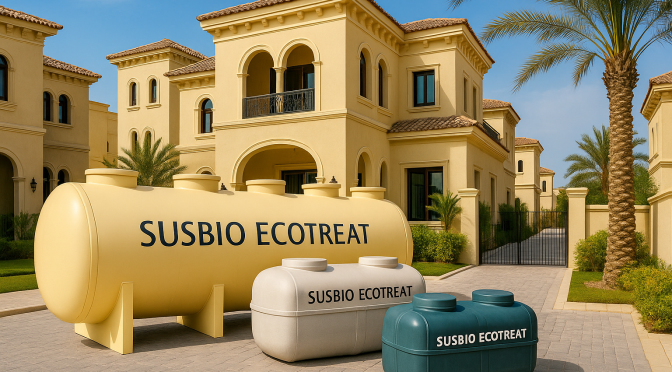
Modern packaged STPs offer adaptable solutions for properties of all sizes in Saudi Arabia. Small hotels and villas work well with capsule-type units (1-20 KLD), while larger commercial complexes can use cylinder models (20-500 KLD). These compact systems adapt well to occupancy changes, which helps Saudi’s seasonal tourism industry.
Energy-Efficient Operation with Automated Iot Monitoring
AI technology has revolutionized sewage treatment efficiency in Saudi Arabia. The system’s advanced automation monitors water quality markers like COD, BOD, TSS, pH, and dissolved oxygen levels with up-to-the-minute data analysis. AI-controlled STPs have shown energy savings up to 90% compared to traditional systems. This optimization is vital for Saudi Arabia where water and energy conservation are top priorities.
Low Maintenance and Quick Installation Benefits
Packaged STPs arrive ready to use from the factory, which speeds up deployment. The installation time drops substantially because these units don’t need complex on-site construction. The automated systems need minimal oversight and keep treatment quality consistent – perfect for Saudi projects in remote areas.
These packaged solutions will shape the future of wastewater management as Saudi Arabia’s infrastructure grows.
Choosing the Right STP Supplier in Saudi Arabia
Picking an experienced STP supplier is a significant step on your path to successful wastewater management in the Kingdom. The right partner will give your system the ability to meet operational needs and regulatory standards.
Factors to Consider: Capacity, Technology, Compliance
The key aspects to think about when choosing sewage treatment plant suppliers in Saudi Arabia include:
- Treatment capacity requirements (KLD)
- Technology type (MBBR, SBR, MBR)
- Saudi environmental regulations compliance
- Energy efficiency (systems can reduce consumption by 30%)
- Maintenance requirements and local support availability
- Project-specific customization options
SUSBIO and Other Leading Providers in the Region
SUSBIO has successfully completed wastewater treatment projects nationwide. Their IoT-integrated STPs feature up-to-the-minute monitoring capabilities. These systems cut power consumption by 70% compared to traditional setups. SUSBIO ECOTREAT stands out as India’s most advanced packaged STP. Its advanced biological processes deliver superior treatment efficiency.
Cost, Compliance, and Reuse Standards for 2025
Saudi Arabia’s growing water management sector needs careful planning for sewage treatment infrastructure. The planning must consider costs, regulatory compliance, and ways to reuse water. These considerations will give optimal returns on investment.
Cost Factors: Technology, Capacity, and Automation
Saudi Arabia’s sewage treatment plant costs vary substantially based on design complexity, treatment technology, and automation levels. SUSBIO data shows that daily treatment capacity, technology type (MBBR, MBR, SBR), automation level, and effluent quality requirements are the main cost drivers. Automated systems can cut energy and chemical costs by 20-40%. SUSBIO ECOTREAT, India’s most advanced packaged STP, delivers exceptional ROI through energy efficiency and low maintenance. This makes it perfect for Saudi Arabia’s future-ready infrastructure needs.
Effluent Quality Requirements for Reuse
Saudi Arabia’s Ministry of Water and Electricity created detailed wastewater reuse standards in 2006 to replace their 2003 guidelines. These standards separate restricted agricultural irrigation (RI) from unrestricted agricultural irrigation (UR), with specific quality thresholds for each. The 2000 Royal Decree requires all wastewater to undergo tertiary treatment, no matter its reuse category or discharge location.
Permits and Environmental Approvals in Saudi Arabia
STP operations need several permits to work properly. These include environmental impact assessment approval, municipal construction permits, operational licenses from the Ministry of Water and Electricity, discharge permits, health department approvals for reuse, and safety clearances. These strict requirements line up with Saudi Arabia’s goal to treat all wastewater by 2025.
Reuse Applications: Landscaping, Cooling, Flushing
Treated wastewater has many uses beyond agriculture. These include landscape irrigation, industrial cooling, toilet flushing, and construction activities. Water reuse cuts costs substantially—desalinated water costs about INR 421.90/m³ while aquifer recharge using treated wastewater costs only INR 21.10-0.50/m³. District cooling ended up as a promising application that could replace the expensive desalinated water used throughout the Kingdom.
Conclusion
Saudi Arabia’s water situation is unlike almost anywhere else on earth. A country with less than 100mm of annual rainfall, hosting 84% of its population in cities, consuming 265 litres per person per day — and sitting on rapidly depleting groundwater reserves. The Vision 2030 target of 100% wastewater reuse was not an aspirational gesture. It was an engineering necessity.
We have been working with developers, contractors, and facility managers across the Middle East and India since 2013. The pattern we see consistently is that the projects that fail to achieve water sustainability targets are not failing because of the wrong technology choice. They fail because plants are sized for average loads without accounting for peak demand, installed without proper commissioning, or handed over without operator training and service agreements.
Saudi Arabia’s wastewater infrastructure is scaling rapidly — from the $4.03 billion base in 2024 toward the $7.43 billion projection by 2033. That growth is happening because the Kingdom has moved from treating wastewater as a disposal problem to treating it as a resource recovery opportunity. The economics confirm it: treated wastewater costs 10 to 20 times less than desalinated water for non-potable applications. Every litre reused is a litre not desalinated.
The technology choices available today — packaged MBBR systems, automated IoT monitoring, modular FRP construction — make it genuinely possible to deploy compliant, reliable STPs in three to five days, across desert terrain, without dedicated operators, at capacities from a single villa to a 500 KLD commercial complex.
What separates a plant that delivers consistent compliance from one that produces a NEBOSH report two years later is the same thing it always is: influent characterisation before design, proper peak flow engineering, commissioning by engineers who have seen the failure modes before, and a service structure that catches deterioration before it becomes a violation.
SUSBIO works with residential developers, hospitality groups, and industrial facilities on sewage treatment projects across India and the broader region. If you are specifying an STP for a Saudi project — new development, labour camp, hotel, or industrial facility — and want a site-specific technical proposal with full scope transparency, reach us at info@susbio.in or +91 88889 80197.
For CPCB and India-specific STP compliance requirements, read our complete guide: Government Standards and Guidelines for STPs in India
Key Takeaways
Saudi Arabia’s sewage treatment sector is experiencing unprecedented growth, driven by Vision 2030’s ambitious water sustainability goals and the urgent need to address water scarcity in one of the world’s most arid regions.
- Saudi Arabia aims for 100% wastewater reuse by 2025, with the water treatment market projected to grow from $4.03 billion to $7.43 billion by 2033.
- Packaged STPs like SUSBIO ECOTREAT offer game-changing efficiency, combining anaerobic and aerobic processes with AI controls to reduce energy consumption by up to 90%.
- Modular systems provide flexible solutions for villas, hotels, and commercial projects with capacities ranging from 1-500 KLD and quick installation times.
- Choosing the right supplier requires evaluating capacity, technology type, compliance capabilities, and local support networks to ensure long-term operational success.
- Treated wastewater costs significantly less than desalinated water (INR 21.10/m³ vs INR 421.90/m³), making reuse applications economically attractive for landscaping, cooling, and industrial uses.
The Kingdom’s transformation from waste disposal to water resource recovery represents a critical shift toward sustainable development, positioning early adopters of advanced treatment technologies at the forefront of this essential infrastructure revolution.
Frequently Asked Questions
Q1. What are Saudi Arabia’s goals for wastewater treatment by 2025?
Saudi Arabia aims to achieve 100% reuse of treated wastewater by 2025. This ambitious target is part of the Kingdom’s Vision 2030 initiative, focusing on water conservation and sustainable development.
Q2. How are packaged sewage treatment plants beneficial for Saudi projects?
Packaged STPs offer numerous benefits for Saudi projects, including quick installation, energy efficiency, and low maintenance. They are ideal for various settings, from villas to large commercial complexes, and can reduce energy consumption by up to 90% compared to conventional systems.
Q3. What factors should be considered when choosing an STP supplier in Saudi Arabia?
When selecting an STP supplier, consider treatment capacity requirements, technology type (e.g., MBBR, SBR, MBR), compliance with Saudi regulations, energy efficiency, maintenance requirements, local support, and customization capabilities for specific project needs.
Q4. What are the main applications for treated wastewater in Saudi Arabia?
Treated wastewater in Saudi Arabia is used for various applications, including landscape irrigation, industrial cooling, toilet flushing, and construction activities. It’s particularly promising for district cooling, potentially replacing costly desalinated water.
Q5. How does the cost of treated wastewater compare to desalinated water in Saudi Arabia?
Treated wastewater is significantly more cost-effective than desalinated water in Saudi Arabia. While desalinated water costs approximately 421.90 INR per cubic meter, treated wastewater for aquifer recharge costs between 21.10 and 0.50 INR per cubic meter, making it an economically attractive option for various applications.