


Water is essential for sustaining life, but the way we manage and treat wastewater is crucial for ensuring a clean and healthy environment. Wastewater — sewage from homes, hotels, offices, and institutions — carries pathogens, heavy metals, and organic pollutants that, left untreated, degrade water quality, trigger eutrophication in receiving water bodies, and pose direct health risks including cholera, dysentery, and typhoid. India’s own numbers make the scale of this clear: per capita water availability has dropped to around 1,486 cubic meters as of 2021, making both treatment and reuse of wastewater increasingly urgent rather than optional.
Traditional sewage treatment plants address the treatment problem, but most still depend on manual monitoring, scheduled maintenance visits, and an operator’s judgment call — which only happens when someone is physically on site checking. SUSBIO ECOTREAT takes a different approach: building monitoring and automation into the system itself, so problems get caught as they develop, not at the next scheduled inspection.
How SUSBIO ECOTREAT Actually Treats Wastewater
ECOTREAT is built on an Anaerobic + MBBR hybrid process — anaerobic pre-treatment ahead of a Moving Bed Biofilm Reactor. The treatment happens in stages:
- Preliminary treatment: Screens and grit chambers remove large debris — rags, plastics, sand — protecting downstream pumps and equipment from damage.
- Primary treatment: In a settling tank, heavier solids sink as primary sludge while oils and grease float and are skimmed off.
- Anaerobic pre-treatment: Bacteria break down organic matter without requiring oxygen, reducing both sludge generation and the load reaching the next stage — this is what allows the following stage to run leaner and more efficiently than a conventional aerobic-only system.
- MBBR (secondary treatment): Plastic biofilm carriers suspended in the tank give bacteria a large surface area to colonize, handling the bulk of BOD and COD reduction more efficiently than a fully suspended-growth activated sludge system.
- Clarification and disinfection: Remaining solids settle out, and UV or chlorination disinfection completes the process before discharge or reuse.
This combination consistently achieves BOD below 10 mg/L across SUSBIO’s 500+ installations, meeting CPCB discharge norms.
What Makes It “Smart”
The Anaerobic + MBBR process is the engineering foundation, but three capabilities layered on top are what actually change how the plant is operated day to day:
- Real-time monitoring: Sensors track key parameters continuously rather than relying on periodic manual sampling, so a shift in performance is visible as it happens — not discovered days later during a scheduled check.
- Automated control: The system adjusts operating parameters in response to changing conditions automatically, reducing the need for constant manual intervention and operator judgment calls.
- Predictive maintenance alerts: Instead of waiting for a failure, the system is designed to flag developing issues before they become a shutdown — the difference between a planned service visit and an emergency callout.
Traditional STP vs. Smart, Automated STP
| Traditional STP | SUSBIO ECOTREAT | |
|---|---|---|
| Monitoring | Manual, periodic sampling | Continuous, real-time |
| Issue detection | After the fact, at next inspection | As conditions develop |
| Operator dependency | High — requires trained on-site staff | Low — automated control |
| Maintenance approach | Reactive | Predictive |
| Energy use | Baseline | Up to 70% less, via Anaerobic + MBBR |
| Installation | Civil construction, months | Prefabricated, days |
Who This Actually Matters For
Automation and remote monitoring matter most for exactly the sites that can least afford dedicated on-site wastewater expertise:
- Residential complexes and gated communities, where no resident wants to become an amateur STP operator, and facility management teams need alerts, not guesswork.
- Hotels and hospitality properties, where an STP failure risks guest experience directly — odor, noise, or a visible malfunction near guest areas is a reputational problem, not just an operational one.
- Mid-size commercial buildings and IT parks, which need reliable compliance without justifying a full-time environmental engineer on staff.
- Institutional campuses (schools, hospitals) where consistent output quality matters for both compliance and public health, but specialized wastewater staff aren’t part of the core team.
Energy Efficiency and Scale
The Anaerobic + MBBR process consumes up to 70% less electricity than conventional STPs — largely because anaerobic pre-treatment reduces the organic load the more energy-intensive aerobic stage has to process. Combined with automated operation, this lowers both the power bill and the staffing cost of running the plant over its lifetime.
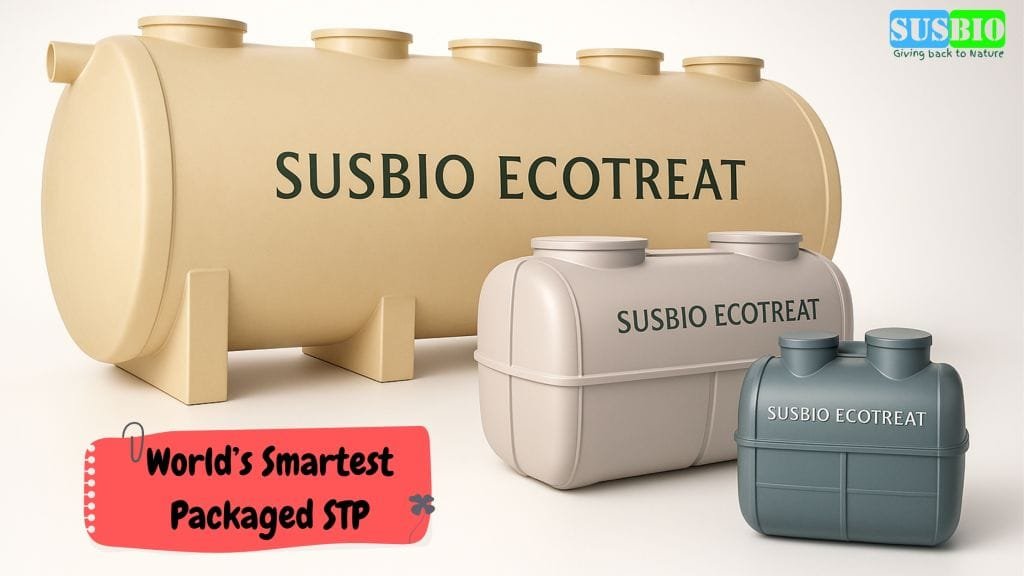
ECOTREAT’s 1–500 KLD range scales from a single villa to a large multi-building campus, with capacity sized against actual influent characterisation — real expected flow and load — rather than a generic per-unit estimate. For sites generating domestic-pattern sewage (washrooms, canteens, general workforce or resident sanitation), ECOTREAT is the right fit. Sites that also generate industrial process effluent with chemical contamination need a different system — see our SUSBIO ETP / IONTREAT page, our electrochemical system built specifically for that contaminant profile.
Conclusion
As water scarcity and pollution challenges grow, wastewater treatment that only gets checked when someone remembers to check it isn’t good enough anymore. SUSBIO ECOTREAT combines proven Anaerobic + MBBR biological treatment with real-time monitoring, automated control, and predictive maintenance — turning a system that traditionally required constant manual oversight into one that mostly manages itself. Backed by 500+ installations across 24 Indian states, it’s built for exactly the sites that need reliable compliance without needing to become wastewater experts themselves.
Frequently Asked Questions
Q1. What makes SUSBIO ECOTREAT a smart wastewater treatment plant?
SUSBIO ECOTREAT is IoT-enabled, allowing real-time monitoring, automated control, and predictive maintenance for efficient wastewater treatment with minimal human intervention.
Q2. How does SUSBIO ECOTREAT help save operational costs?
It reduces energy and maintenance costs through intelligent automation, the Anaerobic + MBBR process’s inherently lower energy demand, and a design that catches problems before they require emergency repairs.
Q3. Is SUSBIO ECOTREAT suitable for residential and industrial use?
Yes, SUSBIO ECOTREAT is ideal for residential complexes, hotels, and commercial projects generating domestic-pattern sewage, thanks to its modular, compact, plug-and-play design. For industrial sites with chemical process effluent, SUSBIO ETP/IONTREAT is the appropriate system instead.
Q4. What are the environmental benefits of using SUSBIO ECOTREAT?
It promotes water reuse, minimizes pollution, conserves resources, and ensures treated water meets CPCB discharge standards.
Q5. Do I need trained staff on-site to operate a smart STP like ECOTREAT?
No — that’s the point of the automation. Real-time monitoring and automated control reduce the need for constant manual oversight, though periodic professional servicing is still recommended.
Q6. Why choose SUSBIO as your wastewater treatment partner?
SUSBIO has 500+ ECOTREAT installations across 24 Indian states, with manufacturing based in Pune and headquarters in Goa — offering Anaerobic + MBBR packaged STP solutions with full lifecycle support from design through installation and maintenance.
Related reading:
- SUSBIO ETP / IONTREAT — our electrochemical ETP built for industrial chemical effluent
- Why Does My STP Smell Bad? Causes and Fixes
- Why My Sewage Treatment Plant Is Not Working



6 Comments
[…] 0 By Akshat Tyagi Latest Blogs September 30, […]
[…] an era where environmental concerns are at the forefront of global discussions, Sewage Wastewater Treatment is emerging as a critical topic for cities and industries alike. With rapid urbanization and […]
[…] properly, can harm the environment and lead to regulatory non-compliance. Installing a reliable wastewater treatment plant (WWTP) is no longer optional but a necessity. This blog discusses why industries need a wastewater […]
[…] essential to remove contaminants, ensuring it can be safely returned to the environment or reused. Wastewater treatment plants are engineered facilities designed to treat sewage, industrial effluent, and other forms of […]
[…] Conservation: Wastewater treatment plants allow treated water to be reused for non-potable purposes like landscaping, reducing pressure on […]
[…] the field of advanced wastewater treatment, choosing the right technology is critical for ensuring efficiency, cost-effectiveness, and […]