

For years, non-functional STPs in housing societies were treated as an open secret — everybody knew about the problem, nobody enforced the rules. That era is over.
In December 2025, the National Green Tribunal upheld an environmental compensation penalty of ₹68.25 lakh on a Gurugram housing society for just 182 days of STP non-compliance. Before that, a housing colony in Agra was fined ₹2 crore by the NGT — a penalty that the Supreme Court itself upheld in 2024 after reviewing photographs of untreated sewage flooding the roads.
These are not isolated incidents. Across India, State Pollution Control Boards (SPCBs), the CPCB, and the NGT are actively pursuing housing societies, RWAs, and developers for STP violations. The fines are getting larger. The enforcement is getting stricter. And for the first time, individual RWA officials are being held personally accountable.
This article tells you exactly what’s at stake — the laws, the penalties, the real cases, and what you must do to stay compliant.
Quick Summary A non-functional or absent STP can result in: fines from ₹10,000 to ₹2 crore+, water supply cuts, Occupancy Certificate denial, NGT prosecution, criminal imprisonment of 1.5–6 years under the Water Act, and personal liability for RWA members. Enforcement in 2025–26 is at an all-time high. |
The Legal Framework: What Laws Apply to Your Society

STP compliance for housing societies is governed by a layered framework of central and state laws. Ignorance of any one of them is not a valid defence before the NGT or an SPCB.
| Law / Authority | What It Governs | Key Obligation for Societies |
|---|---|---|
| Water (Prevention & Control of Pollution) Act, 1974 | Discharge of sewage into any water body or land | No untreated sewage may be discharged. Consent to Operate (CTO) required from SPCB. |
| Environment Protection Act, 1986 | Overall environmental compliance | SPCBs and CPCB can issue closure orders, stop power/water supply under Section 5. |
| National Green Tribunal Act, 2010 | Environmental adjudication and penalties | NGT can award compensation, order imprisonment, and direct government agencies to act. |
| State-level Building Bylaws | Mandatory STP installation thresholds | Varies by state — typically triggered for projects above 20,000 sq. ft. built-up area or 10+ KLD sewage generation. |
| Ministry of Jal Shakti — Liquid Waste Management Rules, 2024 | Wastewater reuse mandates | All bulk water users (>5,000 litres/day) must treat and reuse 20% of wastewater by 2027, rising to 50% by 2031. |
The Key Provision: Water Act Section 25 — Consent to Operate
Every housing society with an STP must hold a valid Consent to Operate (CTO) from the State Pollution Control Board. The CTO is renewed annually or biannually and requires submission of treated effluent test reports confirming your STP meets CPCB norms. Operating without a CTO — or with a lapsed CTO — is itself a violation, independent of whether your STP is working.
CPCB Effluent Standards — What ‘Working’ Actually Means
An STP is not ‘working’ just because it’s running. The treated effluent must meet these CPCB standards at the outlet:
| Parameter | Permissible Limit (Discharge to drain/land) | Permissible Limit (Reuse for irrigation) |
|---|---|---|
| BOD (Biochemical Oxygen Demand) | ≤10 mg/L | ≤10 mg/L |
| TSS (Total Suspended Solids) | ≤10 mg/L | ≤20 mg/L |
| pH | 6.5 – 9.0 | 6.5 – 9.0 |
| COD (Chemical Oxygen Demand) | ≤50 mg/L | ≤50 mg/L |
| Faecal Coliforms | < 230 MPN/100 mL | < 100 MPN/100 mL |
| Oil & Grease | ≤10 mg/L | ≤10 mg/L |
Source: CPCB General Standards for Discharge of Environmental Pollutants. Raw sewage typically has BOD of 150–300 mg/L — your STP must remove over 95% of this.
The Penalties: What You're Actually Exposed To
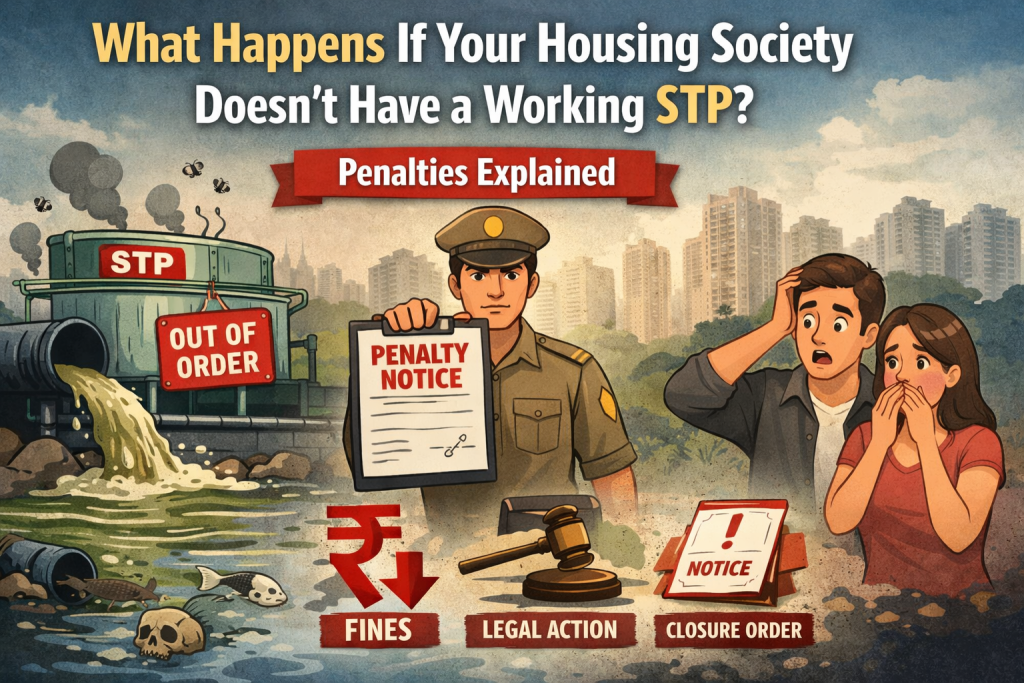
Non-compliance doesn’t result in a single fine. It triggers a cascade of penalties across multiple authorities — often simultaneously. Here is every consequence your society could face:
Penalty 1 — Environmental Compensation (NGT / SPCB)
This is the largest and fastest-growing risk. The NGT applies the ‘polluter pays’ principle: the longer your STP is non-functional, the higher the compensation demanded. The formula used by pollution control boards is typically:
Environmental Compensation Formula Compensation = Daily Generation (KLD) × Number of Days of Non-compliance × Environmental Cost per KLD For residential societies, the environmental cost per KLD per day has ranged from ₹5,000 to ₹37,500 in recent NGT orders. A 50 KLD STP non-functional for 6 months = potential EC of ₹45 lakh to ₹3.4 crore. |
Penalty 2 — Fines Under the Water Act
Under the Water (Prevention and Control of Pollution) Act, 1974, Sections 43 and 44: discharging sewage without consent or beyond permissible limits carries imprisonment of 1.5 to 6 years plus a monetary fine.
For a continuing violation, an additional fine of up to ₹5,000 per day is levied after initial conviction. Under the 2024 amendment, minor offences have been decriminalised and replaced with monetary penalties of ₹10,000 to ₹15 lakh — but major violations (habitual discharge, no STP at all) still attract criminal liability.
Penalty 3 — Water Supply Disconnection
Under Section 33A of the Water Act, SPCBs have the power to direct municipal bodies to cut off water supply to non-compliant premises. This is increasingly being used as a first-step enforcement action before formal legal proceedings. BMC in Mumbai has a standing policy to reduce water supply by 25% to societies found discharging untreated sewage.
Penalty 4 — Electricity Disconnection
SPCBs can also direct electricity suppliers to disconnect power to the non-compliant premises. While typically applied to industries, the NGT has endorsed this power being used against housing societies in extreme cases.
Penalty 5 — Occupancy Certificate and Completion Certificate Denial
For new projects and redevelopment projects, a functional and compliant STP is a prerequisite for receiving the Occupancy Certificate (OC). Without an OC, residents technically cannot occupy the building legally. Banks may also refuse mortgage approvals for flats in buildings without a valid OC. Developers who hand over flats before installing a compliant STP face this risk — and in several states, the RWA inherits the liability once management is transferred.
Penalty 6 — Personal Liability of RWA Officials
This is the penalty most RWA members are unaware of. Under Sections 47 and 48 of the Water Act, when a violation is committed by a company or association (including a cooperative housing society or RWA), every person responsible for the conduct of its affairs — including office bearers — is deemed guilty of the offence unless they can prove they had no knowledge or took all reasonable steps to prevent it.
In practice, this means the Secretary, Chairman, or Managing Committee members of your RWA can be prosecuted personally for STP non-compliance.
Real Cases: What Has Already Happened to Housing Societies
These are not hypothetical scenarios. These are documented legal orders from the recent past:
Case 1: Freedom Park Society, Gurugram — ₹68.25 Lakh (December 2025)
The Haryana State Pollution Control Board (HSPCB) initially imposed a penalty of ₹1.55 crore on Freedom Park Society, a high-rise residential complex in Gurugram, due to a non-functional sewage treatment plant (STP). The authority calculated the violation period as 415 days.
However, upon appeal, the National Green Tribunal (NGT) reduced the penalty to ₹68.25 lakh after determining that actual non-compliance could only be established for 182 days. The reduced duration was attributed to flood damage in August 2022, which had temporarily impacted STP operations.
The tribunal granted relief based on documented repairs and post-restoration compliance reports submitted by the society.
Key Insight:
Even temporary STP failure — including due to natural causes — can result in substantial penalties. Relief is only possible when supported by proper documentation and timely corrective action.
Case 2: Nalanda Town Housing Colony, Agra — ₹2 Crore (Upheld by Supreme Court, 2024)
Nalanda Town Housing Colony in Agra faced a ₹2 crore penalty imposed by the National Green Tribunal for discharging approximately 1.45 lakh litres of untreated sewage daily into open land and nearby drains, ultimately contributing to pollution of the Yamuna River.
The situation was aggravated by the fact that the colony had been developed without adequate sewage treatment infrastructure. Despite this, an Occupancy Certificate had been granted.
In 2024, the Supreme Court upheld the penalty and described the condition of sewage-filled roads as “horrible,” while directing further compliance measures.
Key Insight:
Even if the developer is responsible for infrastructure gaps, the financial burden ultimately impacts residents. Lack of proper STP installation at the development stage can lead to severe long-term consequences.
Case 3: Supertech Eco Village One, Greater Noida — ₹1 Crore (2022)
Supertech Eco Village One in Greater Noida was penalized ₹1 crore by the Greater Noida Industrial Development Authority (GNIDA) after authorities found untreated sewage being directly discharged into rainwater drains.
As per GNIDA regulations, all group housing societies constructed on plots exceeding 20,000 square meters are required to install and operate functional sewage treatment plants.
The penalty was accompanied by strict warnings and mandatory directives for compliance with waste management norms.
Key Insight:
Direct discharge of untreated sewage is a serious violation that attracts immediate penalties and regulatory action. Authorities are actively monitoring compliance in large residential projects.
State-Wise Enforcement: Who Is Most at Risk Right Now
Enforcement intensity varies by state. Here’s the current landscape for key states:
| State | STP Mandatory From | Key Enforcing Authority | Current Enforcement Level |
|---|---|---|---|
| Maharashtra | Built-up area > 20,000 sq. ft. (BMC) | MPCB + BMC | High — 25% water cut policy active |
| Haryana / NCR | >20,000 sq. m. project (GNIDA, HRERA) | HSPCB + local authority | Very High — multiple NGT orders in 2024–25 |
| Karnataka | All group housing >50 units | KSPCB + BBMP | High — stricter standards post-2023 |
| Tamil Nadu | All new residential projects | TNPCB | Moderate-High — TNPCB active in Chennai |
| Uttar Pradesh | >20,000 sq. m. (GNIDA) or as per UPRERA | UPPCB + GNIDA | High — several NGT orders, daily fines used |
| Telangana | All layouts >2,500 sq. m. | TSPCB + HMDA | Moderate — rising post-2024 |
| Goa | As per GPL and GSPCB norms | GSPCB + TCP | Moderate — tourist-area projects under scrutiny |
| All States | Jal Shakti LWM Rules 2024 — bulk users >5 KLD | CPCB / SPCBs | National baseline — applies everywhere from 2025 |
Is Your Society at Risk? A Practical Self-Audit Checklist
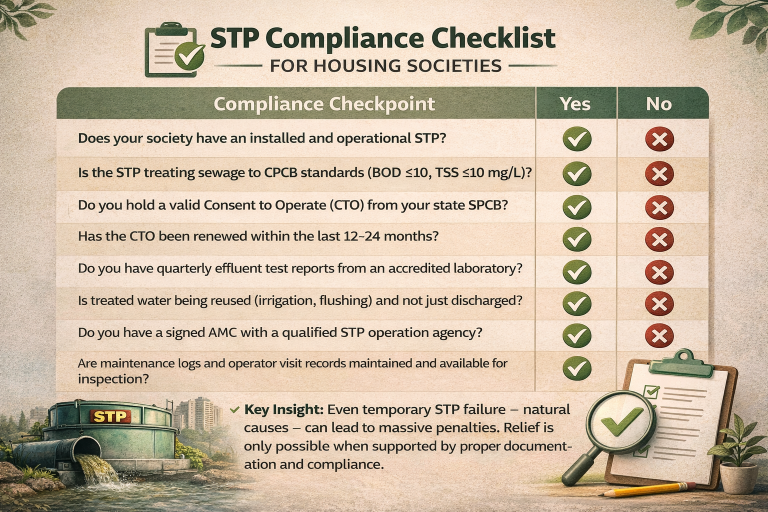
Run through this list honestly. Any ‘No’ answer is a compliance gap that needs immediate attention:
| Compliance Checkpoint | Yes | No |
|---|---|---|
| Does your society have an installed and operational STP? | ✓ | ✗ |
| Is the STP treating sewage to CPCB standards (BOD ≤10, TSS ≤10 mg/L)? | ✓ | ✗ |
| Do you hold a valid Consent to Operate (CTO) from your state SPCB? | ✓ | ✗ |
| Has the CTO been renewed within the last 12–24 months? | ✓ | ✗ |
| Do you have quarterly effluent test reports from an accredited laboratory? | ✓ | ✗ |
| Is treated water being reused (irrigation, flushing) and not just discharged? | ✓ | ✗ |
| Do you have a signed AMC with a qualified STP operation agency? | ✓ | ✗ |
| Are maintenance logs and operator visit records maintained and available for inspection? | ✓ | ✗ |
| Has a SPCB or local authority inspection happened without any notice of violation? | ✓ | ✗ |
Score: 8–9 Yes = Low Risk. 5–7 Yes = Moderate Risk — take action. Below 5 = High Risk — seek professional help immediately
What to Do If Your STP Is Non-Functional or Non-Compliant
Do not wait for an inspection notice. The moment you identify a compliance gap, take these steps immediately:
Step 1 — Assess and Document
Get a technical inspection of your STP done by a qualified engineer. Identify the root cause of failure — is it mechanical (blower failure, pump breakdown), biological (process upset, sludge bulking), or structural (tank crack, membrane damage)? Get a written inspection report with findings and recommendations. This documentation is critical if you later face an SPCB inquiry — it proves you were proactive.
Step 2 — Repair or Upgrade Without Delay
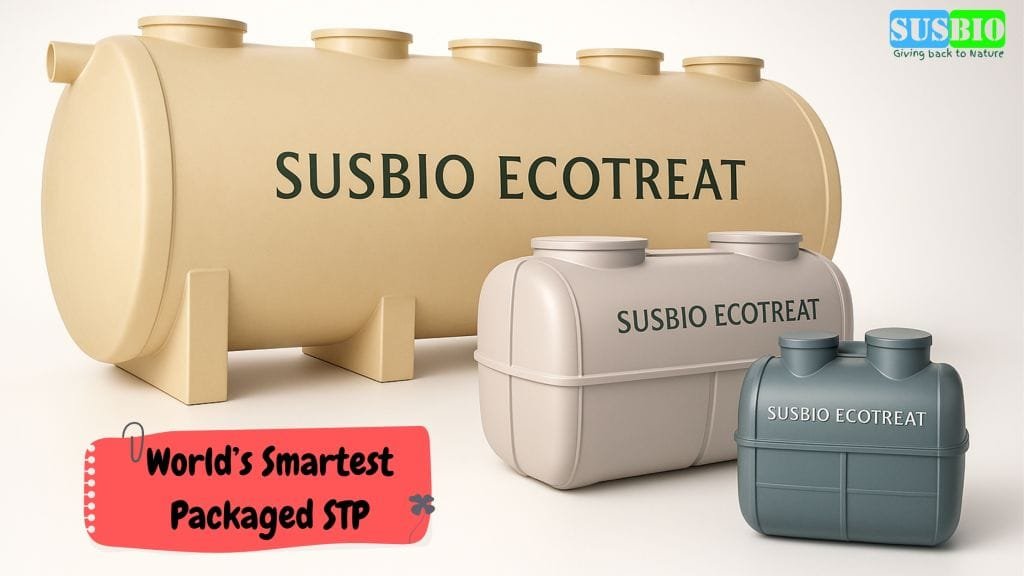
Act on the inspection findings immediately. If the existing STP is beyond economical repair, explore a replacement or upgrade. Packaged STP systems like SUSBIO’s ECOTREAT can be commissioned in 2–4 weeks and are a fast-track compliance solution for societies needing a complete plant replacement.
Step 3 — Restore Your CTO
If your Consent to Operate has lapsed, apply for renewal with your State Pollution Control Board. Carry fresh effluent test reports (post-repair) and maintenance records. A proactive CTO renewal application, even after a period of non-compliance, is viewed far more favourably by SPCBs than waiting for an inspection.
Step 4 — Get Quarterly Effluent Tests Done
Ongoing lab-tested proof of effluent quality is your strongest protection against penalty escalation. Engage an NABL-accredited laboratory to test your STP’s treated water output every quarter. Keep original test reports on file for at least 5 years.
Step 5 — Engage a Professional O&M Agency
Most STP failures in housing societies happen because the plant is operated by untrained security guards or janitors with no process knowledge. Engage a qualified O&M agency with experience in your plant’s technology. A good AMC costs ₹60,000–1,20,000/year for a 10–50 KLD plant — a fraction of the penalty exposure.
Frequently Asked Questions
Q1. Is it mandatory for my housing society to have an STP?
In most Indian states, yes — for medium and large societies. Maharashtra mandates STPs for built-up area above 20,000 sq. ft. Karnataka requires them for group housing above 50 units. Nationally, the Jal Shakti Liquid Waste Management Rules 2024 require any bulk water user generating more than 5,000 litres/day to treat and reuse wastewater. If your society has more than 30–40 flats, you almost certainly cross this threshold.
Q2. Our builder installed an STP but never handed over the documents. Are we liable?
Yes, once management is transferred to the RWA, compliance liability passes with it. Immediately request all STP documentation from the builder — including the Consent to Operate, design drawings, equipment warranties, and operation manuals. If the builder refuses, file an RTI or approach your state’s Real Estate Regulatory Authority (RERA).
Q3. Our STP broke down temporarily. Do we still face penalties?
Potentially yes, but the penalty severity depends on how long the breakdown lasted and whether you took documented steps to repair it. The Gurugram case (Freedom Park Society) shows that even a breakdown caused by flooding resulted in a ₹68.25 lakh fine — but was reduced from ₹1.55 crore because the society could prove repairs were completed within a reasonable time. Document everything immediately when a breakdown occurs.
Q4. Who actually inspects housing STPs?
Inspections are typically conducted by State Pollution Control Board (SPCB) officers — often triggered by neighbour complaints, NGO complaints, or random drive inspections. Local municipal bodies (BMC, GHMC, BBMP, etc.) also conduct inspections. The NGT can suo motu direct inspections based on media reports or public interest applications. CPCB conducts periodic audits of larger STPs (>1 MLD).
Q5. Can residents file a complaint against their own RWA for a non-working STP?
Yes. Any citizen can file an application before the NGT or submit a complaint to the State Pollution Control Board. The NGT accepts applications by email and through its online portal. A well-documented complaint with photographic evidence is sufficient to trigger a formal inspection. Several major cases have been initiated this way — including by residents frustrated with their own RWA’s inaction.
Q6. What is the difference between a Consent to Establish and a Consent to Operate?
Consent to Establish (CTE) is obtained before constructing the STP — it approves the design and technology. Consent to Operate (CTO) is obtained after construction and commissioning — it certifies the plant is working to prescribed standards. Both are required from the SPCB. Most societies that installed STPs years ago have an old CTE but never obtained or renewed their CTO — this alone is a violation.
Q7. Our STP runs but the treated water smells bad. Does that mean it’s non-compliant?
Odour is a process symptom, not a legal standard in itself. However, bad-smelling treated water is almost always a sign of incomplete treatment — meaning your BOD and TSS are likely above permissible limits. The smell will also attract resident complaints and potential SPCB inspections. Get a lab test done immediately to confirm your effluent quality.
Q8. Can we hire SUSBIO to fix or replace our non-compliant STP quickly?
Yes. SUSBIO specialises in fast-track STP commissioning for residential societies, hotels, and institutions. Our ECOTREAT packaged system can be installed and commissioned in 2–4 weeks — far faster than a conventional civil STP, which takes 3–6 months. We also offer STP audits, effluent quality testing coordination, and AMC services to help societies achieve and maintain CPCB compliance.
Conclusion: The Cost of Non-Compliance Far Exceeds the Cost of Compliance
The math is simple. A compliant 50 KLD STP costs ₹25–30 lakh to install and ₹30,000–40,000/month to operate. The penalty for six months of non-compliance can exceed ₹50 lakh — and that’s before water supply cuts, legal fees, and the reputational damage to your society.
More importantly, STP compliance is no longer optional or unenforced. The NGT is active. State Pollution Control Boards are filing cases. Neighbours and residents are filing complaints. And courts are upholding crore-level fines.
The societies that get penalised are almost never the ones that tried and failed to maintain their STP. They’re the ones that ignored the problem, didn’t keep records, and had no documentation of any effort to comply.
Don’t let your society be the next case study.