

A sewage treatment plant (STP) tender should state five things: the design basis (flow, peak factor, inlet quality), the required outlet quality, the scope split between civil, mechanical, electrical and controls, a performance guarantee with its test method, and the operation and maintenance terms. Without them, bids cannot be compared like for like, and the lowest quote usually leaves out the items that cost most later.
This checklist is for consultants, architects and project managers writing or reviewing an STP tender in India. It works for both RCC and prefabricated plants.
Design basis: what the tender must state
| Item | What to state | Why it matters |
|---|---|---|
| Design flow | Average daily flow in KLD and how it was derived (occupancy × litres per head per day) | Sizes every unit. See the capacity calculation guide. |
| Peak factor | The multiple of average flow used for peak hourly flow | An undersized peak factor causes overflow and poor treatment at morning and evening peaks |
| Inlet quality | BOD, COD, TSS, oil and grease and pH at the inlet, and whether kitchen or laundry flows are included | Commercial kitchens and laundries raise the load well above domestic sewage |
| Outlet quality | Limits for BOD, COD and TSS, plus any extra parameters your state pollution control board requires | CPCB Class A limits are BOD <10, COD <50 and TSS <10 mg/L. The state board may set stricter limits in the consent. See the standards guide. |
| End use of treated water | Discharge, flushing, gardening or other reuse | Decides whether polishing such as filtration and disinfection is needed |
| Site constraints | Plot area, groundwater level, soil, access for cranes and vehicles, underground or above-ground | Decides tank type and installation method |
| Power | Available supply, phase and the connected-load limit | Caps what equipment bidders can propose |
| Odour and noise | Limits at the nearest habitation | Sets enclosure and blower requirements |
| Timeline | Required commissioning date | Some technologies need weeks of civil work, others days |
BOQ line items by scope
List each section as its own heading in the BOQ so bidders price the same scope.
| Section | Line items | Unit |
|---|---|---|
| Civil and structural | Excavation, foundation or plinth, RCC tanks (RCC plants only), backfilling | cum / lot |
| Inlet works | Bar screen, oil and grease trap, collection or equalisation tank | nos |
| Biological treatment | Reactor(s), media or carriers, diffusers or aeration system | nos / set |
| Settling | Clarifier or tube settler, sludge return arrangement | nos |
| Disinfection and polishing | Chlorination or UV, filtration if the treated water is reused | nos / set |
| Mechanical | Blowers and pumps, each with duty and standby units shown separately, mixers | nos |
| Electrical and controls | Control panel, cabling, level switches, flow meter, energy meter | lot |
| Piping and valves | Inter-unit piping, valves, fittings | lot |
| Sludge handling | Sludge tank, drying bed or filter press | nos / lot |
| Commissioning and O&M | Testing, operator training, spares, O&M period | lot / months |
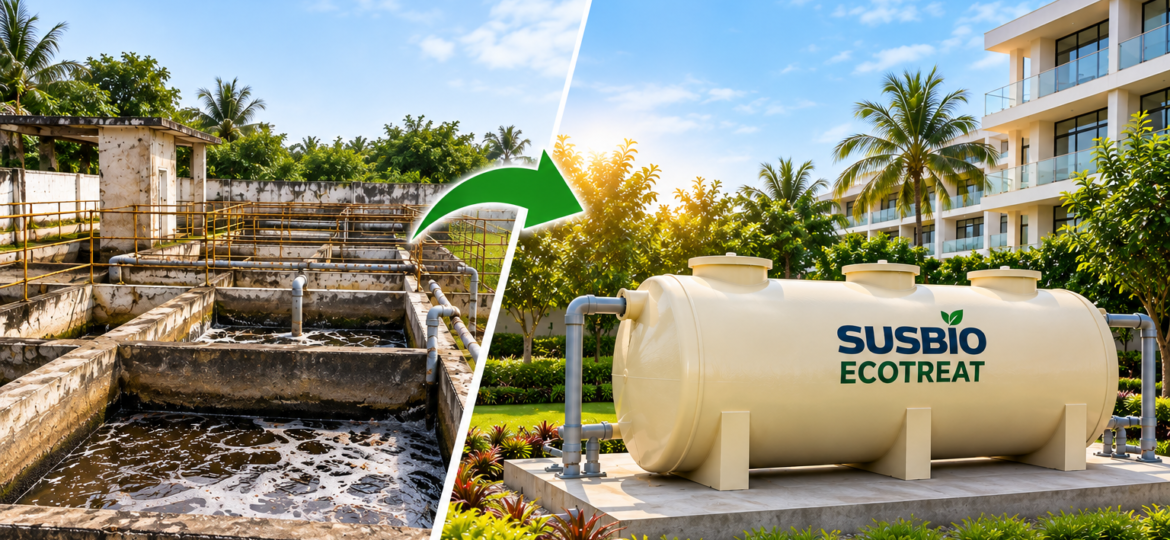
RCC versus prefabricated FRP. An RCC plant needs more civil work and curing time, so the civil section is large and the timeline longer. A prefabricated FRP plant arrives factory-built and is installed on a prepared foundation, so the civil section is smaller. State the tank material and its design life as separate line items so bids compare the same thing. For a closer look at choosing between them, see the FRP STP selection guide.
Ten questions to put to every bidder
- Which treatment process is proposed, and at what loading rate was the biological stage sized?
- Which outlet parameters do you guarantee, and at what inlet quality?
- What is the connected power load, and what is the expected energy use per KLD treated?
- How does the plant perform at low occupancy, for example 40% of design flow in the first year?
- Which equipment has a standby unit, and which does not?
- How many operators are needed, at what skill level, and for how many hours a day?
- How much sludge is produced, how often must it be removed, and who disposes of it?
- How long does installation take, and what site work must the client finish first?
- Which operating plants of similar capacity and sector can we visit, and can we see their lab reports?
- What does the warranty cover, what is the service response time, and what is included in the annual maintenance contract?
Ask for written answers. Answers to questions 2, 3 and 6 are the ones most often missing from low quotes.
Performance guarantee, acceptance testing and comparing bids
Write the guarantee into the tender. State the parameters guaranteed, the sampling point (final outlet), the sample type (composite rather than a single grab sample), the testing laboratory (NABL-accredited), and the number of days the test runs. A one-day test can miss load swings, so state the duration you want. Tie part of the payment to passing the acceptance test.
Compare bids on running cost, not only the quoted price. Ask each bidder for the same figures and compare them side by side:
- Installed cost, including everything in the BOQ above
- Connected power load and energy use per KLD, converted to a yearly electricity cost at your tariff
- Operator count and monthly manpower cost
- Consumables such as chemicals and replacement media
- Sludge removal frequency and cost
- Plant area and installation time
A lower capital quote with a higher power load or a full-time operator can cost more over the plant’s life than a higher quote that runs lean.
For reference, SUSBIO ECOTREAT is a prefabricated FRP plant for 1–500 KLD using an Anaerobic + MBBR process. It installs in 3–5 days and uses up to 70% less electricity. The questions above apply to us as much as to any other bidder.
Frequently Asked Questions
What is a BOQ for an STP?
A bill of quantities (BOQ) lists every item a bidder must supply and price, with its unit and quantity. For an STP it covers civil work, inlet works, biological treatment, settling, disinfection, mechanical equipment, electrical and controls, piping, sludge handling, and commissioning with O&M.
What outlet quality should an STP tender specify?
At minimum the CPCB Class A limits of BOD <10, COD <50 and TSS <10 mg/L, plus any stricter or additional limits in your state pollution control board’s consent to establish.
Should an STP tender specify the technology or the performance?
Specify the performance. State the outlet quality, power limit, area and operator constraints, and require a guarantee. Let bidders propose the technology that meets them, and ask each to justify it.
How long should the performance test run?
State the duration in the tender. It should be long enough to include peak and low-load periods, because a single-day test can pass a plant that fails under varied load.