

A civil STP that no longer treats sewage is a common problem in housing societies, hotels, hospitals, schools and factories. The tanks are there, the pipes are there, and yet the treated water is cloudy, the plant smells, or the blower has been switched off for months to save power. The usual assumption is that the whole plant must be demolished and rebuilt.
In most cases it doesn’t have to be. A failed civil STP can often be revamped by adding packaged units and reusing the parts of the civil structure that are still sound. This guide explains why civil plants fail, how to decide between repair, retrofit and replacement, what can be reused, and how a packaged retrofit is carried out.
Why Civil STPs Fail
Civil STPs are built on site from RCC tanks, and their performance depends on design, workmanship and daily operation. The failures we see most often are these:
- Undersized for today’s load. The plant was designed for the original occupancy. More flats, rooms or students now send far more sewage than the tanks were built for. If you are unsure of your real load, see our guide to calculating sewage treatment plant capacity.
- Aeration has stopped or is too weak. Biological treatment needs steady oxygen. Failed blowers, choked diffusers and wrongly sized equipment are the most common reason the biology dies. Our STP blower selection and sizing guide explains how to check this.
- No equalization tank. Sewage arrives in peaks in the morning and evening. Without a tank to smooth the flow, the biological stage is shock-loaded and washes out.
- Short-circuiting and dead zones. Poor internal layout lets sewage pass through some tanks too quickly while other parts stay stagnant.
- Sludge never removed. Settled solids build up and carry over into the treated water, which is why many plants end up with treated water that stays cloudy.
- Foam, scum and odour. These are symptoms of an unbalanced plant, not separate problems. See why an STP produces foam or scum and why an STP smells bad.
- Grease and kitchen load. Hotels and restaurants send oil and grease that coat the biology if there is no grease trap ahead of the plant.
- High running cost and no trained operator. When electricity cost is high and nobody is responsible for the plant, it gets switched off. Our article on cutting energy costs for sewage treatment plants covers this.
One mistake to avoid: if the plant is overloaded, increasing the size of one unit rarely fixes it. We explain why in Bigger isn’t better: why increasing capacity doesn’t solve performance issues.
Repair, Retrofit or Replace: How to Decide
| Situation | Best route |
|---|---|
| Tanks are sound, but the blower, diffusers or panel have failed | Repair the equipment and re-commission |
| Tanks are sound, but the plant is undersized or the process is outdated | Retrofit with packaged units |
| Tanks are sound, but there is no space for a full second plant | Hybrid retrofit: keep the civil stages, add a packaged biological stage |
| Treatment is acceptable, but the final water fails on TSS or turbidity | Add a packaged polishing stage |
| Tanks are cracked, leaking or structurally unsafe | Replace, and build a new packaged plant elsewhere on the site |
| Plant is too small for a large expansion in load | Replace or add parallel capacity |
The decision comes down to two checks: the structural condition of the existing tanks, and the gap between the plant's design capacity and your actual flow. Both need a site visit.
What Can Be Reused From the Old Plant
The civil structure is not wasted. Depending on its condition, these parts are often kept:
- Collection and inlet chambers, including screens and the grease trap
- The largest tank, converted to an equalization tank, which many failed plants never had
- Treated water storage, for gardening, flushing or cooling reuse
- Sludge holding tank
- Foundation and plinth area for the new packaged units
- Existing piping, power connection and boundary layout
What is usually replaced is the biological and clarification stage, which is where most civil plants fail. Every tank is tested for leaks and structural soundness before it is reused. A tank that is not water-tight must not be kept in service.
How a Packaged Retrofit Works
A packaged unit is a factory-built treatment plant, usually in FRP, delivered to site ready to install. For a retrofit there are three common ways to use it.
1. Replace the failed process, keep the tanks
The existing tanks take on supporting roles (equalization, storage, sludge holding) and a packaged unit takes over the treatment. This is the cleanest option when the process itself has failed.
2. Hybrid retrofit
The civil primary stages (settling and the anaerobic section) stay in service, and a packaged biological stage is added after them. This suits sites with limited space.
3. Packaged polishing stage
If the plant treats reasonably but cannot meet the discharge limits, a packaged polishing step brings the final water within norms.
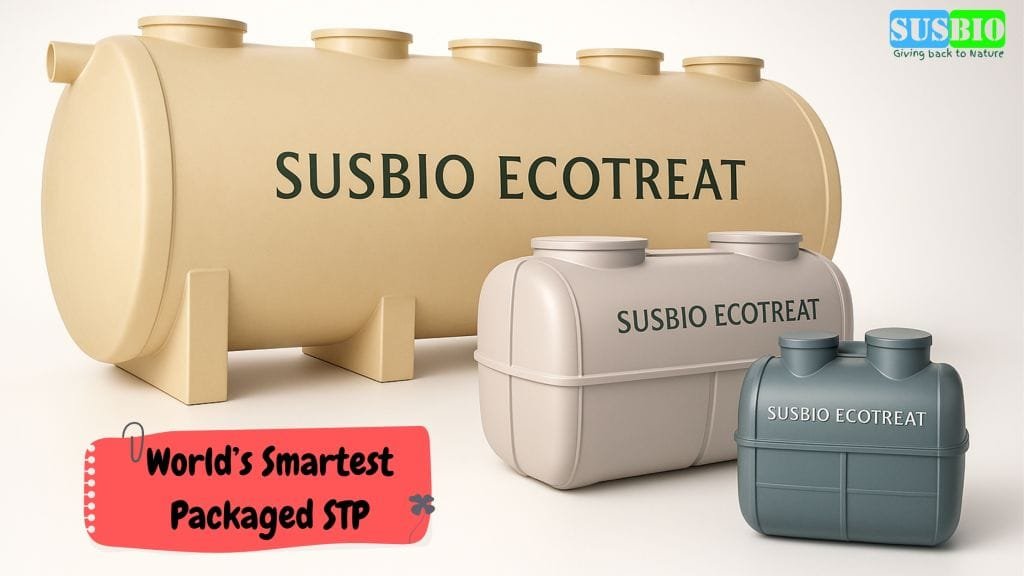
Our SUSBIO ECOTREAT range is built on an Anaerobic + MBBR hybrid process, in prefabricated FRP, from 1 to 500 KLD. Because the units arrive fabricated, installation on site takes about 3 to 5 days once the site is ready. We cover the process in What is the MBBR process in sewage treatment plants, and compare it with the alternatives in our comparative study of MBBR and SBR. Apartments and commercial projects in particular benefit from MBBR; see why MBBR is ideal for apartments and commercial projects.
If you are choosing between building new and using prefabricated units, read STP without civil work: how packaged FRP plants skip construction entirely and how to choose the right FRP STP.
Step-by-Step: A Typical Retrofit Project
- Site audit. Measure actual inflow, check tank dimensions and condition, inspect the blower, diffusers and panel, and review past treated-water test results.
- Sample and test. Test the inlet and outlet for BOD, COD and TSS. This shows whether the problem is overload, aeration or sludge.
- Structural check. Leak-test and inspect every tank you plan to reuse.
- Choose the route. Replace the process, hybrid, or polishing, based on the audit.
- Size the packaged units. Size for the actual present flow plus a margin for growth, not the original design number.
- Prepare the site. Clean and desludge the old tanks, set the foundation and connect piping.
- Install and commission. Place the packaged units, connect, seed and stabilize the biology, and test the outlet.
- Train the operator and set a routine. Daily checks, desludging schedule and service plan.
The old plant can usually keep running, even if poorly, until the new units are connected, which keeps downtime short. Confirm the exact sequence with your supplier before the project starts.
Compliance After the Revamp
A retrofit is also the right moment to get your documents in order. A plant that treats well but has no valid consent is still a compliance risk.
- Check the current norms in our guide to CPCB standards and guidelines for STPs in India, and our note on meeting 2026 CPCB norms with packaged plants.
- Check your state board’s rules: Maharashtra, Karnataka, Goa, Tamil Nadu, or the others on our blog.
- Renew or update your permit, using our consent to operate guide.
- Hospitals have additional rules; see the CPCB hospital sewage treatment plant standards.
SUSBIO ECOTREAT is designed to the CPCB Class A standard: BOD below 10 mg/L, COD below 50 mg/L and TSS below 10 mg/L.
What Does a Retrofit Cost?
The cost depends on the route you choose, the size of the plant and the condition of the existing tanks. Reusing sound civil structures normally removes a large share of the construction cost of a new plant, but the saving varies from site to site, so any figure quoted without a site audit should be treated as a rough guess.
To plan the budget, start with these pages:
- Sewage treatment plant cost in India
- STP plant cost per KLD in India
- Cost analysis and investment planning for STPs
The running cost matters as much as the purchase price. The Anaerobic + MBBR process in ECOTREAT uses up to 70% less electricity than conventional plants, which often decides whether a plant stays on or gets switched off.
Where This Works: Examples From Our Installations
These projects were new installations, not retrofits, but they show how packaged units perform on the kinds of sites that often have failed civil plants:
- 20 KLD underground STP at a villa in Goa (a space-constrained site)
- 15 KLD STP at Stone Woods Gokarna resort (water recycling)
- 50 KLD STP at a school in Pune
- 50 KLD hotel STP at Khopoli, Maharashtra
See more on our case studies page.
Frequently Asked Questions
Can a failed civil STP be revived without demolishing it?
Often, yes. If the tanks are structurally sound and water-tight, they can be reused as equalization, storage or sludge tanks, while a packaged unit takes over the treatment. A site audit confirms this.
How do I know if my existing STP tanks can be reused?
They need to pass a leak test and a structural inspection for cracks, corroded reinforcement and damaged walls. Tanks that are cracked or leaking are replaced rather than reused.
How long does it take to install a packaged unit in a retrofit?
The installation of a SUSBIO ECOTREAT packaged unit takes about 3 to 5 days once the site is prepared. Audit, approvals and site preparation come before this, and their duration depends on the site.
Is a retrofit cheaper than building a new plant?
It can be, because the existing civil work is reused. The saving depends on how much of the structure is usable, so it should be confirmed with a site audit and quote.
Do I need new permissions after revamping my STP?
Usually you need to inform or update your state pollution control board and renew or amend your consent to operate. Requirements differ by state, so check with your board and see our consent to operate guide.
Why did my civil STP fail in the first place?
The most common reasons are load growth beyond the design, failed aeration, no equalization, sludge not being removed, and no trained operator. A retrofit fixes the process, but it still needs daily operation and a service plan.
Get Your Failed STP Assessed
If your civil STP is not performing, the first step is a site assessment. Send us your plant’s capacity, current flow and the problems you are seeing, and we will tell you honestly whether repair, retrofit or replacement makes sense. Contact SUSBIO or explore our service and support options.