

Selecting a sewage treatment plant for a residential society or apartment complex is a high-stakes capital investment. An incorrect choice leads to persistent foul odors, noise disputes with ground-floor residents, skyrocketing electricity bills, and regulatory notices from the State Pollution Control Board. For statutory compliance requirements and general capacity sizing math, review our master Apartment Sewage Treatment Plant (STP) Guide.
Whether you are a developer seeking swift Occupancy Certificate (OC) sanction or a Resident Welfare Association (RWA) management committee planning a plant replacement, use this engineering checklist to evaluate STP technologies, spatial footprints, and lifecycle operating costs before finalizing a vendor.
Evaluating an STP for Your Housing Complex?
Get an engineering site audit, process selection matrix, and turnkey installation proposal from SUSBIO’s technical specialists.
Critical Technical Factors When Evaluating an STP for Flats
1. Sizing by Per-Capita Hydraulic & Organic Load
Never size an apartment STP using rough flat averages alone. Under-sizing causes hydraulic overflow during morning peak usage hours (7:00 AM – 10:00 AM), while over-sizing starves biological bacteria, causing treatment failure and odor.
- Hydraulic Benchmark: 135 to 150 Litres per Capita per Day (LPCD) as defined by CPHEEO guidelines, assuming 4.5 to 5 residents per flat. Net sewage generation is 80% to 85% of total domestic water consumption.
- Peak Factor Allowance: Ensure the equalization basin can handle a peak flow factor of 2.5× to 3.0× average hourly flow without surging into the biological reactor.
- Organic Design Concentration: Ensure biological aeration basins are designed for typical domestic sewage parameters: BOD5 of 250–350 mg/L, COD of 500–700 mg/L, and TSS of 150–250 mg/L.
2. Biological Technology Selection (MBBR vs. SBR vs. MBR)
The biological treatment method dictates plant footprint, power consumption, and mechanical complexity. Selecting the right technology is the single most critical factor for an apartment complex:
| Technology | Footprint | Energy / Power Consumption | Operational Complexity | Suitability for Flats |
|---|---|---|---|---|
| MBBR (Moving Bed Biofilm Reactor) | Compact (medium) | Moderate (~0.7–1.0 kWh/m³) | Low (self-regulating biofilm) | Best overall for 10–200 flats |
| SBR (Sequential Batch Reactor) | Moderate | Medium (~0.8–1.2 kWh/m³) | Medium (requires PLC automation) | Great for large complexes (>200 flats) |
| MBR (Membrane Bioreactor) | Ultra-compact | High (~1.5–2.5 kWh/m³) | High (membrane cleaning/replacement) | Only when space is severely constrained |
| Conventional ASP | Very large | High (~1.2–1.8 kWh/m³) | High (frequent sludge bulking) | Outdated; not recommended for apartments |
3. Physical Footprint & Installation Location (Basement vs. Ground)
- Setback Restrictions: CPCB and local development authorities require clear setback buffers from residential windows due to potential odor and noise.
- Basement Ventilation: If installing in a basement, the plant must feature completely sealed tanks paired with negative air pressure ducting and activated carbon air scrubbers.
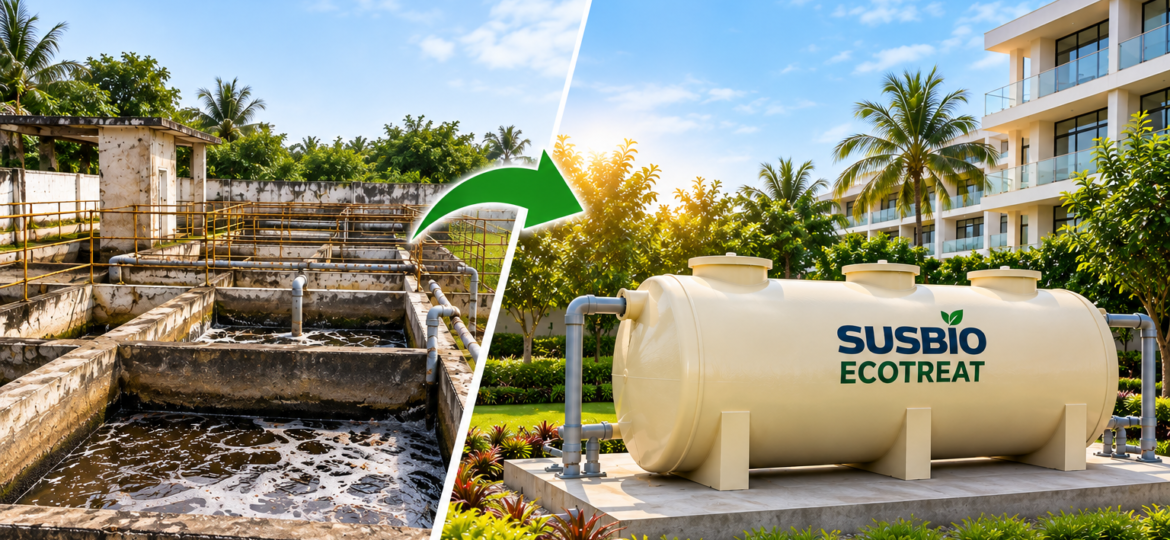
- Civil Construction vs. Packaged Units: Check our detailed analysis on prefabricated modular FRP plants vs. RCC civil tanks to compare build times and waterproofing requirements.
4. Noise and Odor Control Systems
Odors from improper septic conditions and noise from positive displacement blowers are the leading causes of resident complaints in housing societies.
- Air Blower Selection: Demand twin-lobe or tri-lobe blowers housed in acoustic soundproof hoods (maintaining noise levels below 65 dB at 1 meter).
- Odor Mitigation: Avoid open aeration tanks. Opt for biological systems that utilize closed anaerobic digestion followed by submerged diffused aeration to eliminate hydrogen sulfide ($H_2S$) and mercaptan emissions.
5. Long-Term Lifecycle Operating Cost (OPEX vs. CAPEX)
Over a 10-year span, operating costs exceed the initial purchase price of the equipment. Evaluating electricity consumption, consumable usage, and sludge disposal costs is essential:
- Specific Power Consumption: An optimized biological system should consume no more than 0.7 to 1.1 kWh per m³ of treated sewage. Systems with power demands higher than this will place an unnecessary recurring cost burden on society maintenance charges.
- Sludge Yield: Systems with extended anaerobic digestion phases produce 50–70% less excess biological sludge, lowering quarterly vacuum-tanker disposal expenses.
6. Automation Level and Operational Dependency
- Apartment complexes rarely employ full-time environmental engineers. Systems requiring continuous valve adjustments or manual decanting will fail over time.
- Insist on an automated electrical control panel with automatic cyclical pump timers, dry-run protection, dual blower changeover relays, and level sensors.
7. Treated Water Reuse Capabilities (Dual Plumbing & Landscaping)
To qualify for zero liquid discharge (ZLD) mandates and reduce society reliance on private water tankers, the plant’s tertiary stage must reliably deliver water meeting CPCB urban reuse benchmarks:
- Discharge Standards: Biological Oxygen Demand (BOD) < 10 mg/L, Total Suspended Solids (TSS) < 10 mg/L, Turbidity < 2 NTU, and zero detectable fecal coliform.
- Tertiary Train: Ensure the proposal includes a Pressure Sand Filter (PSF), Activated Carbon Filter (ACF), and continuous in-line chlorination or UV disinfection.
8. Vendor Track Record, Manufacturing, and AMC Support
Many suppliers are non-manufacturing intermediaries who assemble generic components on site and disappear after handover. Ask these qualifying questions:
- Does the vendor manufacture their own FRP vessels and bio-carriers, or do they outsource fabrication?
- Do they provide dedicated Annual Maintenance Contracts (AMC) with guaranteed response times for pump or blower breakdowns?
- Can they provide references for operational residential installations within your city that have run successfully for more than 3 years?
Why Choose SUSBIO ECOTREAT for Your Residential Sewage Treatment Needs?

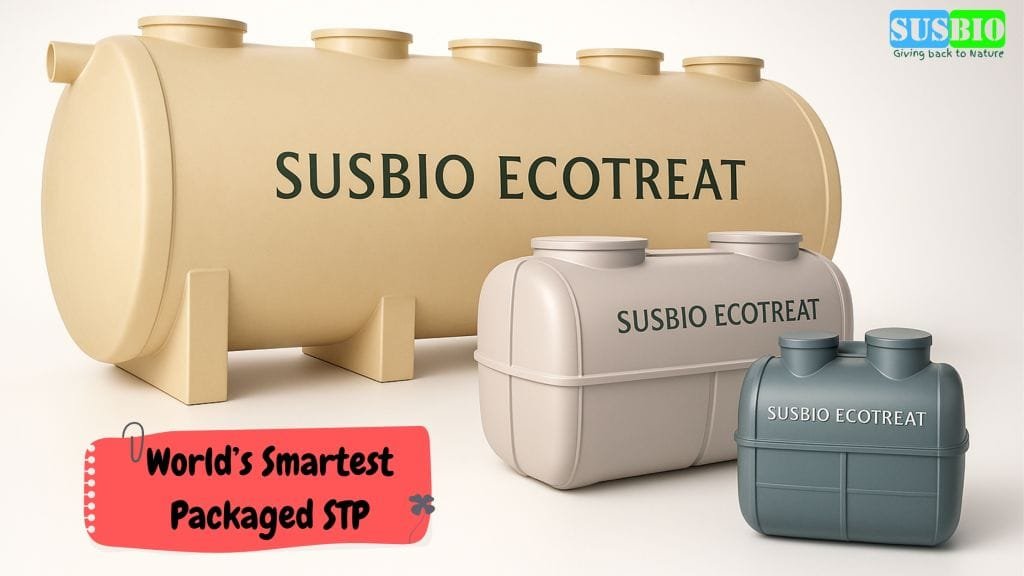
For residential complexes, the SUSBIO ECOTREAT STP stands out as an ideal solution, offering compact, efficient, and sustainable wastewater treatment. With a robust dual-treatment system, energy-efficient components, and a modular design, SUSBIO ECOTREAT is easy to install, maintain, and adapt to the unique demands of residential environments.
Key Benefits of SUSBIO ECOTREAT:
- Prefabricated and Compact Design: Minimizes space requirements and installation time.
- Energy-Efficient and Cost-Effective: Designed to lower operational costs without compromising on performance.
- High-Quality Treatment: Produces treated water suitable for reuse, supporting sustainability in residential buildings.
By choosing a reliable, effective STP like SUSBIO ECOTREAT, residential complexes can efficiently manage wastewater, through the sewage treatment plant process contribute to water conservation, and ensure compliance with environmental standards, making it an investment in the community’s well-being and environmental responsibility.
Key Takeaways: Choosing an STP for Flats
- Sizing Precision: Base system capacity on 135–150 LPCD per person, factoring in an 80% sewage conversion rate and a 2.5× to 3.0× peak inflow buffer.
- Technology Fit: Dual-stage Anaerobic + MBBR offers the most practical balance of footprint, self-regulating biological stability, and low power usage for 20 to 200+ flats.
- Evaluate OPEX First: Factor in motor wattage, sludge vacuum disposal cycles, and consumable costs—OPEX costs will outstrip initial capital costs within 3 to 4 years.
- Demand Verified Effluent: Ensure the tertiary stage delivers BOD < 10 mg/L and clear turbidity to safely feed dual-plumbing toilet flush and irrigation networks.
- Explore Related Guides: Review our comprehensive Apartment Sewage Treatment Plant Guide, examine Prefabricated Modular Packaged STPs, or browse the technical specs for SUSBIO ECOTREAT Systems.
Frequently Asked Questions: Choosing an STP for Flats
1. Which STP technology is best suited for residential flats with space constraints?
For space-constrained apartments (20 to 150 flats), Moving Bed Biofilm Reactor (MBBR) and Membrane Bioreactor (MBR) are the most practical choices. Prefabricated modular MBBR units require up to 40% less civil area than conventional ASP systems, operate with zero odor, and self-regulate biological shock loads during peak morning hours.
2. How much electricity does an apartment STP consume on average?
A well-engineered residential biological STP typically consumes between 0.7 and 1.1 kWh per cubic meter (m³) of treated wastewater. If an STP vendor’s motor configuration demands more than 1.5 kWh/m³, your society will face significantly higher monthly electricity tariffs.
3. Should an apartment society choose civil concrete tanks or prefabricated FRP STPs?
Prefabricated FRP plants are factory-tested, plug-and-play, and install in 7–10 days with zero risk of structural seepage or foul gas leakage. Civil RCC tanks require 2 to 3 months of on-site construction, heavy basement waterproofing, and higher civil maintenance, making prefabricated FRP units the preferred choice for modern housing complexes.
4. Can the treated water from an apartment STP be used for flush tanks?
Yes, provided the plant includes a tertiary treatment train comprising Pressure Sand Filtration (PSF), Activated Carbon Filtration (ACF), and disinfection (Chlorination/UV). The final treated water must meet CPCB urban reuse guidelines (BOD < 10 mg/L, TSS < 10 mg/L, and zero fecal coliform) to be completely odorless and safe for dual-plumbing toilet flushing.
5. What should an RWA look for in an STP Annual Maintenance Contract (AMC)?
An effective AMC must include routine preventive pump and blower inspections, dissolved oxygen (DO) testing, periodic laboratory water quality analysis, emergency breakdown response within 24 hours, and clear protocol for periodic excess sludge dewatering or removal.