

If you’ve searched for ‘STP plant cost per KLD in India‘ and found wildly different numbers — you’re not alone. A simple Google search throws up everything from ₹15,000/KLD to ₹1,20,000/KLD. The reason isn’t that vendors are being vague. It’s that sewage treatment plant pricing is genuinely complex, driven by at least six independent variables.
This guide breaks it all down. Whether you’re a developer budgeting for a new housing society, a hotel manager looking to achieve CPCB compliance, or a hospital administrator planning a wastewater upgrade — you’ll find accurate, current price ranges here, explained clearly.
What Is KLD and Why Does It Matter?
KLD stands for Kilolitres per Day — the standard unit used to measure STP capacity in India. 1 KLD = 1,000 litres of sewage treated per day. Getting the KLD sizing right is the single most important step before estimating cost.
Under-sizing results in non-compliance and poor effluent quality. Over-sizing wastes capital and increases your monthly electricity and O&M bill for no reason.
How to Calculate Your Required KLD
The Bureau of Indian Standards (BIS) and CPCB use the following per capita sewage generation norms:
- Residential: 135 litres per person per day (LPCD)
- Hotels: 150–200 LPCD per room occupancy
- Hospitals: 400–450 LPCD (including laundry, OT, kitchen)
- Offices / Commercial: 45 LPCD per employee
- Schools / Institutions: 45 LPCD per student
Simple Formula:
Required KLD = (Number of Persons × Per Capita Sewage Generation in LPCD) ÷ 1,000 Example: A housing society with 500 residents → 500 × 135 = 67,500 litres/day = 67.5 KLD → Round up to 75 KLD STP |
STP Cost by Capacity — 2026 Price Table
The following table gives a realistic price range for STPs in India as of 2026. These are total installed cost estimates, covering equipment supply, civil construction, piping, electrical, and commissioning. They do not include land cost.
| Capacity (KLD) | Typical Use | Equipment Cost | Civil Cost (Approx.) | Total Installed Cost |
|---|---|---|---|---|
| 2 KLD | Individual villas / bungalows | ₹1–1.5 L | ₹0.5–1 L | ₹1.5–3 L |
| 5 KLD | Small apartments / commercial shops | ₹2–3 L | ₹1–2 L | ₹3–6 L |
| 10 KLD | Hotels, clinics, small offices | ₹4–6 L | ₹1.5–3 L | ₹6–10 L |
| 20 KLD | Mid-size housing societies | ₹7–9 L | ₹2–4 L | ₹10–15 L |
| 50 KLD | Large gated communities / hospitals | ₹14–20 L | ₹4–8 L | ₹20–30 L |
| 100 KLD | Large townships / institutions | ₹25–35 L | ₹8–15 L | ₹30–50 L |
| 200 KLD | Mega complexes / industrial parks | ₹45–70 L | ₹15–30 L | ₹60–100 L |
| 500 KLD+ | Municipal / large industrial | ₹1.2–2 Cr+ | ₹40–80 L | ₹1.5–3 Cr+ |
The Economy of Scale Effect
A critical insight for buyers: the cost per KLD drops sharply as plant capacity increases. A 5 KLD plant may cost ₹80,000–1,00,000 per KLD while a 200 KLD plant from the same vendor using the same technology can drop to ₹35,000–45,000 per KLD. This is why consolidating wastewater requirements into one adequately sized plant is almost always more economical than installing multiple small plants.
STP Cost by Technology
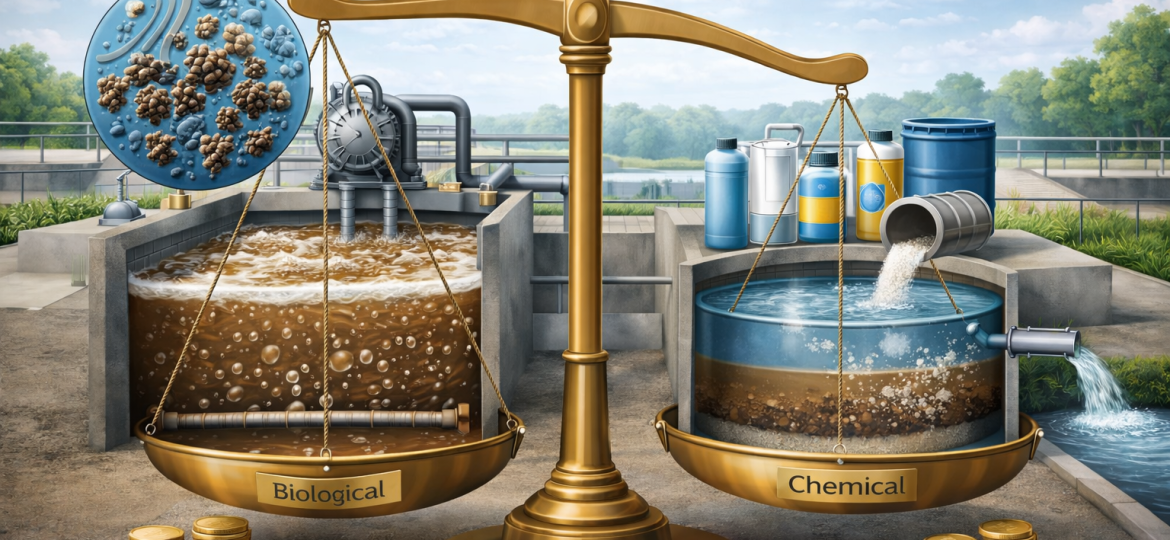
Technology is the second-biggest cost driver after capacity. Here’s how the major STP technologies compare on cost and performance in 2026.
| Technology | Cost per KLD | Space | Treated Water Quality | Best For |
|---|---|---|---|---|
| ASP | ₹15,000–25,000 | High | Moderate (BOD 30 mg/L) | Large municipal / low-budget projects |
| MBBR | ₹30,000–55,000 | Low | Good (BOD <20 mg/L) | Apartments, hotels, commercial spaces |
| SBR | ₹35,000–60,000 | Moderate | Good (BOD <10 mg/L) | Institutions, industries with variable load |
| MBR | ₹65,000–1,10,000 | Very Low | Excellent (BOD <5 mg/L) | Hospitals, premium complexes, water reuse |
| MBBR+MBR (Hybrid) | ₹70,000–1,20,000 | Very Low | Premium | Space-constrained premium projects |
* Costs are for equipment only; civil + installation adds 25–40% to above figures.
Packaged (Prefabricated) STP vs Civil STP
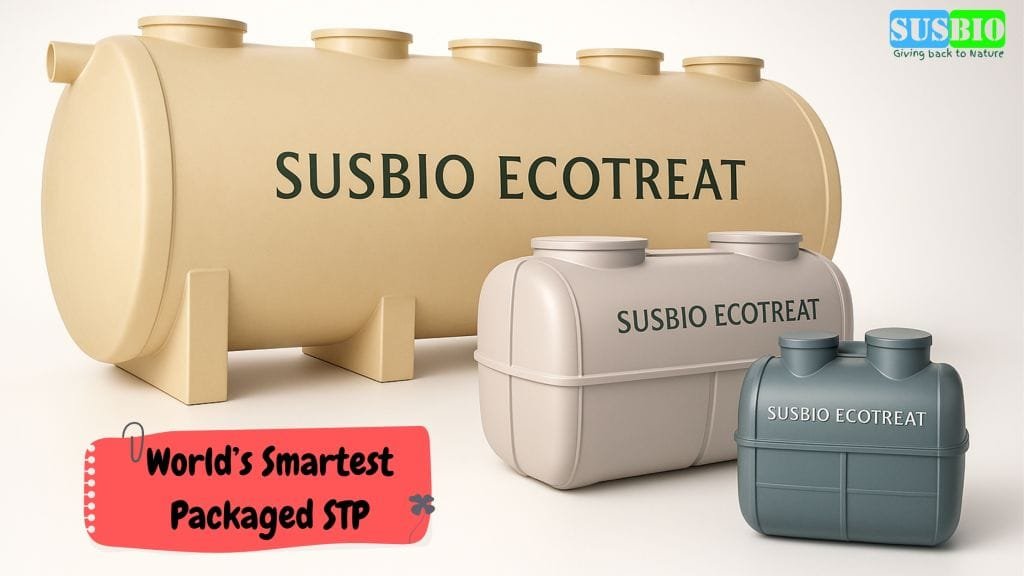
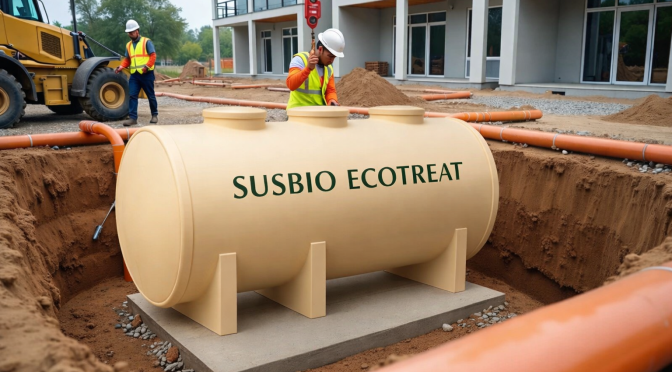
Packaged STPs like SUSBIO’s ECOTREAT are factory-built, FRP-based, plug-and-play systems. They cost 20–35% more per KLD upfront vs civil STPs, but deliver significant savings on:
- Civil & construction time — weeks, not months
- Footprint — 40–60% less space than conventional civil STPs
- O&M — simpler to operate, fewer breakdowns
- Compliance reliability — factory-tested before dispatch
For most residential, hospitality, and healthcare projects under 500 KLD, packaged STPs offer better total cost of ownership (TCO) than conventional civil systems.
What Goes Into the Total Cost? A Component-Wise Breakdown
Many buyers are surprised to discover that the STP ‘equipment cost’ quoted by vendors is only one part of the total project cost. Here’s how the full cost typically breaks down:
| Cost Component | % of Total Cost | What It Includes |
|---|---|---|
| Mechanical & Electrical Equipment | 40–55% | Pumps, blowers, media, membranes, control panels |
| Civil & Structural Work | 20–35% | RCC tanks, inlet chambers, sludge drying beds, pipework |
| Electrical Works & Cabling | 5–10% | Power supply, cable trays, earthing, DG backup provision |
| Instrumentation & Automation | 3–8% | Flow meters, pH sensors, DO sensors, SCADA, online monitoring |
| Erection, Commissioning & Training | 3–7% | Site assembly, piping, trial runs, operator training |
| Design, Engineering & Permits | 2–5% | DPR, drawings, SPCB/CPCB liaison, consent to establish |
Ongoing Costs: Monthly O&M Expenses You Must Budget For
The capital cost of an STP is a one-time investment. What many buyers fail to budget adequately for are the ongoing operational costs, which continue every month for the 15–25 year lifespan of the plant.
| Plant Capacity | Electricity (monthly) | O&M / AMC (monthly) | Total Monthly OPEX |
|---|---|---|---|
| 10 KLD | ₹3,000–6,000 | ₹5,000–8,000 | ₹8,000–15,000 |
| 50 KLD | ₹10,000–18,000 | ₹12,000–20,000 | ₹25,000–40,000 |
| 100 KLD | ₹20,000–35,000 | ₹18,000–30,000 | ₹40,000–70,000 |
| 200 KLD | ₹35,000–55,000 | ₹25,000–40,000 | ₹65,000–1 L |
Note: MBR-based plants may have 20–30% higher electricity costs due to membrane filtration but often have lower chemical dosing needs.
Hidden Operational Costs Often Missed
- Sludge disposal: ₹2,000–8,000/month depending on capacity
- CPCB/SPCB compliance monitoring & lab testing: ₹3,000–6,000/month
- Chemical dosing (chlorine, alum, polymer): ₹1,500–4,000/month
- Periodic membrane replacement (MBR plants only): every 5–7 years
- Operator salary if not included in AMC: ₹12,000–20,000/month
ROI Analysis — Does an STP Actually Save Money?
A well-designed and properly operated STP is not just a compliance expense — it’s a long-term asset. Here’s how to think about the financial return:
Water Cost Savings
The treated effluent from a properly functioning STP (BOD <10 mg/L, TSS <10 mg/L) is suitable for toilet flushing, garden irrigation, car washing, and cooling tower top-up. In Indian urban areas, fresh water costs ₹15–80 per KL (including tanker supply costs for many projects). A 50 KLD STP can recycle up to 45 KLD of usable water daily:
Example ROI Calculation 50 KLD STP | Water saving: 45 KLD/day | Fresh water cost saved: ₹30/KL Monthly saving: 45 × 30 × 30 = ₹40,500/month Annual saving: ~₹4.8 Lakhs Installation cost: ₹25 Lakhs | Payback period: ~5–6 years With tanker dependency (₹50–80/KL), payback improves to 2–3 years. |
Regulatory & Legal Risk Avoidance
Non-compliance with CPCB/SPCB norms can result in:
- Closure notice and operational shutdown of the project
- Fines up to ₹1 Lakh/day under the Environment Protection Act
- Withholding of Occupancy Certificate for new projects
- 25% municipal water supply reduction (BMC policy, Maharashtra)
- Personal liability for RWA officials or building management
Against these risks, a well-functioning STP is one of the most prudent investments a developer or facility manager can make.
Government Regulations Driving Urgency in 2026
The Ministry of Jal Shakti’s Liquid Waste Management Rules (2024), effective October 2025, require bulk water users (>5,000 litres/day) to treat and reuse at least 20% of their wastewater by 2027–28, rising to 50% by 2031. Non-compliance invites penalties and operational restrictions. Any establishment without a functional STP is already at risk.
7. Key Factors That Influence Your Final STP Quote
When you receive different quotes from different vendors for the same KLD capacity, it’s almost always because of one or more of these variables:
Factor 1: Technology Choice
As shown in Section 3, MBR costs 2–3x more than ASP per KLD. Confirm with your engineer which technology is appropriate for your effluent quality requirement and reuse application — don’t over-specify.
Factor 2: Automation Level
A fully automated STP with SCADA, remote monitoring, and IoT sensors costs 15–25% more upfront but reduces manpower and improves compliance reliability significantly. For large residential societies and hospitals, automation is strongly recommended.
Factor 3: Civil Conditions
High water table, rocky soil, basement installation, or access constraints can add ₹5,000–15,000/KLD to civil costs. Always get a site survey done before finalising your budget.
Factor 4: Treated Water Quality Standards
If you need to reuse treated water for irrigation only, a standard MBBR achieving BOD <20 mg/L is sufficient. If you need it for toilet flushing in a hospital, you may need additional tertiary treatment (UV, sand filtration, chlorination), adding ₹8,000–15,000/KLD to equipment cost.
Factor 5: Brand and After-Sales Support
Low-cost STP vendors often save money on component quality, leading to higher breakdowns and non-compliance events within 2–3 years. Always evaluate: warranty terms, local service presence, spare parts availability, and track record of similar installations.
Segment-Wise Cost Benchmarks
Here are indicative budgets for the most common buyer segments in India in 2026:
| Application | Typical Capacity | Budget Range | Technology Recommendation |
|---|---|---|---|
| Villa / Bungalow | 2–5 KLD | ₹2–6 L | Packaged MBBR or Johkasou |
| Small Apartment (50–100 flats) | 10–20 KLD | ₹8–18 L | Packaged MBBR |
| Large Housing Society (200–400 flats) | 50–100 KLD | ₹25–50 L | MBBR or MBBR+MBR Hybrid |
| Hotel / Resort (50–100 rooms) | 10–30 KLD | ₹10–25 L | Packaged MBBR (odour-free critical) |
| Hospital (100–300 beds) | 30–80 KLD | ₹25–55 L | MBR (pathogen removal critical |
| IT Park / Office Complex | 50–200 KLD | ₹30–90 L | MBBR or SBR |
| Industrial Unit (general) | 20–500 KLD | ₹20 L–3 Cr+ | ETP (case-specific), not STP |
Tips to Reduce STP Cost Without Compromising Quality
- Right-size the plant — neither over-size nor under-size. Work with an engineer to calculate actual sewage load.
- Combine grey and black water streams smartly — reduces overall load on the biological stage.
- Opt for packaged STPs when space allows — they reduce civil costs significantly.
- Choose energy-efficient blowers — aeration accounts for 60–70% of power consumption in an STP.
- Negotiate an AMC with the vendor at the time of purchase — bundled AMCs are typically 15–20% cheaper than standalone contracts.
- Plan for water reuse from day one — dual piping for treated water reuse is cheapest to install during construction.
- Compare at least 3 vendors with identical technical specifications — not just the price headline.
- Ask for case studies and site visits to similar operational plants before deciding.
Frequently Asked Questions (FAQs)
Q1. What is the cost of a 10 KLD STP in India in 2026?
A 10 KLD STP in India costs between ₹6 Lakhs and ₹12 Lakhs depending on technology. MBBR-based packaged STPs typically fall in the ₹7–10 Lakh range including civil work. MBR-based systems for the same capacity can cost ₹10–16 Lakhs.
Q2. What is the cost of a 50 KLD STP plant?
A 50 KLD STP typically costs ₹20–30 Lakhs for an MBBR-based system with standard civil work. MBR-based systems for the same capacity range from ₹35–50 Lakhs. Monthly operational cost is approximately ₹25,000–40,000.
Q3. How much space does an STP require?
Space depends on technology. A packaged MBBR STP for 50 KLD needs approximately 150–250 sq. ft. of footprint. A conventional civil STP for the same capacity needs 400–800 sq. ft. MBR systems have the smallest footprint of all technologies.
Q4. How long does it take to install an STP?
Packaged STPs take 3–6 weeks from order to commissioning. Conventional civil STPs take 3–6 months. SUSBIO’s ECOTREAT system is a plug-and-play packaged plant that can be commissioned in as little as 2–4 weeks.
Q5. Is an STP mandatory for housing societies?
Yes, in most Indian states. For Maharashtra, it is mandatory for complexes with built-up area over 20,000 sq. ft. (BMC jurisdiction). Similar mandates exist across Karnataka, Tamil Nadu, Delhi-NCR, Telangana, and other states, typically triggered above 10–20 KLD sewage generation. The Ministry of Jal Shakti’s 2024 Liquid Waste Management Rules further extend obligations to all bulk users generating more than 5,000 litres/day.
Q6. Can STP treated water be used for drinking?
No. Treated STP water is suitable for non-potable uses only: toilet flushing, garden irrigation, car washing, cooling tower top-up, and construction activities. It is not suitable for drinking, cooking, or bathing even if it meets CPCB effluent standards.
Q7. What is the difference between STP and ETP?
An STP (Sewage Treatment Plant) treats domestic wastewater — from toilets, sinks, and kitchens. An ETP (Effluent Treatment Plant) treats industrial wastewater, which may contain chemicals, heavy metals, dyes, or other industrial pollutants. Hotels, hospitals, and residential complexes need an STP. Factories and industrial units need an ETP, sometimes both.
Q8. How long does an STP last?
A well-maintained STP has a design life of 15–20 years. FRP-based packaged STPs like ECOTREAT can last 20–25 years due to corrosion-resistant construction. Key components like membranes (MBR), pumps, and blowers have shorter replacement cycles (5–10 years) and should be budgeted for.
Q9. What is AMC for STP and what does it cost?
AMC stands for Annual Maintenance Contract. It typically covers periodic servicing, consumable replacement (diffusers, filter media), operator visits, and emergency call-outs. AMC costs range from ₹60,000–1,20,000 per year for a 10–50 KLD plant, and ₹1.5–3 Lakhs/year for 100–200 KLD plants.
Q10. Does GST apply to STP installation?
Yes. STP equipment attracts 18% GST. Civil construction work attracts 12% GST under works contract. When evaluating vendor quotes, always confirm whether the price is exclusive of GST and factor in the total GST liability in your project budget.
Get an Accurate Cost Estimate for Your Project
Every project is different. The prices in this guide are indicative benchmarks to help you plan. For a precise quotation tailored to your site, sewage load, space constraints, and compliance requirements, speak to SUSBIO’s engineering team.
SUSBIO manufactures and supplies SUSBIO ECOTREAT — India’s advanced MBBR+MBR hybrid packaged STP, available from 2 KLD to 500 KLD. Designed for zero odour, compact installation, and CPCB compliance out of the box.
Visit susbio.in or call us for a free site consultation and quote.