

Water is one of our most precious resources, yet untreated sewage remains a leading cause of water pollution in India. With growing population density, urbanization, and environmental regulations, installing a Sewage Treatment Plant (STP) has become mandatory for residential complexes, commercial buildings, hotels, resorts, and industrial projects.
However, one of the most common questions developers and project managers ask is:
“What is the cost of a Sewage Treatment Plant in India, and how does it vary by capacity?”
In this detailed blog, we will explore STP costs by capacity, the factors influencing these costs, and provide an updated price range for 2026 based on the latest market data.
Helpful Cost Resources: Sizing for a residential society? Review our complete Apartment STP Engineering Guide, evaluate civil vs. packaged options in our Prefabricated STP Guide, or examine granular per-kilo-litre metrics in our Per-KLD STP Cost Breakdown.
Need an exact quote for your project? Use our interactive STP Capacity Calculator or request a direct technical consultation and price quote from SUSBIO’s engineering team
Comprehensive Pricing Guide by Capacity
| Capacity | Cost per KLD (₹) | Turnkey range | Monthly OPEX | Best Suited For |
|---|---|---|---|---|
| 5-10 KLD | ₹55,000–75,000 | ₹2.75–7.5 lakh | ₹2,000-5,000 | Small residential complexes, individual villas, boutique hotels |
| 10-25 KLD | ₹48,000–65,000 | ₹4.8–16 lakh | ₹5,000-8,000 | Medium apartment buildings, small commercial establishments, schools |
| 25-50 KLD | ₹42,000–58,000 | ₹10.5–29 lakh | ₹8,000-15,000 | Large residential buildings, small hospitals, medium commercial complexes |
| 50-100 KLD | ₹37,000–52,000 | ₹18.5–52 lakh | ₹15,000-25,000 | Large residential complexes, hotels, institutions, shopping centers |
| 100-200 KLD | ₹32,000–46,000 | ₹32–92 lakh | ₹25,000-40,000 | Commercial complexes, townships, medium industrial facilities |
| 200-500 KLD | ₹28,000–42,000 | ₹56 lakh–2.1 cr | ₹40,000-80,000 | Large industrial facilities, extensive townships, campuses |
| 500+ KLD | ₹50 Lakhs+ | Custom | Custom | Major industrial zones, municipalities, specialized applications |
Prices are for MBBR/Anaerobic+MBBR packaged FRP units, turnkey including civil, mechanical, electrical, piping, and commissioning, before GST. MBR and SBR cost 15–30% more at equivalent capacity. Economy of scale applies — per-KLD cost falls as capacity rises.
Civil STP vs Packaged STP Cost
Civil STPs look cheaper on the equipment quote. On a 5-year total cost basis — including construction, delays, and O&M — packaged STPs are typically equal or lower for projects under 500 KLD.
| Factor | Factor Civil / RCC STP | SUSBIO ECOTREAT (Packaged FRP) |
|---|---|---|
| Equipment cost/KLD | ₹20,000–35,000 (equipment only) | ₹35,000–60,000 (turnkey — civil included) |
| Civil construction | ₹8,000–18,000/KLD extra — not in quote | Zero — FRP unit is self-contained |
| Installation time | 3–6 months (OC approval risk) | 3–5 days on site |
| Footprint (100 KLD) | 350–500 sq.m | 80–120 sq.m |
| Lifespan | 15–20 years (concrete degradation) | 50 years (FRP, no corrosion) |
| Sludge & odour risk | Higher (open tanks) | Lower (closed FRP system) |
| CPCB online monitoring | Requires retrofit | IoT/SCADA ready as standard |
| 5-year total cost (50 KLD) | ₹30–45 lakh (equipment + civil + O&M) | ₹28–40 lakh (turnkey + O&M) |
| Best for | 500+ KLD, municipal scale | 10–500 KLD, residential & commercial |
For residential complexes, gated communities, hotels, and institutional projects up to 500 KLD, the total cost advantage of packaged STPs over civil systems typically becomes clear within the first 2 years of operation. → Full comparison: Packaged STP vs Civil STP
6 Factors That Determine Your STP Price in India
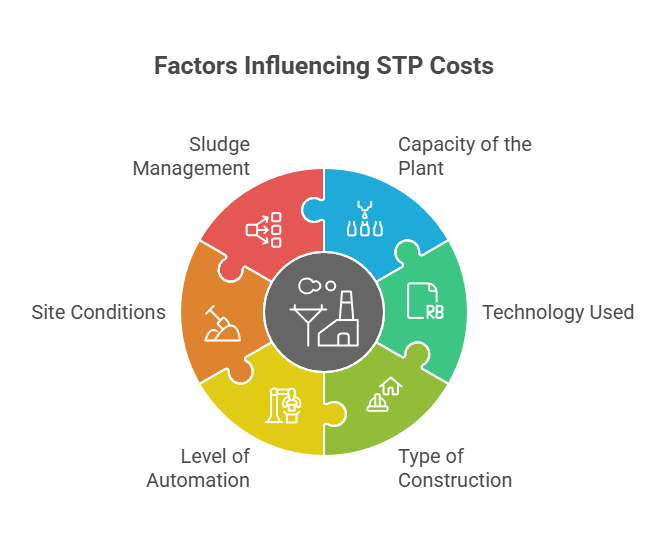
STP costs are not one-size-fits-all. Prices depend on several variables:
1. Capacity of the Plant
Measured in KLD (Kilolitres per Day), capacity is the biggest cost driver. A 5 KLD STP for a small residential building costs far less than a 200 KLD plant for a large housing society or industrial setup.
2. Technology Used
Different STP technologies come at different price points:
MBBR (Moving Bed Biofilm Reactor): Compact, efficient, suitable for apartments and commercial spaces. Anaerobic + MBBR (SUSBIO ECOTREAT) Most efficient for BOD/COD removal at lowest power consumption. Starting at ₹35,000/KLD
SBR (Sequencing Batch Reactor): Offers better process control and effluent quality; slightly more expensive.
ASP (Activated Sludge Process): Economical but requires more space and energy.
MBR (Membrane Bioreactor): Premium technology, delivers high-quality treated water, costs significantly more.
3. Type of Construction
Civil-based concrete tanks: Cost-effective for large-scale plants.
Prefabricated FRP/HDPE plants: Higher initial investment but faster installation and lower footprint.
4. Level of Automation
Manual / Semi-Automatic STPs: Lower initial cost but higher manpower needs.
Fully Automated Systems (with SCADA/PLC): Higher upfront cost but lower O&M expenses.
5. Site Conditions
Civil work costs can rise based on soil type, excavation depth, and accessibility of the project location.
6. Sludge Management
High organic loads and sludge handling systems add to costs.
Advanced Treatment Technologies
| Technology | Cost/KLD (₹) | Effluent quality | Best application |
|---|---|---|---|
| Anaerobic + MBBR (ECOTREAT) | ₹35,000–52,000 | CPCB Class A (<10 BOD) | Residential, hotels, commercial, hospitality. 500+ installations. |
| SBR (SUSBIO SBR) | ₹40,000–58,000 | CPCB Class A | Large townships, institutions, campuses. Handles variable flow. |
| MBR | ₹65,000–1,10,000 | Near-potable quality | Hospitals, premium projects, water-scarce sites needing direct reuse. |
| Civil ASP | ₹20,000–35,000 (equip. only) | Standard discharge | 500+ KLD municipal. Not recommended for residential <500 KLD. |
SUSBIO ECOTREAT — Anaerobic + MBBR
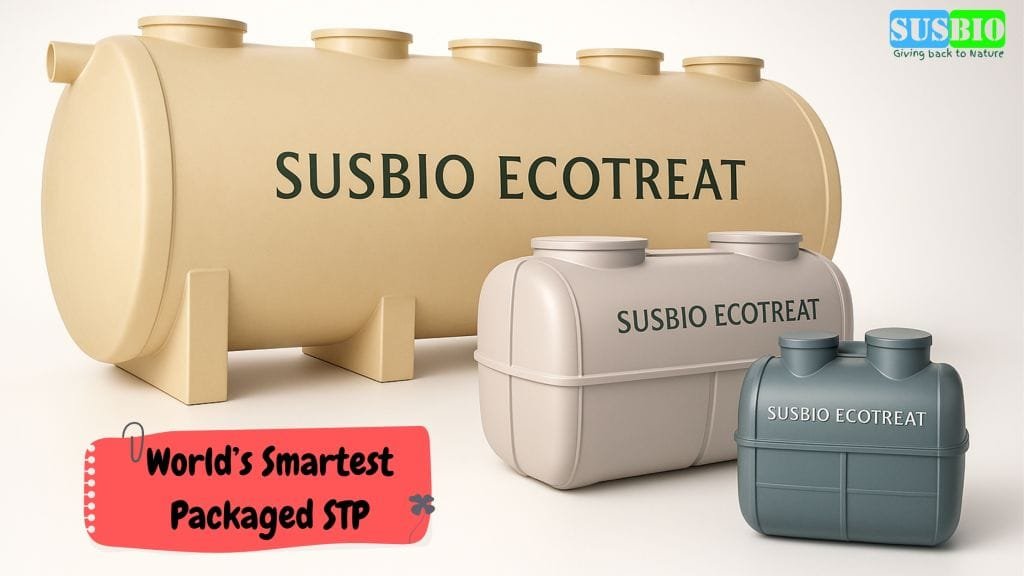
Starting at ₹35,000/KLD. Packaged FRP. Available 1–500 KLD. CPCB Class A compliant. 3–5 day installation. 50-year FRP lifespan. 500+ installations across 24 Indian states and 8 countries. → Get a capacity-wise quote
Comprehensive Plant Features by Capacity
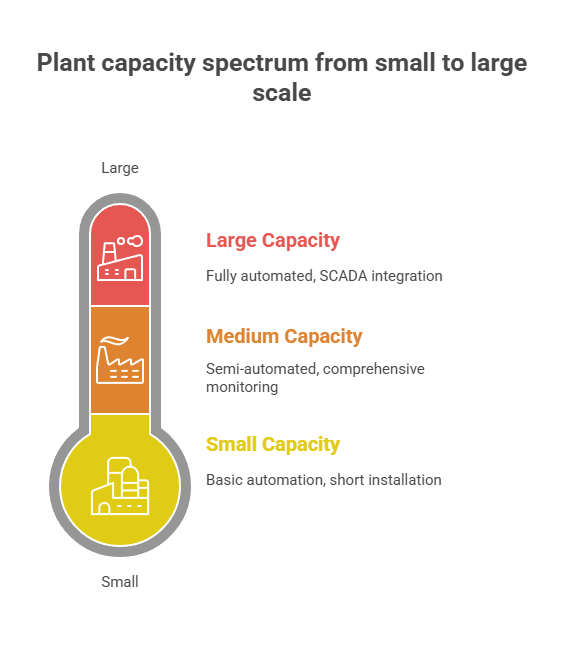
Small Capacity (5-50 KLD)
- Construction: Packaged/prefabricated designs using FRP/HDPE materials
- Installation Time:3–5 days on site (SUSBIO ECOTREAT prefabricated plug-and-play)
- Footprint Requirement: 25-100 sq. meters depending on technology
- Automation Level: Basic automation with manual override capabilities
- Power Consumption: 1.5-2.5 kWh per KLD treated
- Noise Level: <65 dB at 1m distance
- Odor Control: Basic carbon filtration for exhaust air
- Treatment Stages: Primary sedimentation
- Biological treatment
- Secondary clarification
- Basic disinfection
Monitoring: Essential parameters with local display Warranty: 12-month comprehensive coverage Expected Lifespan: 45-50 years with proper maintenance ROI Period: 18-24 months (full savings: water, electricity, and reduced O&M combined — see our ROI calculator for a water-savings-only estimate)
Medium Capacity (50-200 KLD)
- Construction: Modular design with factory-built components and on-site assembly
- Installation Time: Installation Time: 3-7 days including civil preparation and commissioning (SUSBIO ECOTREAT)
- Footprint Requirement: 100-300 sq. meters depending on technology
- Automation Level: Semi-automated operation with comprehensive digital monitoring
- Power Consumption: 1.2-2.0 kWh per KLD treated
- Noise Level: <60 dB at 1m distance
- Odor Control: Advanced carbon filtration with optional biological odor control
- Treatment Stages: Mechanical screening
- Flow equalization
- Primary treatment
- Advanced biological processes
- Secondary clarification
- Tertiary filtration options
- UV disinfection
Monitoring: Comprehensive parameter monitoring with trend analysis Remote Access: Cloud-based monitoring with mobile alerts Warranty: 18-month comprehensive coverage Expected Lifespan: 45-50 years with proper maintenance Energy Efficiency Features: Variable frequency drives, energy-efficient blowers ROI Period: 16-20 months with proper water reuse implementation
Large Capacity (200+ KLD)
- Construction: Custom-engineered solutions with concrete structures and specialized equipment
- Installation Time: 5–10 days on site (SUSBIO ECOTREAT modular prefabricated units)
- Footprint Requirement: 300-1000+ sq. meters depending on technology
- Automation Level: Fully automated with SCADA integration and predictive controls
- Power Consumption: 0.8-1.5 kWh per KLD treated
- Noise Level: <55 dB at 1m distance with acoustic enclosures
- Odor Control: Multi-stage odor management with biological and chemical systems
- Treatment Stages: Mechanical screening and grit removal
- Primary sedimentation
- Anaerobic treatment options
- Multiple biological treatment trains
- Secondary clarification
- Advanced tertiary treatment
- Multi-barrier disinfection
Monitoring: Comprehensive real-time monitoring with predictive maintenance Remote Management: Full remote operation capabilities with automated reporting Warranty: 24-month comprehensive coverage with extended options Expected Lifespan: 45-50 years with proper maintenance Energy Recovery: Biogas utilization options for power generation Water Reuse Capabilities: Advanced treatment for multiple reuse applications ROI Period: 14-18 months with comprehensive water and energy recovery
STP Construction Materials: Cost vs Lifespan
| Material | Initial Cost Premium | Lifespan | Benefits | Recommended Applications |
|---|---|---|---|---|
| FRP (Fiber Reinforced Plastic) | +0-10% | 45-50 years | Lightweight, excellent corrosion resistance, quick installation, factory testing, transportable | Small to medium plants, above-ground installations, coastal areas with high salinity |
| HDPE (High-Density Polyethylene) | +5-15% | 20-25 years | Superior chemical resistance, UV stable, flexible for ground movement, zero leakage welded seams | Underground installations, chemical industry applications, sites with difficult soil conditions |
| Reinforced Concrete | +10-20% | 30+ years | Maximum durability, custom shapes possible, excellent sound dampening, fire resistance, temperature stability | Large permanent installations, municipal applications, heavy-duty industrial use, earthquake-prone areas |
| Stainless Steel | +30-50% | 25-30 years | Premium appearance, highest corrosion resistance, hygienic surfaces, ease of cleaning, temperature resistance | Visible installations, food & beverage industry, pharmaceutical applications, temperature-sensitive processes |
| Hybrid Construction | +15-25% | 25+ years | Optimized cost-to-performance ratio, combines benefits of multiple materials, customizable to specific requirements | Medium to large installations with varying environmental conditions, specialized industrial applications |
Quality Assurance Measures:
- All tanks hydrostatically tested before dispatch
- Welding performed by certified technicians
- NDT (Non-Destructive Testing) for critical components
- Material certifications provided with documentation
- Factory acceptance testing for all mechanical equipment
- Quality control documentation for all major components
- Third-party inspection options available
Monthly Operating Cost (OPEX) of an STP in India
| Expense | 10 KLD | 25 KLD | 50 KLD | 100 KLD |
|---|---|---|---|---|
| Electricity | ₹2,000–3,500 | ₹4,000–7,000 | ₹8,000–14,000 | ₹16,000–28,000 |
| Operator / manpower | ₹3,000–8,000 | ₹6,000–12,000 | ₹10,000–18,000 | ₹15,000–25,000 |
| Consumables & chemicals | ₹500–1,500 | ₹1,000–2,500 | ₹2,000–4,000 | ₹3,500–7,000 |
| AMC (annual, monthly share) | ₹1,000–2,500 | ₹2,000–4,000 | ₹3,500–6,000 | ₹6,000–12,000 |
| Total monthly OPEX | ₹6,500–15,500 | ₹13,000–25,500 | ₹23,500–42,000 | ₹40,500–72,000 |
| Cost per KL treated | ₹22–52 | ₹17–34 | ₹16–28 | ₹14–24 |
ROI benchmark
Treated water saves ₹15–25 per KL vs municipal supply. A 50 KLD plant reusing 80% of treated output saves ₹3.6–6 lakh/year on water. Based on water savings alone, this typically works out to a longer payback period — often 3–5 years, depending on your local water tariff and reuse rate. The 14-24 month payback figures cited by capacity tier above include the full savings picture: reduced electricity consumption, lower manpower and O&M costs versus a conventional civil STP, and avoided tanker/municipal water costs, not water savings in isolation. Use our free ROI calculator to see your water-savings-only payback based on your actual capacity and tariff, then add your site’s electricity and labor savings for the full picture.
Hidden Operational Costs to Budget For
Beyond the monthly OPEX figures above, a few less-visible costs affect total cost of ownership over an STP’s lifetime:
- Aeration energy spikes: Aeration typically accounts for 40-50% of operational energy use. Variable frequency drives (VFDs) on blowers can cut this by up to 30%.
- Chemical dosing variability: Costs fluctuate with influent quality — automated dosing systems help stabilize this expense.
- Sludge disposal: Can reach 40-60% of total plant management costs; dewatering reduces sludge volume by up to 80% before disposal, cutting transport and handling costs significantly.
- Emergency repairs: Facilities without adequate spare-parts stock face higher emergency-repair costs; a preventive maintenance schedule every 3-6 months minimizes this risk.
- Regulatory testing overhead: Online Continuous Emission Monitoring (OCEMS) for larger plants adds ongoing sensor and lab-testing costs not always included in initial estimates.
SUSBIO ECOTREAT’s Anaerobic + MBBR process already delivers the core 70% electricity reduction versus conventional STPs. On top of that baseline, IoT-based automated monitoring helps offset hidden costs further — cutting energy use by up to an additional 20% through precise aeration control — and catches equipment issues before they become costly emergency repairs.
Frequently Asked Questions
1. What is the cost of a 10 KLD STP in India?
A 10 KLD packaged STP costs ₹4.8–6.5 Lakhs turnkey using SUSBIO ECOTREAT’s Anaerobic + MBBR technology, covering mechanical equipment, FRP vessels, piping, and commissioning. MBR technology at the same capacity costs ₹7.5–11 Lakhs. Monthly operating cost runs ₹5,000–8,000.
2. How much space is required for a sewage treatment plant?
A packaged SUSBIO ECOTREAT STP needs 25–100 sq. metres for small systems (5–50 KLD) and 100–300 sq. metres for medium systems (50–200 KLD) — requiring 40–60% less footprint than an equivalent civil RCC STP. Compact underground installations are available for space-constrained basements and parking lots.
3. What are the ongoing maintenance requirements for an STP?
A packaged biological STP requires daily visual pump and blower inspections, weekly screen chamber cleaning, monthly sludge dewatering checks, and quarterly electromechanical servicing to optimize aeration efficiency and biological culture health.
4. Can treated STP water be reused, and for what purposes?
Yes. Water treated through secondary biological processes and tertiary filtration (Sand + Carbon + Disinfection) meets CPCB urban reuse guidelines (BOD < 10 mg/L) and can be reused for landscape gardening, dual-plumbing toilet flushing, cooling tower makeup, and vehicle washing.
5. What permits are required for installing an STP in India?
Commercial and residential facilities require Consent to Establish (CTE) and Consent to Operate (CTO) from their respective State Pollution Control Board (SPCB), local municipal corporation clearance, and environmental clearance (EC) for developments exceeding designated built-up thresholds.
6. What is the average STP price per KLD in India?
Packaged STP cost per KLD in India ranges from ₹35,000 to ₹75,000 per KLD, depending on capacity and technology tier. Smaller plants (5–10 KLD) cost more per KLD due to base electromechanical overheads; larger facilities (100+ KLD) benefit from scale and cost under ₹40,000/KLD.
7. Is a civil STP cheaper than a packaged FRP STP?
Civil STP equipment quotes appear cheaper at ₹20,000–35,000/KLD, but this excludes ₹8,000–18,000/KLD in civil excavation and RCC concrete casting. Packaged FRP STPs like SUSBIO ECOTREAT are self-contained. Over a 5-year total lifecycle cost basis, packaged STPs are more cost-effective for projects under 500 KLD.
8. What is the monthly electricity cost of an STP?
A 10 KLD STP uses approximately 15–20 kWh/day (₹2,000–3,500/month). A 50 KLD plant consumes 60–90 kWh/day (₹8,000–14,000/month). Advanced Anaerobic + MBBR systems use up to 70% less electricity than extended aeration ASP plants by eliminating high-head recirculation pumps.
9. How much does an STP Annual Maintenance Contract (AMC) cost?
An AMC for a packaged STP typically ranges from ₹18,000–30,000 annually for a 10 KLD plant and ₹45,000–75,000 annually for a 50 KLD plant. A comprehensive AMC covers bi-weekly technician visits, consumable replacements, preventive pump servicing, and emergency breakdown attendance.
10. What capacity STP is required for a 100-flat residential apartment?
A 100-flat apartment generates roughly 35 to 45 KLD of sewage, assuming 4.5 persons per flat at 135–150 LPCD consumption and an 80% sewage discharge factor. A 40 KLD to 50 KLD STP is the standard engineering recommendation.
Conclusion
Investing in an STP is no longer an option but a necessity in India. With water scarcity, regulatory pressure, and sustainability becoming priorities, the demand for efficient Sewage Treatment Plants will only grow.
Understanding the cost per KLD and the factors influencing prices helps you plan budgets effectively.
If you are a developer, hotelier, or industrial operator, choose a trusted STP manufacturer in India that offers advanced technology, low operational costs, and strong service support.
Choosing the right wastewater treatment company for your project scale matters as much as the per-KLD price — technology, service network, and compliance track record all affect total cost of ownership.
Looking for the Best Packaged STP in India?
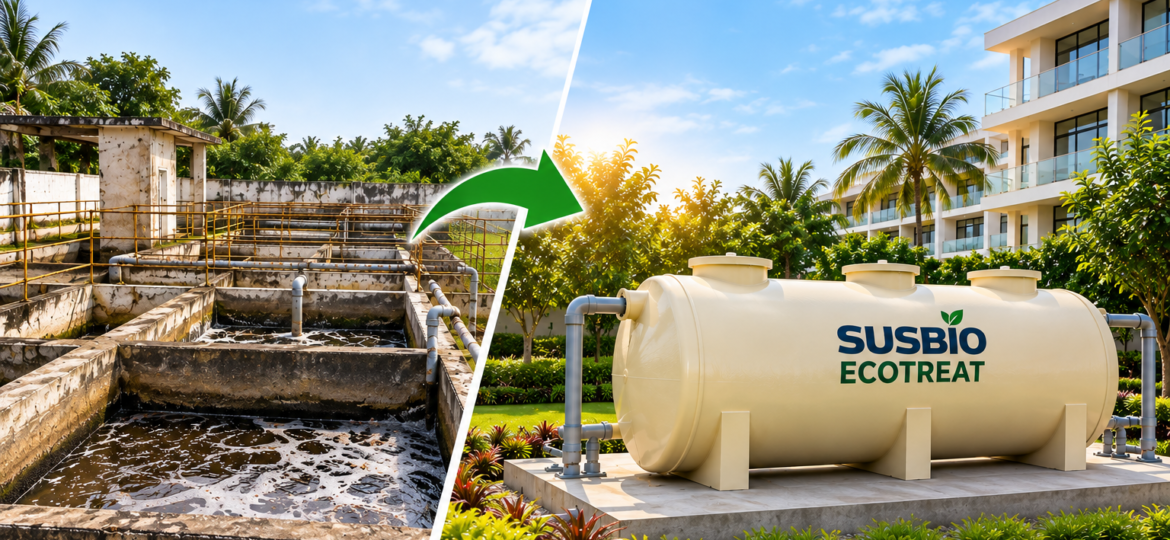
SUSBIO ECOTREAT is one of the most advanced prefabricated packaged STPs in India:
FRP-based modular design for long life and easy installation.
Anaerobic + MBBR dual-stage biological treatment for CPCB Class A effluent quality.
70% less electricity than conventional STPs — lowest operational cost in its class
Plug-and-Play Installation within days, not months.
Why SUSBIO?
Expert team with pan-India service
Tailor-made solutions for residential, commercial, and industrial projects
Contact us today for a free consultation and quote!
Disclaimer
Prices mentioned are indicative and may vary based on site conditions, technology, and vendor. Please consult a professional for accurate estimates.