


Most articles about the ‘future of wastewater treatment’ are written from the outside. They describe trends — IoT, AI, circular economy — without connecting them to what is actually happening in India’s regulatory environment, what the current enforcement picture looks like, or what these changes mean for a developer or facility manager deciding on an STP this quarter.
This article is written from the inside. SUSBIO has been manufacturing and commissionig packaged STPs across India since 2013. We have watched the market change — from near-zero enforcement of STP compliance in 2013 to a 2026 environment where NGT proceedings, SPCB inspections, and OC-linked STP requirements have made compliant wastewater treatment a genuine priority rather than a checkbox.
Here is what is actually changing in India’s packaged STP market in 2026, and what it means in practice.
1. What Has Changed in 2022–2026: From Paper Compliance to Real Enforcement
The single biggest shift in India’s packaged STP market over the last four years is not technology — it is enforcement. Between 2013 and 2021, STP installation was widespread but genuine compliance was rare. Buildings would install a system to get the OC, run it sporadically or not at all, and face minimal consequences. SPCB inspections were infrequent and often resulted in show-cause notices that went unresolved for years.
That picture has changed substantially. Three things drove the change:
National Green Tribunal (NGT) directions — state by state
Since 2020, the NGT has issued state-specific directions across virtually every Indian state requiring compliance audits of all building-level STPs. In Maharashtra, Karnataka, Telangana, Goa, and several other states, these directions have triggered systematic SPCB inspection drives. Buildings found with non-functional or non-compliant STPs have faced show-cause notices, penalties of up to ₹1 lakh per day, and in severe cases, utility disconnection orders.
The enforcement is no longer theoretical. In Karnataka alone, KSPCB issued notices to hundreds of housing societies in Bangalore between 2022 and 2024 for non-compliant STPs. The standard penalty for a faulty apartment STP in Karnataka is now a flat ₹5 lakh fine regardless of the apartment’s size — per KSPCB’s current enforcement policy.
OC-linked STP compliance — pre-commissioning, not post-possession
Most state building regulations now require a functional, tested STP as a precondition for the Occupancy Certificate. The shift is from ‘install before OC’ to ‘commission and test before OC.’ This means a NABL lab test report showing CPCB Class A compliance must be submitted before the occupancy certificate is issued in an increasing number of states.
For developers, this creates a hard deadline that did not exist five years ago. An STP that is installed but not properly commissioned — or that fails the effluent test — blocks the OC. The compliance problem that used to surface 12 months post-possession now surfaces before possession.
Treated water reuse — from nice-to-have to inspected requirement
CPCB has always mandated that treated STP water must be reused for non-potable purposes rather than discharged. In practice, very few buildings had functional dual plumbing for treated water reuse before 2022. SPCB inspectors are now specifically checking for reuse infrastructure during inspections — asking to see the treated water distribution line to toilet flushing tanks or landscape irrigation systems. Buildings that cannot demonstrate reuse are in violation regardless of their effluent quality.
2. AMRUT 2.0 — What the ₹2.99 Lakh Crore Programme Means for Packaged STPs
AMRUT 2.0 (Atal Mission for Rejuvenation and Urban Transformation) was launched on 1 October 2021 with a total outlay of ₹2.99 lakh crore, including central assistance of ₹76,760 crore over five years (FY2021-22 to FY2025-26). The programme targets all statutory towns in India — not just the 500 AMRUT Phase 1 cities.
| AMRUT 2.0 Component | Target / Allocation | Relevance to Packaged STP Market |
|---|---|---|
| Sewerage and septage management | 592 projects worth ₹67,607 crore (includes O&M) | Municipal STP infrastructure — creates institutional demand for treatment capacity that packaged systems at peri-urban and semi-urban scale serve |
| Treated water reuse mandate | Circular water economy goal — recycle and reuse treated water across all AMRUT cities | Buildings must have dual plumbing. Creates demand for high-quality packaged STPs that reliably achieve BOD <10 mg/L for reuse-grade treated water |
| Decentralised treatment | AMRUT 2.0 explicitly promotes decentralised treatment plants at local / neighbourhood scale | Directly validates the packaged STP model — decentralised, at-source treatment is AMRUT 2.0 policy, not just industry preference |
| Progress as of February 2026 | 2.38 crore tap connections and millions of sewer connections active (MoHUA data) | Implementation continues into the next mission phase — AMRUT 3.0 expected; momentum will not stop at 2026 |
What AMRUT 2.0 means for the private packaged STP market is indirect but significant. The programme has raised awareness among Urban Local Bodies (ULBs), state governments, and developers about the necessity of sewage treatment. It has also established treated water reuse as formal government policy — which tightens the compliance obligation for private buildings in AMRUT cities to demonstrate reuse infrastructure, not just effluent quality.
The private building market — apartments, hotels, hospitals, industrial campuses — operates outside AMRUT direct funding. But the regulatory environment that AMRUT 2.0 has reinforced creates indirect pressure: when a city is actively building sewage infrastructure and enforcing treated water reuse as part of a national programme, the tolerance for individual buildings not complying falls sharply.
3. Online Monitoring and IoT — What Is Now Mandatory and What Is Coming
Online Continuous Effluent Monitoring Systems (OCEMS) are now mandatory for STPs above 1 MLD (1,000 KLD) capacity in most states, with data transmitted in real time to the SPCB server. For smaller building-scale STPs, OCEMS is not yet universally mandated — but the direction of travel is clear.
What KSPCB Karnataka has already implemented
Karnataka is ahead of most states. KSPCB’s 2025-26 STP guidelines require STPs above 50 KLD in Karnataka to install online sensors for BOD, COD, TSS, pH, and flow — with data linked to KSPCB’s central server. This covers a large proportion of Karnataka’s apartment complex STPs. Buildings that do not have this monitoring capability are already in compliance arrears with KSPCB.
What MPCB Maharashtra is moving toward
Maharashtra’s MPCB has been piloting online monitoring requirements in Pune and Mumbai for larger building-category STPs. The direction is toward state-wide OCEMS requirements for all commercial and large residential STPs — not just the 1 MLD+ industrial threshold. No official notification has been issued as of May 2026, but the enforcement posture suggests this is coming within the next 12-24 months.
What IoT monitoring actually does for a packaged STP operator
Beyond regulatory compliance, IoT monitoring changes the maintenance model from reactive to predictive. A sensor monitoring aeration flow rate detects diaphragm wear weeks before total aeration failure. A flow meter catches hydraulic overload from new connections before the biological culture is washed out. An outlet turbidity sensor flags treated water quality drift before the monthly manual test catches it.
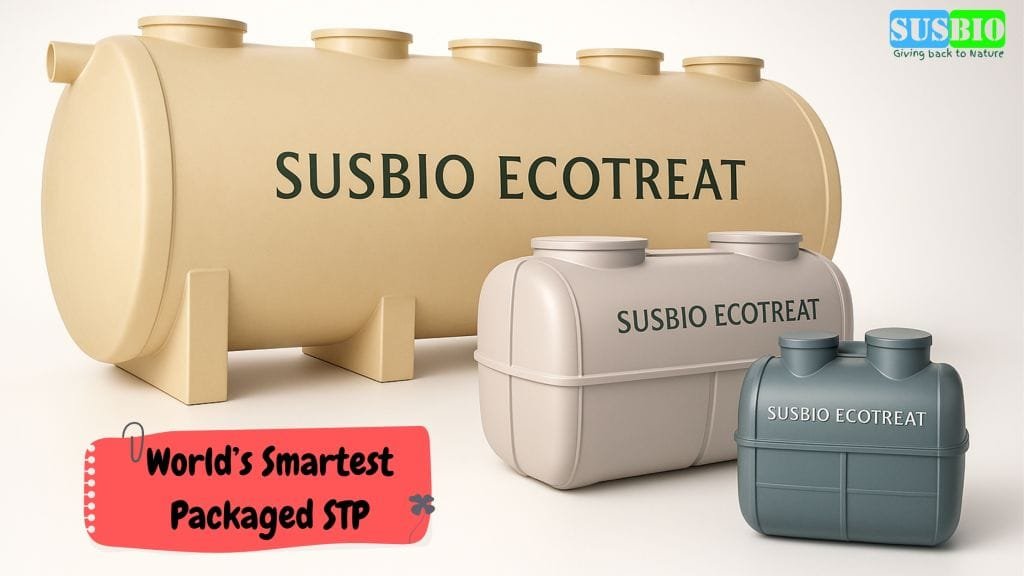
SUSBIO ECOTREAT is IoT-ready as standard. The remote monitoring dashboard gives clients and our service team real-time visibility of system performance — flow rates, aeration status, sludge levels, and outlet quality proxies. For clients in states where online monitoring is now mandatory, we install OCEMS-compliant sensor packages that transmit data in the required format to the relevant SPCB server.
| State / Board | OCEMS Threshold (2026) | Parameters | Status |
|---|---|---|---|
| > 1 MLD (1,000 KLD) | pH, BOD, TSS, flow rate — 24/7 real-time to SPCB portal | Mandatory — enforced | |
| > 50 KLD (per 2025-26 guidelines) | BOD, COD, TSS, pH, flow — linked to KSPCB central server | Mandatory in Karnataka per KSPCB 2025-26 STP guidelines | |
| Currently > 1 MLD; pilot for smaller STPs | BOD, TSS, pH, flow | Pilot underway — full rollout expected 2026-27 | |
| TSPCB Telangana | > 100 KLD increasing scrutiny | BOD, COD, TSS, pH | Enhanced enforcement — specific threshold being tightened |
| > 100 KLD for industrial; AMRUT cities higher scrutiny | Flow, pH, BOD proxy | Requirements tightening across industrial clusters |
4. Treated Water Reuse — The Policy Shift That Changes the Business Case for Good STPs
India generates enormous volumes of treated wastewater that is currently wasted — discharged to drains or water bodies rather than reused. CPCB has long mandated reuse, but actual implementation has been patchy. That is changing, driven by two concurrent pressures: water scarcity in major Indian cities and the AMRUT 2.0 circular water economy mandate.
The reuse requirement changes the business case for a quality packaged STP in a specific way. If treated water is to be genuinely reused for toilet flushing, landscape irrigation, vehicle washing, or cooling tower makeup — it needs to meet a higher quality standard than simply ‘passes CPCB Class A.’
| Reuse Application | Quality Required | Does Single-Stage MBBR Achieve This? | Does SUSBIO ECOTREAT Achieve This? |
|---|---|---|---|
| Toilet flushing (dual plumbing) | BOD <10 mg/L, TSS <10 mg/L, Faecal coliform <1,000 MPN/100mL | Marginal — BOD often 20-35 mg/L from single-stage | Yes — consistently BOD <10, TSS <20, coliform <200 with UV |
| Landscape and garden irrigation | BOD <10 mg/L, pH 6.5–9.0, no harmful pathogens | Sometimes — depends on season and load variation | Yes — reliably achieved across variable loads |
| Cooling tower makeup water | BOD <10, COD <50, TDS <2,000 mg/L, low biological load | Unlikely without polishing step | Achievable with post-treatment RO or activated carbon polish |
| Groundwater recharge (artificial) | BOD <10, TN <10, faecal coliform <1,000 — CGWB guidelines | Only with tertiary treatment added | Achievable with tertiary sand filter addition to ECOTREAT |
The bottom line is this: the push toward genuine treated water reuse raises the minimum acceptable effluent quality from ‘passes inspection’ to ‘actually usable for the intended reuse application.’ A single-stage MBBR system that delivers BOD of 25 mg/L passes some inspection rounds but produces treated water that is not suitable for most reuse applications. An Anaerobic + MBBR system that consistently delivers BOD below 10 mg/L produces treated water that is genuinely usable — and genuinely reusable.
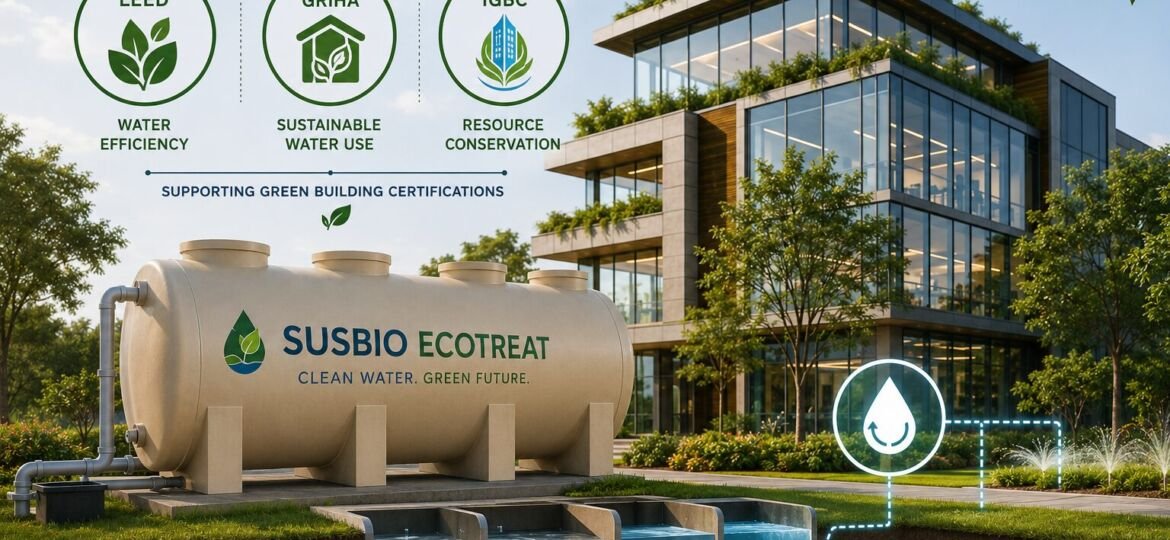
This is not a future development. It is what is already driving purchasing decisions in 2026 among the more sophisticated buyers — developers designing for LEED or IGBC certification, hotel brands with corporate sustainability targets, and industrial clients whose SPCB consent renewal now specifically includes a reuse plan.
5. What the Next Generation of Packaged STP Technology Looks Like
Technology in the packaged STP segment is evolving in three directions. None of these are speculative — all three are already deployed in SUSBIO’s current installations in some form.
Direction 1: Full automation and remote diagnostics as standard
Packaged STPs have been ‘automated’ in the sense of not needing a continuous on-site operator for a decade. The next level is predictive diagnostics — sensors that not only report current status but flag maintenance requirements before failure occurs. SUSBIO’s IoT monitoring dashboard already does this for aeration flow, sludge levels, and power draw. The next iteration integrates AI-based anomaly detection that learns the normal operating pattern of a specific installation and alerts when deviations occur — before they become failures.
Direction 2: Nutrient removal as standard in high-scrutiny states
CPCB’s current Class A norms focus on BOD, COD, TSS, and faecal coliform. The newer parameters attracting regulatory attention are total nitrogen (TN) and ammoniacal nitrogen — nutrients that cause algal blooms in receiving water bodies. CPCB has set limits of TN ≤10 mg/L and ammoniacal nitrogen ≤5 mg/L for larger STPs. As these parameters enter routine inspection testing for smaller building-scale STPs, the biological treatment process needs to handle nitrification and denitrification — not just organic matter removal.
MBBR technology is well-suited to nutrient removal with the right media configuration and carbon dosing. SUSBIO’s process design for installations in high-scrutiny states already incorporates nitrogen removal capability where required. This will become standard for most installations in the next 2–3 years.
Direction 3: ZLD-ready configurations for water-stressed industrial zones
Zero Liquid Discharge (ZLD) has been mandatory for several industrial categories in India since 2016 — textile dyeing, distilleries, tanneries, pulp and paper. The ZLD requirement is now expanding to additional industrial categories in water-stressed basins. For industrial campuses with mixed domestic and process wastewater, this creates a requirement for integrated STP + ETP systems that together achieve full liquid recycling.
SUSBIO’s IONTREAT electrochemical ETP — when combined with ECOTREAT for domestic sewage treatment — provides a modular, scalable path to ZLD for small and medium industrial facilities. The combination of chemical-free electrochemical treatment (which handles colour, heavy metals, and dissolved organics in industrial effluent) with the energy-efficient Anaerobic + MBBR process for domestic sewage is increasingly what industrial park developers and MIDC-based manufacturers are specifying.
6. What SUSBIO Is Doing Differently in 2026 Compared to 2013
When SUSBIO started in 2013, the packaged STP market in India was thin. There were very few manufacturers, compliance enforcement was minimal, and most building owners treated an STP as a statutory requirement to be met at minimum cost. The company we built in that environment — focused on technical performance, FRP manufacturing quality, and genuine CPCB compliance — is not the same company we need to be in 2026’s environment.
| Area | SUSBIO in 2013–2018 | SUSBIO in 2026 |
|---|---|---|
| Manufacturing scale | Small batch production from Goa; limited standardisation | Dedicated factory at Vasuli MIDC, Chakan, Pune with full production QC and pressure testing before dispatch |
| Technology | MBBR-focused; SBR prominent product | Anaerobic + MBBR as standard — dual-stage process delivering BOD <10 mg/L reliably across all ECOTREAT units |
| Service infrastructure | Post-installation support from HQ on request | Structured AMC with 24-hr response SLA; field team across regions; quarterly preventive maintenance as standard |
| Monitoring capability | Manual inspection visits only | IoT / SCADA remote dashboard; OCEMS-compatible sensor packages for Karnataka, Maharashtra, and other states |
| Compliance support | CPCB approval certificates provided on request | Full CTE/CTO documentation packages; NABL test reports at commissioning; SPCB correspondence support; sludge disposal records maintained |
| Warranty | 1–3 years (standard industry) | 10-year module warranty — India’s longest. Lifetime service commitment. |
| Installed base | ~50 installations by 2015; primarily Goa and Maharashtra | 500+ installations across 24 Indian states; exports to multiple countries |
The company in the right column is more resilient to the 2026 enforcement environment than the one in the left column. That is not because the market got easier — it got harder. It is because every element of what we built over 13 years was designed around the assumption that compliance would eventually be enforced, and that the value of a packaged STP is measured not at commissioning but at year five and year ten.
Frequently Asked Questions
No. CPCB’s national mandate currently applies primarily to STPs above 1 MLD (1,000 KLD) capacity. However, state-level regulations are becoming stricter. Karnataka’s KSPCB requires online monitoring for STPs above 50 KLD under its 2025–26 guidelines, while Maharashtra’s MPCB is also moving toward tighter monitoring requirements for smaller STPs. If your STP is above 50 KLD in Karnataka, online monitoring connected to the KSPCB server is already mandatory. For other states, requirements vary and should be confirmed with the respective SPCB, as compliance norms are evolving rapidly.
2. What does AMRUT 2.0 mean for a private developer building apartments?
AMRUT 2.0 does not directly fund private developers. The scheme primarily finances municipal water and sewage infrastructure in covered cities and towns. However, it has significantly increased regulatory focus on treated water reuse and STP compliance. In AMRUT-covered cities, SPCB enforcement related to STPs, treated water reuse, and CTO approvals has become more stringent. Developers planning apartment projects should design STPs and dual plumbing systems for actual treated water reuse from the beginning, as retrofitting later can become expensive and operationally difficult.
3. Will CPCB add total nitrogen and ammoniacal nitrogen to routine STP testing?
CPCB has already prescribed standards for total nitrogen (TN ≤10 mg/L) and ammoniacal nitrogen (≤5 mg/L) for larger STPs and for discharge into certain sensitive water bodies. These parameters are not yet universally enforced for smaller building-scale STPs during routine inspections. However, the long-term regulatory trend clearly points toward wider enforcement due to increasing concerns around river pollution and groundwater contamination. Modern MBBR-based STPs can be designed with nitrification and denitrification capability for nitrogen removal. Developers designing STPs for long-term operation should consider systems that can either achieve these standards now or be upgraded later without replacing the complete plant.
4. How long will it take for AMRUT 2.0 to be replaced by a new scheme?
AMRUT 2.0 is scheduled to continue through FY2025–26. The Government of India has already indicated continued focus on urban water and sanitation infrastructure, making a successor programme or AMRUT 3.0 highly likely. More importantly, the broader movement toward wastewater reuse, stricter STP compliance, and digital monitoring is structural rather than scheme-dependent. Even if AMRUT evolves into a new programme, compliance expectations related to treated water reuse, OCEMS, and environmental discharge standards will continue because these requirements are driven by CPCB, SPCB, and NGT regulations — not solely by AMRUT policies.
SUSBIO ECOTREAT — Built for the 2026 Compliance Environment
The direction of travel in India’s packaged STP market is clear: stricter enforcement, online monitoring requirements, reuse as a compliance obligation, and CPCB Class A as a genuine minimum — not a brochure claim. SUSBIO ECOTREAT was designed for exactly this environment. Anaerobic + MBBR technology that consistently delivers BOD below 10 mg/L. IoT-ready as standard. OCEMS-compatible for states that require it. CPCB product-level approval on every model. 10-year warranty backing the performance claim.
If you are designing an STP for a project that needs to be compliant in 2026 and still compliant in 2036, we should talk.


4 Comments
[…] 0 By Akshat Tyagi Latest Blogs August 7, […]
[…] the field of wastewater treatment, choosing the right technology is critical for ensuring efficiency, cost-effectiveness, and […]
[…] is at the forefront of wastewater treatment innovation in India, offering state-of-the-art solutions that prioritize both performance and sustainability. The […]
[…] essential to remove contaminants, ensuring it can be safely returned to the environment or reused. Wastewater treatment plants are engineered facilities designed to treat sewage, industrial effluent, and other forms of […]