
Skip to main content Scroll Top
Goa: #5, Umiya Habitat, Zuarinagar, South Goa | Pune: V130, Vasuli MIDC, Chakan | Mumbai: GD-05, Suyog Industrial Estate, Vikhroli West

Types of Disinfection: Expert Guide to Modern Sewage Treatment Technologies (2026)

Last Updated 27 Aug 2026

 Wastewater treatment is no longer just about removing visible impurities — it’s about ensuring complete pathogen destruction before water is discharged or reused. Disinfection is the final and most crucial step that makes treated water safe for the environment and human health.

Untreated wastewater is a breeding ground for harmful bacteria, viruses, and parasites such as E. coli, Salmonella, Cryptosporidium, and Giardia. Left unchecked, these pathogens cause life-threatening diseases like cholera, typhoid, hepatitis, and gastroenteritis. That’s why every sewage treatment plant (STP) must adopt reliable disinfection methods as its last line of defense.

This expert guide covers everything you need to know about modern disinfection technologies in sewage treatment (2025), from traditional chlorine dosing to advanced hybrid systems like SUSBIO ECOTREAT.

Why Disinfection is Critical in Sewage Treatment

Disinfection in Sewage Treatment

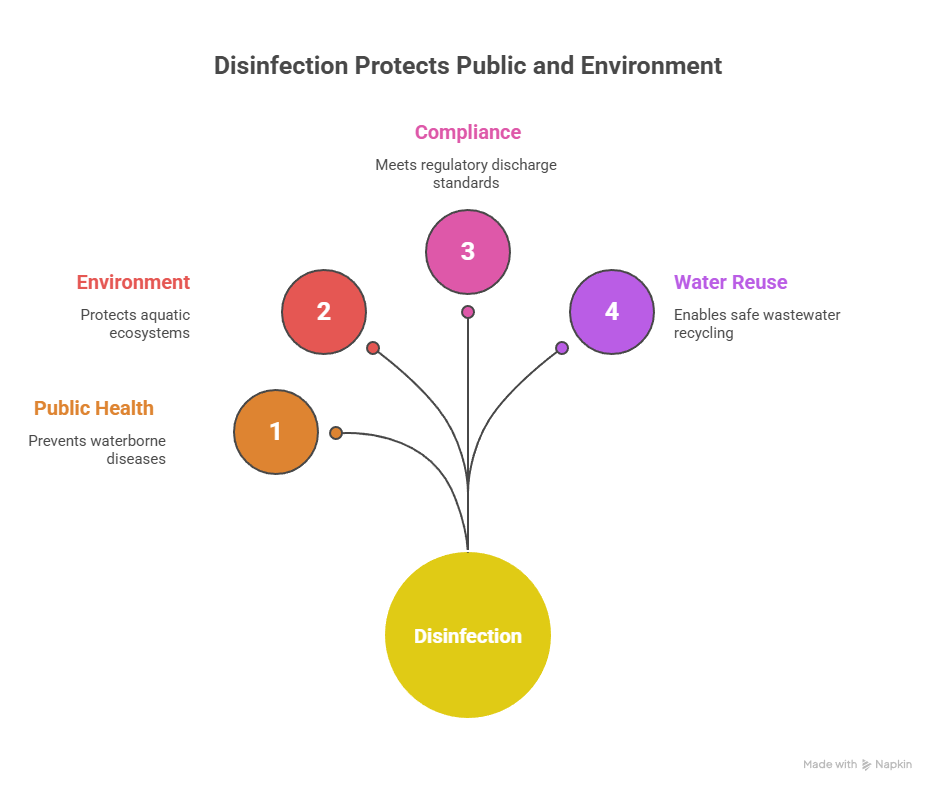
1. Safeguarding Public Health

Communities depend on safe water for drinking, bathing, and sanitation. Disinfection neutralizes disease-causing organisms before they can spread through rivers, lakes, or groundwater.

2. Environmental Protection

Even small amounts of untreated wastewater can damage aquatic ecosystems. Pathogens infect fish, plants, and wildlife, creating ripple effects across the food chain.

3. Regulatory Compliance

Authorities like the Central Pollution Control Board (CPCB) in India and international bodies like the WHO mandate strict discharge standards. Without proper disinfection, STPs fail compliance and risk penalties.

4. Water Reuse & Sustainability

Modern urban planning encourages wastewater recycling. But reuse (for landscaping, flushing, or industrial processes) is only possible if the treated water is disinfected to a safe level.

Core Disinfection Methods in Wastewater Treatment

Core Disinfection Methods in Wastewater Treatment

1. Chlorination: Affordable but with Byproducts

Chlorination has been the world’s most widely used method for decades. It involves adding chlorine gas or sodium hypochlorite to wastewater.

  • How it works: Chlorine forms hypochlorous acid (HOCl) and hypochlorite ions (OCl⁻) that break down cellular processes in microorganisms.

  • Dosage range:

    • Sodium hypochlorite: 0.2–2 mg/L

    • Chlorine gas: 1–16 mg/L

  • Pros:

    • Cost-effective

    • Provides residual protection in pipelines

  • Cons:

    • Produces disinfection byproducts (DBPs) such as trihalomethanes (THMs) and haloacetic acids (HAAs).

    • DBPs are linked to cancer and long-term health risks.

2. UV Disinfection: Light that Destroys DNA

Ultraviolet (UV) light at 254 nm penetrates microorganisms and disrupts their DNA by forming thymine dimers, preventing them from replicating.

  • Time required: 20–30 seconds (much faster than chlorine).

  • Effectiveness: 3-log (99.9%) reduction in total coliforms at 164.1 mWs/cm².

  • Pros:

    • No harmful chemicals

    • Highly effective against chlorine-resistant organisms like Cryptosporidium and Giardia

  • Cons:

    • No residual protection

    • Some microbes recover via photoreactivation or dark repair

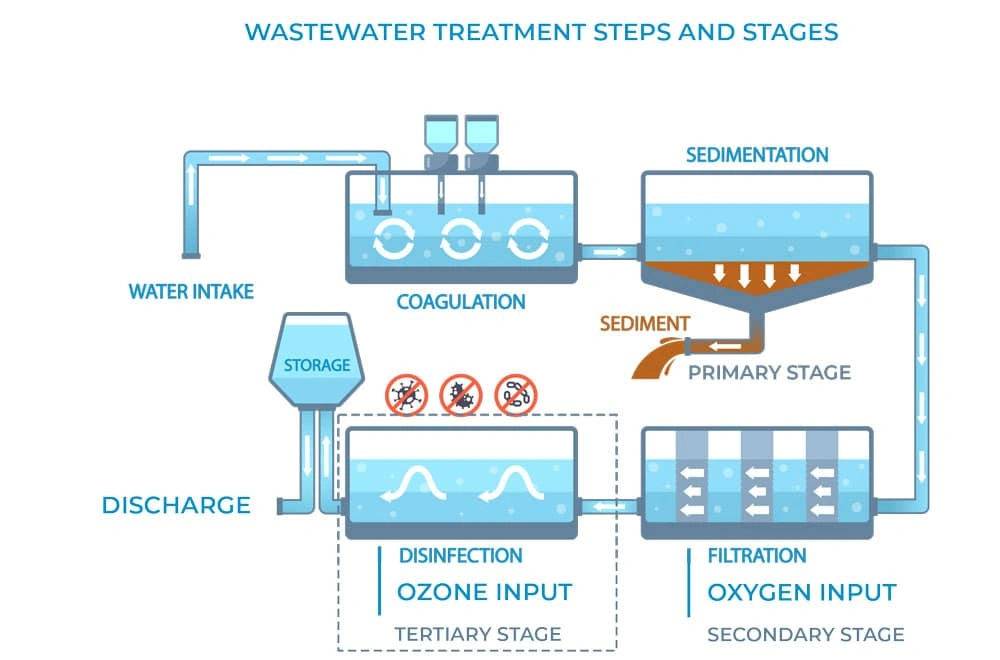
3. Ozonation: Nature’s Most Powerful Oxidizer

Ozone (O₃) is generated onsite using corona discharge in oxygen or dry air. It’s one of the strongest disinfectants known.

  • Strength: 3,000 times more effective than chlorine.

  • Contact time: 10–30 minutes.

  • Pros:

    • Destroys bacteria, viruses, and protozoa

    • Works well against chlorine-resistant organisms

  • Cons:

    • Higher energy demand

    • Complex equipment (generators, contact chambers, air dryers)

4. Chlorine Dioxide: A Cleaner Alternative

ClO₂ disinfects by oxidizing organic molecules through one-electron transfer reactions.

  • Dosage range: 0.07–2.0 mg/L

  • Pros:

    • Produces fewer DBPs than chlorine

    • Works better in highly polluted water

  • Cons:

    • Must be produced onsite

    • Sensitive to storage and handling conditions

5. Membrane Filtration: Physical Barrier

Microfiltration (MF) and ultrafiltration (UF) remove microorganisms physically based on pore size.

  • MF pores: 0.1–10 μm (blocks bacteria and turbidity)

  • UF pores: 0.001–0.1 μm (blocks viruses and macromolecules)

  • Pros:

    • High pathogen removal efficiency

    • No chemicals involved

  • Cons:

    • Expensive membranes

    • Susceptible to fouling

Factors That Influence Disinfection Efficiency

Water treatment operators must optimize several key factors to achieve maximum pathogen elimination through different types of disinfection. A proper understanding of these variables will give a better wastewater treatment in a variety of conditions.

Contact Time and Flow Rate Optimization

Pathogens need enough contact time with disinfectants to be eliminated effectively. Most low-level disinfectants take 30–60 seconds to eliminate vegetative bacteria, yeasts, mycobacteria, and viruses. Notwithstanding that, each disinfectant needs different exposure times—ozone works faster than chlorine. The CT value (concentration × time) remains the main measurement to check disinfection effectiveness, especially with the T10 method (time for 10% of concentration to pass through a contact basin). High flow rates reduce treatment time, so contact time calculations must factor in peak flows.

Turbidity and Organic Load Effect on UV and Chlorine

Water quality substantially affects how well disinfection works. Total Suspended Solids (TSS) can hurt disinfection even at levels under 20 mg/L. Particles in UV systems protect microorganisms from light exposure. The efficiency drops at UV doses of 7.5 mJ/cm² once TSS hits 50 mg/L. Organic matter reacts with chlorine and reduces available germicide. This shows up as a strong negative link between turbidity and disinfection efficiency (r = -0.96 to -0.98).

Residual Disinfectant Monitoring in Distribution Systems

Distribution networks need proper disinfectant residuals to serve three vital purposes: they kill microorganisms, show system problems, and control biofilm growth. Pipe volume, water characteristics, disinfectant type, and contamination events all affect residual maintenance. Regular checks of residual levels help catch sudden changes that might point to contamination.

System Design: Baffling, Mixing, and Dosing Accuracy

System setup plays a big role in how well disinfection works. Tank baffles cut down free space and create even velocity distribution. This minimizes short circuits and recirculation zones. The baffling factor affects chlorine contact time directly—numbers closer to 1.0 mean better-distributed flow and contact between water and disinfectants. On top of that, good mixing helps disinfectants reach all water parts and prevents problematic air pockets.

Advanced & Emerging Disinfection Technologies

Advanced & Emerging Disinfection Technologies

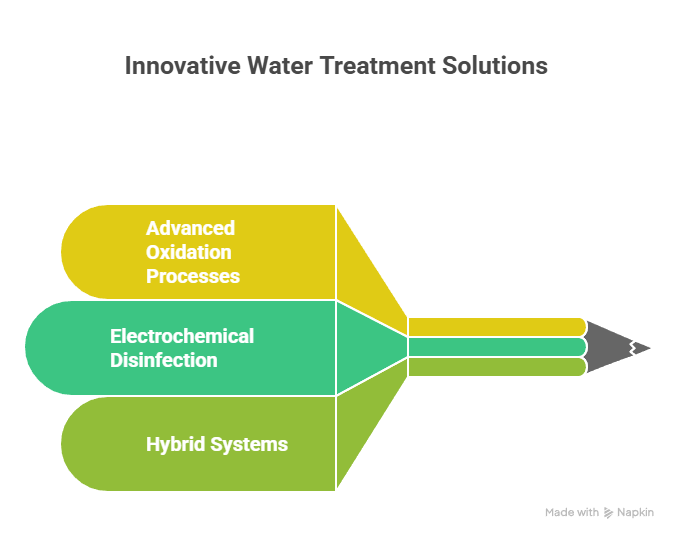
Advanced Oxidation Processes (AOPs)

  • Generate hydroxyl radicals (•OH) that break down pharmaceutical residues and micropollutants.

  • Examples: UV/H₂O₂, Fenton’s method.

Electrochemical Disinfection

  • Electrodes generate oxidants directly from water.

  • Perfect for decentralized STPs in remote locations.

  • Can run on solar energy for sustainable operation.

Hybrid Systems

  • Combine UV + ozone + membranes for multi-barrier protection.

  • Designed to tackle chlorine-resistant pathogens and micropollutants.

SUSBIO ECOTREAT: Disinfection in a Packaged STP

SUSBIO ECOTREAT integrates disinfection as a standard stage
in its Anaerobic + MBBR treatment process — not an add-on, and not a chemical
treatment system. The biological treatment (anaerobic pre-treatment ahead of a
Moving Bed Biofilm Reactor) handles organic and pathogen load reduction;
disinfection is the final polishing step that ensures the treated water is safe
for discharge or reuse.

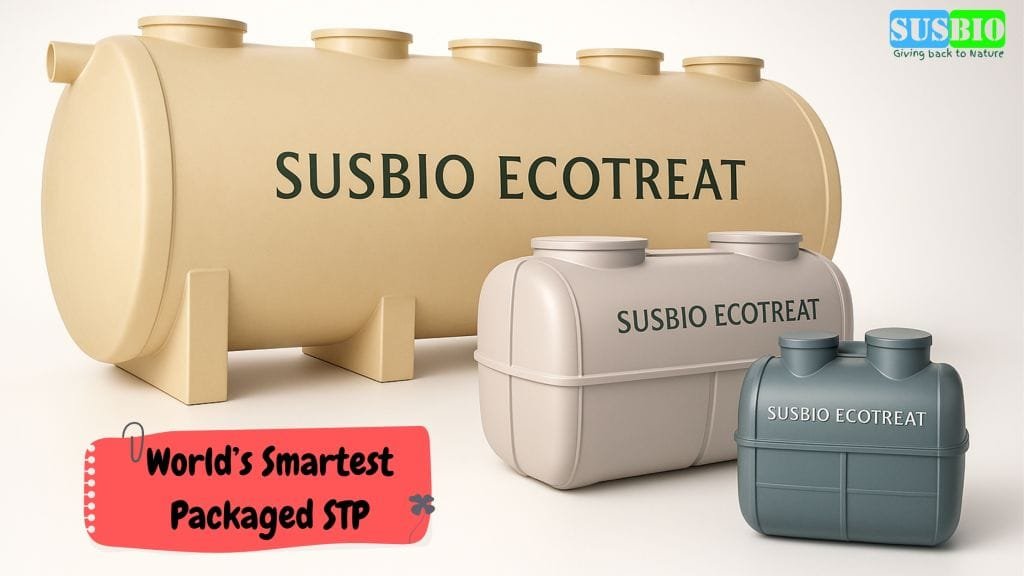
What is SUSBIO ECOTREAT?

SUSBIO ECOTREAT is a prefabricated, FRP-based packaged sewage treatment plant designed for plug-and-play installation with minimal civil work. It uses a purely biological treatment process — Anaerobic + MBBR — to ensure water is reusable, safe, and CPCB-compliant, with UV or chlorination disinfection as the final stage.

Disinfection Approach in SUSBIO ECOTREAT

UV disinfection is SUSBIO’s standard disinfection method — chemical-free, effective against chlorine-resistant pathogens like Cryptosporidium and Giardia, and requiring no ongoing chemical dosing or storage.

Chlorination is available as an alternative or supplementary option where residual disinfectant protection is specifically required (for example, in distribution piping), consistent with the trade-offs described earlier in this guide.

Ozone generation is not part of SUSBIO ECOTREAT’s standard configuration — as covered above, ozone systems require complex, energy-intensive equipment (generators, contact chambers, air dryers) that runs counter to ECOTREAT’s core design goal of a compact, low-energy, minimal-maintenance packaged system. For applications specifically requiring ozone or advanced oxidation-level disinfection, that’s a specialized requirement worth discussing directly with our engineering team rather than assuming it’s standard.

Advantages of SUSBIO ECOTREAT

      Plug & Play: Installation in 3-5 days, versus months for conventional civil-built STPs.

      Energy Efficient: Up to 70% less electricity than conventional STPs, since the Anaerobic + MBBR process reduces the load reaching the more energy-intensive aerobic stage.

      Reuse Ready: Treated, disinfected water suitable for landscaping, flushing, and cooling tower applications.

      IoT Monitoring: Real-time data on flow, treatment performance, and disinfection status.

      Durability: FRP construction with a 45-50 year service life.

      Compact Design: Requires significantly less space than conventional RCC plants.

Why SUSBIO ECOTREAT Fits Modern STP Requirements

Most STPs face a trade-off between cost, complexity, and reliability. SUSBIO ECOTREAT is engineered around keeping disinfection simple and dependable rather than maximally complex: UV as standard (chemical-free, effective, low-maintenance), factory-tested construction that removes on-site quality variability, and IoT monitoring that confirms disinfection is actually working rather than assuming it is. That’s why SUSBIO ECOTREAT is used by real estate developers, industries, hospitality chains, schools, and hospitals across India.

How to Know If Standard UV Disinfection Is Right for Your Site

The comparison earlier in this guide shows there’s no universal best disinfection method — the right choice depends on what a specific site actually needs. Here’s how that plays out for a typical ECOTREAT installation decision:

      If your priority is avoiding disinfection byproducts entirely — common for sites near sensitive ecosystems, or reusing water for irrigation — standard UV is the right fit, since it produces none of the THMs or HAAs associated with chlorination.

      If your treated water needs residual protection in downstream piping — for example, water stored before reuse rather than used immediately — UV alone won’t provide that, since it has no residual effect once the water leaves the disinfection stage. This is where SUSBIO’s optional chlorination configuration applies.

      If your site has an unusually high turbidity or organic load feeding into disinfection — which can shield pathogens from UV exposure, as covered earlier in this guide — that’s a signal to look at upstream treatment performance first, not just the disinfection stage. SUSBIO ECOTREAT’s Anaerobic + MBBR process is designed to deliver consistently low TSS ahead of disinfection specifically to avoid this problem.

      If your application has specific, unusual pathogen resistance concerns beyond what standard UV addresses — this is a genuine case for a direct engineering conversation rather than assuming a packaged system’s standard configuration covers it.

For the large majority of residential, commercial, and institutional applications, standard UV disinfection within the Anaerobic + MBBR process meets CPCB requirements reliably without the added complexity, energy demand, and maintenance burden of ozone-based systems — which is why it’s SUSBIO’s default configuration rather than an afterthought.

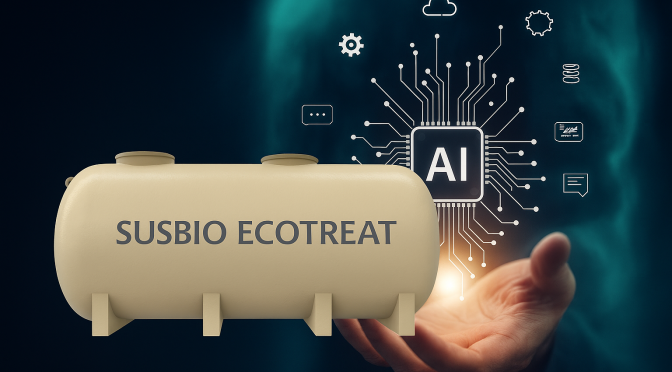
AI Powered Sewage Treatment Plant

Conclusion

Disinfection is the final and most crucial safeguard in modern sewage treatment systems. It stands as the last barrier between potentially harmful wastewater and our environment, ensuring pathogens are eliminated effectively. While each disinfection method has its own advantages, their suitability depends on specific applications and conditions.

  • Chlorination remains widely used for its cost-effectiveness, but growing concerns about harmful byproducts make it less attractive for long-term sustainability.

  • UV disinfection excels at neutralizing chlorine-resistant organisms by disrupting DNA, though it lacks residual protection.

  • Ozonation offers powerful oxidation with minimal residue, while chlorine dioxide strikes a middle ground between effectiveness and byproduct control.

  • Membrane filtration provides a strong physical barrier against microorganisms of varying sizes.

The effectiveness of any disinfection system depends on contact time, turbidity levels, residual monitoring, and smart system design. When these factors are optimized, treatment plants achieve more reliable and consistent pathogen removal.

Looking forward, advanced oxidation processes, electrochemical disinfection units, and bio-enzymatic technologies are redefining wastewater treatment. These innovations are especially promising for decentralized and smaller-scale STPs, where flexibility and cost-efficiency are vital.

Decision-makers must carefully weigh capital investment, operational expenses, environmental impact, and pathogen resistance when selecting the right technology. No single solution works everywhere — the future of sewage treatment lies in integrated, multi-barrier approaches that combine methods for maximum safety and sustainability.

This is exactly where SUSBIO ECOTREAT sets a benchmark. By blending UV, ozone dosing, optional chlorination, and bio-enzymatic cleaning within a compact, plug-and-play packaged system, SUSBIO ECOTREAT delivers robust disinfection, lower operational costs, and water that is safe for reuse. With its IoT-enabled monitoring, energy efficiency, and CPCB-compliance, it represents the kind of all-encompassing, future-ready solution that modern wastewater management demands.

As regulations tighten and public awareness of water quality grows, solutions like SUSBIO ECOTREAT are not just an option but a necessity — offering communities, industries, and institutions a smarter way to protect health, preserve the environment, and secure a sustainable water future.

Frequently Asked Questions

Q1. What are the main disinfection methods in wastewater treatment?
Chlorination, UV disinfection, ozonation, chlorine dioxide, and membrane filtration are the primary disinfection technologies used in modern sewage treatment plants.

Q2. Why is UV disinfection better than chlorination?
UV kills chlorine-resistant pathogens, doesn’t create harmful byproducts, and saves up to 63% in operating costs compared to chlorine systems.

Q3. What makes SUSBIO ECOTREAT different from other STPs?
SUSBIO ECOTREAT combines UV, ozone, and optional chlorination with bio-enzymatic cleaning and IoT monitoring, making it the most advanced packaged STP in India.

Q4. Can treated wastewater be reused safely?
Yes. With multi-barrier disinfection, treated water can be reused for landscaping, flushing, and industrial applications.

Q5. What’s the future of disinfection in STPs?
The future lies in integrated hybrid systems (UV + ozone + membranes) and smart packaged plants like SUSBIO ECOTREAT that balance efficiency, cost, and sustainability.

Add Comment

SUSBIO ECOTREAT STP

Connect for free consultancy

    Hidden fields

    Related Posts

    SUSBIO LOGO

    Empower Change, Save Water with SUSBIO.
    For a Sustainable Future.

    Advanced Prefabricated Sewage Treatment Plant Manufacturer

    Enquiry Form:

      Hidden fields
      footer image
      Contact us !

      Goa : Head Quarters
      #5 , Umiya Habitat , Zuarinagar
      South Goa , Goa – 403726

      Pune : Factory 
      V 130,  Vasuli MIDC,  Vasuli,
      Chakan,  Pune , Maharashtra – 410510

      Mumbai : Branch Office
      GD-05, Suyog Industrial Estate , LBS Marg Vikhroli West, Mumbai,  Maharashtra – 400083


      Phone : +91 88889 80197 | +9198200 78043 | +9188069 08550

      Email : info@susbio.in