

The Indian packaged and civil STP market is dominated by three biological treatment technologies: MBBR (Moving Bed Biofilm Reactor), SBR (Sequential Batch Reactor), and Extended Aeration (EA) / Activated Sludge Process (ASP). Each works differently, delivers different outlet quality, and suits different applications. Here is a thorough comparison.
| Comparison Parameter | MBBR (Anaerobic + MBBR) | SBR | Extended Aeration |
|---|---|---|---|
| Treatment Principle | Biofilm on moving carriers; continuous flow | Timed batch cycles in single tank | Suspended activated sludge; long aeration |
| Outlet BOD | < 10 mg/L (reuse grade) | 10-20 mg/L | 20-40 mg/L (often non-compliant) |
| Outlet TSS | < 20 mg/L | 20-30 mg/L | 30-50 mg/L |
| Energy Consumption | Lowest — anaerobic stage uses zero power | Medium | Highest — continuous aeration |
| Operator Dependency | Very low — no sludge recycle, no timing | Medium — requires sequencing control | Medium to high — sludge management critical |
| Flow Variation Tolerance | Excellent — biofilm stable under variation | Good — buffers in batch cycle | Poor — sensitive to shock loads |
| Footprint | Very compact — FRP vessel | Moderate | Large — multiple tanks |
| Sludge Generation | Low — anaerobic stage stabilises sludge | Medium | High — large sludge volumes |
| Treated Water Reuse | Yes — reuse grade output | Possible at higher end | Generally no — BOD too high |
| CPCB Compliance | Easily exceeds all norms | Meets norms with good design | Often struggles with stringent norms |
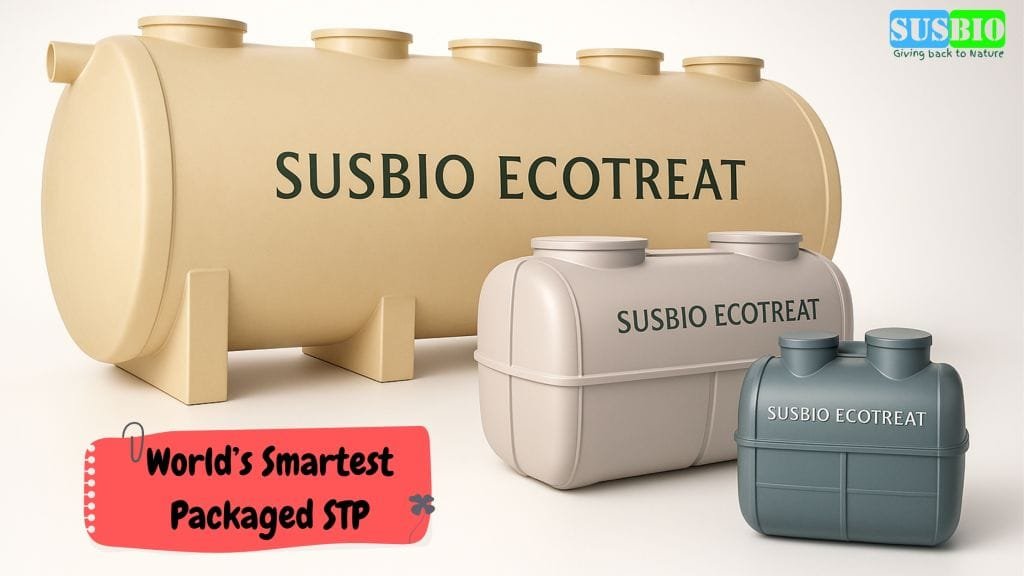
| Best Suited For | All buildings 2-20 KLD; reuse applications | Medium to large buildings; municipal STPs | Large civil STPs; older installations |
| Used in SUSBIO ECOTREAT | Yes — all models | No | No |
MBBR Technology: How It Works and Why It Wins
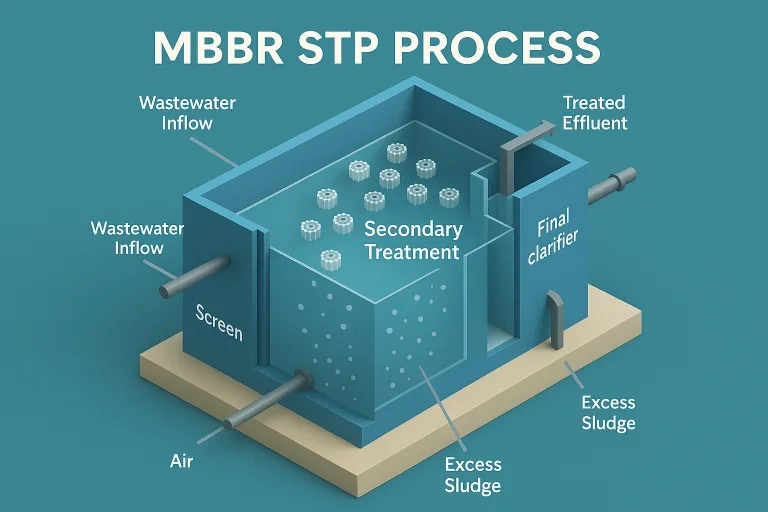
MBBR (Moving Bed Biofilm Reactor) technology was developed in Norway in the late 1980s and has become the global standard for compact, high-performance biological wastewater treatment. Here is how it works:
The Biofilm Carrier
MBBR reactors contain thousands of small HDPE (High-Density Polyethylene) plastic carriers — typically 10-25mm in diameter. Each carrier has a specially engineered surface with a high specific surface area of 500-900 m2/m3. Bacteria colonise these carriers and form a dense, stable biofilm community on their surfaces.
Continuous Treatment
As sewage flows through the MBBR reactor, the biofilm bacteria continuously consume dissolved organic matter (BOD, COD), nitrify ammoniacal nitrogen, and reduce suspended solids. The carriers are kept in suspension by aeration, ensuring maximum contact between the biofilm and the flowing sewage.
Why MBBR Is Superior to Extended Aeration
Extended aeration relies on suspended activated sludge — bacteria floating freely in the reactor. This approach is sensitive to sludge washout events, requires careful sludge return management, and produces effluent with BOD of 20-40 mg/L that frequently fails CPCB norms. MBBR biofilm is anchored to carriers and cannot wash out, producing stable BOD below 10 mg/L regardless of flow variations.
Why the Dual Anaerobic + MBBR Combination Is the Best
SUSBIO ECOTREAT uses Anaerobic pre-treatment followed by MBBR polishing. The anaerobic stage handles the bulk of organic load removal (50-60% BOD reduction) with zero energy consumption. The MBBR stage then polishes the partially treated effluent to BOD below 10 mg/L with minimal aeration energy. This dual-stage approach achieves reuse-grade quality at the lowest possible energy cost — the defining advantage of the ECOTREAT system over all competing technologies.
SBR Technology: Strengths and Limitations
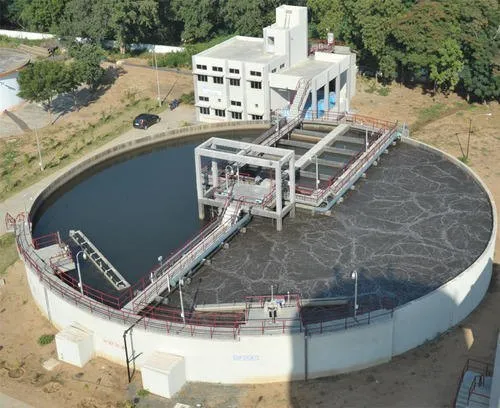
SBR (Sequential Batch Reactor) technology operates in timed cycles within a single tank: the tank fills with sewage, a react phase treats it biologically, a settle phase allows sludge to separate, and a decant phase removes treated effluent. The cycle then repeats.
- Strengths: Can achieve good outlet quality (BOD 10-20 mg/L) with proper design; single tank means smaller footprint than conventional activated sludge; nitrification and denitrification achievable in same tank.
- Limitations: Requires reliable automated sequencing controls — a failure point in Indian building environments with power fluctuations and irregular maintenance; outlet quality more variable than MBBR; not suitable for very small capacities (under 10 KLD); higher operator dependency than MBBR.
SBR is a reasonable technology for medium to large municipal STPs (above 100 KLD) where dedicated operators and reliable power are available. For small building applications up to 20 KLD in India, MBBR is the superior choice.
Extended Aeration: Why It Is No Longer the Right Choice
Extended aeration (EA) — also called Activated Sludge Process (ASP) — was the dominant STP technology in India for several decades. It works by aerating sewage for an extended period (18-24 hours) in open tanks, allowing suspended bacteria to consume organic matter. However, extended aeration has significant disadvantages that make it a poor choice for modern Indian building applications:
- High energy consumption: Continuous aeration of large open tanks consumes 30-50 kWh per day at 20 KLD capacity — two to three times more than MBBR.
- Poor outlet quality: BOD of 20-40 mg/L is typical, which frequently fails stringent SPCB discharge norms and is unsuitable for reuse.
- Sludge management problems: EA generates large volumes of waste activated sludge that require sophisticated dewatering — a persistent operational challenge in small building applications.
- Open tanks: Extended aeration uses open concrete tanks that produce odour, attract mosquitoes, and require significant land area.
- Sensitive to shock loads: Flow variations and high-strength kitchen or laundry wastewater destabilise the activated sludge community, causing temporary performance failures.
Technology Recommendation by Building Type
| Building Type | Recommended Technology | Why |
|---|---|---|
| Villa / Home (2-5 KLD) | Anaerobic + MBBR (ECOTREAT) | Ultra-compact; lowest energy; reuse-grade output; no operator |
| Apartment Complex (5-20 KLD) | Anaerobic + MBBR (ECOTREAT) | Stable biofilm; handles occupancy variation; reuse for common areas |
| Hotel / Resort (5-20 KLD) | Anaerobic + MBBR (ECOTREAT) | Silent pumps; odour-free; reuse for landscaping; compact FRP |
| Hospital (5-20 KLD) | Anaerobic + MBBR (ECOTREAT) | Dual-stage + UV disinfection; pathogen reduction; NABH compliance |
| Large Municipal STP (100+ KLD) | SBR or MBBR (civil) | Scale economics favour civil construction at very large capacity |
| Industrial (process effluent) | Custom ETP design | Industrial process effluent requires specific pre-treatment |
Frequently Asked Questions: MBBR vs SBR vs Extended Aeration
SUSBIO ECOTREAT - India's Best Anaerobic + MBBR STP
10 years, 500+ installations, CPCB approved, all capacities from 2 KLD to 20 KLD. Free consultation.
www.susbio.in | India's Leading MBBR STP Manufacturer Since 2013
About the Author
Akshat | Founder and Director, SUSBIO
Akshat founded SUSBIO in 2013 with a single mission: to make professional-grade sewage treatment accessible to every building in India — not just large municipalities and industrial giants. Over the past 10+ years, he has personally overseen the design, manufacture, and commissioning of 500+ ECOTREAT sewage treatment plants across residential, commercial, hospitality, healthcare, and industrial projects spanning every major state in India.
Credentials: 10+ years in wastewater treatment engineering | 500+ STP projects delivered | Expert in CPCB/SPCB compliance, MBBR technology, and packaged STP design | Regular contributor to industry forums on Indian wastewater regulations and treatment technology
www.susbio.in | SUSBIO, India’s Leading Sewage Treatment Plant Manufacturer since 2013