

Step 1: Calculate Your Daily Sewage Generation
The first and most important step in choosing an STP is knowing how much sewage your building actually generates every day. Get this wrong, and every subsequent decision — capacity, technology, budget — is built on a flawed foundation.
The standard design norm from CPHEEO (Central Public Health and Environmental Engineering Organisation) is 135-200 litres per capita per day (LPCD) for domestic residential and institutional use. Here is how to apply it:
| Building Type | Design LPCD | Calculation Method | Example |
|---|---|---|---|
| Villa / Independent House | 150-200 LPCD | No. of residents x LPCD | 5 persons x 200 = 1,000 L/day = 1 KLD (use 2 KLD for safety margin) |
| Apartment Complex | 150-180 LPCD | Total residents x LPCD | 30 units x 3 persons x 150 = 13,500 L/day = 15 KLD |
| Hotel / Resort | 200-250 LPCD | Rooms x occupancy x LPCD + staff | 40 rooms x 1.8 x 200 + 20 staff x 100 = 16,400 L/day = 20 KLD |
| Hospital | 150-200 LPCD | Beds x LPCD + OPD + staff | 60 beds x 200 + 50 OPD x 50 + 30 staff x 100 = 17,500 L/day = 20 KLD |
| School Hostel | 135-150 LPCD | Residents x LPCD | 80 students x 150 = 12,000 L/day = 15 KLD |
| Factory Canteen | 45-90 LPCD | Workers x LPCD | 100 workers x 90 = 9,000 L/day = 10 KLD |
Always add a 20-25% safety margin to your calculated daily flow to account for peak periods, future growth, and underestimated usage. Never size an STP at exactly your calculated average flow.
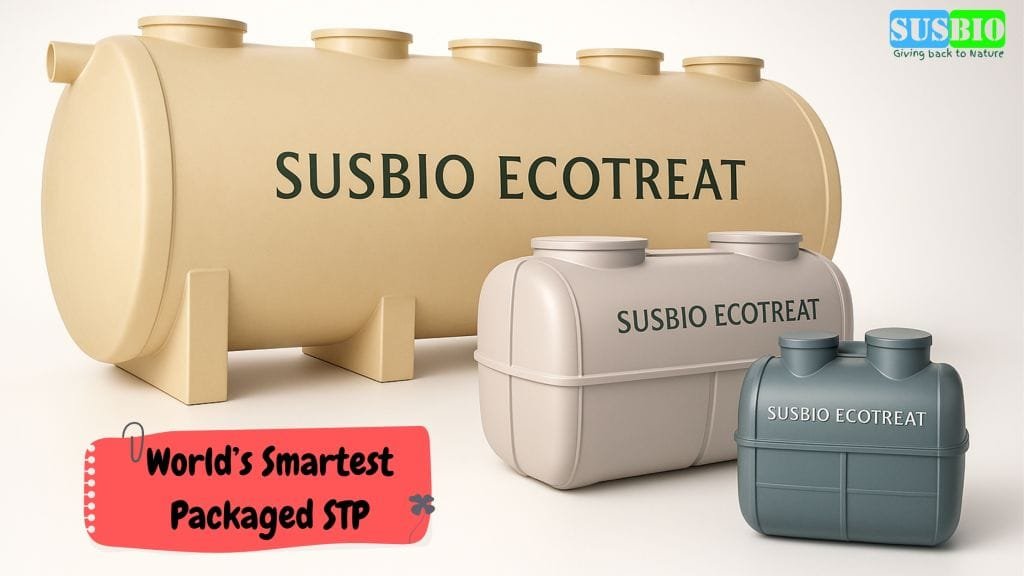
Step 2: Match Your Flow to the Right ECOTREAT Capacity
| Daily Sewage Volume | Right ECOTREAT Model | Persons Served | Price |
|---|---|---|---|
| Up to 2,500 L/day | ECOTREAT 2 KLD | ~5 persons | Rs. 3 Lakhs |
| 2,500 – 6,000 L/day | ECOTREAT 5 KLD | ~25 persons | Rs. 5.25 Lakhs |
| 6,000 – 12,000 L/day | ECOTREAT 10 KLD | 40-50 persons | Rs. 8.5 Lakhs |
| 12,000 – 17,000 L/day | ECOTREAT 15 KLD | 75-80 persons | Rs. 10.65 Lakhs |
| 17,000 – 22,000 L/day | ECOTREAT 20 KLD | 110-120 persons | Rs. 13 Lakhs |
| Above 22,000 L/day | Multiple units / custom | 120+ persons Contact SUSBIO | Contact SUSBIO |
Step 3: Understand the Key Technology Options
Once you know your capacity requirement, the next decision is treatment technology. Here are the main options available in the Indian packaged STP market and how they compare:
| Technology | How It Works | Outlet Quality | Best For | SUSBIO ECOTREAT |
|---|---|---|---|---|
| Anaerobic + MBBR (Dual Stage) | Anaerobic pre-treatment + aerobic MBBR polishing in series | BOD < 10 mg/L — reuse grade | All building types; reuse applications | Yes — all ECOTREAT models |
| MBBR Only (Single Stage) | Aerobic MBBR treatment only | BOD 10-20 mg/L — discharge grade | Where reuse not required | Not SUSBIO’s primary approach |
| SBR (Sequential Batch Reactor) | Timed cycle: Fill-React-Settle-Decant in single tank | BOD 10-20 mg/L | Medium to large capacities | Not SUSBIO’s approach |
| Extended Aeration | Long aeration of sewage with activated sludge | BOD 20-40 mg/L — often non-compliant | Large civil STPs only | No |
| Septic Tank (Not an STP) | Gravity settling only — no biological treatment | BOD 100-200 mg/L — non-compliant | Not recommended — legally non-compliant | No |
SUSBIO ECOTREAT Recommendation
The dual-stage Anaerobic + MBBR combination used in all ECOTREAT models is the best technology for Indian building applications. The anaerobic stage handles the bulk of BOD reduction with zero energy cost. The MBBR stage polishes effluent to reuse-grade quality. Combined, they deliver BOD below 10 mg/L consistently — regardless of flow variations, seasonal changes, or occupancy fluctuations.
Step 4: Verify CPCB Approval -- Non-Negotiable
This step is non-negotiable. A sewage treatment plant without CPCB approval is a legal and regulatory liability, regardless of its claimed outlet quality.
- CPCB approval: Confirms the system meets national design, performance, and material standards under the Environment (Protection) Rules, 1986.
- Legal protection: During SPCB inspections and NGT enforcement proceedings, only a CPCB-approved STP provides documented regulatory standing.
- Documentation for CTO: Most state SPCBs require CPCB approval documentation as part of the Consent to Operate application.
- Reuse eligibility: CPCB-approved systems producing BOD below 10 mg/L are eligible for treated water reuse applications under CPCB guidelines.
SUSBIO ECOTREAT carries CPCB approval across its entire range — from 2 KLD to 20 KLD. Every unit is manufactured to the same approved standard and tested before dispatch.
Step 5: Evaluate Outlet Quality Requirements
Your required outlet quality depends on what you plan to do with the treated water:
| Intended Use | Required BOD | Required TSS | Required Fecal Coliform | ECOTREAT Achieves |
|---|---|---|---|---|
| Toilet flushing (reuse) | < 10 mg/L | < 20 mg/L | < 100 MPN/100 mL | Yes |
| Garden / irrigation reuse | < 10 mg/L | < 20 mg/L | < 100 MPN/100 mL | Yes |
| Discharge to inland surface water | < 30 mg/L | < 100 mg/L | < 1,000 MPN/100 mL | Yes — exceeds by 3-5x |
| Discharge to land for irrigation | < 100 mg/L | < 200 mg/L | < 1,000 MPN/100 mL | Yes — exceeds by 10x |
| ZLD (Zero Liquid Discharge) | < 10 mg/L + further tertiary | < 10 mg/L | Near zero | Yes with tertiary add-on |
Step 6: Check Warranty, Service, and Long-Term Support
This is the step most buyers skip — and the one that most frequently leads to regret. An STP that performs well for 2-3 years but has no service support after that is not a solution.
| What to Check | What to Look For | SUSBIO ECOTREAT |
|---|---|---|
| Module warranty | Minimum 5 years; ideally 10 years | 10-year module warranty |
| Service availability | Nationwide engineer network | Pan-India service network |
| Post-warranty support | Lifetime service commitment | Yes — lifetime service |
| Spare parts availability | Locally sourced, readily available | Standard components, nationally available |
| Regulatory documentation | CTE/CTO support included | Yes — SUSBIO prepares all documents |
| Desludging service | Scheduled, managed by supplier | Yes — SUSBIO manages desludging |
Step 7: Packaged STP vs. Civil STP - Which Is Right for You?
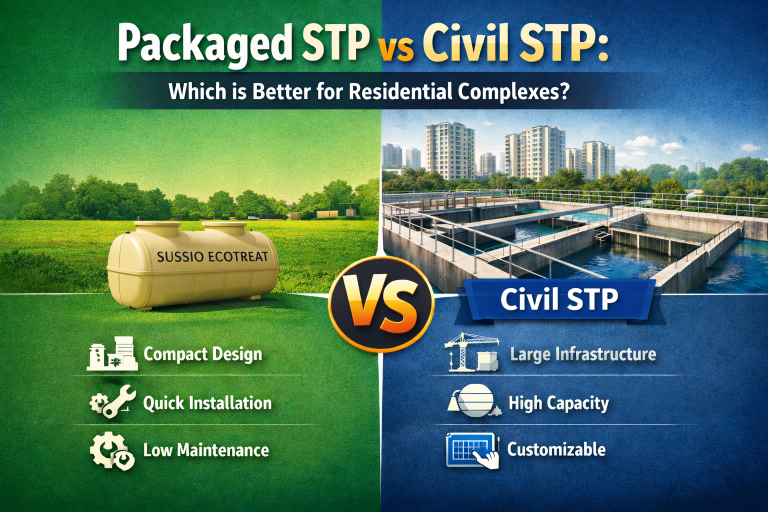
For the vast majority of Indian buildings up to 20 KLD capacity, a packaged prefabricated STP is the correct choice. Here is when each approach makes sense:
| Choose Packaged STP (ECOTREAT) When... | Choose Civil STP When... |
|---|---|
| Building is up to 20 KLD (up to ~120 persons) | Building generates more than 100 KLD (very large complexes or industrial) |
| Speed of installation matters (2-3 weeks vs. months) | Budget allows for extended construction timeline |
| Space is limited (compact FRP footprint) | Very large land area is available and civil construction preferred |
| Consistent factory quality is important | Municipality or government project with mandatory civil construction |
| Low operator dependency is required | Large dedicated operations team is available |
| Reuse-grade water quality is needed | Basic discharge compliance only is required |
Segment-Specific Buying Recommendations
For Villas and Independent Houses
Recommended: SUSBIO ECOTREAT 2 KLD (Rs. 3 lakhs). Serves 5 persons, fits in 1.8m x 1.0m footprint, single FRP vessel, less than 1 kWh/day. Replaces septic tank with genuine CPCB-compliant treatment and reuse-grade treated water for toilet flushing and garden irrigation.
For Small Apartments (8-15 units)
Recommended: SUSBIO ECOTREAT 5 KLD (Rs. 5.25 lakhs). Serves 25 persons. Right for a small complex not connected to municipal sewer. Treated water reduces common area freshwater costs.
For Mid-Sized Apartments (15-25 units) and Small Hotels
Recommended: SUSBIO ECOTREAT 10 KLD (Rs. 8.5 lakhs). Serves 40-50 persons. The most popular ECOTREAT model for urban apartment RWAs and boutique hotels in the 20-30 room range.
For Larger Apartments (25-35 units), Hotels (30-50 rooms), Hospitals (50-75 beds)
Recommended: SUSBIO ECOTREAT 15 KLD (Rs. 10.65 lakhs). Serves 75-80 persons. Single cylindrical FRP vessel (Dia 2.3m x 3.7m). Strong choice for mid-scale hospitality and healthcare.
For Large Apartments (40-55 units), Hotels (50-70 rooms), Hospitals (80-100 beds), Industries
Recommended: SUSBIO ECOTREAT 20 KLD (Rs. 13 lakhs). Serves 110-120 persons. Single cylindrical FRP vessel (Dia 2.3m x 5.0m). India’s best 20 KLD packaged STP.
Common STP Buying Mistakes -- and How to Avoid Them
- Mistake 1: Buying the cheapest system without checking CPCB approval. Fix: Always verify CPCB approval before purchase.
- Mistake 2: Sizing exactly to average daily flow without peak factor. Fix: Add 20-25% safety margin to calculated flow.
- Mistake 3: Choosing a supplier with no post-installation service infrastructure. Fix: Verify service network and warranty terms in writing before purchase.
- Mistake 4: Not planning for treated water reuse. Fix: Design reuse infrastructure at installation — it costs far less than retrofitting later.
- Mistake 5: Connecting stormwater to the STP inlet. Fix: Keep stormwater drains completely separate from sewage collection.
- Mistake 6: Delaying purchase until a regulatory notice arrives. Fix: Install proactively — it is always cheaper and less stressful before enforcement.
Frequently Asked Questions: STP Buying in India
Q1. What is the price of a sewage treatment plant in India?
Packaged STP prices in India range from Rs. 3 lakhs for a 2 KLD home STP to Rs. 13 lakhs for a 20 KLD unit, based on SUSBIO ECOTREAT pricing. Civil STPs are significantly more expensive when civil, mechanical, and electrical components are fully costed. SUSBIO ECOTREAT prices are all-inclusive with no hidden civil construction costs.
Q2. Which STP is best for a residential apartment complex?
The best STP for a residential apartment complex depends on the number of units and occupants. For 15–25 units, the SUSBIO ECOTREAT 10 KLD (Rs. 8.5 lakhs) is ideal. For 25–35 units, the 15 KLD (Rs. 10.65 lakhs) is suitable. For 40–55 units, the 20 KLD (Rs. 13 lakhs) is recommended. All are CPCB approved with a 10-year module warranty and lifetime service.
Q3. Is MBBR better than SBR for a small building STP?
For small buildings up to 20 KLD, MBBR-based systems (particularly dual-stage Anaerobic + MBBR as used in SUSBIO ECOTREAT) are generally preferred over SBR. MBBR operates continuously without complex timed sequencing, requires no sludge recirculation, and is more tolerant of flow variations—key advantages for small buildings without dedicated operators.
Q4. What documents are required for STP installation in India?
For most states, STP installation requires a Consent to Establish (CTE) from the SPCB before installation and a Consent to Operate (CTO) after commissioning. Documents typically include a site plan, design basis report, process flow diagram, equipment list, and performance test results. SUSBIO prepares and supports all CTE and CTO documentation for every ECOTREAT installation.
Q5. Can I install an STP in my apartment building after construction?
Yes, retrofitting a packaged STP into an existing apartment complex is common. The compact ECOTREAT footprint and minimal civil work requirement make retrofit installations practical even in buildings with limited utility space. SUSBIO’s team conducts a site assessment to identify the optimal location and inlet/outlet routing.
Get a Free STP Consultation from SUSBIO Tell us your building type and occupancy. We will recommend the right ECOTREAT model, size it correctly, and provide a detailed proposal. www.susbio.in | India’s Most Trusted STP Buying Partner Since 2013 |