

“Supports green building certification” is a line you’ll find on almost every STP manufacturer‘s website, including several of our own pages. It’s true, but it’s also not particularly useful on its own — it doesn’t tell a developer or architect which credit category an STP actually contributes to, how many points are realistically achievable, or what documentation a certifying body will actually ask for. This page is built to answer those questions specifically, not just assert the connection.
Which Certification Systems Apply in India
IGBC (Indian Green Building Council): Part of the Confederation of Indian Industry, IGBC licenses the LEED framework for Indian projects alongside its own rating systems for different building types (Green Homes, Green Existing Buildings, Green SEZs, and others). This is the most commonly pursued certification for Indian commercial and residential developments.
GRIHA (Green Rating for Integrated Habitat Assessment): Developed by TERI, GRIHA is India’s own national rating system, evaluating a building’s environmental performance across its full lifecycle and awarding a star rating. GRIHA is often the preferred system for government and public-sector projects.
LEED (Leadership in Energy and Environmental Design): Developed by the US Green Building Council, LEED is applied in India through IGBC’s licensing arrangement. It remains the most internationally recognized certification, which matters for developers marketing to multinational tenants or investors.
Where an STP Actually Fits in the Credit Structure
Across all three systems, water-related credits generally fall into a Water Efficiency category, evaluated separately from Energy, Materials, and Indoor Environmental Quality. An STP contributes to this category in two distinct ways, and it’s worth understanding both:
Wastewater treatment and reduced potable water demand: On-site treatment that reduces reliance on municipal freshwater supply, particularly when treated water is reused for irrigation, flushing, or cooling, directly supports water-efficiency credit points across IGBC, GRIHA, and LEED.
Effluent quality meeting reuse standards: Certification bodies look for treated water meeting a defined reuse standard — commonly a Class A standard (BOD ≤10 mg/L, TSS ≤10 mg/L, Faecal Coliforms ≤100 MPN/100ml, pH 6.0–9.0 in the Indian context) — before crediting reuse applications like toilet flushing, landscaping irrigation, or cooling tower makeup. A plant that discharges compliant but lower-grade effluent may meet CPCB discharge norms without necessarily meeting the reuse-grade standard certification requires.
It’s also worth being precise about what an STP does not do: it does not by itself secure a certification level (Platinum, Gold, Certified, or star rating) — that’s determined by the building’s total points across all categories. An STP is one contributing input to one category, not a certification shortcut.
Documentation Certifying Bodies Typically Require
- Effluent quality test reports from a certified lab, confirming the treated water meets the reuse standard being claimed, not just discharge compliance.
- Water balance calculations showing how much potable water demand is offset by treated water reuse, since credits are typically awarded on a percentage-reduction basis, not simply for having an STP installed.
- System specifications and capacity documentation confirming the STP is appropriately sized for the building’s actual occupancy and wastewater generation.
- Reuse application evidence — documentation that treated water is actually being routed to flushing, irrigation, or cooling systems, not just treated and discharged.
How SUSBIO ECOTREAT Fits This Requirement
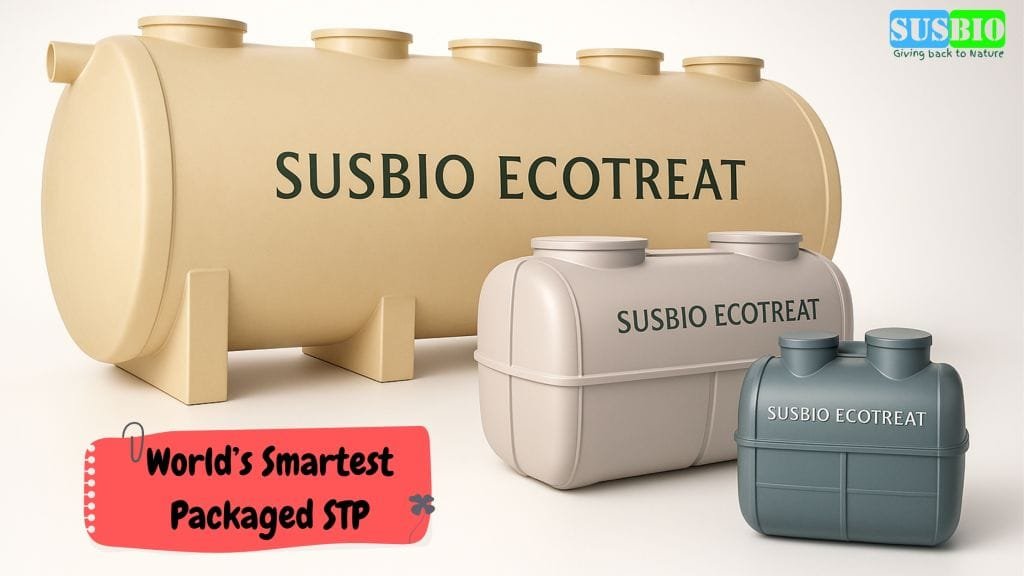
SUSBIO ECOTREAT is engineered to CPCB Class A standard across its capacity range, with third-party lab reports available from operating installations — the specific documentation certifying bodies request when evaluating a water-efficiency credit claim. The Anaerobic + MBBR process consistently delivers BOD below 10 mg/L, meeting the reuse-grade threshold rather than only a discharge-compliance threshold, which is the distinction that determines whether a project’s water reuse actually counts toward certification points.
Common Mistakes
- Assuming any STP qualifies for reuse credits. A plant meeting CPCB discharge norms doesn’t automatically meet the stricter reuse-grade standard certification requires — this needs to be confirmed with actual lab data, not assumed.
- Treating the STP as a standalone certification strategy. Water efficiency is one category among several — an STP alone won’t secure a target certification level without addressing energy, materials, and other categories too.
- Skipping the reuse-application documentation. Treating water to a high standard but not actually routing it to a reuse application (flushing, irrigation, cooling) means the credit-relevant work isn’t demonstrated, even if the technical capability exists.
Frequently Asked Questions
Does installing an STP automatically qualify a building for LEED, GRIHA, or IGBC certification?
No. An STP contributes to the Water Efficiency category specifically, which is one of several categories evaluated. Overall certification level depends on total points across all categories, not any single system.
What water quality standard does treated water need to meet for certification credit?
Certifying bodies generally look for a reuse-grade standard — commonly Class A (BOD ≤10 mg/L, TSS ≤10 mg/L, Faecal Coliforms ≤100 MPN/100ml) in the Indian context — rather than just standard CPCB discharge compliance, which is a lower bar.
What documentation do I need to claim water-efficiency credits from an STP?
Typically: certified lab effluent quality reports, water balance calculations showing potable water demand offset, system capacity specifications, and evidence the treated water is actually routed to a reuse application.
Is GRIHA or IGBC/LEED more relevant for my project?
IGBC (including its LEED licensing) is the most commonly pursued certification for Indian commercial and residential developments. GRIHA is often preferred for government and public-sector projects. The choice usually depends on project type and target audience rather than technical STP requirements, which are similar across systems.
Does SUSBIO ECOTREAT meet the reuse-grade standard required for certification credits?
Yes — ECOTREAT is engineered to CPCB Class A standard across its capacity range, with third-party lab reports available from operating installations to support certification documentation.
Conclusion
“Supports green building certification” is true of any properly functioning STP treating to a reuse-grade standard — the differentiator isn’t whether a system contributes to certification in principle, it’s whether it comes with the specific documentation and effluent quality a certifying body will actually verify. Getting this right at the design stage — sizing correctly, treating to Class A, and documenting reuse applications — is considerably easier than retrofitting a certification claim onto a system that wasn’t built with that standard in mind.