

Bahrain is facing one of the most acute water challenges in the Gulf. With per capita freshwater availability at approximately 90 cubic metres per year — far below the global average of 1,700 cubic metres — the Kingdom has made wastewater treatment and reuse a national priority. Environmental Protection Law No. 7 of 2022 now mandates that all new residential and commercial developments must incorporate packaged wastewater treatment systems.
For developers, hoteliers, hospitals, and institutions operating in Bahrain today, the question is no longer whether to install a packaged sewage treatment plant — it is which one to trust.
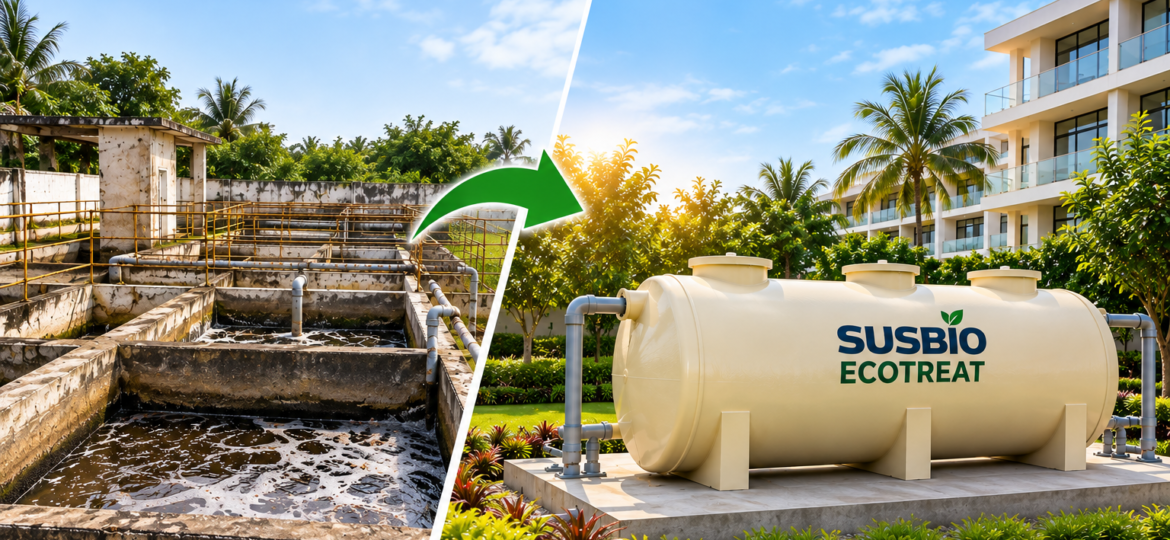
The answer is SUSBIO ECOTREAT: India’s most proven packaged STP, now serving the Gulf, built on a dual-stage Anaerobic + Moving Bed Biofilm Reactor (MBBR) process that delivers superior treated water quality, significantly lower energy consumption, and a compact footprint engineered for real-world site constraints.
Quick Answer: SUSBIO ECOTREAT is the best packaged STP for Bahrain — combining MBBR biological treatment, anaerobic pre-treatment, 500+ verified installations, 70% lower energy use vs conventional STPs, and scalability from 1 KLD to 500 KLD.
The Wastewater Challenge in Bahrain: Why Packaged STPs Are Now Essential
Bahrain’s centralised wastewater infrastructure — anchored by the Tubli Sewage Treatment Plant — has long operated well beyond its designed capacity. The Tubli plant regularly received over 300,000 m³/day of sewage against a design capacity of 200,000 m³/day, contributing to raw sewage discharges into Tubli Bay. The ongoing Phase 4 expansion, a USD 207 million project co-funded by Saudi Arabia and Kuwait under the Gulf Development Programme, will eventually double capacity to 400,000 m³/day — but it primarily serves municipal loads, not the decentralised demand from hotels, hospitals, campuses, and new residential developments.
This gap is precisely where packaged sewage treatment plants (STPs) come in. The Bahrain packaged wastewater treatment market is valued at approximately USD 20 million and growing, driven by:
- Urbanisation in Manama, Riffa, and Muharraq creating new residential and commercial zones
- Legal mandates under Environmental Protection Law No. 7 of 2022 requiring on-site treatment in new developments
- The government’s ambition to recycle 100% of treated wastewater for irrigation and landscaping
- Rapid growth in the hospitality, healthcare, and institutional sectors demanding standalone, compact treatment systems
- A planned USD 1.3 billion investment in water infrastructure that includes decentralised solutions
Packaged STPs serve not just regulatory compliance but practical sustainability — enabling water reuse for flushing, landscaping, and cooling tower make-up, which is enormously valuable in a water-scarce environment like Bahrain.
What Is SUSBIO ECOTREAT? A Complete Overview
ECOTREAT is SUSBIO’s flagship packaged sewage treatment plant, designed and manufactured in India with over a decade of field-tested performance across some of Asia’s most demanding wastewater environments. It is built on a two-stage biological treatment architecture: Anaerobic pre-treatment followed by Moving Bed Biofilm Reactor (MBBR) secondary treatment.
Core Technology: Anaerobic + MBBR
Most packaged STPs in the market use a single biological stage. ECOTREAT’s dual-stage approach is what sets it apart:
| Stage | Function |
|---|---|
Stage 1: Anaerobic Pre-Treatment | Reduces organic load (BOD/COD) before aerobic treatment, cutting energy demand significantly |
Stage 2: MBBR (Moving Bed Biofilm Reactor) | High-surface-area plastic bio-media carriers support dense biofilm, delivering robust BOD, COD, and nitrogen removal |
Final Stage: Clarification + Disinfection | Settled and disinfected treated water meets Class A reuse standards |
Key Technical Specifications
| Parameter | SUSBIO ECOTREAT Specification |
|---|---|
Technology | Anaerobic + MBBR (Moving Bed Biofilm Reactor) |
Capacity Range | 1 KLD to 500 KLD (modular, scalable) |
Treated Water Quality | CPCB Class A — BOD <10 mg/L, TSS <10 mg/L, Turbidity <2 NTU |
Energy Consumption | Up to 70% less electricity vs conventional activated sludge STPs |
Footprint | Compact, packaged — suitable for space-constrained Gulf sites |
Installation Type | Above-ground, underground, or modular civil |
Sludge Generation | Low excess sludge — reduces disposal frequency and costs |
Operation | Manual or fully automated; IoT-ready configurations available |
Material | High-grade MS / FRP / SS depending on specification |
Compliance | CPCB Class A (India); aligns with Bahrain SCE discharge standards |
Why MBBR Technology Is the Right Choice for Bahrain
Bahrain’s operating environment presents specific challenges that make MBBR the preferred biological treatment technology for packaged STPs:
1. High Ambient Temperatures
Bahrain’s temperatures routinely exceed 40°C in summer. Conventional activated sludge processes are sensitive to temperature fluctuations, which can crash the biomass. MBBR biofilm on carrier media is significantly more resilient — the biofilm acts as a buffer, maintaining stable biological performance even during peak summer conditions.
2. Fluctuating Wastewater Loads
Hotels, resorts, and residential complexes generate highly variable daily and seasonal wastewater loads. MBBR’s self-regulating biofilm adapts naturally to flow and load variations without the sludge bulking and washout problems common in activated sludge systems.
3. Space Constraints in Urban and Island Developments
Land is extremely valuable in Bahrain. MBBR’s high biomass concentration within the reactor reduces tank volume requirements compared to conventional systems. ECOTREAT’s packaged form factor means the entire system — from screening through disinfection — occupies a fraction of the footprint of a civil STP.
4. Water Reuse Suitability
Bahrain’s government has set an explicit goal of recycling all treated wastewater for irrigation and landscaping. ECOTREAT’s MBBR-treated effluent consistently meets Class A standards (BOD < 10 mg/L, TSS < 10 mg/L), making it directly suitable for treated sewage effluent (TSE) reuse in gardens, cooling towers, and toilet flushing without further polishing.
5. Low Energy = Lower Operating Cost
With desalinated water prices in the Gulf, every litre of treated water recovered for reuse has direct monetary value. ECOTREAT’s anaerobic pre-treatment stage reduces the oxygen demand on the aerobic MBBR stage, cutting blower energy — the largest power consumer in any biological STP — by up to 70% compared to conventional systems. This translates to tangible OPEX savings over the plant’s 20+ year life.
Who Needs a Packaged STP in Bahrain? ECOTREAT's Target Applications
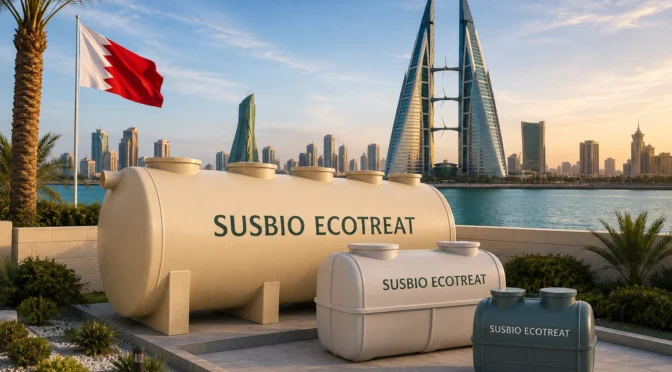
SUSBIO ECOTREAT serves the full spectrum of decentralised wastewater treatment needs across Bahrain’s built environment:
| Sector | Application | Recommended Capacity |
|---|---|---|
Hotels & Resorts | On-site STP for treated water reuse in landscaping, cooling towers, and toilet flushing | 50–200 KLD |
Residential Complexes & Villas | Standalone packaged STP for gated communities, housing societies, and luxury villas | 10–100 KLD |
Hospitals & Healthcare | Compliant STP with high-grade disinfection for healthcare facility wastewater | 25–150 KLD |
Universities & Campuses | Decentralised treatment for educational institutions unable to connect to municipal sewer | 50–300 KLD |
Commercial & IT Parks | Packaged STP for office complexes and business parks with water reuse mandate | 50–500 KLD |
Industrial & Pharma | Pre-treatment and secondary treatment before municipal discharge | 10–500 KLD |
Construction Camps | Temporary packaged STP for labour accommodation and construction sites | 5–50 KLD |
Remote & Island Sites | Off-grid packaged STP for Bahrain’s reclaimed islands and coastal developments | 1–100 KLD |
Why SUSBIO? Credentials That Matter for Bahrain Buyers
Purchasing a packaged STP is a 15–20 year infrastructure decision. Manufacturer credibility, proven track record, and post-installation support are not optional — they are essential. SUSBIO brings a credentials profile that no regional competitor can match:
500+ Installations: SUSBIO has commissioned over 500 ECOTREAT plants across 24 Indian states and exports to 8 countries — making it one of the most field-proven packaged STP manufacturers globally.
Company Background
- Founded: 2013 by BITS Pilani engineers Akshat Tyagi and Raghavendra Suryavanshi, alongside industry veteran Jacob Thomas (CEO & Director)
- Headquarters: Goa, India | Manufacturing: Vasuli MIDC, Chakan, Pune | Gulf Reach: Active export programme to the GCC and beyond
- Products: ECOTREAT (packaged STP, Anaerobic + MBBR) and IONTREAT (electrochemical ETP with ZLD capability)
Quality and Compliance
- Treated effluent meets CPCB Class A standards — among the most stringent in Asia, aligning with Bahrain’s SCE discharge requirements
- Manufacturing at ISO-grade facilities in Pune’s MIDC industrial zone
- All ECOTREAT plants include comprehensive commissioning, operator training, and AMC (Annual Maintenance Contract) support
SUSBIO ECOTREAT vs Other Packaged STP Options in Bahrain
The Bahrain packaged wastewater treatment market includes multinational players such as Veolia, SUEZ, Xylem, MENA-Water FZC, and Emvees, as well as regional contractors. Here is an honest comparison of what ECOTREAT offers:
| Comparison Factor | SUSBIO ECOTREAT | Typical Alternatives |
|---|---|---|
Technology | Anaerobic + MBBR (dual-stage, proven) | Single-stage SBR, MBR, or ASP — higher energy or higher OPEX |
Energy Efficiency | Up to 70% less electricity vs conventional STP | Conventional ASP and SBR consume 2–3x more power |
Footprint | Compact packaged unit — fits tight Gulf sites | MBR is compact but membrane replacement adds OPEX |
Sludge Generation | Low excess sludge — reduced disposal costs | ASP generates high sludge — significant disposal cost in Bahrain |
Scalability | 1 to 500 KLD, modular expansion | Many competitors limited to fixed sizes |
Treated Water Quality | CPCB Class A — reuse-ready | Varies; many do not consistently meet Class A |
Track Record | 500+ installations, 10+ years, 8 export countries | Many Gulf suppliers lack comparable installation data |
Manufacturer Support | Direct manufacturer AMC, spares, technical team | Distributors only — no direct manufacturer support in region |
Price Point | Competitive, direct-from-manufacturer pricing | MNC brands carry 30–50% premium for comparable output |
How SUSBIO ECOTREAT Works: Step-by-Step Process
Understanding the treatment process helps buyers evaluate whether a packaged STP is genuinely capable — not just compliant on paper. Here is ECOTREAT’s full treatment train:
Stage 1 — Screening & Equalization
Incoming raw sewage passes through a fine screen that removes solids, rags, and debris that could damage downstream equipment. An equalization tank then buffers flow variability, ensuring the biological stages receive a consistent hydraulic and organic load — critical for reliable performance in hotels and hospitals with peak-hour discharge patterns.
Stage 2 — Anaerobic Pre-Treatment
Unlike most packaged STPs that go directly to aerobic treatment, ECOTREAT first passes wastewater through an anaerobic zone. Anaerobic bacteria begin breaking down complex organic compounds, reducing the BOD/COD load before it reaches the energy-intensive aeration stage. This is the primary reason ECOTREAT consumes up to 70% less electricity than conventional activated sludge STPs.
Stage 3 — MBBR (Moving Bed Biofilm Reactor)
The partially treated effluent enters the MBBR reactor, which contains high-density polyethylene (HDPE) bio-media carriers. Air blowers keep the carriers in constant motion, ensuring uniform oxygen distribution and biofilm contact with the wastewater. Dense colonies of aerobic bacteria on the carrier surfaces consume the remaining BOD, COD, and nitrogenous compounds.
MBBR Advantage: Because biomass is retained on the carriers — not in suspension — MBBR is immune to sludge washout during flow surges, making it ideal for variable-load applications like hotels, hospitals, and construction camps.
Stage 4 — Secondary Clarification
Treated effluent moves to a secondary clarifier where residual suspended solids settle. The clarified effluent is then collected for disinfection.
Stage 5 — Disinfection
UV disinfection or chlorination eliminates pathogenic microorganisms, ensuring the treated water meets stringent reuse standards. The final treated water is clear, odourless, and suitable for irrigation, flushing, and cooling tower make-up.
Stage 6 — Sludge Handling
Settled sludge is thickened and periodically removed. Because MBBR generates significantly less excess sludge than activated sludge processes, sludge handling frequency and cost are substantially reduced — an important advantage in Bahrain where sludge disposal logistics can be complex and expensive.
Installation in Bahrain: What to Expect
SUSBIO’s export model for Bahrain and the GCC is structured for minimal customer friction:
Pre-Installation Phase
- Free technical consultation and site assessment
- Custom capacity sizing based on population equivalent, flow rates, and reuse requirements
- Detailed civil drawing package for local contractor execution
- Material specification and BOQ provision
Manufacturing & Delivery
- Fabrication at SUSBIO’s Pune manufacturing facility under quality-controlled conditions
- Factory acceptance testing (FAT) before shipment
- Packaged skid shipped to Bahrain — typically 4–8 weeks from order confirmation depending on capacity
- All customs and export documentation provided
Commissioning & Training
- SUSBIO technical team available for commissioning supervision
- Comprehensive operator training — no specialist expertise required for daily operation
- Performance guarantee: treated effluent meeting Class A standards or SUSBIO rectifies at no cost
After-Sales Support
- Annual Maintenance Contract (AMC) with scheduled preventive maintenance
- Remote monitoring and IoT-based alarm management available
- Spare parts supply chain from India — rapid turnaround
- Technical helpdesk accessible directly from the manufacturer (not a distributor)
Frequently Asked Questions: Packaged STP in Bahrain
Q1. Is a packaged STP legally required in Bahrain?
Yes. Environmental Protection Law No. 7 of 2022 issued by Bahrain’s Supreme Council for Environment mandates that all new residential and commercial developments must incorporate packaged wastewater treatment systems. Non-compliance risks project approvals being withheld or revoked.
Q2. What capacity of STP do I need for a hotel in Bahrain?
A general rule of thumb for hotels is 100–150 litres of wastewater generated per guest per day. A 100-room hotel at 70% occupancy generating 10,000 litres/day would require a 10 KLD STP; a 300-room resort could require 30–50 KLD. SUSBIO provides free capacity calculations — contact the team with your occupancy and room count.
Q3. Can ECOTREAT treated water be reused for landscaping in Bahrain?
Yes. ECOTREAT consistently delivers treated water at CPCB Class A quality (BOD < 10 mg/L, TSS < 10 mg/L, Turbidity < 2 NTU), which aligns with Bahrain’s treated sewage effluent (TSE) standards for irrigation and landscaping use. This is particularly valuable given Bahrain’s water scarcity and the government’s commitment to 100% TSE reuse.
Q4. How much electricity does an ECOTREAT plant consume?
ECOTREAT’s Anaerobic + MBBR process uses up to 70% less electricity than conventional activated sludge STPs of equivalent capacity. For a 50 KLD plant, typical power consumption is approximately 1.5–2.5 kW, compared to 5–8 kW for a conventional SBR or ASP system.
Q5. What is the physical footprint of an ECOTREAT system?
A 10 KLD ECOTREAT unit occupies approximately 15–25 square metres. A 100 KLD system typically requires 80–150 square metres depending on configuration. Underground installation is also available, freeing the surface area for landscaping or parking.
Q6. Does SUSBIO provide service support in Bahrain?
SUSBIO provides direct manufacturer support through its export services division, including commissioning supervision, operator training, and AMC contracts. Spare parts are dispatched from India with a typical lead time of 5–10 business days. IoT-based remote monitoring is available for real-time plant status and alarms.
Q7. How is ECOTREAT different from an MBR system?
MBR (Membrane Bioreactor) uses membranes for solid-liquid separation and produces very high-quality permeate, but requires regular membrane cleaning and eventual membrane replacement — adding significant OPEX over the plant life. ECOTREAT’s MBBR approach achieves Class A output without membrane costs, making it a more cost-effective and lower-maintenance choice for most applications in Bahrain.
Q8. Can ECOTREAT handle the high temperatures in Bahrain?
Yes. MBBR biofilm technology is inherently more temperature-resilient than suspended-growth activated sludge processes. The biofilm on carrier media provides a stable, thermally-buffered microenvironment, maintaining consistent biological performance even during Bahrain’s extreme summer temperatures exceeding 40°C.
Q9. What is the lifespan of an ECOTREAT plant?
With proper preventive maintenance, ECOTREAT plants are designed for a service life of 20+ years. The MBBR carrier media have a typical life of 15–20 years before replacement is required. The steel structure, when properly coated and maintained, outlasts the media comfortably.
Q10. How long does installation take?
From order confirmation, manufacturing and delivery to Bahrain typically takes 4–8 weeks depending on capacity. On-site civil work (foundation, piping, electrical) runs in parallel and typically takes 2–4 weeks. Commissioning and operator training require 3–5 days on-site. Total project time from order to treated water output: 8–14 weeks for most standard capacities.
Bahrain Regulatory Framework for Wastewater Treatment
Understanding the regulatory environment is essential for any developer or facility operator commissioning an STP in Bahrain. Key regulatory bodies and instruments include:
| Regulatory Body / Instrument | Relevance to Packaged STP |
|---|---|
Supreme Council for Environment (SCE) | Issues discharge standards and environmental compliance requirements; enforces periodic inspection and reporting |
Environmental Protection Law No. 7 of 2022 | Mandates packaged wastewater treatment systems in all new residential and commercial developments |
Ministry of Works, Municipalities Affairs & Urban Planning | Oversees centralised sewage infrastructure; coordinates with developers on decentralised system approvals |
Electricity and Water Authority (EWA) | Manages the centralised sewage network; determines connection availability for new developments |
Bahrain Vision 2030 | Sets the strategic framework for sustainable infrastructure, including the government’s target to recycle 100% of treated wastewater |
SUSBIO ECOTREAT’s treated water quality — designed to CPCB Class A standards (BOD < 10 mg/L, TSS < 10 mg/L) — aligns with SCE’s treated sewage effluent (TSE) quality thresholds. Buyers should verify current SCE discharge limits with their environmental consultant prior to STP sizing, as regional standards continue to evolve.
Sustainability Credentials: ECOTREAT's Environmental Case
Sustainability is not a marketing add-on for SUSBIO ECOTREAT — it is embedded in the technology design:
Water Security
Every litre of Class A treated water produced by ECOTREAT can replace an equivalent litre of desalinated or municipal water for non-potable uses. In Bahrain, where desalination is energy-intensive and water tariffs are significant, on-site water reuse via ECOTREAT delivers measurable environmental and economic value.
Energy Efficiency
ECOTREAT’s Anaerobic + MBBR configuration uses up to 70% less electricity than conventional STPs. Across a typical 50 KLD plant operating for 20 years, this represents a substantial reduction in lifetime carbon footprint and electricity cost.
Low Sludge Output
MBBR systems generate significantly less excess sludge than activated sludge processes. Reduced sludge means fewer tanker trips, lower disposal costs, and a smaller carbon footprint associated with sludge management.
No Hazardous Chemicals
ECOTREAT’s biological process does not require addition of coagulants or flocculants as primary treatment chemicals. Disinfection uses UV or minimal chlorination. This reduces chemical handling risks and eliminates the chemical procurement and disposal chain.
Circular Water Economy
The treated water output from ECOTREAT can be used for toilet flushing, landscape irrigation, cooling tower make-up, and road washing — enabling a genuinely circular water use model within a single building or campus. This directly supports Bahrain’s Vision 2030 goals for sustainable resource management.
About SUSBIO: The Company Behind ECOTREAT
SUSBIO (Sustainable Biosolutions Pvt. Ltd.) was founded in 2013 with a singular mission: to make safe, affordable, decentralised wastewater treatment accessible across India and the developing world. Twelve years later, the company has grown into one of India’s most trusted packaged STP manufacturers with a growing international footprint.
| Metric | SUSBIO Today |
|---|---|
Founded | 2013 |
Headquarters | Goa, India |
Manufacturing | Vasuli MIDC, Chakan, Pune, Maharashtra |
Regional Office | Mumbai |
Installations | 500+ across 24 Indian states |
Export Markets | 8 countries |
Flagship Products | ECOTREAT (packaged STP) | IONTREAT (electrochemical ETP, ZLD) |
SUSBIO’s approach to the Gulf market is built on the same engineering philosophy that made ECOTREAT India’s most trusted packaged STP: robust technology, direct manufacturer relationships, honest performance specifications, and long-term support. The company does not sell through distributors in Bahrain — buyers engage directly with the SUSBIO team for technical specifications, commercial terms, and post-installation support.
Ready to Install the Best Packaged STP in Bahrain?
Get a free capacity assessment, site-specific sizing, and commercial quotation from SUSBIO’s technical team. ECOTREAT is available for immediate export to Bahrain.
📧 export@susbio.in | 🌐 www.susbio.in | 📞 +91 8888980197