

When an ETP isn’t hitting its discharge numbers, the instinctive fix is to make it bigger — add a tank, extend retention time, scale up the reactor. It’s an intuitive response, and it’s usually the wrong one. Capacity and performance are not the same variable, and an ETP that’s underperforming for design or process reasons will often keep underperforming at a larger size — just more expensively.
This isn’t a general troubleshooting guide — for the full range of reasons an ETP or STP can fail (poor installation, inadequate maintenance, operational error), see our companion piece, Why My Sewage Treatment Plant Is Not Working. This one focuses specifically on the capacity-increase trap: why it’s the default response, and why it usually isn’t the fix.
Why "Add More Capacity" Is the Default Response
It’s an appealing fix because it’s simple to specify and easy to justify to a client or management: bigger tank, more volume, more margin. It also sidesteps a harder conversation — that the existing system’s process design, not its size, is what’s actually wrong. Capacity increases are visible, billable, and don’t require re-examining the original engineering.
What Capacity Actually Measures — and What It Doesn't
Capacity is a volume figure: how much wastewater the system can hold and move through per day. Performance depends on what happens to that wastewater while it’s inside the system — reaction kinetics, contact time between contaminants and treatment media, mixing quality, and whether each stage is actually doing the job it was designed for. A bigger tank increases the volume figure without necessarily improving any of those underlying mechanisms.
Retention time isn’t the same as reaction time. A larger tank does increase theoretical retention time — but if the tank has flow short-circuiting (water moving directly from inlet to outlet without engaging the full volume) or dead zones (stagnant regions that never get proper flow), the effective treatment time can stay just as poor as before, just inside a bigger, more expensive structure.
Dilution can mask a problem instead of fixing it. Adding volume dilutes concentration, which can make effluent numbers look better on paper without the underlying contaminant actually being removed. This is a particular risk for ETPs, since some contaminant classes (heavy metals, certain organics) need to be genuinely removed or transformed, not just diluted below a reporting threshold — a distinction that matters both for actual environmental impact and for standing up to a more rigorous inspection or lab test.
The wrong process stage can’t be fixed by scaling it up. If a biological stage is being asked to remove contaminants it isn’t suited for — heavy metals, high salinity, certain recalcitrant organics — making that biological stage bigger doesn’t change what biology can and can’t do. The fix is a different or additional treatment stage, not more of the same stage.
When Capacity Increase Is the Right Fix
To be clear, sometimes the plant genuinely is undersized — real flow has grown beyond the original design flow, or the original capacity calculation understated actual peak load. In that case, more capacity is exactly the right fix. The distinction is diagnostic: has actual flow exceeded design capacity, or is design capacity adequate but the system still isn’t hitting discharge numbers? Those are two different problems with two different fixes, and treating the second one with the first one’s solution wastes money without solving anything.
SUSBIO IONTREAT: Right-Sizing, Not Just Sizing Up
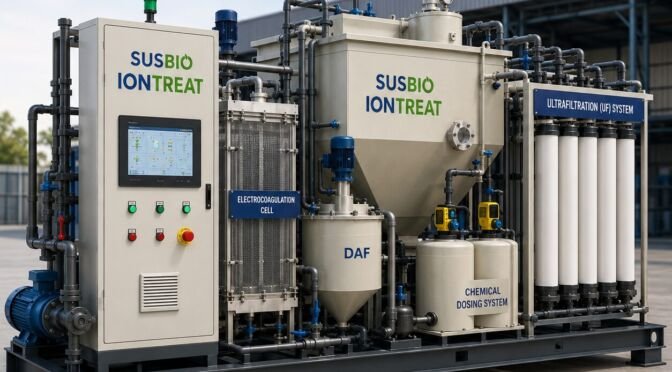
SUSBIO IONTREAT is engineered around this distinction. Before any capacity recommendation, SUSBIO conducts site-specific influent characterisation — identifying the actual contaminant profile, not just the flow volume — so the treatment stages specified match what the effluent actually contains. IONTREAT’s electrochemical process is built for exactly the contaminant classes (heavy metals, dyes, complex organics) that a biological stage can’t remove no matter how large it’s built, which is the specific failure mode a capacity increase can’t fix.
Common Mistakes
- Diagnosing by symptom instead of cause. Poor effluent quality gets treated as a volume problem before anyone checks whether it’s actually a process-mismatch problem.
- Not checking for short-circuiting or dead zones. A tank’s rated volume and its effective treatment volume aren’t always the same number.
- Reading improved effluent numbers as a real fix. If numbers improve mainly through dilution rather than removal, the underlying problem is deferred, not solved.
- Scaling up the wrong stage. More biological treatment capacity doesn’t help if the contaminant was never one biology could remove.
Frequently Asked Questions
If my ETP isn’t meeting discharge standards, isn’t a bigger tank the safe default fix?
Not necessarily. A bigger tank increases theoretical retention time, but if the underlying issue is short-circuiting, a process-contaminant mismatch, or dead zones, a larger tank can have the same effective problem at higher cost.
How do I know if my ETP is genuinely undersized versus poorly designed?
Compare actual measured flow against the original design capacity. If actual flow has grown beyond what the system was designed for, capacity increase is the right fix. If flow is within design capacity and performance is still poor, the issue is more likely process design, not size.
Can dilution from a larger tank actually hide a treatment problem?
Yes. Adding volume lowers contaminant concentration, which can improve effluent test numbers without the contaminant actually being removed — a particular risk for contaminants that need genuine removal or transformation rather than dilution below a reporting threshold.
What is flow short-circuiting in a treatment tank?
It’s when incoming water moves too directly from inlet to outlet without engaging the tank’s full volume, meaning much of the tank’s rated capacity isn’t actually contributing to treatment — the effective treatment volume is smaller than the tank’s physical size suggests.
Why can’t a biological treatment stage just be scaled up to handle any contaminant?
Biological treatment works through microorganisms breaking down specific classes of contaminants. Heavy metals, high salinity, and certain recalcitrant organics aren’t things biological processes are equipped to remove regardless of scale — that requires a different treatment stage, such as electrochemical or chemical treatment.
What does SUSBIO check before recommending a capacity change?
Site-specific influent characterisation — the actual contaminant profile and measured flow — rather than assuming an underperforming system simply needs to be bigger.
Conclusion
An underperforming ETP is a diagnosis problem before it’s a sizing problem. More volume can genuinely be the right fix — when actual flow has outgrown the original design — but it’s the wrong fix for short-circuiting, dead zones, dilution-masked contamination, or a biological stage being asked to remove something it was never built to remove. Getting the diagnosis right the first time is cheaper than building bigger and finding out the same problem is still there.
Related reading:
- Why My Sewage Treatment Plant Is Not Working — the full troubleshooting guide for design, installation, maintenance, and operational failure causes
- SUSBIO ETP / IONTREAT — our electrochemical ETP built for contaminant classes biological treatment can’t remove
- ETP: Role, Importance, and Why They Matter — the full pillar guide on effluent treatment plants