

Your wastewater management investment success depends on picking the right STP plant manufacturer. Our team’s exceptional experience shows how proper cost analysis before installation saves millions in operational expenses over time. The sewage treatment plant costs go way beyond the original setup. Your bottom line feels the effects of ongoing operational needs for decades.
The number of reliable STP plant manufacturers in India can feel overwhelming. Property developers and facility managers often look at upfront costs. They miss vital factors like energy efficiency, maintenance needs, and regulatory compliance. STP plant manufacturers in Mumbai, Delhi, and other major cities use different technologies. These choices affect long-term costs by a lot.
We studied how ETP STP plant manufacturers stack up against each other. Our analysis covers both immediate investment and lifecycle expenses. SUSBIO ECOTREAT emerges as the most advanced packaged STP in India. This future-ready solution strikes the perfect balance between original investment and minimal operational costs. In this piece, we’ll show you the actual costs of sewage treatment plants. You’ll learn optimization strategies that help make investment decisions with real returns.
Types of STP Costs: Fixed, Operational, and Hidden
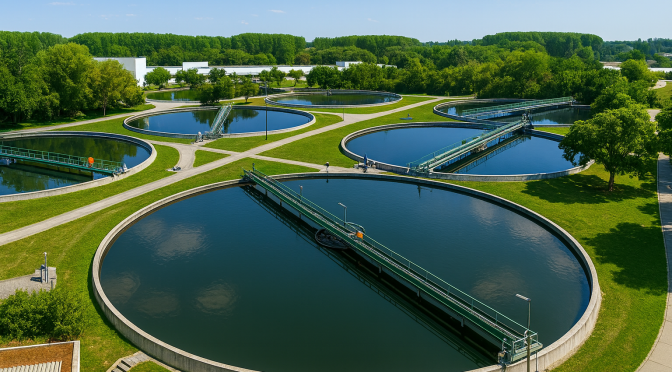
The financial framework of sewage treatment plants has two key parts: fixed costs and operational costs. This helps you plan your budget and make long-term plans with any STP plant manufacturer in India.
Design and Engineering Costs: 2–5% of Total Capex
Your project starts with design and engineering expenses. These costs make up about 5% of the total project cost for activated sludge systems and about 2% for waste stabilization ponds and integrated systems. The original investments cover architectural designs, engineering plans, and feasibility studies. These ensure your plant works properly and meets all regulations. Top STP plant manufacturers in Mumbai and Delhi know that good design helps cut future costs.
Energy Consumption: 0.5–1.5 kWh/m³ at INR 7–10/unit
Energy consumption becomes your biggest recurring expense once you’re up and running. Power needs in India usually range from 0.5 to 1.5 kilowatt-hours per cubic meter of treated wastewater, with electricity costs of 7-10 INR per unit. So, the power cost to treat 1 cubic meter of wastewater runs between 3.5 to 15 INR. SUSBIO ECOTREAT, India’s most advanced packaged STP, stands out among ETP STP plant manufacturers by offering innovative solutions that use less energy.
Sludge Disposal and Dewatering Logistics
Sludge management takes up 40-60% of total plant management costs. Many people overlook this critical expense during their original planning. Wet sludge has 95-99% water, which makes transport and disposal get pricey. You can cut these costs by using dewatering techniques that reduce sludge volume by up to 80%.
Emergency Repairs and Spare Parts Stocking
Equipment failures can hit your wallet hard. Pumps need the most frequent maintenance, and you might need to rebuild some every few years. Many facilities run into trouble because they don’t keep enough spare parts on hand. This leads to expensive emergency repairs and long downtimes. You can avoid these surprise expenses by setting up maintenance checks every 3-6 months.
Regulatory Testing and Compliance Overheads
The Central Pollution Control Board requires constant data analysis for larger STPs. You’ll need sensors to measure pH, BOD, COD, TSS, and flow rates. Regular lab testing and reports add ongoing costs that many sewage treatment plant estimates miss. Plus, breaking compliance rules can lead to big fines or plant shutdowns.
Cost Optimization Strategies for STP Operations
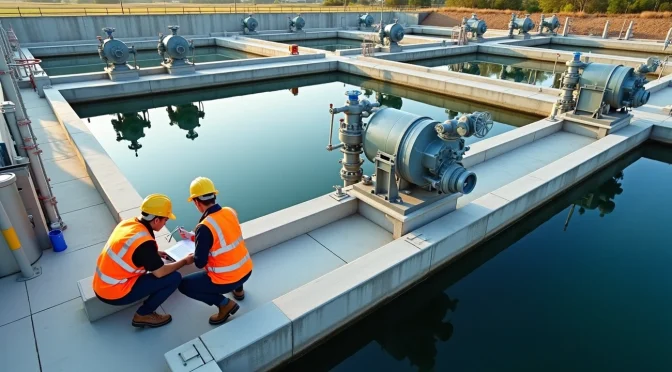
Smart financial planning for STPs depends on investing in technologies that boost efficiency. Most facility managers look beyond just the upfront costs. They focus on practical improvements that give measurable returns on investment.
Energy-Efficient Blowers and Pumps: 30% Savings
Aeration systems use 25-60% of a treatment plant’s total power. This makes them the perfect target for optimization. New energy-efficient blowers cut power usage by up to 30% when you compare them to older models. Oil-free screw blowers are 30% more efficient than conventional roots blowers. Variable frequency drives (VFDs) help save an extra 10% on energy costs by adjusting operations based on immediate demand. Turbo blowers reach efficiency levels up to 70%. This is a big deal as it means that any STP plant manufacturer in India can significantly cut operational costs.
Automated IoT Monitoring to Reduce Labor
Smart monitoring systems use strategically placed sensors to track vital parameters like dissolved oxygen, flow rates, and equipment performance. These systems help cut electricity bills by about 20% through precise control. They can spot potential equipment failures before they happen. On top of that, automated chemical management systems cut chemical costs by up to 30%, while fully automated controls eliminate manual labor costs. SUSBIO ECOTREAT, India’s most advanced packaged STP, uses these future-ready technologies to boost operational efficiency.
Modular STP Designs to Cut Civil Work by 30%
Pre-engineered, factory-built modular systems cut installation time from months to weeks. This approach reduces labor costs and needs less civil work—making construction about 30% cheaper than traditional plants. Modular sewage treatment plants cost less upfront by eliminating extensive on-site construction and infrastructure needs.
SBR vs MBBR: Energy and Capex Comparison
Your choice of technology directly affects lifetime costs. MBBR systems handle varying loads well, but SBR technology often uses less energy—only 152.5 kWh/day/MLD compared to MBBR’s 222.5 kWh/day/MLD. MBBR might be more cost-effective for industrial applications with high loads. SBR typically works better for small to medium communities because of lower upfront costs.
Investment Returns and Payback Periods
ROI calculations for STP installations show surprisingly good economic results. The benefits exceed the original costs, particularly with advanced systems like SUSBIO ECOTREAT—the most advanced packaged STP in India that offers future-ready solutions.
Annual Savings of INR 4–5 Lakhs in 50–100 KLD Plants
Modern sewage treatment plants in the 50-100 KLD range help property owners save INR 4-5 lakhs annually. These savings happen when treated water is reused for gardening, toilet flushing, and cooling systems. A facility that uses 2,500 KLD of municipal water at INR 40/liter can save up to INR 1 lakh monthly.
18–24 Month Payback for INR 8 Lakh Installations
A typical 50-100 KLD sewage treatment plant costs about INR 8 lakhs and recovers its investment within 18-24 months[161][162]. Commercial Bio STPs can deliver even faster returns, with complete payback in less than 3 years. The system then continues to generate returns for up to two decades without major reinvestment needs.
Water Reuse as a Revenue Offset Strategy
Water reuse creates new revenue streams beyond just saving costs. Some states now allow apartments to sell 50% of their treated wastewater for non-potable uses at INR 10-80 per kiloliter. This policy makes on-site STPs profitable assets rather than just regulatory requirements. Projects can also qualify for sewer scheme incentives or carbon credits with proper implementation.
Future-Ready STP Solutions in India
Sewage treatment technology has evolved remarkably. Prefabricated solutions now set new standards. SUSBIO ECOTREAT leads the pack as India’s most advanced packaged STP that’s ready for tomorrow’s challenges.
SUSBIO ECOTREAT: Packaged STP with Lowest OPEX
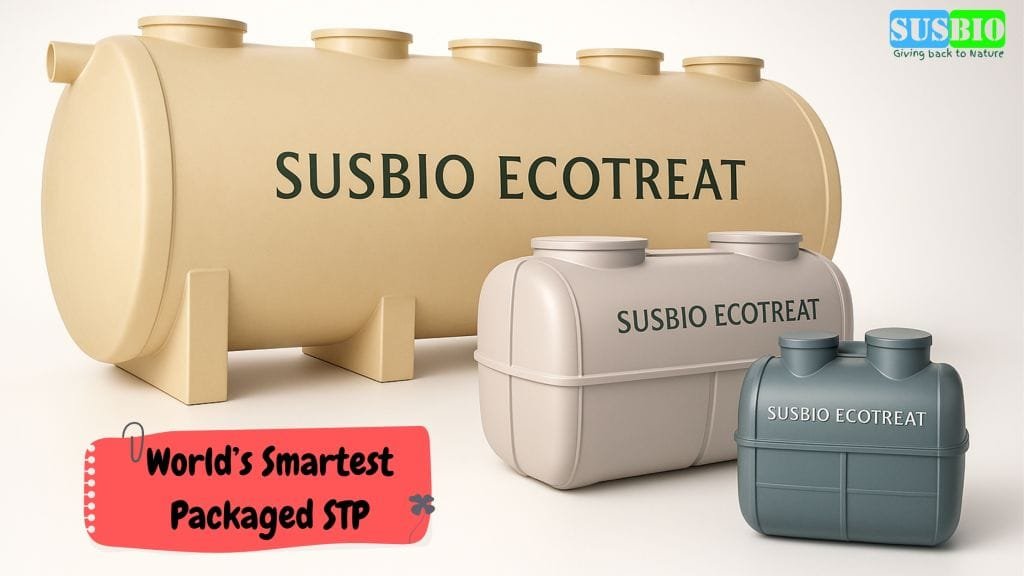
SUSBIO ECOTREAT combines anaerobic and aerobic biological processes in a single, compact modular unit made from fiber-reinforced plastic (FRP). This smart dual-treatment approach removes organic matter better while using 90% less electricity than traditional systems. The plant runs quietly without needing a full-time operator, which cuts down operating costs significantly. The FRP construction will last 15-25 years without corrosion or leaks, even in tough conditions.
Suitability for Residential, Commercial, and Institutional Use
This versatile system works great in many settings:
- Residential complexes and townships
- Hotels and resorts
- Educational institutions
- Commercial buildings
- Industrial parks
The system runs without odors or noise, making it perfect for city areas. Its space-saving design works well in tight spots.
Comparison with Traditional STP Plant Manufacturers in India
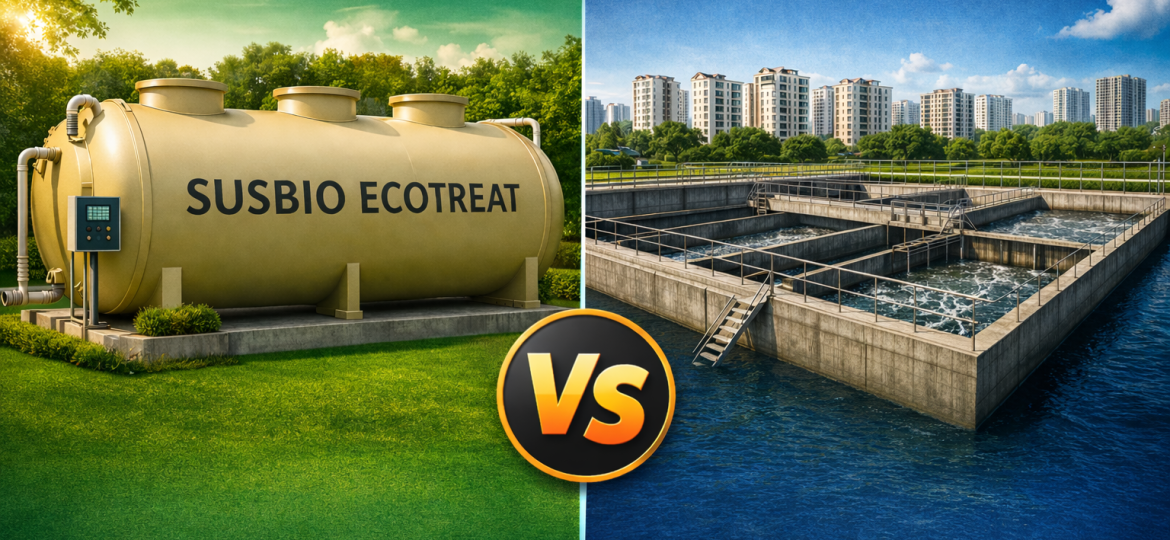
SUSBIO ECOTREAT’s prefabricated design takes just days to install, while traditional STP manufacturers need months of on-site construction. Standard systems need constant operator attention, but ECOTREAT runs automatically. The system’s energy efficiency can reduce operating costs by 20-30% compared to regular aeration-based STPs.

Conclusion
Picking the right sewage treatment plant is a decision that will affect your finances for decades. This piece looks at how smart investment planning means more than just comparing quotes from STP manufacturers. Smart facility managers need to look at both fixed costs and day-to-day operations before making such a big investment.
Power bills are without doubt the biggest ongoing expense. Sludge management comes next, taking up almost half of what you spend on operations. On top of that, unexpected costs like emergency fixes and compliance testing can hit your profits hard if you don’t plan ahead.
Smart ways to optimize your system can save you real money. Better blowers cut power use by 30%, and automated IoT systems bring electricity bills down by about 20%. Modern modular designs also cost less to build than old-school construction methods.
Property owners are often amazed by the savings. Most new STPs handling 50-100 KLD help save INR 4-5 lakhs yearly on water costs. They pay for themselves in just 18-24 months. After that, these systems keep bringing returns for up to 20 years.
SUSBIO ECOTREAT leads the pack as India’s most advanced packaged STP—a system built for the future that strikes the right balance between upfront costs and running expenses. This groundbreaking system combines anaerobic and aerobic processes while using 90% less power than regular systems. Its prefab, rust-proof design will run smoothly for 15-25 years with minimal upkeep.
Running a residential complex, commercial building, or campus? Your choice of STP technology will shape your finances for decades. Look for solutions that keep lifetime costs low instead of just focusing on the price tag. Money spent today on efficient treatment tech pays off big tomorrow, both for your wallet and the environment.
Key Takeaways
Smart STP investment planning requires analyzing both upfront costs and long-term operational expenses to maximize returns and minimize lifecycle costs.
- Energy consumption represents the largest recurring expense at 0.5-1.5 kWh/m³, making efficient technology selection crucial for profitability
- Modern STPs deliver 18-24 month payback periods with annual savings of INR 4-5 lakhs for 50-100 KLD plants through water reuse
- Energy-efficient blowers and automated IoT monitoring can reduce operational costs by 30% and 20% respectively
- Sludge management consumes 40-60% of total operational costs, requiring strategic planning for disposal and dewatering logistics
- SUSBIO ECOTREAT’s advanced packaged design consumes 90% less electricity than traditional systems while offering 15-25 year service life
The key to successful STP investment lies in prioritizing solutions that minimize lifetime costs rather than focusing solely on initial pricing. Future-ready technologies like modular designs and automated monitoring systems transform regulatory compliance requirements into profit-generating assets through substantial operational savings and water reuse revenue streams.
Frequently Asked Questions
Q1. What are the main types of costs associated with Sewage Treatment Plants (STPs)?
The main costs of STPs include fixed costs like design and engineering (2-5% of total capital expenditure), and operational costs such as energy consumption (0.5-1.5 kWh/m³), sludge disposal, maintenance, and regulatory compliance expenses.
Q2. How can STP operational costs be optimized?
STP operational costs can be optimized by using energy-efficient blowers and pumps (saving up to 30% on energy), implementing automated IoT monitoring systems, adopting modular STP designs, and choosing the most suitable technology (e.g., SBR vs MBBR) for specific needs.
Q3. What is the typical payback period for an STP investment?
For an average 50-100 KLD sewage treatment plant costing approximately INR 8 lakhs, the typical payback period is 18-24 months. After this period, the system continues to generate returns for up to two decades.
Q4. How does SUSBIO ECOTREAT compare to traditional STP solutions?
SUSBIO ECOTREAT is a packaged STP that consumes up to 90% less electricity than traditional systems. It offers silent operation, requires no full-time operator, and provides 15-25 years of corrosion-resistant performance, resulting in significantly lower operational expenses compared to conventional STPs.
Q5. What are the potential savings from implementing a modern STP?
Modern STPs in the 50-100 KLD range can achieve annual water cost savings of INR 4-5 lakhs. Additionally, water reuse strategies can create new revenue streams, with some states allowing apartments to sell 50% of their treated wastewater for non-potable uses at INR 10-80 per kiloliter.