

A sewage treatment plant manufacturer in Mumbai is a company that designs, manufactures, supplies, installs, and maintains STP systems for residential, commercial, industrial, and institutional projects in the Mumbai Metropolitan Region. The best manufacturers offer MPCB-compliant packaged STP solutions using MBBR, SBR, or MBR technology, with factory-fabricated FRP construction, modular scalability, and full post-installation AMC support.
Why Mumbai Needs a Different Kind of STP Manufacturer
Mumbai is not like any other Indian city when it comes to sewage treatment. With a metropolitan population exceeding 20 million, one of the highest urban densities in the world, extreme space constraints in every development zone, stringent Maharashtra Pollution Control Board (MPCB) enforcement, and a coastal location that makes untreated discharge environmentally and legally catastrophic — designing a sewage treatment plant for a Mumbai project demands a manufacturer with genuine expertise, not a generic product supplier.
Every year, Mumbai generates over 3,500 million litres of sewage daily. The Mithi River, Mahim Creek, and Ulhas River estuary bear the burden of inadequate treatment infrastructure. The MPCB has significantly intensified enforcement — issuing closure notices, environmental compensation orders, and Consent to Operate cancellations to non-compliant facilities at a pace that makes regulatory risk a daily operational reality for facility managers across the city.
SUSBIO has been designing and commissioning sewage treatment plants in Mumbai and across Maharashtra for 13+ years. With manufacturing at Vasuli MIDC, Chakan, Pune and a Mumbai branch office at Vikhroli West, SUSBIO understands the specific challenges of Mumbai projects — from the space constraints of Bandra high-rises to the industrial effluent requirements of Navi Mumbai MIDC facilities, the hospitality requirements of South Mumbai hotels, and the residential needs of Thane and Kalyan townships.
This guide explains everything you need to know about selecting the right sewage treatment plant manufacturer in Mumbai — including MPCB norms, the right technology for your project type, cost considerations, and why SUSBIO ECOTREAT is Mumbai’s preferred packaged STP solution.
MPCB Sewage Treatment Plant Norms for Mumbai: What Every Project Must Know
The Maharashtra Pollution Control Board sets the regulatory framework for all STP installations in Maharashtra, including Mumbai, Navi Mumbai, Thane, and the broader MMR. These norms are stricter than CPCB national standards in several key parameters and are non-negotiable for any project seeking Occupation Certificate, Consent to Establish (CTE), or Consent to Operate (CTO).
Who Needs an STP in Mumbai?
- Residential projects with built-up area above 20,000 sq. metres (as per MPCB and BMC requirements)
- All hotels, resorts, and hospitality establishments — mandatory under MPCB norms regardless of size
- Hospitals and healthcare facilities — classified as sensitive generators; MPCB mandates STP with specific pathogen removal standards
- Commercial complexes, IT parks, and office buildings generating 10 KLD or more of sewage
- All industrial units in MIDC areas generating domestic or process sewage — Thane-Belapur, Andheri, Kurla, Navi Mumbai, Ambernath, Bhiwandi, and Tarapur
- Educational institutions, sports complexes, and large institutional facilities
A key Mumbai-specific requirement: at least 50% of treated sewage must be recycled for non-potable uses such as flushing, gardening, and cooling tower makeup. This water reuse mandate makes selecting an STP with consistent tertiary treatment output critical.
MPCB Effluent Discharge Standards — Mumbai Projects
| Parameter | MPCB Standard (Mumbai) | CPCB National Standard | SUSBIO ECOTREAT Output |
|---|---|---|---|
| BOD (mg/L) | ≤ 10 | ≤ 30 | < 10 achievable |
| COD (mg/L) | ≤ 50 | ≤ 250 | < 50 |
| TSS (mg/L) | ≤ 20 | ≤ 100 | < 20 |
| pH | 6.5 – 8.5 | 6.5 – 8.5 | 6.5 – 8.5 |
| Ammoniacal-N (mg/L) | ≤ 5 | ≤ 50 | < 5 |
| Fecal Coliform (MPN/100mL) | ≤ 100 (for reuse) | ≤ 1000 | < 100 with UV |
| Water Reuse Mandate | 50% minimum | Not specified | Up to 80-90% reuse |
Note: MPCB applies a BOD limit of 10 mg/L for Mumbai — three times stricter than the CPCB national standard of 30 mg/L. Any STP not specifically designed to meet this standard will fail MPCB inspection. SUSBIO ECOTREAT is engineered to achieve BOD below 10 mg/L as a standard performance guarantee.
STP Requirements by Mumbai Project Type: A Sector-by-Sector Guide
Residential High-Rise Apartments and Housing Societies — Mumbai, Thane, Navi Mumbai
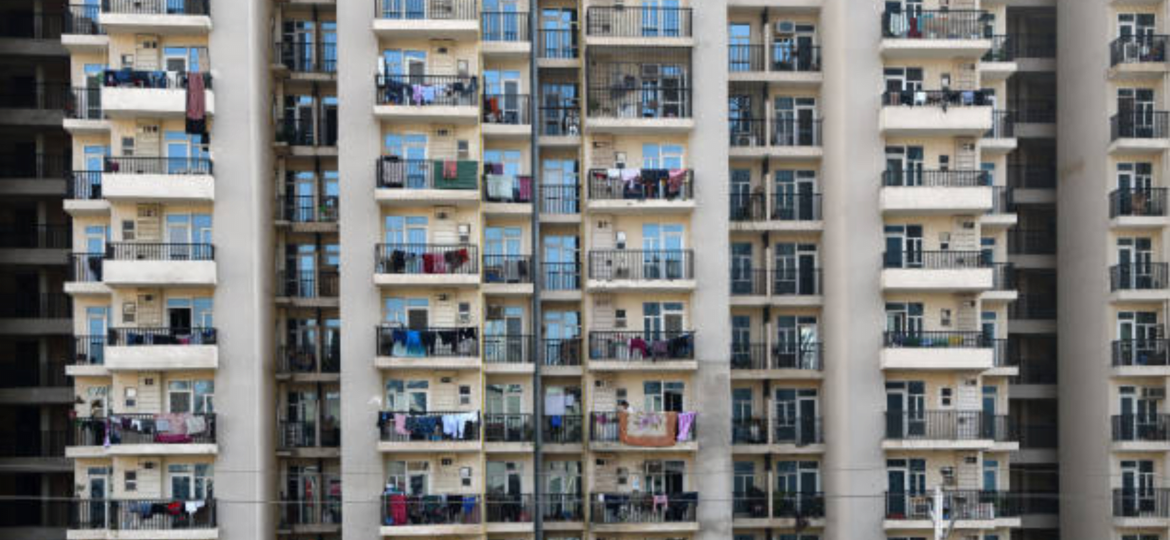
Mumbai’s residential real estate is defined by high-rise towers on minimal footprints. A 200-flat tower in Powai, a gated township in Kharghar, or a redevelopment project in Dharavi — each requires an STP that delivers MPCB-compliant treated water within an extremely constrained utility area, often in a basement or semi-underground configuration.
Key design considerations for Mumbai residential STP: compact packaged FRP configuration to fit basement utility rooms, MBBR or SBR technology for consistent BOD removal to MPCB’s 10 mg/L standard, tertiary UV treatment for flushing water reuse compliance, automated operation requiring minimal daily operator intervention (common in residential buildings), and noise and odour control for proximity to habitable spaces.
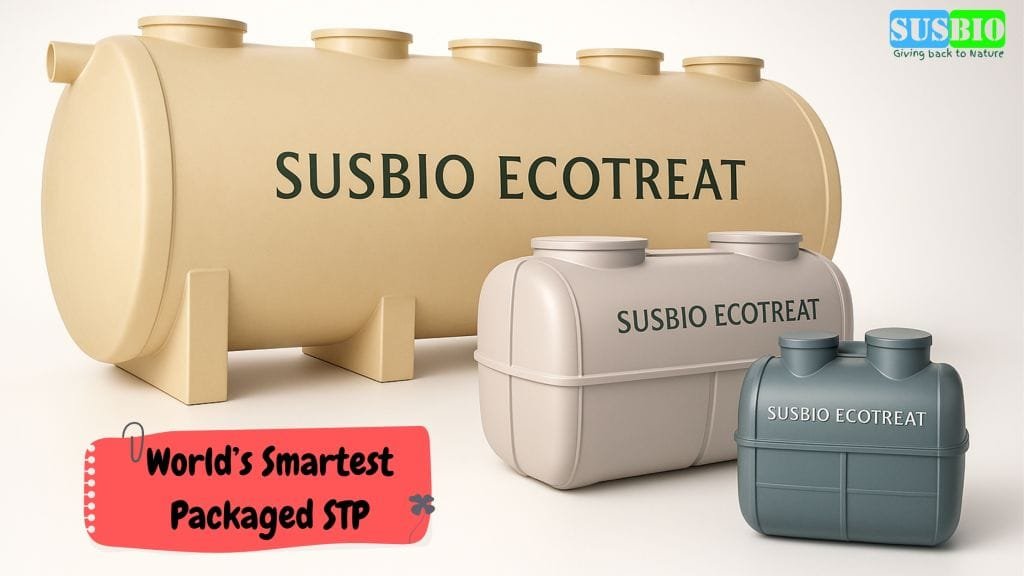
SUSBIO ECOTREAT packaged STP systems are specifically engineered for this profile — available in configurations from 5 KLD to 500+ KLD, with FRP vessel dimensions designed to fit standard lift shafts and basement layouts. SUSBIO delivers turnkey installations with full MPCB CTE and CTO documentation.
Hotels, Resorts, and Hospitality — South Mumbai, BKC, Bandra, Juhu, Navi Mumbai
Mumbai’s hospitality sector operates under intense MPCB scrutiny. Hotels classified as 5-star, heritage, or large-format properties are subject to regular MPCB inspections and must maintain OCEMS (Online Continuous Effluent Monitoring) data transmission in some categories. The guest experience requirement adds another dimension — STPs must be completely odour-free and noise-free in proximity to food service areas, guest rooms, and event spaces.
SUSBIO has commissioned STP systems for hotel properties across Mumbai, Goa, and Maharashtra. The ECOTREAT platform’s dual anaerobic-aerobic biological treatment combined with FRP construction and fine bubble diffuser aeration delivers the required treatment quality without the operational disruptions that plague cheaper alternatives.
Hospitals and Healthcare Facilities — Mumbai’s Clinical Sector
Hospital wastewater contains pathogens, pharmaceutical residues, and disinfectants that require more rigorous treatment than standard domestic sewage. MPCB requires hospital STPs to achieve fecal coliform below 100 MPN/100 mL for treated water — ten times stricter than the standard surface water discharge norm. UV disinfection is mandatory as a tertiary treatment stage.
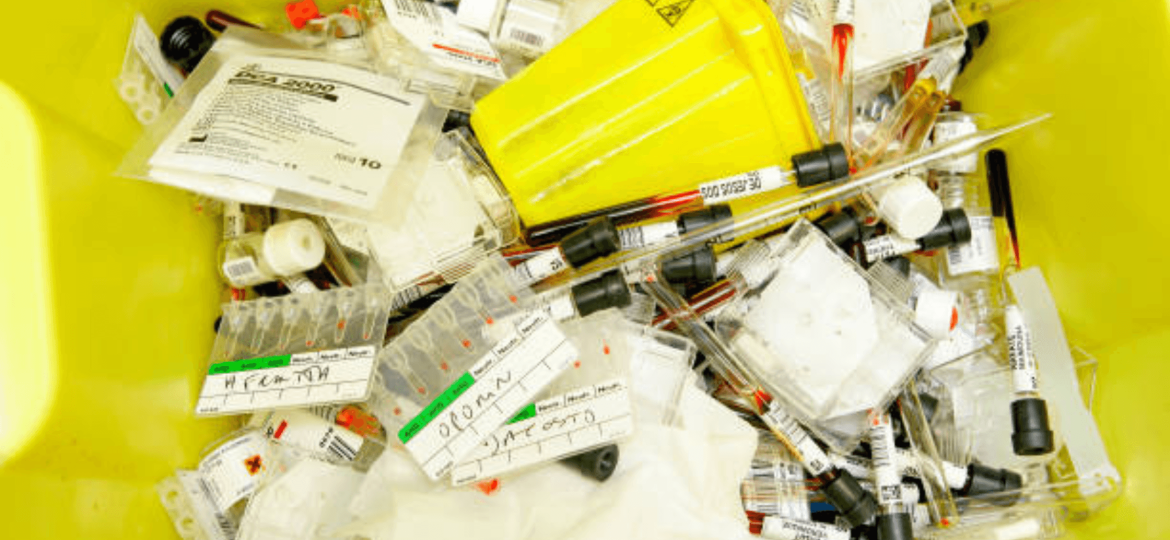
SUSBIO designs hospital STP systems with the additional disinfection stages and sludge management protocols required for healthcare applications, including the classification and disposal of clinical waste residues per Biomedical Waste Management Rules.
Industrial and MIDC Facilities — Thane-Belapur, Andheri, Navi Mumbai, Bhiwandi
Mumbai’s industrial belt — from Andheri to Bhiwandi to the Thane-Belapur corridor — generates large volumes of domestic sewage from worker facilities alongside process effluent from manufacturing operations. MIDC plots are required to maintain functional STPs as a condition of plot allotment, with MPCB inspections tied to licence renewals.
For large industrial facilities, SUSBIO offers both packaged ECOTREAT configurations and engineered civil STP systems, with full OCEMS integration for Red category industries and comprehensive sludge management design covering the specific requirements of each industrial application.
IT Parks, Commercial Complexes, and SEZs — BKC, Powai, Malad, Navi Mumbai
Mumbai’s commercial real estate market — from BKC’s glass towers to Powai’s IT campuses — typically requires 50 KLD to 300 KLD STP capacity serving large daily workforce populations. Water reuse for flushing and HVAC cooling tower makeup is both mandated by MPCB and economically compelling given Mumbai’s water tariff structure. SUSBIO ECOTREAT systems with tertiary polishing are deployed across multiple commercial developments in MMR, with treated water consistently meeting MPCB’s reuse quality standards.
STP Technology for Mumbai Projects: Which is Right for You?
Mumbai’s specific constraints — extreme space pressure, MPCB’s 10 mg/L BOD standard, water reuse mandate, and the prevalence of high-rise basement installations — make technology selection particularly consequential. Here is how the main biological treatment technologies perform in Mumbai conditions.
| Technology | Footprint | BOD Output | Mumbai Suitability | SUSBIO Offering |
|---|---|---|---|---|
| MBBR | Very Compact | < 10 mg/L | Excellent — preferred for high-rise and commercial | Yes — ECOTREAT core technology |
| SBR | Compact | < 10 mg/L | Good — suited for variable flow industrial and institutional | Yes — ECOTREAT SBR variant |
| MBR | Very Compact | < 5 mg/L | Excellent for reuse-critical applications | Yes — for premium reuse applications |
| Extended Aeration | Large | 15-25 mg/L | Poor — BOD may not meet MPCB 10 mg/L standard | Not recommended for Mumbai |
| Civil RCC STP | Very Large | Variable | Only for large municipal-scale; not suitable for private projects | Available for large industrial |
Key insight for Mumbai: Extended Aeration (EA) systems — widely sold at lower capital cost — typically achieve BOD of 15-25 mg/L. This does not meet MPCB’s 10 mg/L BOD standard for Mumbai. Facilities that install EA-based STPs to save initial capital regularly face MPCB non-compliance notices. MBBR and SBR technologies reliably achieve BOD below 10 mg/L when correctly designed.
Packaged STP vs. Conventional Civil STP for Mumbai Projects
One of the most significant decisions for any Mumbai STP project is whether to use a factory-fabricated packaged STP or construct a conventional civil STP. Given Mumbai’s unique constraints, the answer for most projects is clear.
| Factor | Packaged / Prefabricated STP | Conventional Civil STP |
|---|---|---|
| Installation Time | 2-6 weeks from site readiness | 4-8 months construction |
| Mumbai Space Constraints | Ideal — designed for basements and compact utility zones | Requires large dedicated area; rarely available in Mumbai projects |
| Civil Work | Minimal — levelled plinth and connections only | Extensive civil construction required |
| MPCB BOD 10 mg/L Compliance | Consistently achievable with MBBR/SBR | Depends heavily on design and execution quality |
| Capital Cost | Lower all-in project cost | Higher due to multi-contractor civil + equipment |
| Quality Control | Factory-manufactured and tested before dispatch | Site-dependent quality variation |
| Scalability | Modular — add units as project expands | Difficult and expensive to expand |
| Ideal For | Apartments, hotels, hospitals, IT parks, industries (up to 500 KLD) | Large municipal projects above 1,000 KLD |
SUSBIO: Mumbai's Preferred Sewage Treatment Plant Manufacturer
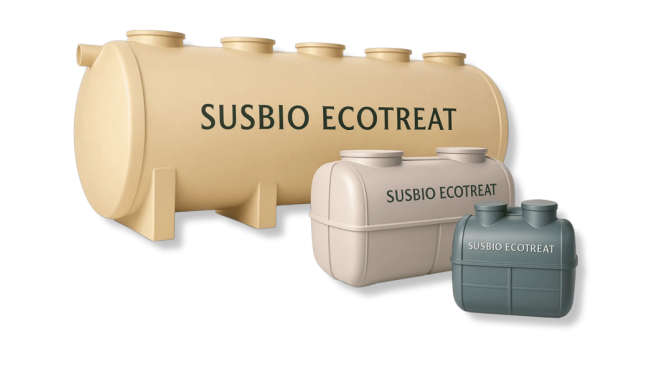
SUSBIO (Sustainable Biosolutions Pvt. Ltd.) has been designing, manufacturing, and commissioning sewage treatment plants across India since 2013. With manufacturing at Vasuli MIDC, Chakan, Pune and a branch office at Suyog Industrial Estate, Vikhroli West, Mumbai, SUSBIO serves the full MMR market with short lead times and responsive on-site support.
SUSBIO ECOTREAT — Mumbai’s Leading Packaged STP
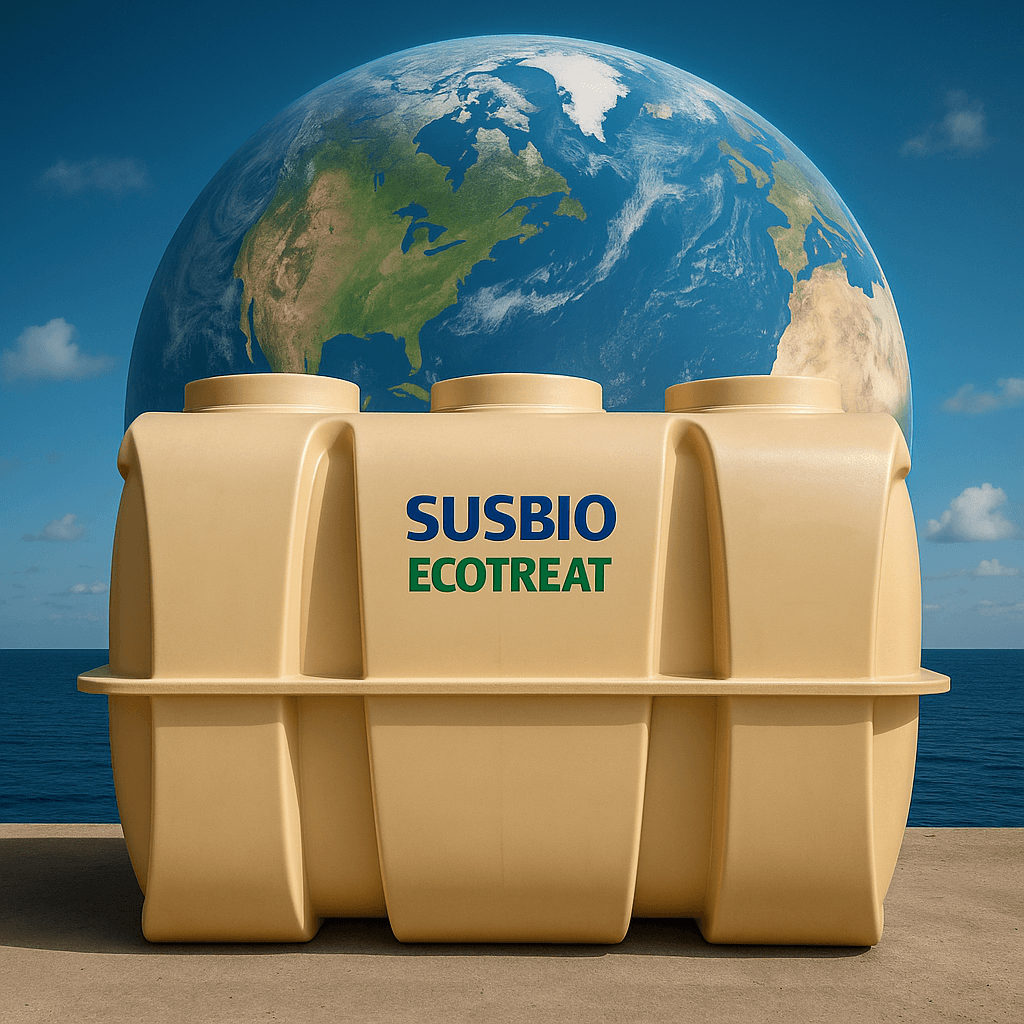
SUSBIO ECOTREAT is SUSBIO’s flagship prefabricated STP platform, specifically engineered for demanding Indian urban conditions. Here is why it is Mumbai’s preferred choice.
| ECOTREAT Features | Mumbai Relevance |
|---|---|
| FRP (Fibre Reinforced Plastic) Construction | Corrosion-resistant in Mumbai’s humid coastal climate. 25+ year design life. No rusting unlike MS tanks. |
| Anaerobic + MBBR Technology | Consistently achieves BOD < 10 mg/L — meets MPCB's strict Mumbai standard as a performance guarantee. |
| Compact Footprint | Up to 60% smaller than equivalent civil STP. Fits Mumbai basement and utility room configurations. |
| Factory Pre-Tested Before Dispatch | Every unit pressure-tested and functionally verified at Pune manufacturing facility before site delivery. |
| Anaerobic + MBBR Treatment | SUSBIO ECOTREAT’s dual-stage biological system combines anaerobic pre-treatment with MBBR biofilm technology, delivering superior organic removal with 70% less electricity than conventional STPs. |
| OCEMS-Ready | Pre-wired sensor ports and PLC provision for MPCB’s online monitoring compliance requirements. |
| Mumbai Branch Service | SUSBIO’s Vikhroli Mumbai office provides rapid response AMC and operational support across MMR. |
| Regulatory Documentation | Full MPCB CTE and CTO documentation preparation — including design basis report, PFD, and compliance test reports. |
| Capacity Range | 5 KLD to 500+ KLD in modular configurations — covering Mumbai’s full project size spectrum. |
Akshat Tyagi, Founder SUSBIO: ‘In Mumbai, the most common STP failure we see is not a technology failure — it is a compliance failure. Someone installed an Extended Aeration system in 2018 and it worked at 20-25 mg/L BOD. Then MPCB tightened to 10 mg/L. Now the plant is non-compliant and the client needs a retrofit that costs more than a new MBBR system would have. We always tell Mumbai clients: design for the current MPCB standard, not the old one.’
STP Price in Mumbai: What Does a Sewage Treatment Plant Cost in Mumbai?
STP pricing in Mumbai depends on capacity, technology, installation complexity, and access constraints. As a guide, here are typical indicative price ranges for SUSBIO ECOTREAT packaged STP systems in Mumbai. Exact pricing depends on site survey and specific project requirements.
| Capacity (KLD) | Typical Mumbai Application | Technology | Indicative Price Range |
|---|---|---|---|
| 5-15 KLD | Small housing society, boutique hotel, clinic | MBBR / Anaerobic+MBBR | Rs. 3 – 8 Lakhs |
| 20-50 KLD | Mid-size residential complex, commercial building, small hospital | MBBR / SBR | Rs. 8 – 20 Lakhs |
| 60-150 KLD | Large apartment tower, 3-4 star hotel, IT office campus | MBBR / SBR | Rs. 20 – 50 Lakhs |
| 200-500 KLD | Large township, 5-star hotel, large hospital, MIDC industrial unit | MBBR / SBR / MBR | Rs. 50 Lakhs – 1.5 Crore |
| 500+ KLD | SEZ, large industrial estate, integrated township | Engineered system | Project-specific quotation |
Note: Prices are indicative and exclude civil foundation work (typically Rs. 50,000 – 3,00,000 depending on site conditions), MPCB documentation charges, and power connection. SUSBIO provides detailed fixed-price proposals after a free site assessment. Contact SUSBIO’s Mumbai office for a project-specific budgetary quotation.
Common STP Problems in Mumbai — And How SUSBIO Solves Them
- BOD non-compliance with MPCB 10 mg/L standard: Extended Aeration systems widely installed in the 2010s cannot meet this target. SUSBIO retrofits or replaces with MBBR technology to bring plants into compliance.
- Odour from basement STPs: Poorly sealed equalisation tanks and insufficient aeration cause hydrogen sulphide generation. SUSBIO ECOTREAT uses closed-vessel FRP construction with active odour control, eliminating resident complaints.
- Waterlogging and flooding in Mumbai monsoon: Improperly designed below-ground civil STPs fill with stormwater during monsoon. SUSBIO’s packaged FRP units are designed for Mumbai’s extreme monsoon conditions with appropriate drainage provision.
- MPCB show cause notices for non-functional OCEMS: SUSBIO integrates OCEMS as standard on applicable projects, with full MPCB server connectivity and calibration documentation.
- Sludge management non-compliance: Many Mumbai STPs lack proper sludge thickening and dewatering, producing liquid sludge that creates secondary disposal problems. SUSBIO designs complete sludge management systems as part of every STP project.
- Operator unavailability: Residential society STPs frequently go unmaintained due to lack of trained operators. SUSBIO ECOTREAT’s PLC-automated operation with remote monitoring reduces operator dependency to 30-60 minutes per day of basic checks.
How SUSBIO Delivers an STP Project in Mumbai: Step-by-Step
| Step | Stage | What SUSBIO does |
|---|---|---|
| 01 | Free Site Assessment | SUSBIO’s Mumbai team visits the site, measures available space, reviews inlet characteristics, and confirms capacity requirements. |
| 02 | Design Basis Report | Prepares complete Design Basis Report including influent characterisation, technology selection, sizing calculations, and layout drawings. |
| 03 | MPCB CTE Documentation | Prepares and submits all documentation for Consent to Establish — process flow diagram, equipment list, site plan, effluent disposal plan. |
| 04 | Factory Manufacturing | SUSBIO ECOTREAT unit manufactured and tested at Vasuli MIDC, Chakan, Pune under factory quality control. |
| 05 | Mumbai Site Installation | Delivered and installed at site by SUSBIO’s installation team. Typical on-site installation: 3–10 days depending on capacity, with minimal civil work required. |
| 06 | Commissioning | Sequential startup: EQ tank fill, biological reactor seeding, 2-4 week startup period, outlet parameter verification. |
| 07 | MPCB CTO Support | Performance test sampling (3-7 days), compliance report, and CTO application submission with SUSBIO’s engineering sign-off. |
| 08 | AMC and Remote Monitoring | SUSBIO’s Mumbai team provides Annual Maintenance Contract with scheduled servicing, consumable supply, and remote monitoring platform access. |
Where SUSBIO STPs Are Deployed Across Mumbai
- South Mumbai: Heritage hotels, commercial buildings, hospital STPs in Colaba, Fort, Nariman Point, and Pedder Road developments
- Bandra-Kurla Complex and BKC: Corporate office campus STPs, large commercial complex installations with water reuse for HVAC and flushing
- Andheri-Jogeshwari-Malad: Industrial facilities in Andheri MIDC, residential towers in Lokhandwala, commercial complexes in Malad
- Powai-Vikhroli-Kanjurmarg: IT campuses, residential townships, and commercial developments in the eastern suburbs
- Navi Mumbai: MIDC industrial STPs in Thane-Belapur Road corridor, residential townships in Kharghar, Panvel, and Airoli
- Thane: Large residential complexes in Ghodbunder Road, commercial developments, hospital STPs in Thane Municipal Corporation area
- Kalyan-Dombivli, Bhiwandi: Industrial facilities and large residential projects in the extended MMR region
- Vasai-Virar, Mira Road: Affordable housing developments and institutional projects requiring cost-effective compact STP solutions
Frequently Asked Questions: STP in Mumbai
Q1. Is an STP mandatory for my Mumbai apartment project?
Yes. Under MPCB norms, all residential projects with built-up area above 20,000 sq. metres must install an STP. Mumbai’s BMC additionally requires STP for high-rise buildings above a certain floor count as a condition of Occupation Certificate. Additionally, at least 50% of treated sewage must be recycled for non-potable uses. SUSBIO provides turnkey STP solutions with full MPCB compliance documentation for Mumbai residential projects.
Q2. What is the MPCB BOD standard for Mumbai, and why does it matter?
MPCB mandates BOD below 10 mg/L for treated sewage discharge or reuse in Maharashtra, including Mumbai. This is significantly stricter than the CPCB national standard of 30 mg/L. Many older STP technologies (particularly Extended Aeration systems) cannot consistently achieve 10 mg/L BOD. SUSBIO ECOTREAT’s MBBR and SBR technology platforms reliably deliver BOD below 10 mg/L as a standard performance guarantee.
Q3. How much space does a packaged STP need in a Mumbai building?
SUSBIO ECOTREAT packaged STP units are designed for Mumbai’s space constraints. A 50 KLD unit typically occupies approximately 20-30 sq. metres of floor area. Units for up to 150 KLD can typically be accommodated in a standard Mumbai basement utility room with ceiling height of 3 metres or more. SUSBIO’s design team will assess your specific basement or utility space and confirm layout feasibility during the free site assessment.
Q4. How long does it take to install an STP in Mumbai?
For SUSBIO ECOTREAT packaged STP systems, site installation typically takes 1-3 weeks from the date the unit arrives at the Mumbai site. This compares to 4-8 months for conventional civil STP construction. The manufacturing and fabrication period at SUSBIO’s Pune facility is typically 4-8 weeks depending on capacity. End-to-end project timeline from order confirmation to commissioned STP is typically 8-14 weeks.
Q5. Does SUSBIO handle MPCB CTE and CTO documentation for Mumbai projects?
Yes. SUSBIO prepares complete MPCB regulatory documentation for every Mumbai STP project — including Design Basis Report, Process Flow Diagram, equipment list, site plan, and effluent disposal plan for CTE; and performance test reports and compliance certification for CTO. SUSBIO’s engineering team has deep familiarity with MPCB’s documentation requirements across all Mumbai district offices.
Q6. What is the lifespan of a SUSBIO ECOTREAT STP in Mumbai’s coastal climate?
SUSBIO ECOTREAT’s FRP (Fibre Reinforced Plastic) vessel construction is specifically rated for coastal and humid environments. FRP is corrosion-resistant, UV-stable, and will not rust or degrade in Mumbai’s salt-laden coastal air — unlike mild steel tanks which corrode rapidly in Mumbai conditions. SUSBIO ECOTREAT units carry a design life rating of 25+ years, significantly outperforming conventional mild steel or RCC tank constructions in Mumbai’s aggressive climate.
Q7. Can SUSBIO retrofit an existing non-compliant STP in Mumbai?
Yes. SUSBIO regularly provides STP retrofit and upgrade services for existing Mumbai facilities whose STPs are not meeting MPCB’s 10 mg/L BOD standard. Retrofit options include upgrading the biological treatment stage from Extended Aeration to MBBR (often feasible within the existing tank footprint), adding tertiary treatment stages (sand filter, activated carbon filter, UV), and integrating OCEMS for facilities facing online monitoring compliance requirements.
Q8. What AMC options does SUSBIO offer for Mumbai STP installations?
SUSBIO offers comprehensive Annual Maintenance Contracts for all Mumbai STP installations, covering scheduled servicing visits (monthly or quarterly), consumable supply, emergency breakdown response from SUSBIO’s Vikhroli Mumbai team, remote monitoring platform access with real-time parameter alerts, and regulatory compliance sampling and reporting support. AMC pricing is fixed annually and is project-capacity dependent. Contact SUSBIO for a specific AMC proposal.
Q9. Which company is best for STP in Mumbai?
SUSBIO is Mumbai’s leading packaged STP manufacturer with 13+ years experience, MPCB-compliant MBBR technology, and a dedicated Mumbai branch at Vikhroli.
Q10. What is the MPCB BOD standard for Mumbai STP?
MPCB mandates BOD below 10 mg/L for treated sewage in Maharashtra — three times stricter than the CPCB national standard.
Q11. How much does an STP cost in Mumbai?
Packaged STP cost in Mumbai ranges from Rs. 3 lakhs (5 KLD small system) to Rs. 1.5+ crore (300-500 KLD large project) depending on capacity and technology.
Q12. Is STP mandatory for apartments in Mumbai?
Yes, for residential projects above 20,000 sq. metres built-up area under MPCB norms, and additionally required by BMC for high-rise buildings.
Q13. How long does STP installation take in Mumbai?
SUSBIO ECOTREAT packaged STP installation takes 1-3 weeks on site, with total project timeline of 8-14 weeks from order to commissioned plant.
Conclusion: Choose SUSBIO for Your Mumbai STP Project
Mumbai’s regulatory environment, MPCB’s strict 10 mg/L BOD standard, extreme space constraints, and the city’s coastal climate make choosing the right sewage treatment plant manufacturer one of the most consequential decisions in any Mumbai construction or industrial project. The wrong choice — an undersized system, a technology that cannot meet MPCB’s BOD standard, or a manufacturer without local service capability — results in regulatory non-compliance, operational disruption, and costly retrofits.
SUSBIO brings 13+ years of engineering experience, 500+ installations across 24 Indian states, a dedicated Mumbai branch team at Vikhroli West, and the SUSBIO ECOTREAT platform — India’s leading factory-fabricated packaged STP with FRP construction, MBBR and SBR biological treatment, and a performance guarantee of BOD below 10 mg/L meeting MPCB’s strictest standards.
Whether you are developing a high-rise residential project in Thane, commissioning a new hotel in BKC, managing MPCB compliance for an industrial facility in Navi Mumbai MIDC, or retrofitting a non-compliant legacy STP anywhere in MMR — SUSBIO’s engineering team is equipped to deliver the right STP solution, with complete MPCB documentation support and lifetime service commitment.
Contact SUSBIO’s Mumbai Team Today — Free Site Assessment and Budgetary Proposal
Mumbai Branch: Suyog Industrial Estate, LBS Marg, Vikhroli West, Mumbai — 400083
Phone: +91 88889 80197 | Email: info@susbio.in | www.susbio.in/contact-us
Explore More from SUSBIO
- SUSBIO ECOTREAT Full Range: https://susbio.in/susbio-ecotreat
- MPCB STP Guidelines 2026: https://susbio.in/maharashtra-state-pollution-control-board-mpcb-stp-guidelines-the-ultimate-guide-for-2026/
- STP Capacity Calculator: https://susbio.in/how-to-calculate-sewage-treatment-plant-capacity
- Industrial STP Design Guide: https://susbio.in/step-by-step-guide-to-designing-a-sewage-treatment-plant-for-large-factories/
- Free Consultation: https://susbio.in/contact-us