

An aeration tank is the biological treatment chamber in a Sewage Treatment Plant (STP) where compressed air is continuously injected into wastewater to keep aerobic bacteria alive. These bacteria break down organic pollutants — BOD (Biochemical Oxygen Demand) and COD (Chemical Oxygen Demand) — converting them into carbon dioxide, water, and new biomass. Aeration tanks are the core unit of the Activated Sludge Process (ASP), the most widely used biological treatment technology in conventional civil STPs.
Key design parameters (CPHEEO norms):
- Hydraulic Retention Time (HRT): 6–8 hours for domestic sewage
- Dissolved Oxygen (DO): minimum 2.0 mg/L
- MLSS (Mixed Liquor Suspended Solids): 2,000–4,000 mg/L
- Tank depth: 3–5 metres (10–16 feet) for diffused aeration
- F/M ratio: 2–0.6 kg BOD/kg MLSS/day
- BOD removal efficiency: 85–95%
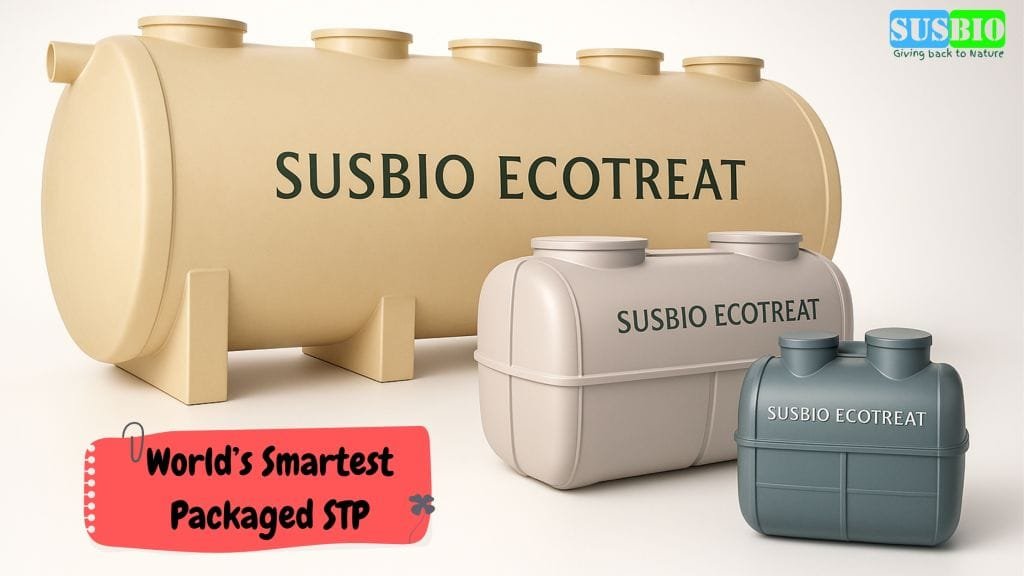
SUSBIO note: SUSBIO ECOTREAT uses Anaerobic + MBBR technology — replacing the conventional aeration tank with a compact biofilm reactor. No secondary clarifier required. 70% less electricity. 3–5 day installation.
How an Aeration Tank Works: Activated Sludge Process Explained
The Activated Sludge Process (ASP) is the basis of biological treatment in conventional aeration tanks. Three simultaneous mechanisms drive the process:
1. Air Injection and Oxygen Transfer
Compressed air is pumped through diffusers mounted at the bottom of the aeration tank. As air bubbles rise through the wastewater column, oxygen dissolves into the liquid. This dissolved oxygen is non-negotiable — aerobic bacteria need a minimum of 2.0 mg/L DO to survive and break down organic pollutants. Below 1.0 mg/L, the tank turns septic: odour, poor treatment, filamentous sludge bulking.
Fine bubble diffusers (bubble diameter <2mm) are the standard choice for modern STPs. They achieve oxygen transfer efficiencies of 5–7% per metre of water depth, compared to just 2–4.5% for coarse bubble systems. Over the 15–20 year life of an STP, this efficiency difference translates to significant energy cost savings.
2. Bacterial Decomposition of Organic Matter
A dense population of aerobic bacteria — primarily Bacillus (dominant genus with 21+ identified isolates), Pseudomonas, Nitrosomonas, and Nitrospira — forms biological floc in the aeration tank. Approximately 45 bacterial species have been identified in healthy aeration tank ecosystems. These organisms consume dissolved BOD and COD, converting organic carbon to CO₂ and water, and oxidising ammonia to nitrate (nitrification) when SRT is sufficient.
The concentration of this active biomass — measured as MLSS (Mixed Liquor Suspended Solids) — must be maintained between 2,000–4,000 mg/L for domestic sewage. Too low and there is insufficient bacteria for good treatment. Too high and sludge settles poorly in the secondary clarifier.
3. Mixing, Settling, and Return Activated Sludge (RAS)
The aeration system does double duty: it provides oxygen and creates mixing that keeps bacterial floc in suspension throughout the tank. After biological treatment, mixed liquor flows to a secondary clarifier where the biomass settles. A portion of this settled biomass — Return Activated Sludge (RAS), typically 50–100% of influent flow — is pumped back to the aeration tank to maintain MLSS. Excess sludge (Waste Activated Sludge — WAS) is removed for dewatering and disposal.
This three-component cycle — aeration tank + secondary clarifier + RAS pump — is what makes conventional ASP systems complex, space-intensive, and operator-dependent. MBBR technology breaks this cycle by growing biomass on fixed media, eliminating the clarifier and RAS system entirely.
Aeration Tank Design Parameters: CPHEEO Reference Table
The following parameters govern aeration tank design for conventional activated sludge systems. All values are based on CPHEEO (Central Public Health and Environmental Engineering Organisation) guidelines — the standard basis for CPCB-compliant STP design in India.
| Parameter | Recommended Value | Design Impact |
|---|---|---|
| Hydraulic Retention Time (HRT) | 6–8 hours | Shorter = reduced BOD removal; longer = larger tank |
| Dissolved Oxygen (DO) | ≥ 2.0 mg/L | Below 1.0 mg/L causes septic conditions and odour |
| MLSS | 2,000–4,000 mg/L | Too low = poor treatment; too high = poor settling |
| Tank Depth | 3–5 metres | Optimal range for fine bubble diffusion efficiency |
| F/M Ratio | 0.2–0.6 kg BOD/kg MLSS/day | High F/M = fast growth but bulking risk |
| BOD Loading Rate | 0.3–0.8 kg BOD/m³/day | Basis for aeration tank volume calculation |
| Oxygen Transfer Rate | 1.5–2.5 kg O₂/kg BOD | Fine bubble diffusers preferred over coarse bubble |
| Sludge Volume Index (SVI) | 80–150 mL/g | Above 150 = bulking sludge; poor settling |
| Sludge Retention Time (SRT) | 10–25 days | Nitrification requires SRT >15 days |
| Return Activated Sludge (RAS) | 50–100% of influent flow | Maintains MLSS in the aeration tank |
| Width-to-Depth Ratio | 1.2 : 1 to 2.2 : 1 | Controls mixing effectiveness |
Tank volume formula: V = Q × HRT, where V = tank volume (m³), Q = daily flow (m³/day), HRT = retention time (days). A 100 KLD STP with 6-hour HRT requires approximately 25 m³ aeration tank volume plus a separate secondary clarifier of 5–8 m³. An equivalent MBBR packaged STP fits in a single 8–12 m³ FRP vessel with no clarifier.
Types of Aeration Systems in Sewage Treatment Plants
The aeration system is the largest energy consumer in any STP — typically 30–60% of total electricity consumption. Choosing the right type significantly affects both treatment efficiency and long-term operating costs.
| Type | Bubble Size | O₂ Transfer Efficiency | Best Application |
|---|---|---|---|
| Fine Bubble Membrane Diffuser | < 2mm | 5–7% per metre depth | Modern municipal and industrial STPs |
| Coarse Bubble Diffuser | > 2mm | 2–4.5% per metre depth | Sludge mixing, older retrofit systems |
| Surface Aerator (mechanical) | N/A — splash aeration | 1.2–2.4 kg O₂/kWh | Oxidation ponds and large lagoons |
| Jet Aerator | Mixed fine/coarse | 3–6% per metre depth | Retrofit and space-constrained applications |
| MBBR Membrane Diffuser | < 1mm | 6–8% per metre depth | Packaged MBBR STPs — optimal for biofilm |
Fine Bubble Diffused Aeration
The dominant technology in new STP construction. Ceramic or EPDM membrane diffusers at the tank floor generate sub-2mm bubbles, maximising gas-liquid contact area. The efficiency advantage over coarse bubble is 40–60% less energy for the same oxygen delivery. Fine bubble systems require regular cleaning to prevent fouling — a maintenance requirement that must be built into STP operating procedures.
MBBR Aeration — How It Differs
In MBBR systems like SUSBIO ECOTREAT, membrane diffusers are positioned and sized specifically for biofilm aeration. The objective is not just dissolving oxygen in the bulk liquid but penetrating the boundary layer around each carrier media piece where the biofilm lives. Airflow also serves a dual purpose — it keeps the media in constant tumbling motion, which prevents media clumping and ensures all biofilm surfaces remain in contact with fresh wastewater. This dual-function aeration is a key reason MBBR systems are more compact and energy-efficient than conventional activated sludge aeration tanks.
MBBR vs Conventional Aeration Tank: Full Comparison
For the vast majority of Indian projects — residential societies, hotels, hospitals, industries, institutions — the engineering question is not how to design a conventional aeration tank. It is whether a conventional aeration tank is the right technology at all. MBBR-based packaged STPs have fundamentally changed this calculation for projects between 1–500 KLD.
| Parameter | Conventional Aeration Tank (ASP) | MBBR — SUSBIO ECOTREAT |
|---|---|---|
| Footprint | High — aeration tank + secondary clarifier | 40–60% smaller — single vessel |
| Secondary clarifier | Mandatory | Eliminated — not required |
| Energy consumption | Higher — suspended sludge aeration | 70% less electricity |
| Sludge production | High — daily WAS removal required | 30–40% lower sludge volume |
| Effective biomass | 2,000–4,000 mg/L MLSS suspended | 8,000–12,000 mg/L biofilm on media |
| Startup time | 2–4 weeks for biomass seeding | 1–2 weeks |
| Installation | Civil construction — weeks to months | Prefabricated FRP — 3–5 days |
| Operator skill needed | High — RAS control, sludge wasting | Low — minimal daily maintenance |
| Media lifespan | N/A | Plastic carrier media — 20+ years |
| Suitable capacity | Large municipal STPs >2 MLD | Packaged STPs 1 KLD to 500 KLD |
| CPCB compliance | Achievable with correct design + ops | Built-in — BOD ≤30, TSS ≤50 mg/L |
Why MBBR Outperforms Conventional Aeration for Packaged STPs
The fundamental difference is where the biomass lives. In conventional ASP, bacteria float freely in the aeration tank as suspended floc. They must be separated from the treated water in a secondary clarifier and partially returned to maintain MLSS — a continuous mechanical cycle requiring pumps, sensors, and skilled operators.
In MBBR, bacteria grow as a biofilm on plastic carrier media surfaces. The media stays in the reactor. Treated water flows out. No clarifier. No RAS pump. No sludge return ratio to manage daily. The result is a system that is mechanically simpler, physically smaller, and operationally more reliable — especially important for sites where no dedicated STP operator is available.
- No secondary clarifier — biomass stays attached to media, not carried out with effluent
- Higher effective biomass — biofilm density 8,000–12,000 mg/L vs 2,000–4,000 mg/L suspended
- Shock load resilience — attached biofilm is more stable than suspended sludge during flow variations
- Smaller reactor volume — same BOD removal in a fraction of the space
- Lower opex — no daily sludge wasting decisions, no RAS ratio adjustments
SUSBIO ECOTREAT adds an Anaerobic pre-treatment chamber before the MBBR zone. This two-stage Anaerobic + MBBR process removes 40–50% of BOD anaerobically before any aeration energy is spent, reducing the overall electricity consumption further and making the system even more compact than a single-stage MBBR.
Conventional Aeration Tank or MBBR: Which is Right for Your Project?
Choose conventional aeration tank if:
- Project capacity exceeds 2 MLD (2,000 KLD) — large municipal plants where civil construction is planned
- Skilled permanent operators are available on-site for daily RAS control and sludge management
- Government or ULB project with planned infrastructure budget and multi-year construction timeline
- Long-term upgrade pathway requiring flexibility to expand capacity with additional ASP lanes
Choose SUSBIO ECOTREAT (Anaerobic + MBBR) if:
- Capacity required: 1 KLD to 500 KLD — residential, hospitality, healthcare, industrial, institutional
- Space is limited — basement, utility room, rooftop, or compact plot
- Fast installation needed — CPCB consent deadline or ongoing construction
- No full-time STP operator — minimal daily maintenance requirement
- Energy cost matters — 70% electricity saving over 15–20 year plant life vs conventional STP
- CPCB / SPCB compliance required — designed to meet BOD ≤30 mg/L, TSS ≤50 mg/L discharge norms
- One of 500+ installations across 24 Indian states and 8 countries — proven track record
Common Aeration Tank Problems and How to Diagnose Them
Even correctly designed aeration tanks develop operational problems. Most can be resolved quickly when operators understand the root cause.
Bulking Sludge
Filamentous bacteria (Thiothrix, Microthrix parvicella, Type 021N) outcompete floc-forming bacteria under certain conditions, producing sludge that settles poorly in the secondary clarifier and overflows into the treated effluent. Causes: DO below 1.5 mg/L, F/M ratio too low (underloading or overloading), nitrogen or phosphorus deficiency. Fix: raise DO to ≥2.0 mg/L, check nutrient dosing, adjust sludge wasting rate.
Low Dissolved Oxygen — Septic Conditions
When DO drops below 1.0 mg/L, the aeration tank goes anaerobic. Signs: sulphur odour, black mixed liquor, rising effluent BOD. Common causes: diffuser fouling reducing oxygen transfer, blower undersizing or failure, excessive organic loading above design. Action: inspect diffusers monthly, verify blower airflow against design specs, check influent BOD loading.
Rising Sludge in the Clarifier
Gas bubbles form under the settled sludge blanket in the secondary clarifier, causing sludge to float to the surface. This is usually denitrification — nitrate being reduced to nitrogen gas under the low-oxygen conditions at the clarifier floor. Fix: increase RAS rate to reduce HRT in clarifier, reduce SRT to limit nitrification, or add a pre-anoxic zone. In MBBR systems without a clarifier, this problem does not occur.
Effluent Failing CPCB Discharge Norms
If treated water BOD exceeds 30 mg/L or TSS exceeds 50 mg/L, the most common causes are: insufficient HRT (tank undersized for actual flow), MLSS too low, diffuser fouling reducing oxygen transfer, or hydraulic short-circuiting through the tank. Conduct a settling jar test to assess sludge quality, measure DO at 5 points along the tank length, and compare actual influent flow against design capacity.
Need a Compact STP for Your Project?
SUSBIO ECOTREAT uses Anaerobic + MBBR technology — no complex aeration tank design, no secondary clarifier, no months of civil work. 500+ installations across 24 Indian states and 8 countries.
1–500 KLD | 3–5 day installation | 70% less electricity | ISO 9001:2015
Get a Free Sizing Quote → susbio.in/contact-us/
Frequently Asked Questions — Aeration Tanks
Q1. What is an aeration tank in a sewage treatment plant?
An aeration tank is the biological treatment chamber in an STP where compressed air is injected to maintain dissolved oxygen above 2.0 mg/L. This oxygen supports aerobic bacteria — collectively called activated sludge or MLSS — that break down organic pollutants (BOD and COD) in the wastewater. It is the core unit of the Activated Sludge Process (ASP) used in conventional civil STPs. The treated mixed liquor then flows to a secondary clarifier to separate clean water from sludge.
Q2. What is the standard depth and HRT for an aeration tank as per CPHEEO?
Standard aeration tank depth is 3–5 metres for diffused aeration systems. Hydraulic Retention Time (HRT) should be 6–8 hours for domestic sewage under CPHEEO norms. Tank volume is calculated as V = Q × HRT, where Q is daily flow. A 100 KLD STP with 6-hour HRT requires approximately 25 m³ aeration volume plus a separate secondary clarifier. MBBR-based systems achieve equivalent BOD removal with 4–6 hour HRT in a single compact vessel with no clarifier.
Q3. What dissolved oxygen level must be maintained in an aeration tank?
A minimum of 2.0 mg/L dissolved oxygen (DO) must be maintained throughout the aeration tank for effective aerobic biological treatment. DO below 1.0 mg/L creates near-anaerobic conditions, causing sulphur odour, black mixed liquor, and poor BOD removal. DO above 4.0 mg/L wastes energy without additional treatment benefit. The optimal operating range is 2.0–3.5 mg/L. Aeration typically accounts for 30–60% of total STP electricity consumption, making DO control critical for energy efficiency.
Q4. What is the difference between an aeration tank and MBBR?
A conventional aeration tank uses suspended microorganisms (MLSS floating in the wastewater) and requires a secondary clarifier to separate treated water from biomass. MBBR (Moving Bed Biofilm Reactor) grows microorganisms as a biofilm on plastic carrier media, eliminating the need for a secondary clarifier entirely. MBBR achieves higher effective biomass density (8,000–12,000 mg/L biofilm vs 2,000–4,000 mg/L suspended), requires 40–60% less space, uses 70% less electricity, and is significantly simpler to operate. SUSBIO ECOTREAT uses Anaerobic + MBBR technology.
Q5. What is MLSS and why does it matter?
MLSS (Mixed Liquor Suspended Solids) is the concentration of active aerobic biomass in the aeration tank, measured in mg/L. The recommended range for domestic sewage is 2,000–4,000 mg/L. Too low means insufficient bacteria for adequate BOD removal. Too high causes poor settling in the secondary clarifier, leading to sludge carryover in the effluent. Maintaining correct MLSS requires balancing sludge wasting (WAS removal) against return sludge (RAS) rates — a daily operational task requiring a skilled operator.
Q6. What causes bulking sludge in an aeration tank?
Sludge bulking occurs when filamentous bacteria (Thiothrix, Microthrix parvicella) outgrow normal floc-forming bacteria, producing sludge that floats and does not settle in the clarifier. Primary causes: dissolved oxygen below 1.5 mg/L, F/M ratio imbalance (overloaded or underloaded tank), and nitrogen/phosphorus deficiency. Correction: raise DO to ≥2.0 mg/L, adjust sludge wasting rate to normalise F/M, check and correct nutrient dosing. SVI above 150 mL/g indicates bulking conditions.
Q7. Is a secondary clarifier always needed with an aeration tank?
Yes — every conventional activated sludge aeration tank requires a secondary clarifier. The clarifier separates the treated effluent from the biological sludge and allows sludge to be returned to the aeration tank (RAS) to maintain MLSS. It adds 15–25% more footprint and a significant capital cost. MBBR technology eliminates the secondary clarifier because biomass grows on fixed carrier media and does not need to be settled and returned. This is why MBBR-based packaged STPs are significantly more compact.
Q8. How do I calculate aeration tank capacity for a residential project?
Step 1: Estimate sewage generation — number of residents × 135 L/person/day (CPHEEO norm). Step 2: Calculate required STP capacity (KLD). Step 3: Apply HRT of 6–8 hours: Tank volume (m³) = daily flow (m³/day) × HRT (hours) / 24. Example: 100-flat complex (400 persons) = 400 × 135 = 54,000 L/day = 54 KLD. Aeration tank volume = 54 × 6/24 = 13.5 m³ plus secondary clarifier. Alternatively, a 60 KLD SUSBIO ECOTREAT MBBR unit covers this in a single prefabricated vessel installed in 3–5 days.